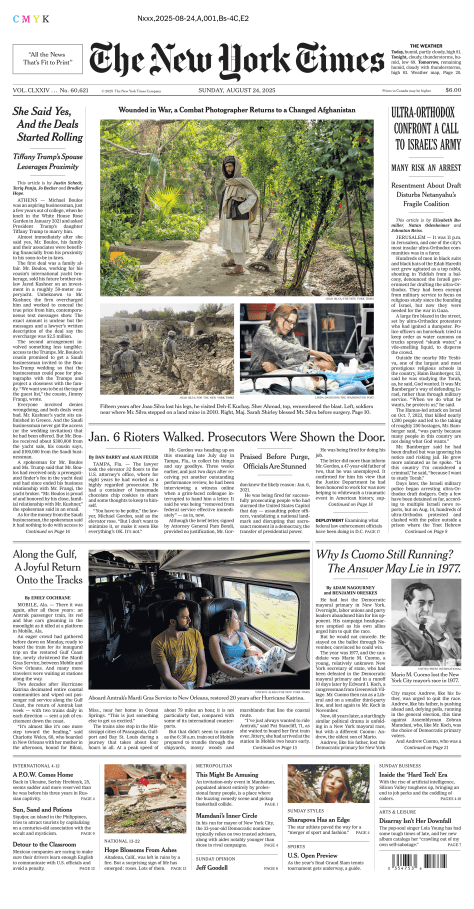
THE NEW YORK TIMES – SUNDAY, AUGUST 24, 2025

Reframing Jan. 6: After the Pardons, the Purge

The Trump Justice Department has fired or demoted more than two dozen Jan. 6 prosecutors, even as those they sent to prison walk free.

Fed Officials Try to Keep Focus on Economy as Trump Intensifies Attacks

President Trump’s pressure campaign for lower borrowing costs created an inescapable distraction at this year’s Jackson Hole conference.

Peace Talks in Ukraine All Lead to the Donbas

The contested region is where Russia’s war in Ukraine began a decade ago. Scores of Ukrainian soldiers have died defending it. Would Ukraine give it up now?

Why Haven’t Sanctions on Russia Stopped the War? The Money Is Still Flowing.

For decades, companies feared being on the wrong side of U.S. sanctions. That’s not always true anymore.

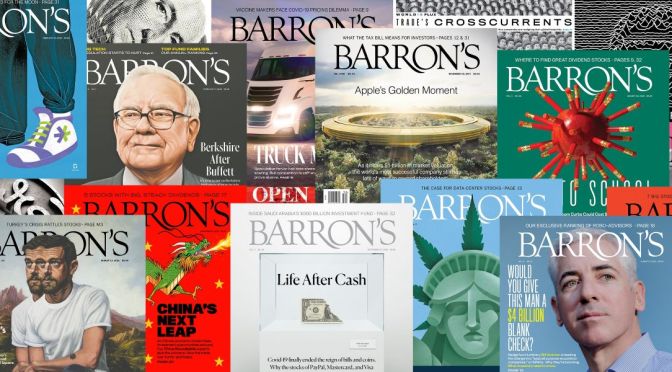
BARRON’S MAGAZINE – AUGUST 25, 2025 PREVIEW

BARRON’S MAGAZINE: The latest issue features ‘Private Equity Is Headed for Your 401(k). The Industry Is Celebrating. Should You?’

Private Equity Is Headed for Your 401(k). The Industry Is Celebrating. Should You?

The Trump administration is taking the handcuffs off the private-market industry. The outcome for retirement savers will be complicated.

Walmart and Other Retailers Have Eaten the Cost of Tariffs. Now It Is the Consumer’s Turn.

While last quarter’s sales were strong, price increases could be felt starting now.

Want to Work Fewer Hours? How to Ask Without Sabotaging Your Career.

Be ready to hear “no,” and more tips from financial advisors and an HR manager.

Tariffs Won’t Break the Economy. Corporate Shakedowns Might.

An economy as large and as diversified as the U.S. can handle tariffs. The president’s other actions pose a bigger risk.

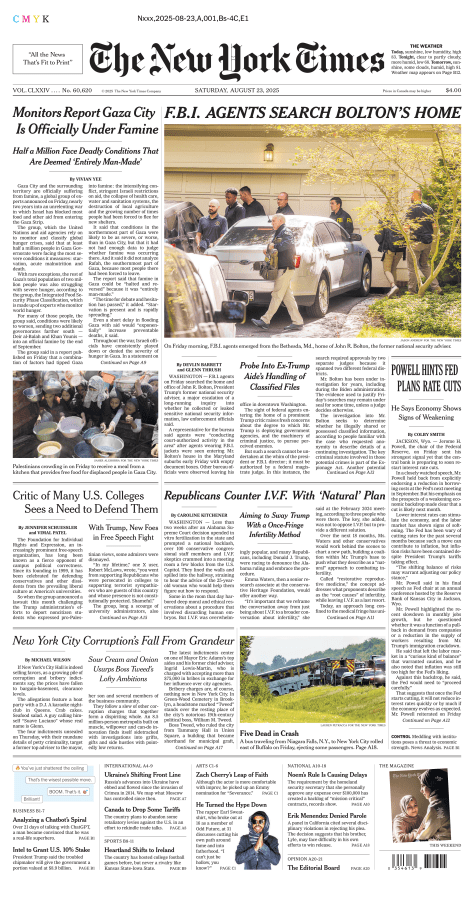
THE NEW YORK TIMES – SATURDAY, AUGUST 23, 2025

Corporate America’s Newest Activist Investor: Donald Trump

The president is demanding government stakes in U.S. companies. Experts see some similarities to state-managed capitalism in other parts of the world.

Intel Agrees to Sell U.S. a 10% Stake in Its Business

The deal is among the largest government interventions in a U.S. company since the rescue of the auto industry after the 2008 financial crisis.

In Trump’s Second Term, Far-Right Agenda Enters the Mainstream

President Trump has embraced an array of far-right views and talking points in ways that have delighted many activists who have long supported those ideas.

After Gaza Famine Report, U.S. Is Mostly Silent and Israel Defiant

The White House has not commented on a report that found famine in Gaza. Analysts say that without U.S. pressure, Israel’s war is not likely to change course.

Cervantes in the Cave — The Art of Illusion

From Lepanto to Algiers to Seville, he recast Plato’s cave: instead of fleeing, he trimmed the wick—using comedy and narrative to make honest light out of shadow.

By Michael Cummins, Editor, August 22, 2025

In a cave in Argamasilla de Alba, Spain, a man sits hunched over a manuscript. The air is damp; the light keeps deciding what to keep. He writes not with the flourish of a court poet but with the urgency of someone who has known confinement—who has lived among shadows and learned to speak their language. The man is Miguel de Cervantes. The cave, according to local legend, is where he began Don Quixote. Whether the story is true hardly matters. The image endures: Cervantes, imprisoned, wounded, obscure, writing the book that would fracture the very idea of literary realism.

He breaks the silence first, as if talking to the walls. “Engendrado en una cárcel, donde toda incomodidad tiene su asiento,” he says—begotten in a prison, where every discomfort keeps its chair. He smiles at his own choice of verb. Begotten. It gives hardship hands.

A foot scuffs the threshold. Mateo steps into the half-light, a fellow freed captive from a life the two men still carry like a watermark. He takes the cave in at a glance—the whitewash, the barred slit of window, the stone bench that knows the shape of a tired back.

“You write in the dark, Miguel,” Mateo says. “Still chasing shadows?”

“Not chasing,” Cervantes replies, without looking up. “Refracting. These shadows are more honest than the sunlit lies of court and empire.”

Plato’s prisoners mistook flicker for fact. Cervantes has no such innocence; he knows exactly what light can do and what it cannot. In Algiers he learned the cost of sunlight and the uses of a candle. “We invented stories to survive,” he says. “We imagined rescue. We became authors of unreality. And in doing so, we learned how unreality works.”

He had boarded a homeward ship in 1575 and sailed straight into a profession he did not apply for. Corsairs took the vessel. Letters of recommendation—ironically the very proof of his merit—made him valuable. Algiers swallowed him for five years. Four escape attempts, each with its choreography of bribes, whispers, and night boats, failed in turn; punishments followed with bureaucratic punctuality. In the baños he organized fellow captives, staged plays that felt like oxygen rations, and discovered a kind of command that requires neither rank nor drumrolls. The lesson was not transcendence. It was texture. Captivity did not reveal some pure, sunlit truth; it revealed illusion’s machinery: how shadows are cast, how they persuade, how they can be turned from weapon into instrument.

“So you believe captivity reveals truth?” Mateo asks.

“No,” Cervantes says. “It reveals illusion. But if you know you’re in a cave, illusion can be honest about itself.”

He speaks like a man who has balanced too many ledgers and decided to keep one for the soul. In his prologue to the Exemplary Novels he would boast with a craftsman’s pride: mías propias, no imitadas ni hurtadas—my own pieces, not imitated or stolen. After a life in which other people held the keys, authorship felt like a kind of lawful possession. He is not naïve about it; theft will come in a thousand copies. Still, he plants his flag in sentences.

Mateo lowers himself onto the bench. The cave keeps its cool.

“Begin earlier,” Mateo says softly. “Begin with the wound.”

Cervantes nods, as if paging back. “Lepanto,” he says. “Two shots to the chest, one to the hand. El mayor bien que me vino. The greatest favor that came to me.”

Mateo laughs—a short, incredulous bark. “Favor?”

“A hand is a tool,” Cervantes says, flexing his right, letting the left sleeve fall into its gentle emptiness. “So is a story. One broke and taught the other its work. I learned that honor is not trumpets; it is the bruise that stays after the sound goes.”

“What did it smell like—the battle?” Mateo asks, because some questions insist.

“Oak and salt and a fire that wandered,” Cervantes says. “The sea keeps bad accounts—always debits, never balance. We threw our bodies at its ledger and called it glory. I got a bill I could live with.”

The cave changes its mind about brightness by a single shade. Light climbs a little higher on the wall, as if memory has a temperature.

“After Algiers,” Mateo says, “you came home to paper.”

“To paper and suspicion,” Cervantes answers. “Spain wanted receipts more than epics.” He became a purchasing agent, then a tax collector—the sort of work that presses humility into a man’s pockets and takes the lint besides. A banker fell in Seville and the ground gave way beneath him. Jail happened the way weather happens. Bureaucracy, he discovered, is a prison with nicer pens.

He thumps the palm of his right hand on the bench, a quiet imitation of a ledger closing. “Always the same sum,” he says. “Loyalty plus wounds equals suspicion.”

“That arithmetic,” Mateo says, “taught you comedy.”

“It taught me instruments,” Cervantes corrects gently. “Comedy is a surgeon’s knife you can carry in public.”

He had tried other rooms. La Galatea (1585), a pastoral romance, sighs under painted trees and speaks expertly in a fashionable voice—too expertly for a man who had learned to breathe in iron. “A ceiling too low for the lungs,” he says. Failure did not embarrass him; it emancipated him. “I loved what books promised. I wrote the promise’s correction.”

“And then you choose another cave,” Mateo says, looking around.

“This time I brought the candle.” Cervantes nods at the stub trembling in its dish. “The cave is not a prison if you know you’re inside it. Fiction is not delusion if you wield it knowingly.”

“Is that freedom?” Mateo asks. “To live in fiction?”

Cervantes answers with a line he will later put in a knight’s mouth because knights carry sentences farther than taxmen do. “La libertad, Sancho, es uno de los más preciosos dones…” Freedom, Sancho, is one of the most precious gifts. He lets the clause hang and then adds the counterweight: captivity is the greatest evil. “But there is a third thing,” he says. “The discipline of the wick. Not everyone reaches the sun. Many of us live by hearth-light. So make the hearth honest.”

He laughs, not kindly but not unkindly, at the memory of a barber’s basin mistaken for a helmet. “A basin can be a helmet,” he says, “if the story is honest about the trick.” The joke is not cruelty; it’s consent. Illusions that confess their wages are allowed to work.

“You sound like Plato’s least obedient pupil,” Mateo says. “He wants the prisoner out of the cave. You stay.”

“Plato had less practice with caves,” Cervantes says. “I stay and trim the wick.”

The man who stays in the cave can tell you about the cost of zeal. He knows what happens when mercy runs faster than attention: chaos dresses up as freedom. He has written a scene in which a knight frees a chain gang of galley slaves with a fine speech and a flash of temper, and the liberated—unbriefed on narrative responsibility—repay the favor with stones. “Pity without comprehension,” he says, “is a door swinging in a storm. Freedom without narrative becomes a mess that lets tyrants say, ‘You see? Chains keep order.’”

Mateo’s eyes drift toward a wooden head in the corner, painted eyes arrested mid-glance. “Master Pedro,” Cervantes says, amused at the prop the cave has supplied. He tells the story of a puppet theater, a knight who cannot bear strings, a sword that corrects an illusion into splinters. Even illusions keep accounts, he reminds Mateo. Someone pays for the pleasure. “In that scene,” he says, “I taxed zeal. I sent the bill to laughter.”

“So your book is a theater?” Mateo asks.

“A theater that shows its ropes,” Cervantes says. “A historian with a wink in his ink. A narrator who argues with me, and I with him. A false sequel enters the room, and I absorb him into the play. If illusion is a crime, let the evidence be visible. If it is a craft, let the strings show and the audience decide.”

He keeps his quotes short and to the point, letting them behave like tools rather than trophies. “Yo sé quién soy,” he says, not to boast but to set a boundary—I know who I am. “And I know what I am not. I am not the sun. I am a candle with a good memory.”

Memory is a troublesome servant. “¡Oh memoria, enemiga mortal de mi descanso!,” he mutters with theatrical exasperation—Oh memory, mortal enemy of my rest—knowing full well he cannot do without her. In the deepest fold of the book he is writing, he lowers his knight into the Cave of Montesinos and gives him a private vision no one can verify. Minutes pass in the world; days unfold in the cave. Readers will fight about that descent for centuries: lie or parable? He shrugs. The rope held. The telling is what matters.

“What about truth?” Mateo asks. “You dodge it like a matador.”

“Truth is errant,” Cervantes says. “Like my knight. It wanders, stumbles, reinvents itself. La verdad adelgaza y no quiebra—truth thins but does not break. It lives in the flicker between shadow and flame.” He aims for a truth you can sit with, not a blaze you must worship. Even now, when the cave dims or brightens by a breath, he adjusts nothing in his voice. He trusts the room to keep up.

The room has heard other versions of this life. Soldier, captive, clerk, failed author—the catalogue is accurate and useless until you give it breath. He has learned that a life of refusals and humiliations can be rearranged into a lamp. “El que lee mucho y anda mucho, ve mucho y sabe mucho,” he says with a grin—he who reads much and travels much sees much and knows much—and Mateos’s chuckle bounces off the whitewash and returns as agreement.

If the cave is a theater, it is also a workshop. He places three objects on the bench as if laying out tools: a frayed rope (failed escape; lesson kept), a ledger (bureaucracy’s Bible, now a prop for comedy), and the puppet head (illusion, demystified and retained). He sets the rope across the ledger like a sash and props the puppet against both like a child asleep between two patient adults.

“You’re staging your own life,” Mateo says.

“Everything I own appears in my books,” Cervantes answers. “Better to put them to work than let them gather dust.”

He will put even injury to work. He has already done it. “There is no book so bad that it does not have something good,” he says—No hay libro tan malo que no tenga algo bueno—and he means, among other things, his own early efforts. He tried the fashion and failed; he learned to write beyond it. The failure cleared the room.

“And the counterfeit?” Mateo asks. “The other Quixote?”

“I made room,” Cervantes says, not quite happily. He doesn’t bother to call the rival by name. “I let the counterfeit into Part II and gave him the dignity of being wrong on the page. It is the politest way to win.”

Outside, late afternoon arranges itself. Inside, the candle practices its small weather. The conversation acquires the unhurried gravity of men who have been forced to wait before and know that waiting can be made useful. They speak of the Información de Argel—the sworn testimonies that stitched a biography out of scars and courage; of the petition to the Council of the Indies that asked for four possible offices across the ocean and delivered no; of Seville’s auditoriums of suspicion where a man could do arithmetic all day and still owe.

“You turned all that into a style,” Mateo says.

“I turned it into a temperament,” Cervantes corrects. Style is the residue. The temperament is the choice: to stay in the cave and make the light adjustable; to refuse the panic of transcendence in favor of the patience of attention; to let laughter be a form of moral accounting. “I wanted a book in which the strings show,” he says. “So when someone pulls, we know who is moving what.”

He reaches for the candle with wetted fingers and trims the wick. The flame tightens, steadies, sharpens the edges of the room with a surgeon’s manners. The gesture is mundane and feels like a thesis.

“Why not flee?” Mateo asks one last time, because some questions return until answered in the body.

“Because someone must tend the flame,” Cervantes says. “Because most people live by hearth-light. Because the cave tells the truth about limits, and I prefer honest rooms to lying palaces.”

He stands, and the bench acknowledges the change with a creak that has learned both complaint and loyalty. He touches the stone with the backs of his fingers, as one does a sleeping child. The puppet keeps its round attention. The rope adopts its length. The ledger decides to be heavy again.

“Begin,” Mateo says, suddenly shy of making a ceremony of it.

“I did,” Cervantes answers, and returns to his page.

He writes the opening lines of Don Quixote as the candle throws a peninsula of light bordered by ink. A poor gentleman with a head full of books starts out into a world that will bruise him into philosophy. A squire with a sack of proverbs learns to spend them one by one, after listening. Windmills declare their innocence; a basin negotiates a new title. Dukes turn out to be children who have learned cruelty by playing. Priests explain themselves into farce. Puppets are freed to their ruin, then repaired by a writer who has learned to apologize with laughter.

Cervantes does not flee illusion; he illuminates it. He does not reject reality; he reframes it. He does not promise truth; he escorts it, errant and sturdy, through rooms with honest walls. He turns shadows into stories and stories into a way of seeing that does not blind. He has stayed where Plato urged ascension and found, by staying, a different kind of ascent: the climb of attention, the charity of proportion, the courage to let strings show and still believe in the show.

Unlike Plato’s prisoner, Cervantes remains in the cave. He writes. He refracts. He talks to the walls and to the future, and both answer. His broken hand, his captive mind, his errant knight—everything he survived and everything he invented—gathers in the small weather of a candle and becomes, against all instruction, a form of daylight.

THIS ESSAY WAS WRITTEN AND EDITED UTILIZING AI

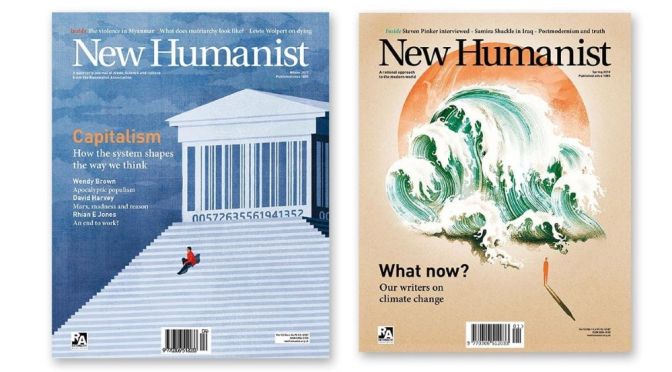
Culture: New Humanist Magazine – Autumn 2025

The cover of New Humanist's Autumn 2025 issue is an illustration of an astronaut surrounded by stars

NEW HUMANIST MAGAZINE: This issue is all about how the battle over space – playing out unseen above us – concerns us all.

Space and society

In the latest edition of our “Voices” section, we ask five experts – from scientists to philosophers – how to protect space for the benefit of all of humanity.

“When people hear the term ‘space technology’, they tend to picture rocket launches, or maybe missions to the Moon … Other types of space activity with strong social impact tend to get less attention”

The satellite war

We speak to security expert Mark Hilborne about space warfare – and how it could be the deciding factor in the conflict between Russia and Ukraine.

“The public doesn’t understand how much we rely on space as a domain of warfare”

Sexism in space

When Nasa prepared a message to aliens with the Pioneer probes in the 1970s, sexism skewed how they represented humankind. Within the next decade, we may have another chance to send a message deep into space – and this time, we must do better, writes Jess Thomson.

“Only five objects we have crafted here on Earth are now drifting towards infinity, and four of them tell a lie about half of humankind”

American alien

The new Superman movie offers the vision of a kinder, more tolerant United States – saved by an immigrant, in this case a literal alien. But should we really pin our hopes on a superhero?

“Trump has even shared photoshopped images of himself as Superman. The idea that superheroes can save us all, if we just let them break all the rules, is one that the Maga followers find congenial”

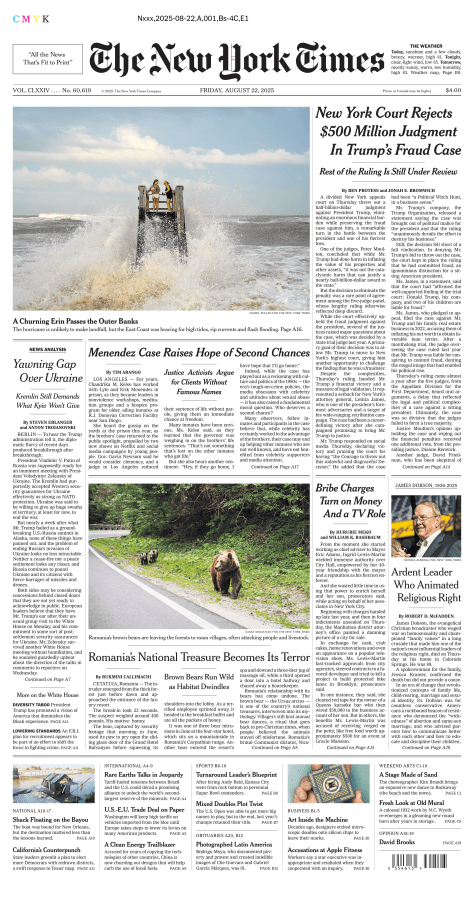
THE NEW YORK TIMES – FRIDAY, AUGUST 22, 2025

F.B.I. Searches Maryland Home of Ex-Trump Adviser John Bolton

F.B.I. agents were searching the home of Mr. Bolton, President Trump’s former national security adviser who is now a frequent critic of the president, an agency official said.

Taking On the Fed, Trump Combines Retribution Tactics With a Power Play

President Trump’s term has been marked by assertions of authority and the eager hounding of foes. Both traits are clear as he seeks control over the central bank.

Gaza City and Surrounding Areas Are Officially Under Famine, Monitors Say

At least half a million people in the enclave were facing the most severe conditions measured by U.N.-backed international experts. An Israeli agency rejected the finding.

What Does the Famine Announcement Mean?

Judge Orders That ‘Alligator Alcatraz’ Detention Center Be Shut Down for Now

A judge ruled that governments acted illegally by not conducting an environmental review before building the center in the Florida Everglades.

White House Lists Smithsonian Exhibits It Finds Objectionable

The Trump administration highlighted material dealing with topics such as sexuality, slavery and immigration.

3 min read

THE ECONOMIST MAGAZINE – AUGUST 23, 2025 PREVIEW

THE ECONOMIST MAGAZINE: The latest issue features All-American silicon‘…

Donald Trump’s fantasy of home-grown chipmaking

To remain the world’s foremost technological power, America needs its friends

A new opposition could be a healthy sign for Syria

Ahmed al-Sharaa, the new president, needs to bring his critics closer

Who will America’s president listen to next on Ukraine?

The problem with Donald Trump’s fast-moving, unpredictable diplomacy

Pregnant women need protecting from heatwaves

As temperatures rise, so must understanding of the risks

The One-Room Rebellion

How Arizona’s microschool boom is reshaping the American classroom—and reviving old questions about freedom, equity, and the gaze of the state.

By Michael Cummins, Editor, August 21, 2025

Jeremy Bentham never saw his  panopticon built. The English philosopher imagined a circular prison with a central watchtower, where a single guard could observe every inmate without being seen. Bentham saw it as a triumph of efficiency: if prisoners could never know when they were being watched, they would behave as though they always were. A century later, Michel Foucault seized on the design as metaphor. In Discipline and Punish, he argued that the panopticon revealed the true mechanics of modern institutions—not brute force, but the internalization of surveillance. The gaze becomes ambient. The subject becomes self-regulating.

This, in many ways, is the story of the American public school. The common school movement of the mid-nineteenth century, led by Horace Mann, sought standardization: children from Boston to St. Louis would recite the same lessons, read the same primers, and adopt the same civic habits. As cities grew, schools scaled up. By the twentieth century, especially in the wake of A Nation at Risk, the classroom had become a site of discipline. Bells regulated time. Grades ranked performance. Administrators patrolled hallways like wardens. Testing regimes quantified ability. The metaphor was not lost on Foucault. Brown University notes that his vision of the panopticon extended beyond prisons to schools: a “system of surveillance where individuals internalize the feeling of being constantly watched, leading to self-regulation of behavior” (Brown University).

Every American child knows this regime. The bell rings. The roll is called. The test is bubbled and scanned. Hall passes are signed like parole slips. Cameras blink in cafeteria corners. Laptops carry software that tracks keystrokes. Even silence becomes an instrument of order.

Bentham saw efficiency. Foucault saw discipline. Students often see only the weight of the watchtower.

What happens when families walk out of the circle?

In the far suburbs of Phoenix, on the edge of the White Tank Mountains, a converted casita serves as the Refresh Learning Center. Founded in 2023 by a pastor and his wife, it doesn’t look like much—aluminum siding, recycled chairs, a wall chart that places the birth of the universe at 4004 B.C. Yet, as Chandler Fritz wrote in the September 2025 issue of Harper’s Magazine, the little school has become an emblem of a movement reshaping American education.

Its existence rests on a radical policy shift. In 2022, Arizona launched the nation’s most expansive Empowerment Scholarship Account (ESA) program. Unlike traditional vouchers, which could be redeemed only at approved institutions, ESA funds flow directly to parents—roughly $7,500 per student, sometimes more. Families can spend the money on almost anything that counts as “educational”: a cello, a VR headset, a trampoline, or, increasingly, a place in one of the microschools sprouting across the state.

The metaphor of the frontier clings naturally to Arizona. Here, in the desert’s glare, families are homesteading education in much the same spirit as settlers once claimed land. A garage becomes a classroom. A supply closet, a high school. A church basement, an academy. In his Harper’s piece, Fritz describes a child attending class in a room where chickens wandered the yard outside, and another high-school seminar meeting in a closet stacked with supply boxes. Parents pull their children not only for ideology but for intimacy, pace, or simple safety. “Without ESA, this school would not—could not—exist,” one founder told him.

For advocates, the program represents liberation from a failing system. For critics, it siphons resources from public schools already parched of funding. But for the families gathered in little schoolhouses like Refresh, the stakes feel simpler: children freed from the gaze of bureaucracy, from endless testing and administrative oversight, given room to learn like human beings again.

Microschools are not new. Before the rise of the common school, most American children learned in homes, barns, or one-room cabins where a single teacher instructed a dozen children of all ages. Reformers dismissed those spaces as unsystematic, unjust. The standardized school, they argued, would correct inequities and prepare citizens for democracy.

Today, the pendulum swings back. Inside Refresh’s aluminum-sided room, teenagers do crafts next to six-year-olds. Grade levels blur: a thirteen-year-old may still be in second grade; another, the same age, reads at a high school level. Students spend mornings mucking chicken coops and afternoons in shop class. A boy named Aaron, dyslexic and restless in traditional schools, thrives in the workshop, building desks and repairing tools. He dreams of becoming an Air Force mechanic. One teacher observed that he learned fractions by cutting lumber and measuring shelves—mathematics discovered in wood grain and sawdust.

Another student, Hailey, is quick with skepticism. She listens to indie rock from her AirPods between classes, balances her faith with her friendships, and rolls her eyes at biblical literalism. “Stop comparing everything to religion,” she wrote in a survey. “I know it’s a Christian school, but it’s annoying learning about history when it’s asking about the Bible.”

And then there is Canaan, a foster child, the oldest in the room. During a discussion of To Kill a Mockingbird, he startled his peers by pressing the point of segregation. “What if everyone were actually given the same resources?” he asked. The question, naïve and profound, echoed the legal logic of Brown v. Board of Education, though he had never heard of it. His teachers had worried about whether he was “ready” for a seminar text. Yet here he was, articulating the problem of equality with more clarity than many adults.

Their stories recall sepia-toned photographs of America’s one-room schoolhouses, where a teacher might balance a baby on one hip while drilling older students in long division. Nostalgia clings to such places, but for children like Aaron and Hailey and Canaan, the sense of being known—of not being lost in the machinery of standardization—is more than nostalgia. It is survival.

The ESA marketplace, though, has the volatility of a boomtown. Alongside earnest shop classes and backyard literature circles, Fritz encountered vendors offering tongue-posture therapy for ADHD, pirate-themed cooking classes tied to multilevel marketing schemes, even sword-making courses. In one Tucson suburb, a “Kids in the Kitchen” class doubled as an advertisement for a health supplement brand. Fraud has siphoned hundreds of thousands of dollars from taxpayers (Arizona Central).

More troubling is fragmentation. Public schools, for all their flaws, force pluralism: children from different families, faiths, and incomes learning together under one roof. In microschools, communities splinter. Wealthier families claim ESA funds for private tuition; poorer families scrape together what they can. Evangelical churches convert Sunday schools into full-time academies. A Southern Baptist initiative now urges every church with a basement to consider opening a weekday school. For some, ESAs represent not escape from the panopticon, but an opportunity to build new watchtowers of ideological oversight.

And yet—the children remain. Their stories suggest that the most powerful escape is not from testing regimes or surveillance, but from anonymity. In a one-room schoolhouse, a teacher cannot forget you. Your hands matter. Your questions land. You are not a datapoint in a dashboard but a voice in a circle.

The paradox of the new homestead is that it is subsidized by the very state it seeks to escape. Every ESA contract is drawn from public funds, even as public schools wither under declining enrollment and teacher shortages. Arizona’s superintendent warned in 2024 that the state’s teacher shortage, already in the thousands, could “eventually lead to zero teachers” (Arizona Policy). Meanwhile, parents swipe ESA debit cards for pianos, VR headsets, or ski passes.

But the deeper paradox is philosophical. The panopticon teaches that institutions discipline by watching. Yet children, it turns out, discipline themselves when unseen, too. In one seminar, Canaan insisted that segregation was the true injustice, not just a false verdict. Without oversight, a conversation about reparations and justice unfolded around plastic tables in a desert conversation.

Could it be that the very fragmentation critics fear might also produce unexpected awakenings? That freedom from the gaze of the state could allow children to stumble, clumsily but genuinely, into civic consciousness?

The question is not whether microschools should exist—they already do, enrolling as many students as Catholic schools nationwide. The question is how to balance their intimacy with the democratic promise of education for all. Some states experiment with guardrails: Georgia ties funds to low-performing districts; Iowa requires accreditation and assessments. Arizona, the boldest frontier, remains laissez-faire. The experiment is still young, and the stakes enormous.

Bentham dreamed of efficiency. Foucault warned of discipline. But neither accounted for what happens when the watchtower is abandoned, when families strike out into the desert to build little schools of their own. The panopticon dissolves, and in its place rises the homestead, the one-room schoolhouse, the handmade desk, the boy who lights up in shop class.

Public education was once America’s grandest democratic experiment: the poor man could reach into the rich man’s pocket and demand an education, as Emerson put it, “not as you will, but as I will” (Ralph Waldo Emerson, Education). That dream is endangered—not only by privatization, but by the creeping sense that children are means rather than ends, data points rather than persons.

The frontier metaphor cuts both ways. It can justify privatization, sectarianism, inequality. But it also gestures toward freedom, self-reliance, discovery. The challenge now is to reclaim the best of the homestead spirit—education as intimate, child-centered, alive—without abandoning the pluralistic commons that democracy requires.

Wallace Stegner once called life on the frontier a “homemade education.” He meant not only the Bible lessons of pioneer families but the curriculum of the land itself—children learning resilience from drought, ingenuity from scarcity, curiosity from the wide sky. The graduates of such an education—Lincoln, Twain, Cather, John Wesley Powell—proved that learning could be stitched together from books, rivers, and conversation. Powell, chastised in school for his parents’ abolitionist views, was pulled from the classroom and tutored privately. He learned geology by picking up stones, ornithology by watching birds, justice by watching neighbors turn cruel. The lessons carried him down the Colorado River, into history.

Perhaps the future lies not in the panopticon or the homestead alone, but in something more fluid: a system where every child is seen not from above, but up close. Where accountability measures ensure equity without strangling individuality. Where the workshop and the test, the prayer and the debate, the child who loves Jesus and the child who loves indie rock can share the same fragile, human classroom.

Education is not a prison, nor a frontier settlement. It is, at its best, a river: wide enough to carry all, winding enough to follow curiosity, strong enough to shape the land it touches. The question is whether we will keep damming it with watchtowers—or whether we will learn, finally, to let it flow.

THIS ESSAY WAS WRITTEN AND EDITED UTILIZING AI
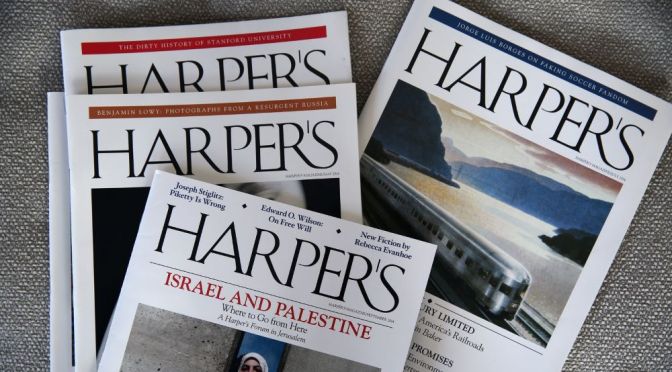
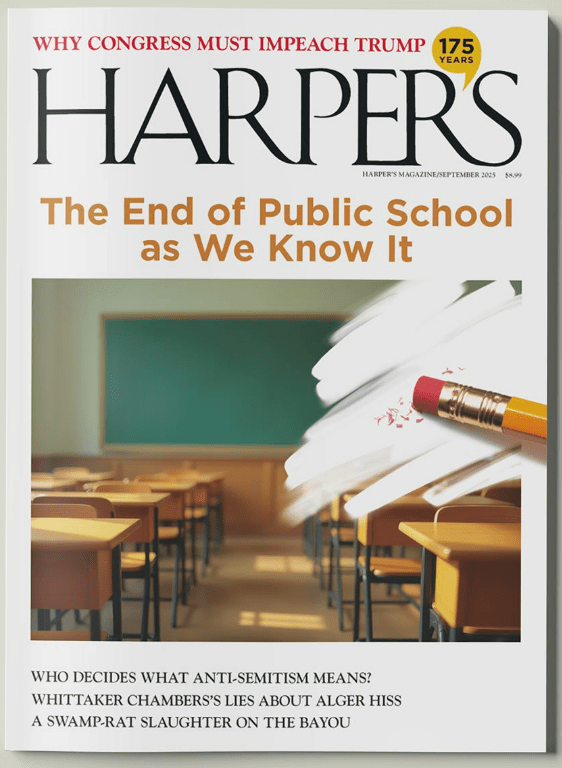
HARPER’S MAGAZINE – SEPTEMBER 2025 PREVIEW

HARPER’S MAGAZINE: The latest issue features ‘The End of Public School as We Know It’

The Homemade Scholar

A new frontier in American education By Chandler Fritz

Ecological Warfare

A swamp-rat slaughter on the bayou By Nathaniel Rich

The Decisive Moment

Why Congress must impeach Trump By Chris Lehmann

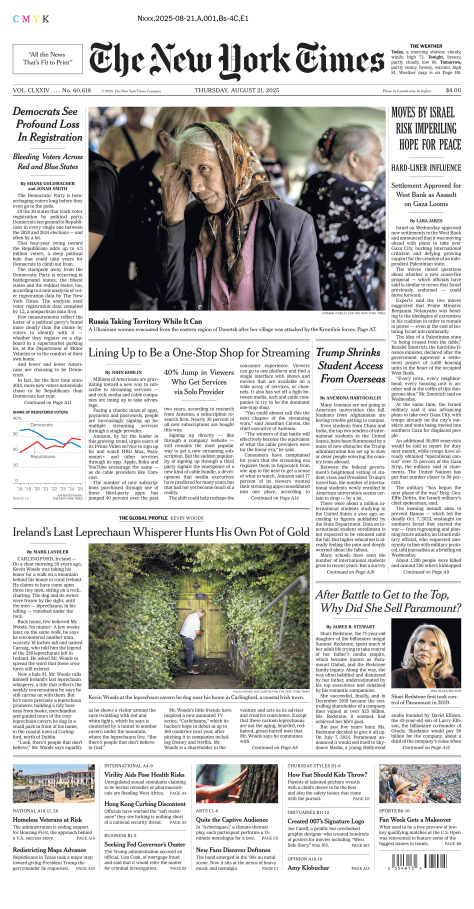
THE NEW YORK TIMES – THURSDAY, AUGUST 21, 2025

U.S. and E.U. Agree on Details of Trade Deal; High Tariff on Cars Remains, for Now

Under the newly fleshed-out details, Washington will keep high tariffs on cars imported from the bloc until the E.U. takes steps to lower levies on many U.S. products.

What Matters More to the Stock Market: The Fed or Nvidia?

Deportations Reach New High After Summer Surge in Immigration Arrests

With an infusion of cash from President Trump’s domestic policy bill, ICE appears poised to scale its operations even further.

In Trump’s Ideal Picture of America, Diversity Is Taboo

Using the full power of the federal government, President Trump has promoted a vision of the U.S. that challenges the legitimacy of the Black experience.