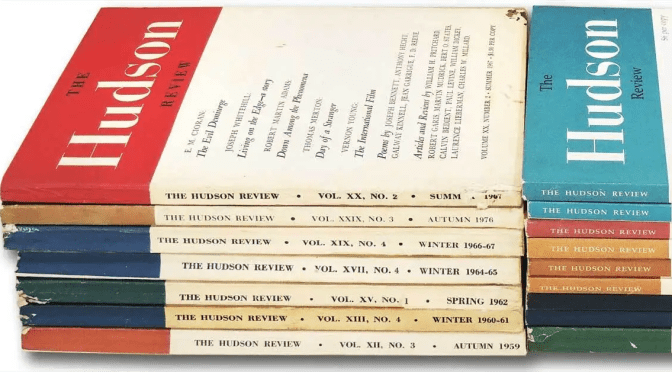

THE HUDSON REVIEW: The latest issue features….
ESSAYS

THE HUDSON REVIEW: The latest issue features….
ESSAYS

Doctor, writer, musician, and orator: Rudolph Fisher was a scientist and an artist whose métier was Harlem By Harriet A. Washington
The music of Jimi Hendrix continues to strike a chord By James McManus
When a filmmaker wanted to understand the war that changed his father, he decided to make a documentary By Thomas A. Bass
Two deaths nearly five decades apart and the hospital that felt like a nightmare By Natalie Angier
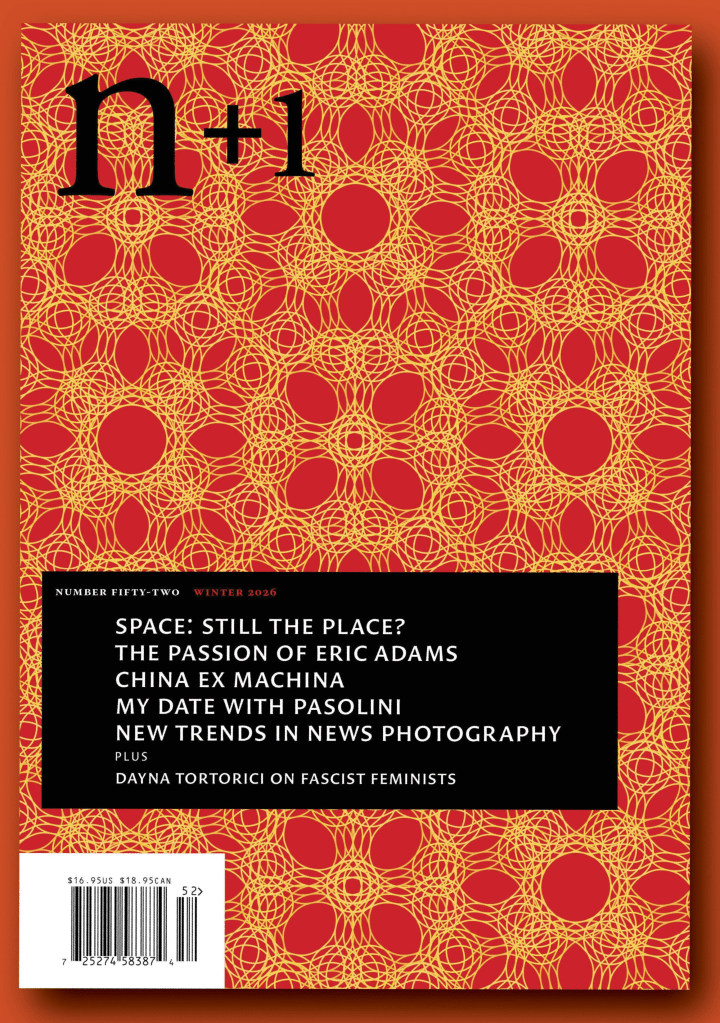
n+1 Magazine: The latest issue features the ‘Winter 2026 issue, CLOSE ENCOUNTERS’ – H is for hawks. Trump’s cleavage: a semiotic investigation. Haters, waiters, trash containers. Emily Callaci and Dayna Tortorici on intra-feminist debates. Matthew Porges on new space odysseys.
In the contemporary Chinese context, the idea that crucial parts of the central government could simply cease to operate for more than a month, as part of a procedural standoff between rival governing factions, would beggar belief. And in turn, to an American observer, the thought that miles of new high-speed rail lines could simply materialize by bureaucratic fiat, unencumbered by years of legislative horse-trading, environmental review, suburban backlash, and budgetary overshoot, is no less astonishing.
Adams will be remembered for his petty corruption, his self-mythologizing, and his ignominious dealmaking with the Trump White House; but he should also be remembered as the mayor who got New Yorkers to stop tossing giant bags of trash onto city sidewalks as if there were no alternative. You can laugh at a New York mayor who walks into a press conference wheeling out a trash can, beaming as if he invented the contraption, while “Empire State of Mind” blares triumphantly in the background. But truly, Adams’s proclaimed “trash revolution” represented a tremendous advance over abysmal past practice.
“Men make their own history,” Marx wrote, “but they do not make it as they please; they do not make it under self-selected circumstances, but under circumstances existing already, given and transmitted from the past.” That may be broadly true, but Dick Cheney got to make history under the exact circumstances he would have chosen.

ORION MAGAZINE: The Winter 2026 Issue features the elusive cryptid—creatures that, despite mysterious sightings, dedicated societies, and extensive mythologizing, have not been scientifically proven to exist. Across the issue, writers grapple with questions of belief: Why do we want to believe in the things that we do? What might our enthusiastic focus on creatures like Bigfoot be preventing us from seeing, and protecting, in the real world? What do the stories we tell about the natural world really reveal about ourselves? Ranging from the playful to the impassioned, the fantastical to the deadly serious, Cryptids: On the Trail of Bigfoot and Other Improbable Beasts offers a tour through a menagerie both real and imagined. Inside:
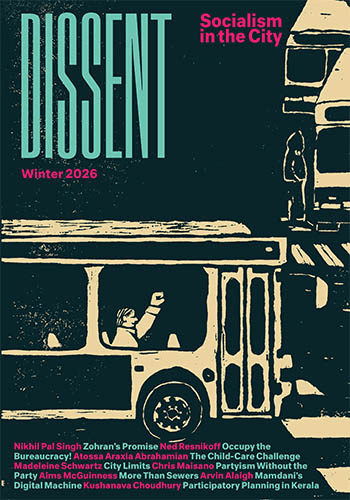
DISSENT MAGAZINE: The latest issue features ‘Socialism in the City’…

Wolfram Lacher and Yvan Guichaoua
Alexander Hertel-Fernandez and Alan Yan

FOREIGN POLICY MAGAZINE: The latest issue features ‘The World Minus One’ – The emergence of a post-American order.
Managing the global order with an antagonistic Washington. By Amitav Acharya
U.S. allies and partners are taking steps toward a post-American nuclear order.Rebecca Lissner, Erin D. Dumbacher
Beijing never bought the argument that reducing emissions would cause economic harm. Kelly Sims Gallagher
Allies fear that Washington is retreating from leadership at the worst possible time. Rishi Iyengar

Claremont Review of Books: The latest issue features ‘Special Anniversary Double Issue’….

Imagine sitting near the apex of power in an empire and then being shown the door. You might want to write a tell-all book about it. If so, however, you would be advised to proceed with caution. Now, imagine what would barely be conceivable today: that you undertook to write your exposé while you were still in office. You would need all the finesse of a tightrope walker.
This essay is adapted from remarks delivered at the Claremont Review of Books 25th anniversary gala, held at the Metropolitan Club in New York City on November 6, 2025.
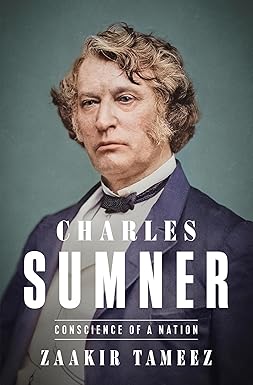
In the early hours of March 11, 1874, word spread around Washington that Charles Sumner was on the brink of death. The 63-year-old senator from Massachusetts had suffered a massive heart attack the previous evening. By 9 a.m., a crowd of several hundred had gathered in front of his home on Lafayette Square. “Colored men and women mingled with white in knots about his home,” wrote The New-York Tribune. Government workers, merchants, shopmen, waiters, and even “old colored women with baskets and bundles on their arms” stood together. Many were crying and begging to be let inside. They were stopped by one of Sumner’s friends and two policemen standing guard at the front door.
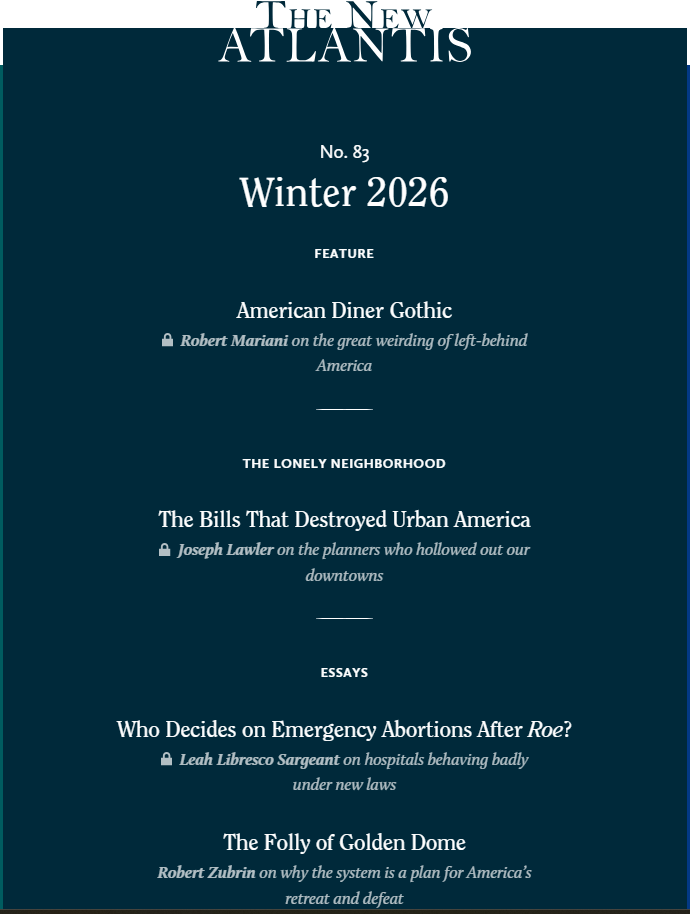
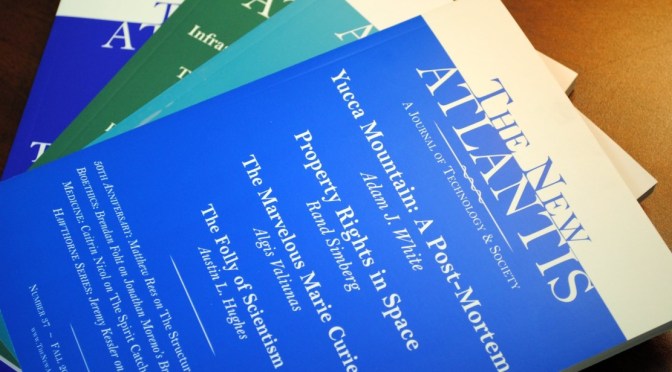
THE NEW ATLANTIS MAGAZINE: The latest issue features….
In the 2020s, the weird soul of placeless America is being born on Discord servers. Robert Mariani
The planners dreamed of gleaming cities. Instead they brought three generations of hollowed-out downtowns and flight to the suburbs. Joseph Lawler
Trump’s vaunted missile defense system is a plan for America’s retreat and defeat. Robert Zubrin




 Boomers Daily