

A selection of three essential articles read aloud from the latest issue of The Economist. This week, how to save the supreme court from itself, how wearable technology promises to revolutionise health care (10:29) and our Bartleby columnist on why working from anywhere isn’t realistic (18:29).
Tag Archives: Wearable Technology
Health: ‘Overcoming Challenges In Medical Wearables’ (Video)
Medical wearables are quickly becoming a potential solution in a world where tele-health is gaining ground. Here are three examples of challenges in designing medical wearables, and how to overcome them.
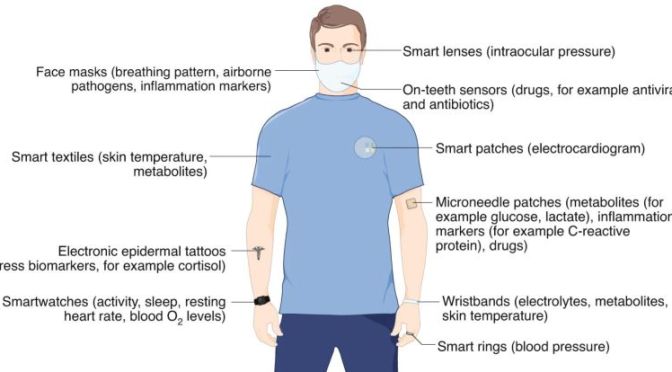
Digital Health: The Future Of Wearable Devices
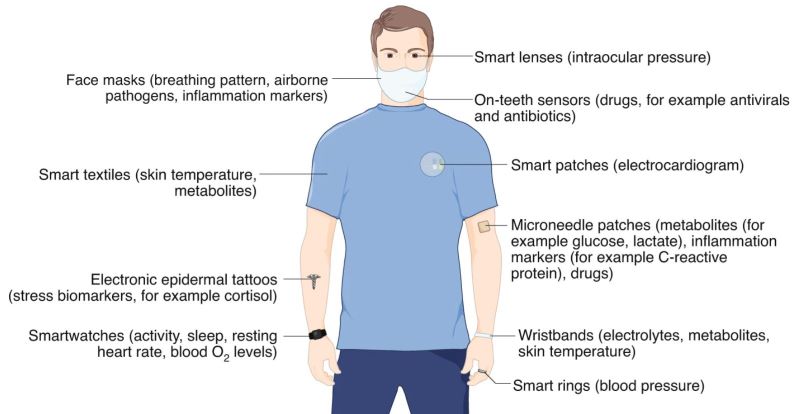

Currently, smartwatches provide information such as heart rate, sleep time and activity patterns. In the future, this could be augmented with new classes of wearable devices that monitor, for example, concentrations of cortisol for tracking stress (using electronic epidermal tattoos), biomarkers of inflammation and levels of blood O2 (microneedle patches), skin temperature (electronic textiles), blood pressure (smart rings), concentration of ions (wristbands), intraocular pressure (smart contact lenses), the presence of airborne pathogens and breathing anomalies (face masks), and the concentration of therapeutic drugs (on-teeth sensors)2,10,12,13,14,15,16. Such emerging low-cost wearable sensing technologies, monitoring both physical parameters and biochemical markers, could be used to identify symptomatic and pre-symptomatic cases in future pandemics. The devices could also be used to remotely monitor the recovery of individuals undergoing treatment or self-isolating at home.
Innovations: ‘Wireless Wearable Health Sensor’ Is Human Motion Powered
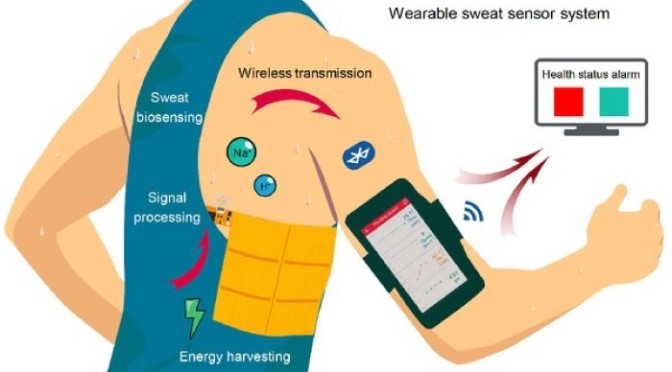
Gao has developed a new way to power wireless wearable sensors: He harvests kinetic energy that is produced by a person as they move around.

“Our triboelectric generator, also called a nanogenerator, has a stator, which is fixed to the torso, and a slider, which is attached to the inside of the arm. The slider slides against the stator during human motion, and, an electrical current is generated at the same time,” Gao says. “The mechanism is quite simple. Friction results in electrical generation. This is not something new, concept-wise.”

This energy harvesting is done with a thin sandwich of materials (Teflon, copper, and polyimide) that are attached to the person’s skin. As the person moves, these sheets of material rub against a sliding layer made of copper and polyimide, and generate small amounts of electricity. The effect, known as triboelectricity, is perhaps best illustrated by the static electric shock a person might receive after walking across a carpeted floor and then touching a metal doorknob.
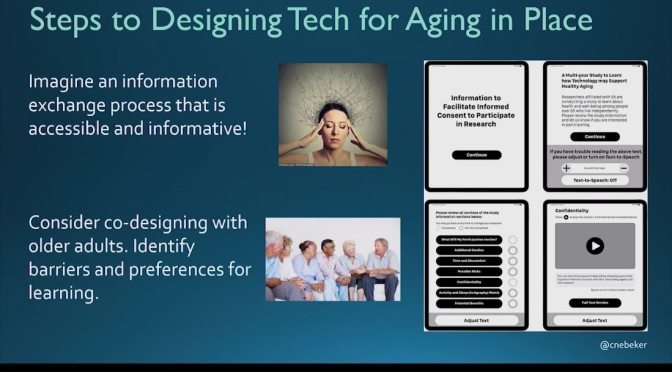
Research: “Designing Tech For Healthy Aging In Place” (UC San Diego Video)
Digital tools including mobile apps, wearable sensors, and social network platforms offer unprecedented opportunities in health research and healthcare. However, this rapidly emerging sector is outpacing existing regulatory structures and challenging norms for ethical practice.
Camille Nebeker, EdD, MS, Associate Professor of Behavioral Medicine in the Department of Family Medicine & Public Health at the UC San Diego School of Medicine describes how technologies, including wearable sensors and artificial intelligence, are leveraged to capture personal health data and infer health status. Nebeker presents the ethical considerations specific to informed consent, risks of harm and potential benefits while underscoring the role that funding agencies, policy makers, researchers, ethicists, and editors have in creating the infrastructure needed to advance safe digital health research and practice.
 Boomers Daily