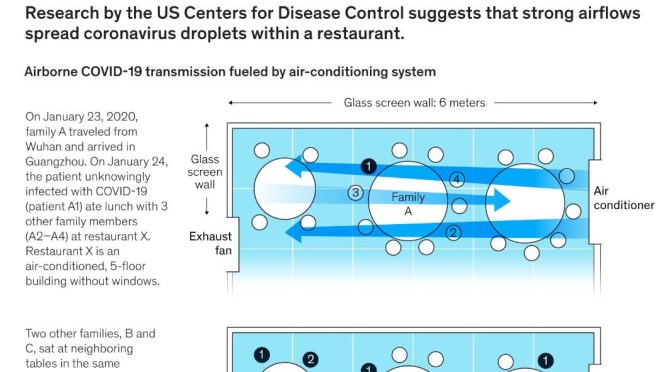
The World Health Organization recently acknowledged that some evidence about in-room transmission is worrisome. In addition, after analyzing a transmission event at a restaurant in China, the US Centers for Disease Control and Prevention (CDC) concluded that an asymptomatic patient transmitted the virus to families at two nearby tables.
Based on the restaurant layout, seating arrangements, and smear samples from air-conditioning inlets and outlets, the CDC found that the coronavirus was likely transmitted when strong airflows from a nearby air conditioner spread large droplets from the infected person. These droplets traveled more than one meter—further than usual, but less than the distance aerosols can typically travel.
Nature discusses the massive coronavirus outbreak that struck the iconic Californian prison after it rejected expert aid.
In this episode:
01:47 Disaster in San Quentin
San Quentin prison is facing a massive outbreak, we dig into how they got there. The crisis has arisen despite warnings from experts, and offers of free tests, which were declined. We ask why? And what can be done now?
For the last episode of Coronapod, our hosts pick out ways that the pandemic has changed them for the better, including professional flexibility, a renewed focus on the power of reporting and time with family
36:07 Lockdown and children’s health
Reporter Stewart asks if lockdowns could have any lasting impact on her young children – what evidence is there on the effect of isolation on young minds?
Public health organizations track the spread of coronavirus and use graphs and charts to visualize the data. WSJ’s Brianna Abbott explains what to look for in the data to understand how the virus is impacting your community.
The spread of misinformation is crippling our fight against the coronavirus. Social media and a deeply partisan divide are fueling what the World Health Organization calls an “infodemic,” which is just as urgent as the virus itself.
Plus, the 2020 election could determine the future of the Keystone XL and Dakota Access pipelines.
And, going back to work might require getting used to surveillance and data collection in the workplace.
Guests: Axios’ Bryan Walsh, Ben Geman, and Erica Pandey
Originating during the Black Death of the Middle Ages, face coverings to protect against the transmission of disease are not just medical requirements; they’re now a fashion statement. Mark Phillips talks with medical historian Mark Honigsbaum (“The Pandemic Century”) about the purpose and style of facemasks.
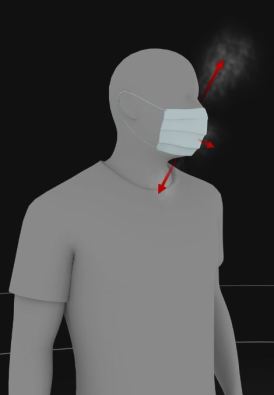
Face Mask Disrupts trajectory of cough New York Times April 14 2020
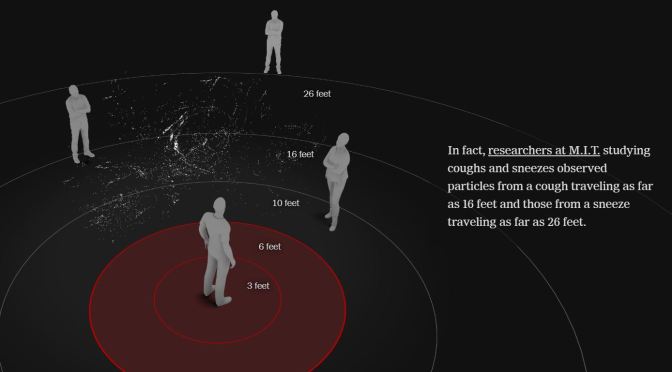
But as this simulation suggests, and scientists have argued, droplets can travel farther than six feet. And small droplets known as aerosols can remain suspended or travel through the air before they eventually settle on surfaces. This is how they could disperse over the next 20 minutes.
The Centers for Disease Control and Prevention encourages people to stay home. If you must venture out, you should stay at least six feet away from others. The World Health Organization recommends a minimum of three feet of separation.
Scientists are learning about the novel coronavirus in real time, and those who study similar respiratory illnesses say that until it is better understood, no guideline is likely to offer perfect safety. Instead, understanding the possible transmission routes for the virus can help us see why keeping our distance is so important.
From web post by Michael B. Edmond (April 11, 2020):
Our goal should be to have a face shield for every person in the country. It should be worn anytime a person leaves their home, while in any public place, and even at work. From news reports, it appears that face shields are already being more commonly worn in other nations, particularly in some Asian countries.
The advantages of face shields are their durability allowing them to be worn an indefinite number of times, the ability to easily clean them after use, their comfort, and they prevent the wearer from touching their face. Importantly, they cover all the portals of entry for this virus–the eyes, the nose, and the mouth. Moreover, the supply chain is significantly more diversified than that of face masks, so availability is much greater.
Some are critical of any strategy that isn’t perfect. But let’s think about the influenza vaccine. Although the effectiveness varies from year to year, on average it’s 40%. We push this vaccine hard in the hospital and in the community. Could we expect that face shields are at least 40% effective in reducing the transmission of COVID-19? I think so. Universal shielding would bend the curve more quickly and accelerate the ability to reduce social distancing and restrictions on movement.
.
Face shields are a simple solution that if implemented universally would have a major impact on public health. Until we have a vaccine, this may be our best intervention for preventing transmission in the community.
Michael B. Edmond, MD, MPH, MPA, MBA is the Chief Quality Officer and Associate Chief Medical Officer for University of Iowa Health Care and Clinical Professor of Infectious Diseases at the University of Iowa Carver College of Medicine. He previously served as the Richard P. Wenzel Professor of Internal Medicine, Chair of the Division of Infectious Diseases, and Hospital Epidemiologist at Virginia Commonwealth University in Richmond.
A hundred days after a Chinese government website announced the discovery of a “pneumonia of unknown cause”, it has become clearer that the dynamics behind the virus’s rapid expansion across the globe has relied heavily on such “cluster effects”.
Each of the countries most heavily hit by the pandemic has reported similar stories of social, cultural or religious gatherings where large numbers spent numerous hours in close company – holding hands, kissing, sharing drinks from the same glass – which then turbo-charged the spread of the pandemic.
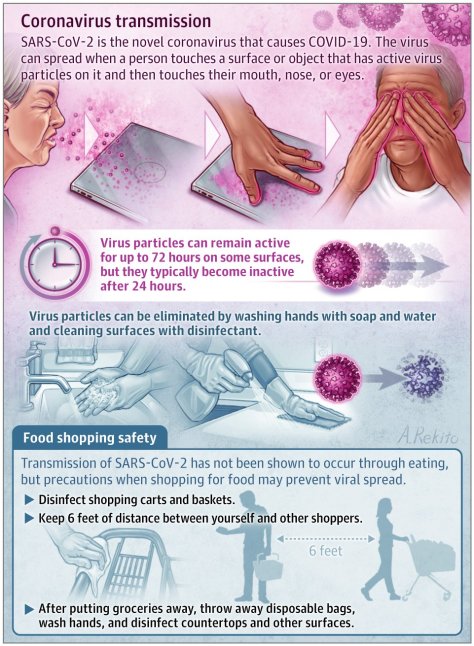
“Most infections didn’t take place in supermarkets or restaurants,” Streeck said of his preliminary findings. In Heinsberg, his team of coronavirus detectives could find scant evidence of the virus being transmitted via the surfaces of door handles, smart phones or other objects.

 The World Health Organization recently acknowledged that some evidence about in-room transmission is worrisome. In addition, after analyzing a transmission event at a restaurant in China, the US Centers for Disease Control and Prevention (CDC) concluded that an asymptomatic patient transmitted the virus to families at two nearby tables.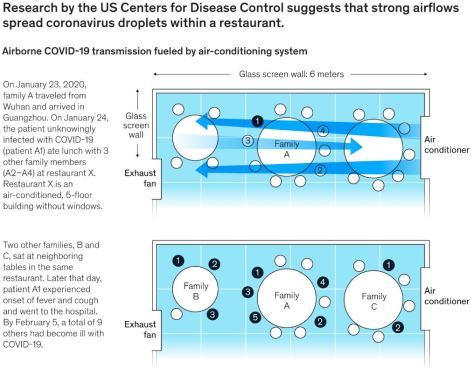


 Nature discusses the massive coronavirus outbreak that struck the iconic Californian prison after it rejected expert aid.



 The spread of misinformation is crippling our fight against the coronavirus. Social media and a deeply partisan divide are fueling what the World Health Organization calls an “infodemic,” which is just as urgent as the virus itself.

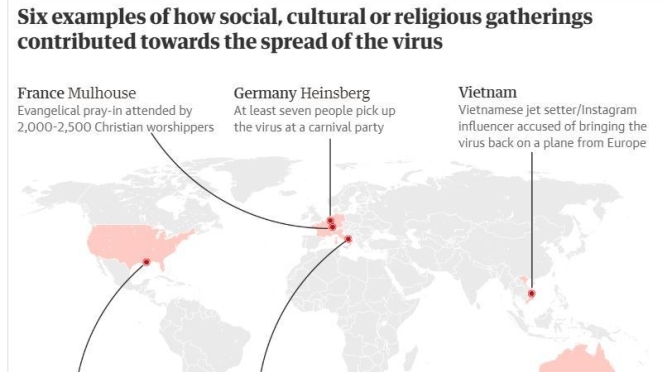
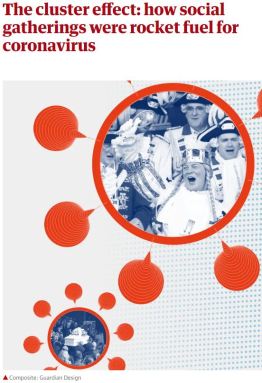 A hundred days after a Chinese government website announced the discovery of a “pneumonia of unknown cause”, it has become clearer that the dynamics behind the virus’s rapid expansion across the globe has relied heavily on such “cluster effects”.
 Boomers Daily