
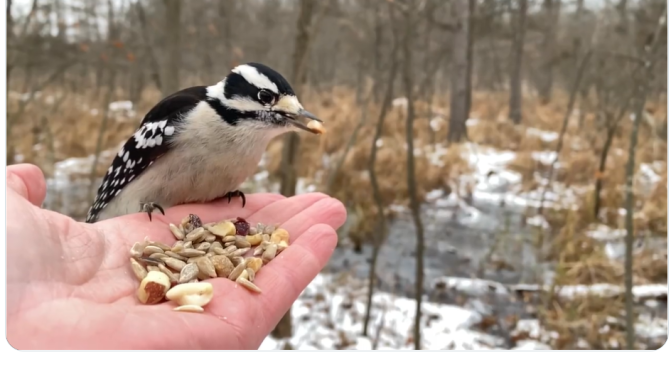
A female Downy Woodpecker enjoys a few sunflower seeds on a brisk morning. After she leaves, a Black-capped Chickadee and a Tufted Titmouse grab snacks. Video switches to real time a little after 2 min. pic.twitter.com/4tmOaeVTVg
— Jocelyn Anderson Photography (@JocAPhotography) December 23, 2021
Tag Archives: Videos
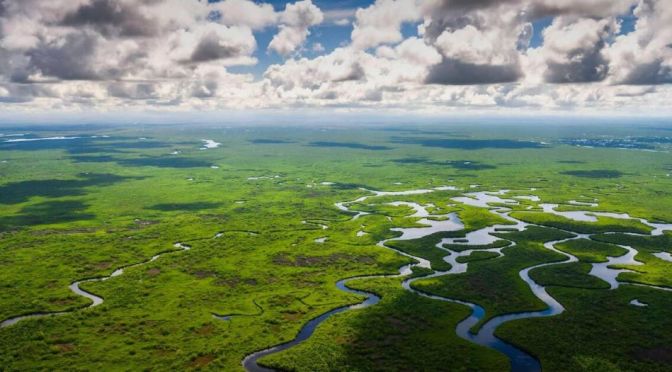
Views: Secret Islands Of The Everglades, Florida
The Everglades is a water world — It’s the widest and slowest river in the United States. But in the heart of this great water body exist secret islands that have outsize importance for the cultural heritage of a people and for the biodiversity of this important wetland. Thousands of these tree islands dot the Everglades.
For generations, the Miccosukee people have called these islands home. And they’ve long understood that the islands are a giver of life in this unforgiving environment. The islands are some of the only dry land around and harbor a surprising diversity of plant and animal life, including: coyotes, bobcat, bear, and even the Florida panther.
But among the scientific establishment, the islands are little understood. Researchers from the Miccosukee tribe are working to understand how animals use the islands and what role they play in the larger Everglades ecosystem. With the islands under threat from outside forces, their studies have taken on increased urgency. What they’re finding could be key to preserving the Miccosukee culture and the balance of life in this great river.

Review: Math & Computer Science Discoveries (2021)
It was a big year. Researchers found a way to idealize deep neural networks using kernel machines—an important step toward opening these black boxes. There were major developments toward an answer about the nature of infinity. And a mathematician finally managed to model quantum gravity. Read the articles in full at Quanta Magazine: https://www.quantamagazine.org/the-ye…

Analysis: Best Ways To Produce Green Energy
Fossil fuels still supply about 80% of the world’s power. How can energy be produced and used more sustainably to meet climate targets? We answer your questions. film supported by @Infosys
Timeline: 00:00 – Why energy needs to become more sustainable 00:33 – How much energy should come from renewables? 01:19 – Why isn’t nuclear power used more widely? 02:19 – How can solar power be made more efficient? 03:34 – Will biofuels become widely used? 04:30 – Do electric vehicles make a difference? 05:10 – How heating and air conditioning can be more sustainable

History Of Art: Albrecht Dürer’s Lasting Influence
Even if you don’t know the name, chances are you’ve seen a reproduction of one of his prints. What is it about his work that has made it last? Through paintings, drawings, prints, and letters, our exhibition ‘Dürer’s Journeys: Travels of a Renaissance Artist’ brings to life this art history megastar and the people and places he visited.

2021 In Review: National Geographic’s Top Images
ABC News’ Linsey Davis speaks with Pulitzer Prize-winning photographer Lynsey Addario about some of the top images from National Geographic’s “Year in Pictures” issue.
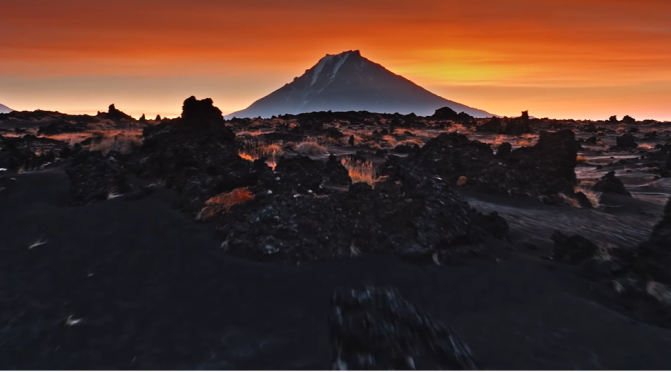
Aerial Views: Kamchatka Peninsula, Eastern Russia
Kamchatka Peninsula, also spelled Kamčatka, Russian Poluostrov Kamchatka, peninsula in far eastern Russia, lying between the Sea of Okhotsk on the west and the Pacific Ocean and Bering Sea on the east. It is about 750 miles (1,200 km) long north-south and about 300 miles (480 km) across at its widest; its area is approximately 140,000 square miles (370,000 square km).
Two mountain ranges, the Sredinny (“Central”) and Vostochny (“Eastern”), extend along the peninsula and rise to 15,584 feet (4,750 metres) in Klyuchevskaya Volcano. The trough between these mountain chains is occupied for much of its length by the Kamchatka River. Of the 127 volcanoes, 22 are still active, as are a number of geysers and hot springs. Most of the active volcanoes lie along a fault line on the eastern flank of the Vostochny Range.
The western coastlands of the Kamchatka Peninsula form a low plain crossed by many rivers and with extensive swamps, while the eastern coast is an alternation of broad gulfs and cliffed, mountainous peninsulas. A small geothermal-power station uses underground steam and is in operation near the southern end of the peninsula.
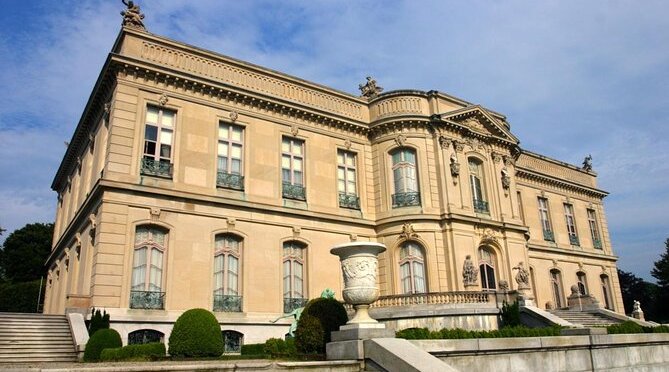
Christmas Tours: The Elms In Newport, Rhode Island
The Elms was the summer residence of Mr. and Mrs. Edward Julius Berwind of Philadelphia and New York. Mr. Berwind made his fortune in the coal industry. In 1898, the Berwinds engaged Philadelphia architect Horace Trumbauer to design a house modeled after the mid-18th century French chateau d’Asnieres (c.1750) outside Paris.
Construction of The Elms was completed in 1901 at a cost reported at approximately $1.4 million. The interiors and furnishings were designed by Allard and Sons of Paris and were the setting for the Berwinds’ collection of Renaissance ceramics, 18th century French and Venetian paintings, and Oriental jades.
The elaborate Classical Revival gardens on the grounds were developed between 1907 and 1914. They include terraces displaying marble and bronze sculpture, a park of fine specimen trees and a lavish lower garden featuring marble pavilions, fountains, a sunken garden and carriage house and garage. These gardens were recently restored.
Mrs. Berwind died in 1922, and Mr. Berwind invited his sister, Julia, to become his hostess at his New York and Newport houses. Mr. Berwind died in 1936 and Miss Julia continued to summer at The Elms until her death in 1961, at which time the house and most of its contents were sold at public auction. The Preservation Society of Newport County purchased The Elms in 1962 and opened the house to the public. In 1996, The Elms was designated a National Historic Landmark.

 Boomers Daily