Tag Archives: Trump

REVIEW: “Donald Trump, Zohran Mamdani, and Posting as Politics”

An AI Review: “Donald Trump, Zohran Mamdani, and Posting as Politics”

In The New Yorker essay “Donald Trump, Zohran Mamdani, and Posting as Politics,” Kyle Chayka explores how social media has become not merely a communication tool for political figures but the primary arena in which politics itself now unfolds. The piece contrasts the digital personas of Donald Trump and Zohran Mamdani to illustrate how posting has evolved into a core exercise of power and a new form of political identity.

Chayka begins by chronicling former President Trump’s frenetic use of Truth Social, the platform he created after leaving Twitter. Trump does not merely announce decisions online; he appears to make them there. For instance, in June 2025, Trump unilaterally declared and publicized a ceasefire between Israel and Iran on Truth Social after having ordered strikes on Iranian nuclear facilities only days earlier. He issued warnings and taunts in the same all-caps style he once used to brag about the size of his nuclear arsenal compared to Kim Jong Un’s. The essay argues that this real-time posting has compressed world-shaking events into casual, ephemeral updates, trivializing violence and policy into the equivalent of viral content.

Yet Trump is not alone in harnessing the power of constant broadcasting. Chayka turns to Zohran Mamdani, a 33-year-old New York State assembly member and Democratic nominee for New York City mayor, who embodies a different approach to digital politics. Where Trump’s style is bombastic and combative, Mamdani’s presence on TikTok and Instagram is more polished and warm. His short-form videos—some produced by the creative agency Melted Solids—blend documentary realism with the aesthetics of viral influencer content. Clips of Mamdani walking through Manhattan or spontaneously greeting his filmmaker mother, Mira Nair, have garnered millions of views. His collaborations with high-profile digital creators like the Kid Mero and Emily Ratajkowski reflect an understanding that modern campaigns are not only about policy but about generating a steady stream of engaging material.

Chayka underscores that both politicians are symptoms of the same phenomenon: social media has swallowed the traditional infrastructure of political communication. No longer is there a clear boundary between a politician’s private musings and official pronouncements. The medium has become the message—and often the entire substance. Even memes have turned into flash points of political conflict. The article recounts how U.S. border officials detained a Norwegian tourist, Mads Mikkelsen, who carried a satirical meme of Vice President J.D. Vance on his phone, suggesting that political images have acquired the power to implicate their holders in ideological battles.

This transformation, Chayka argues, has significant consequences. Trump’s unfiltered posts, once viewed as a sideshow, have become a primary instrument of governance, with the potential to inflame conflicts or disrupt alliances. Meanwhile, Mamdani’s refined authenticity—crafted through video diaries and collaborations—illustrates how even progressive candidates must adopt the same always-online posture to cultivate a political following. While Mamdani’s style is less aggressive than Trump’s, it similarly depends on projecting a version of authenticity that is inseparable from performance.

The essay closes by reflecting on the future of American politics in this environment. The Democratic Party has struggled to counter Trump’s cultural dominance, as shown by tone-deaf spectacles like a Pride concert at the Kennedy Center with anti-Trump parodies of Les Misérables. In contrast, Mamdani’s campaign has generated genuine enthusiasm. Yet Chayka raises an open question: can the idealistic energy of this new digital-first politics survive the compromises of actual governance? If online performance has become the main credential for leadership, it is unclear whether any politician—no matter their ideology—can avoid the pressures of perpetual self-promotion.

In the end, Chayka’s essay offers a clear warning: social media has transformed politics into a theater of the immediate, where every post carries the weight of policy and every meme can become an instrument of power. Whether this dynamic can be reconciled with the demands of responsible government remains the central challenge of the digital age.

Strengths of the Essay

  1. Compelling Illustrations of Digital-First Governance
    • The article effectively juxtaposes Trump’s all-caps proclamations with Mamdani’s handheld videos.
    • Vivid examples: Trump’s posts about Iranian bombings feel almost satirical in their triviality—like “food grams”—yet they are deadly serious.
    • The Vance meme incident (Norwegian tourist Mikkelsen denied entry partly over a meme) underscores how digital artifacts can become politically consequential.
  2. Clear Argument
    • Chayka convincingly demonstrates that posting is no longer merely a marketing tactic—it is a form of exercising power.
    • The phrase “influencer-in-chief” encapsulates this new paradigm succinctly.
  3. Timeliness and Relevance
    • The piece captures the unsettling normalcy of this phenomenon—how we now expect statecraft to be conducted via apps.
    • It connects to broader anxieties about the erosion of institutional boundaries between governance and entertainment.
  4. Balanced Comparison
    • The contrast between Trump’s aggression and Mamdani’s optimism avoids simple equivalence.
    • The essay suggests that while style differs, both are beholden to the same dynamics: immediacy, spectacle, and performative authenticity.

Areas For Further Exploration

  1. A Critique of Consequences
    • While Chayka notes the trivialization of serious decisions (e.g., bombings posted like selfies), he stops short of examining the systemic dangers—the erosion of deliberative processes, the collapse of public trust, and the incentivizing of extremism.
    • A deeper dive into why social media rewards such maximalist performances—and how this affects democracy—would have been valuable.
  2. An Exploration of Audience Complicity
    • The essay portrays politicians as the main actors, but it could interrogate how audiences co-produce this environment: what are the incentives to consume, share, and reward this content?
    • Do voters really want “authenticity,” or simply entertainment masquerading as politics?
  3. Further developed Historical Context
    • While the piece references Trump’s first term, it could have drawn richer parallels with earlier media transformations:
      • Roosevelt’s radio “Fireside Chats”
      • Kennedy’s TV charisma
      • Obama’s early social media campaigns
    • This would help readers situate today’s moment within a longer trajectory.

Broader Implications

The essay ultimately raises unsettling questions:

  • If the performance of authenticity is now the primary qualification for political power, how do policy substance and institutional competence survive?
  • Is there any way for governance to reassert seriousness, or will the logic of virality always prevail?
  • What happens when online theater collides with offline consequences—wars, economies, civic life?

These questions feel especially urgent given that the piece suggests this dynamic is not limited to Trump’s right-wing populism but has also infiltrated progressive candidates.

*THIS ESSAY WAS WRITTEN BY CHAT GPT AND EDITED BY INTELLICUREAN.
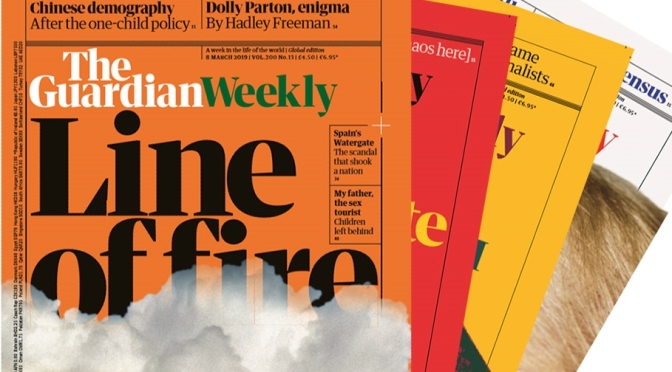
The Guardian Weekly – April 11, 2025 Preview

THE GUARDIAN WEEKLY (April 10, 2025): The latest issue features ‘Crash Course – Trump’s Tariff War on the World; Reach for the stars – Are reviews changing our brains?,,,


Trump’s crash course: inside the 11 April edition

The US president’s tariff war on the world. Plus: The unsellable art of Jeremy Deller


 Get the Guardian Weekly delivered to your home address

Graham SnowdonWed 9 Apr 2025 13.00 EDTShare

Donald Trump’s “liberation day” US tariffs on imported goods from a long list of international territories – including some inhabited only by penguins – sparked market turmoil and fears of a global recession.

As the chaos continued into this week, the question loomed of how the world, from China to Europe, would respond. An increasingly dark-looking spiral with China of tariff threats and counter-threats this week led Beijing to vow to “fight to the end”, while vice-president JD Vance again showed his lack of class by referring to “Chinese peasants” in an interview.

Spotlight | Families’ shock at IDF’s killing of paramedics in Gaza
Relatives who waited an agonising week before the bodies were found speak of the passion that drove Red Crescent workers. Malak A TanteshJulian Borger and Bethan McKernan report

Science | Is ratings culture changing our brains?
We live under mutual surveillance, asked to leave public ratings for every purchase, meal, taxi ride or hair appointment. What is it doing to us, asks Chloë Hamilton

Feature | The huge, unsellable public art of Jeremy Deller
Jeremy Deller can’t really draw or paint. Instead of making things, he makes things happen. Charlotte Higgins spends time with one of Britain’s best-known but unlikely artists

Opinion | Donald Trump won’t stop me visiting the US – a country I love
For John Harris, the United States means music, progress, hope. Whatever their president does, he argues, plenty of Americans continue to believe in those too

Culture | How Tracy Chapman captured a moment and inspired a generation
Zadie Smith was 12 years old when she saw Tracy Chapman captivate a massive crowd at 1988’s Free Nelson Mandela concert. Her astonishing debut album has mesmerised the novelist ever since

Foreign Affairs Essays: ‘China’s Trump Strategy’

FOREIGN AFFAIRS MAGAZINE (February 6, 2025): In the months since Donald Trump won the U.S. presidential election in November, policymakers in Beijing have been looking to the next four years of U.S.-Chinese relations with trepidation. Beijing has been expecting the Trump administration to pursue tough policies toward China, potentially escalating the two countries’ trade war, tech war, and confrontation over Taiwan. The prevailing wisdom is that China must prepare for storms ahead in its dealings with the United States. 

Trump’s imposition of ten percent tariffs on all Chinese goods this week seemed to justify those worries. China retaliated swiftly, announcing its own tariffs on certain U.S. goods, as well as restrictions on exports of critical minerals and an antimonopoly investigation into the U.S.-based company Google. But even though Beijing has such tools at its disposal, its ability to outmaneuver Washington in a tit-for-tat exchange is limited by the United States’ relative power and large trade deficit with China. Chinese policymakers, aware of the problem, have been planning more than trade war tactics. Since Trump’s first term, they have been adapting their approach to the United States, and they have spent the past three months further developing their strategy to anticipate, counter, and minimize the damage of Trump’s volatile policymaking. As a result of that planning, a broad effort to shore up China’s domestic economy and foreign relations has been quietly underway.

READ MORE

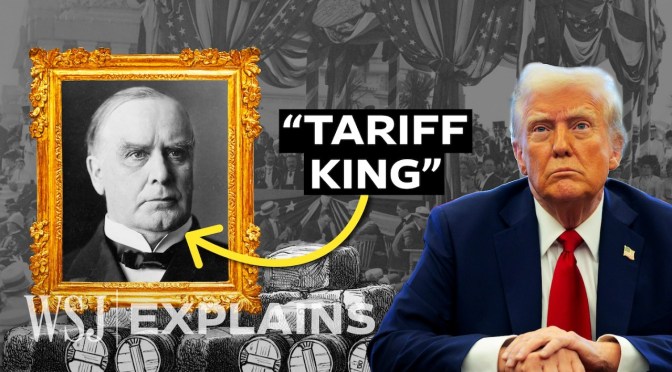
The Trump Tariffs: Why McKinley Dumped Them

The Wall Street Journal (February 4, 2025): President Donald Trump often cites the 25th President, William McKinley, as an inspiration for tariffs.

Chapters: 0:00 Trump’s tariff idol 0:50 Revenue 3:30 Restriction 5:02 Reciprocity 7:17 Trump today

The ‘McKinley Tariffs’ were some of the largest hikes in U.S. history, but in his second term, McKinley changed his mind, and argued for more free international trade as a way of helping the U.S. economy. WSJ explores how McKinley used tariffs, how Trump is following a similar playbook and why McKinley. Actually came to speak out against them.

#Trump #Tariffs #WSJ

The New Statesman – January 17, 2025 Preview

THE NEW STATESMAN MAGAZINE (January 16, 2025): The latest issue features ‘The Disruptors’ – Elon Musk, Donald Trump and the hostile takeover of America…

Elon Musk’s hostile takeover

Inside the mind of the billionaire at the heart of American power. By Quinn Slobodian

The question of childlessness

With the fertility rate falling across the West, there is much more affecting parents’ decisions than the economy. By Madeleine Davies

Letter from Los Angeles: My city is burning

The fires ripping through LA show that, here, beauty and danger are two sides of a coin. By Sanjiv Bhattacharya

The Economist Magazine – January 18, 2025 Preview

THE ECONOMIST MAGAZINE (January 16, 2025): The latest issue features ‘The Trump Doctrine’ – America’s new foreign policy…

Donald Trump will upend 80 years of American foreign policy

A superpower’s approach to the world is about to be turned on its head

Much of the damage from the LA fires could have been averted

The lesson of the tragedy is that better incentives will keep people safe

Rising bond yields should spur governments to go for growth

The bond sell-off may partly reflect America’s productivity boom

The Economist Magazine – January 11, 2025 Preview

Donald the Deporter

THE ECONOMIST MAGAZINE (January 9, 2025): The latest issue features ‘Donald the Deporter‘….

Donald the Deporter

Could a man who makes ugly promises of mass expulsion actually fix America’s immigration system?

The capitalist revolution Africa needs

The world’s poorest continent should embrace its least fashionable idea

How Labour is failing England’s schools

It is fiddling with what works and not yet dealing with what doesn’t

Get tough with Russian sabotage

Russian-linked attacks on undersea infrastructure are rising

Plastic surgery a go-go

Young customers in developing countries propel a boom in plastic surgery

Oldies behaving badly

Why people over the age of 55 are the new problem generation

Read full edition

Foreign Policy Magazine – Winter 2025 Preview

Image

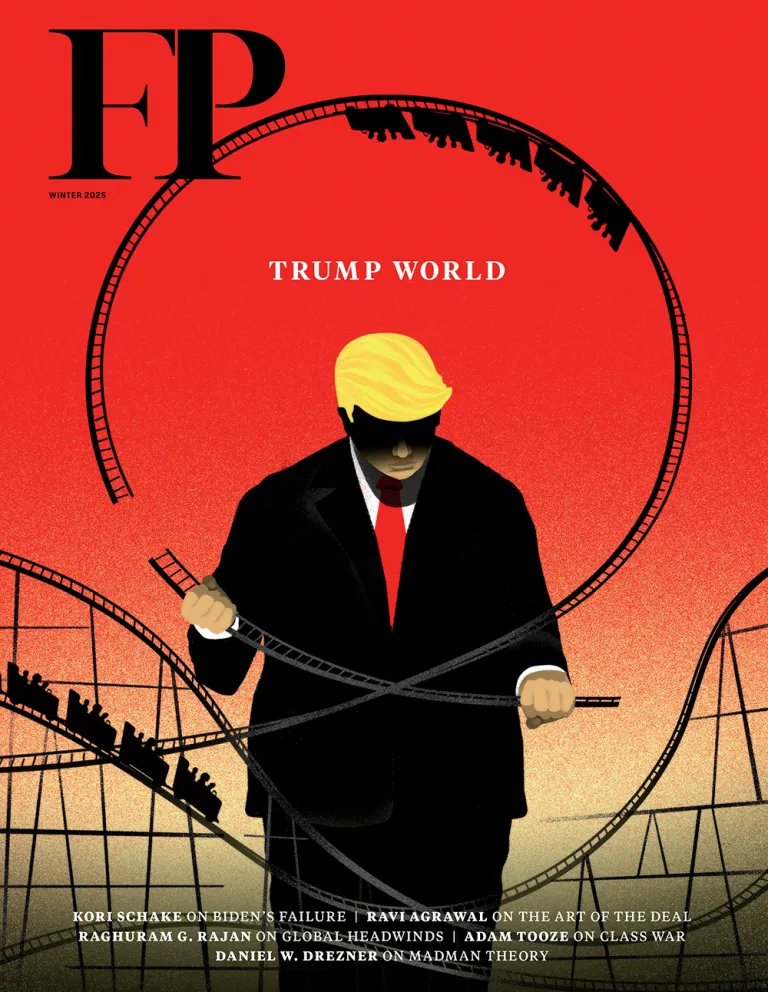
FOREIGN POLICY MAGAZINE (January 7, 2025): The latest issue features ‘Trump World’…

Trump Is Ushering in a More Transactional World

Countries and companies with clout might thrive. The rest, not so much.By Ravi Agrawal

Why Biden’s Foreign Policy Fell Short

The White House never met its own grandiose standards. By Kori Schake

Does the Madman Theory Actually Work?

Trump likes to think his unpredictability is an asset.Daniel W. Drezner

The Guardian Weekly – January 3, 2025 Preview

THE GUARDIAN WEEKLY (December 31, 2024): Trump v the world; Global leaders pivot to face Trump 2.0. Plus South Korea latest.

Anticipation for the promise a new year brings is, in 2025, heavily tempered by trepidation about what Donald Trump’s second term will look like. For the big story of our first edition of the new year, diplomatic editor Patrick Wintour surveys how the world from Moscow to London, Tehran to Beijing and Brussels to Kyiv is gearing up for 20 January. Whether they be populists or hard-headed foreign-policy realists, it is clear that leaders are prepared to talk back to Trump in his language of power. Equally true is that despite the incoming White House administration’s preference to concentrate on America first domestic issues, the war in Ukraine, conflict in the Middle East and tensions with China force themselves to the forefront of Trump’s agenda and are unlikely to be solved in either his first day, week or month in office. As the year unfolds, Guardian Weekly will continue to help you make sense of Trump’s return and the biggest global issues of 2025.

Spotlight | Air disaster compounds South Korea’s troubles
A major fatal air accident is a tragedy for any nation but as Justin McCurry and Raphael Rashid report, the Jeju Air crash has come against a continued background of political division and instability.

Science | Time’s paradox
A timely exploration by Miriam Frankel of recent research has found out about the factors that make life drag or fly by. And, importantly, what you can do to help reset your inner clock to a more satisfactory tempo.

Features | The millennium bug that didn’t bite us
A quarter of a century ago, doomsayers thought the world would end as we clicked over to a new century due to malfunctioning computer systems. But, Tom Faber reports, the much-feared bug was always going to be a damp squib.

Opinion | Uneasy parallels between the McCarthy era and Trump 2.0
Richard Sennett reflects on how postwar paranoia about the ‘enemy within’ changed his family and what it can teach Americans when a similarly anti-liberal administration is in power.

Culture | Another side of Bob Dylan
Bob Dylan shuns discussion of his early years, so how did James Mangold, the director of a new biopic, and his creative team approach their script – and what happened when Dylan asked for a meeting? Alexis Petridis finds out.


Quadrant Magazine – January/February 2025

QUADRANT MAGAZINE (December 28, 2024): The latest issue features ‘Trump Takes Charge’…

Donald Trump and John Galt: Disruptors-in-Chief

Donald Trump’s election as President of the United States anoints him as “Disruptor in Chief”, a vital role with world-historical significance. Trump’s ascension to this position was presaged in Ayn Rand’s stupendous novel Atlas Shrugged (1957), whose central character, John Galt, confronts a similarly sclerotic America, which he sets out systematically to disrupt in a radical, transformative manner. This highly controversial novel is important in illuminating what is at stake at the cultural level in the struggle to come, and in emphasising the scale and direction of the challenges facing Trump, his administration and his supporters. Atlas Shrugged is also valuable because, together with Rand’s earlier novel The Fountainhead (1943), it offers in compelling fictional form a powerful, necessarily hyperbolic, statement of the philosophical values that must be reasserted to make America great again.

Musk Lifts Off

If Hillbilly Elegy was compulsory reading for observers of American politics wanting to understand Trump’s first presidency, Walter Isaacson’s biographical portrait of Elon Musk is mandatory holiday reading for those wanting to understand how Donald J. Trump turned so many critics into passionate supporters and won a resounding presidential vote in 2024, and to gauge how his nation-reshaping policies might play out over the next four years.