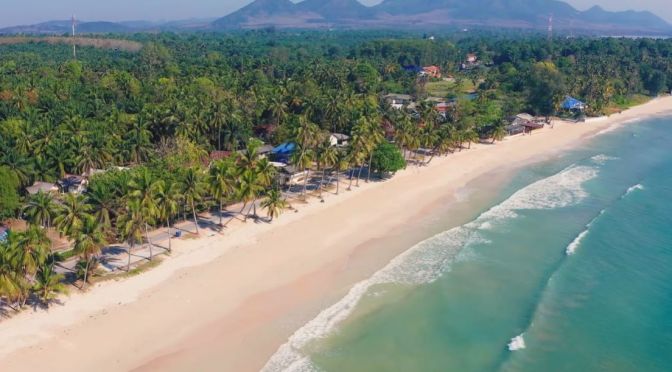
The white sandy Thung Wua Laen Beach is 2 km long and lies 13 km North of Chumphon in Southern Thailand.
The “beach of the bull running across the field” is also signposted ‘Thung Wualan’. According to the legend the beach was named by hunters who killed a wild bull. This bull was so strong that it freed itself and escaped while it was being skinned. It ran “across the field”.
Beach chairs and jet skis are not allowed on this beach. The priority here lies on environmentally friendly tourist projects where they try to keep a natural balance.
With a rich history in agriculture and shipbuilding, Kennebunk today retains her connection to the land and sea. With easy access to the ocean, river, and wooded trails, the town is one of those special communities that seems to have it all, even the prestige of name (there is only one Kennebunk in the country).
Kennebunk balances a rural feel with true convenience – Portland is only 25 miles away and catching the Downeaster train in Wells makes the commute to Boston a snap. Featured on the town seal is the Lafayette Elm, which was planted to commemorate General Lafayette’s 1825 visit to Kennebunk. The handsome tree is one of the only survivors of the Dutch Elm that destroyed hundreds of trees that once lined Kennebunk’s streets.
The residents are a bit like the mighty tree: able to withstand the changing of seasons and passing of time with a sense of quiet nobility. In this tight-knit, laid-back community, it’s easy to be a good and helpful neighbor.
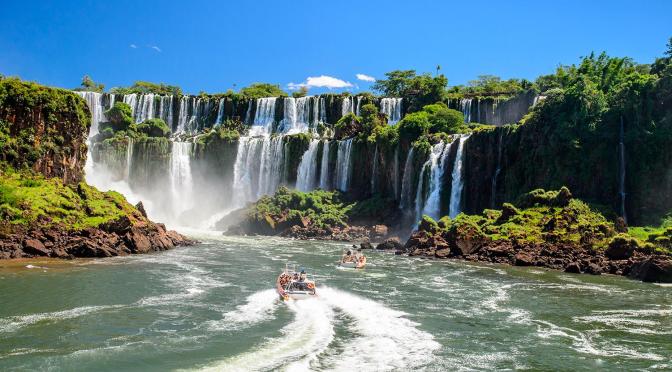
This is a walk in Iguazu Falls, in the province of Misiones in Northern Argentina. This video was recorded in the Devil’s throat.
The Iguazu National Park consists of two national parks, one in Foz de Iguazu (Brazil) and the other one in Puerto Iguazu (Argentina). The curious thing is that although one only sees the falls as the main attraction, the park has a size of 252,982 hectares (67,720 on the Argentine side and 185,262 on the Brazilian side).
These falls in Argentina and Brazil managed to attract so much attention that almost at the same time they were declared National Parks (1934 in Argentina and 1939 in Brazil). And after some years and millions of visitors fascinated by the landscape and the sound of this natural attraction, UNESCO declared them as World Heritage Site in 1984, and reaffirmed as Exceptional Universal Value (their cultural and nature it’s so important that it’s conservation should be of worldwide interest) in 2013.
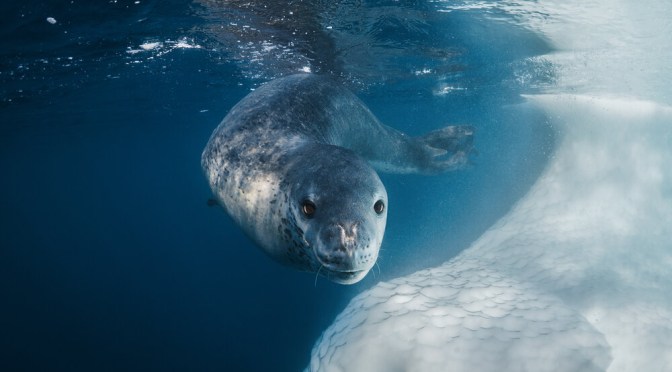
Take a peek behind the scenes of Frozen Planet 2 as the team battle conditions to film the hunting behaviours of leopard seals. The extreme cold and icy weather weren’t the only factors the team had to deal with, as some leopard seals got a little bit too curious for the crew’s liking…
The leopard seal, also referred to as the sea leopard, is the second largest species of seal in the Antarctic. Its only natural predator is the orca. It feeds on a wide range of prey including cephalopods, other pinnipeds, krill, birds, fish and penguins. It is the only species in the genus Hydrurga.
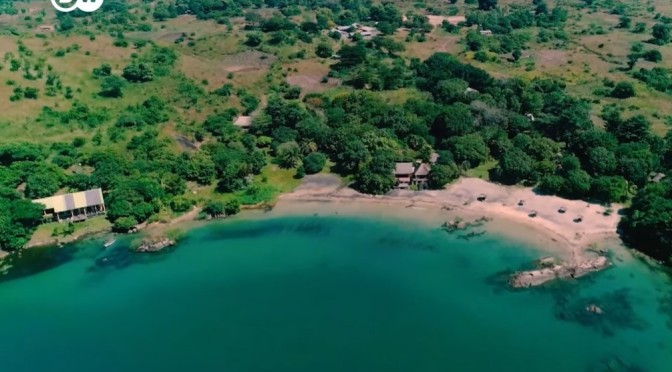
Located on the shores of Lake Malawi, Africa’s third largest lake, Makuzi Beach Lodge is secluded, isolated and offers fantastic views of the water. Guests’ meals are cooked with ingredients from the lodge’s huge garden — or from the lake on the doorstep. With concepts like this, eco-friendly and sustainable tourism is being promoted in Africa.
Malawi, a landlocked country in southeastern Africa, is defined by its topography of highlands split by the Great Rift Valley and enormous Lake Malawi. The lake’s southern end falls within Lake Malawi National Park – sheltering diverse wildlife from colorful fish to baboons – and its clear waters are popular for diving and boating. Peninsular Cape Maclear is known for its beach resorts.
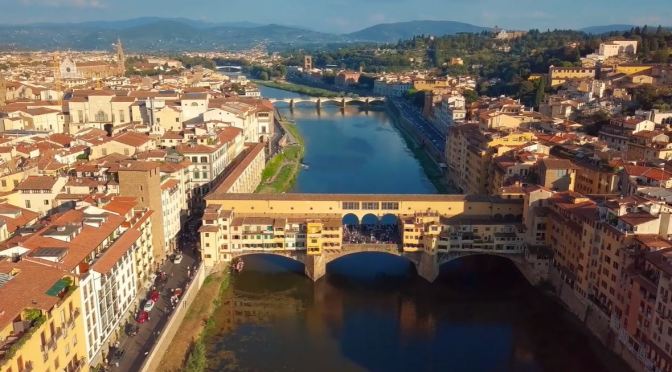
Florence, capital of Italy’s Tuscany region, is home to many masterpieces of Renaissance art and architecture. One of its most iconic sights is the Duomo, a cathedral with a terracotta-tiled dome engineered by Brunelleschi and a bell tower by Giotto. The Galleria dell’Accademia displays Michelangelo’s “David” sculpture. The Uffizi Gallery exhibits Botticelli’s “The Birth of Venus” and da Vinci’s “Annunciation.”
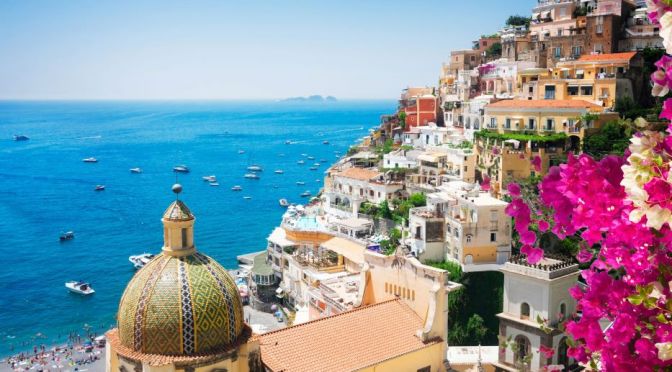
Positano is the most famous and iconic village, the pearl of the Amalfi Coast, the spectacular strip of coastline with the turquoise waters of the Mediterranean Sea to one side and the peaks of the Lattari Mountains to the other.
It lies in the ravine of the Mulini Valley, along the Gulf of Salerno, southeast of Naples. Although it was known in the 4th century, Amalfi was of little importance until the mid-6th century under the Byzantines. As one of the first Italian maritime republics in the 9th century, it rivaled Pisa, Genoa, Venice, and Gaeta as a naval power in trade with the East. Subdued and annexed by King Roger II of Sicily in 1131, it was sacked by the Pisans in 1135 and 1137 and rapidly declined in importance, although its maritime code, the Tavola Amalfitana (“Table of Amalfi”), was recognized in the Mediterranean until 1570.
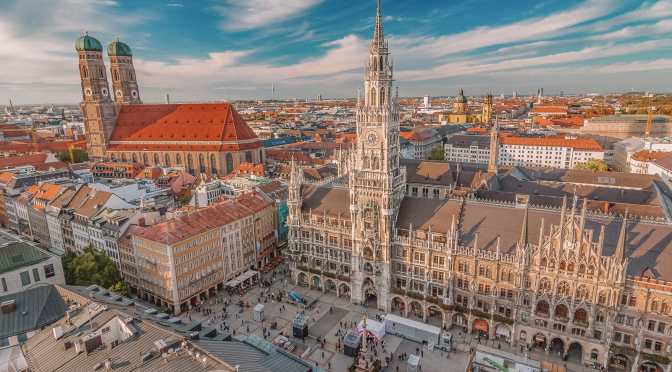
Munich, Bavaria’s capital, is home to centuries-old buildings and numerous museums. The city is known for its annual Oktoberfest celebration and its beer halls, including the famed Hofbräuhaus, founded in 1589. In the Altstadt (Old Town), central Marienplatz square contains landmarks such as Neo-Gothic Neues Rathaus (town hall), with a popular glockenspiel show that chimes and reenacts stories from the 16th century.
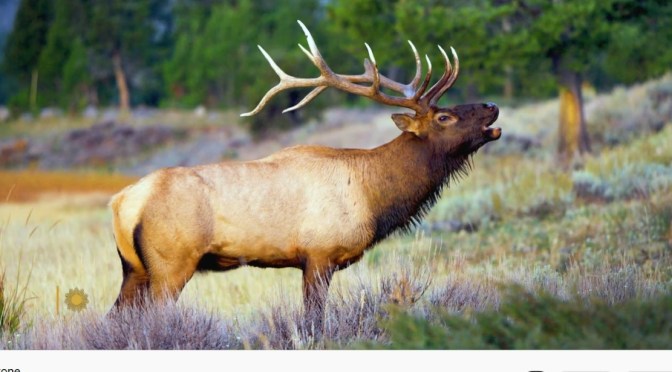
“Sunday Morning” leaves us this morning with elk bugling at Yellowstone National Park. Videographer: Doug Jensen.
Yellowstone’s autumn is defined in many ways-frost on morning grass, color creeping into shimmering aspen leaves, ice rimming mountain ponds. There are sights and smells to a Yellowstone autumn, elements that, if you’ve visited here many times, become as familiar as old friends. But nothing etches the lens through which we see fall as much as the rut of the elk, Cervus alaphus. The reason for this is almost entirely auditory.
The Sound of a Bull Elk in Autumn
If you’ve never heard the bugle of the bull elk during the fall rutting period, you are in for an experience that is at once thrilling and haunting. The sound of a bull elk bugling is something that draws many visitors to Yellowstone each autumn, for it is an experience as memorable as anything you are likely to have in the park. In most cases, the bugle starts low and throaty, rising to a high whistle, then dropping to a grunt or a series of grunts. It’s a sound that is difficult for the human alphabet to imitate, a guttural bellow, a shrill pitch, and a hollow grunting. A-a-a-a-a-a-a-a-eeeeeeeeeeeeee-oh. Ee-uh. Ee-uh. Ee-uh. It’s an odd combination that, like the buzz of your first rattlesnake, you’ll never forget.
News, Views and Reviews For The Intellectually Curious




 Boomers Daily