Tag Archives: The Local Project

Home Tour: ‘Menzies Pop’ In Sumner, New Zealand

An architect’s own home, Menzies Pop is a celebration of architectural craft. Introducing a refined material palette to the pre-existing building, Common Architecture maximises the potential of the New Zealand property. Located in Sumner, a suburb settled on the outskirts of Christchurch, Menzies Pop is a distinctive concrete construction.

A house tour of ‘The Bunker’, as it is referred to by locals, reveals the creative possibilities of the building that culminated in it becoming an architect’s own home. Hand-crafted details give character to the foundation of the house, such as clover shapes cut into the parapets and a skilfully carved arched entrance. Features retained by Common Architecture, such as a concrete ceiling and concrete work beams, present the home as an architecturally exciting offering.

Cementing its status as an architect’s own home, Menzies Pop emerges as a thoughtful reconfiguration of its original building. Three bedrooms are reimagined as a kitchen-living area, with their north-west orientation allowing the spaces to have access to a deck at the rear of the home. By moving the kitchen into a more communal part of the house, Common Architecture presents the space as central to family life. The interior design of the structure speaks to the fact that it is an architect’s own home.

An expert eye is applied to the scale of furniture, skylights and the single-length boards that cover some of the walls of the home, so that the dimensions of the building are emphasised. The beloved timber of the pre-existing home is complemented by teak, stone and brass accents, which form a sophisticated extension of the original material palette. Embracing its structural history, Menzies Pop stands as a cleverly crafted example of an architect’s own home.

Timeline: 00:00 – The Local Project’s Print Publication 00:20 – An Introduction to Menzies Pop by Common Architecture 00:40 – Where It’s Located 00:52 – The Existing House 01:35 – The Beginning of the Renovations 02:45 – The Key Elements of the New Renovation 03:47 – The Kitchen 04:01 – The Extension (First Floor Edition) 05:03 – The Key Learnings 05:41 – What Common Architecture Are Most Proud Of 06:19 – The Local Project’s Tri-Annual Subscription
Tours: ‘Captain Kelly’s Cottage’ On Bruny Island in Southern Tasmania

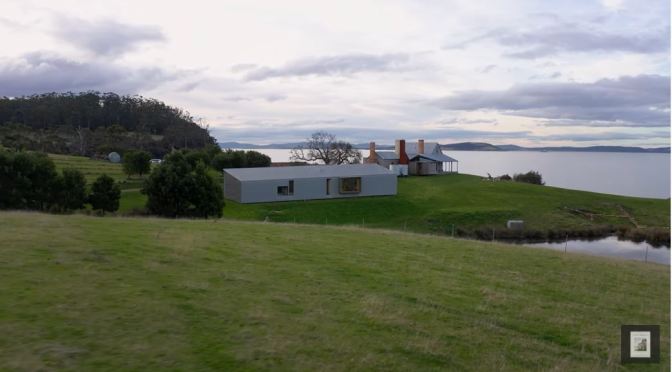
Captain Kelly’s Cottage is the story of restoring a historical home on the edge of the world. The house was finished in 2016 by John Wardle Architects for John and his wife Susan.

Having bought Waterview without knowing its history, John and Susan quickly researched the landscape and its colonial settlement. After asking neighbours and previous owners, John found out that Captain Kelly was a first-generation European Australian with convict parents. Before John and Susan intervened, the cottage had weathered multiple additions and alterations and, along the way, lost a sense of its own history.

As one of two large structures perched along the edge of the vast maritime landscape, looking out over the ocean of Storm Bay, Captain Kelly’s Cottage is steeped in architectural history. Throughout the story of restoring a historical home on the edge of the world, John Wardle Architects achieved a contemporary reading of the existing structure whilst featuring important elements of its past.

For a small and condensed project, John found the restoration challenging – to give the interior design and the architecture a present-day reinterpretation, whilst staying true to its heritage and understanding the environmental impacts and climatic conditions of being on the edge of a cliff. John also took the time to understand the responsibility of owning the Tasmanian land.

More recently, research into the pre-colonial history of the First Nation’s stewardship of the property is being undertaken, an important task John is intent on doing. As the story of restoring a historical home on the edge of the world comes to a close, John views his interventions as a curatorial restoration. The home is primarily made from timber and brick, which has been locally sourced.

Additionally, a lot of the interior design is fuelled by locally sourced elements – materials, furniture and pieces. Fabrics and objects within the interior have also been sourced by John and Susan from their international travels, evoking the essence of a maritime home on the edge of a cliff, looking out to the world beyond. Stated to have been built by carpenters from Kelly’s ship, the architecture and interior design of the home today speaks to its original identity and tells the story of restoring a historical home on the edge of the world.

Internally, a strip of paint has been removed to reveal the home’s original paint colours, exploring both the original and subsequent eras of the cottage’s existence at once. Located on Bruny Island in Southern Tasmania, Captain Kelly’s Cottage by John Wardle Architects is a significant intersection of historical eras. The cottage is the story of restoring a historical home on the edge of the world; there is an appreciation felt throughout – of its past and a celebration for its future.

Design: A Modern Home In Australia Is ‘Split In Two’

Located in Manly, this modern house emphasises casual beachside living through a strong connection to the external environment. Sitting in one of the suburb’s leafiest streets, the modern house enjoys optimal views to the surrounding areas, maximising the cross-flow of natural breezes from its elevated position.

The modern house’s material palette draws inspiration from the history of the surrounding area, whilst raw materials provide a contemporary architectural form, blurring the lines between casual and formal life. A long horizontal concrete form with chamfered edges is clad in breeze-admitting passive timber shading devices and bands of glazing that invite views of the carefully curated greenery. Responding to its coastal location, this modern house is defined by a timber-lined ceiling extending to the soffit and polished concrete floors, creating a series of seamless spaces flowing onto each other, from open to closed, informal to formal, refined and robust all at the same time.

Open-plan living spaces spill out to the outdoor living and pool areas on the ground floor, blurring the line between outside and inside, emphasising the garden outlook, natural light-filled spaces and the modern house’s connection to its environment. A large oversized island bench is the meeting point of the modern home, with streamlined kitchen and living room joinery connecting the living spaces. Ancillary spaces are tucked away into the core of the building, allowing maximum natural light to the living spaces.

As a modern house, the concrete stair is a sculptural presence that sweeps upwards, binding the living spaces to the bedrooms and bathrooms on level one, where the external timber screens add ventilation and ever-changing shadows within. In the basement, a wine cellar, laundry, utility and theatre room provide technical support to the rest of the modern house.

Architecture and Interior Design by DKO Architecture. Development by Adjani. Photography by Tom Ferguson and Toby Peet. Filmed and Edited by Cheer Squad Film Co. Production by The Local Project.

Architectural Home Tour: A Converted Warehouse, Melbourne, Australia (4K)

An architect’s own home can be a challenge to design, with no brief or boundaries to adhere to, leaving the architect’s skill set and true style exposed for all to see. This converted warehouse is an architect’s own home, designed by and for Rob Mills of Rob Mills Architecture and Interior Design.

Located in Armadale, a Melbourne suburb known for its character and village atmosphere, the house was created through a warehouse conversion, which gave the architect plenty of scope and space to design a piece of architecture that truly reflected his likes and wishes. Harnessing this space in the converted warehouse home, the house carries over three levels, with an apartment, sauna and garage at ground level, living in the middle, and bedrooms above.

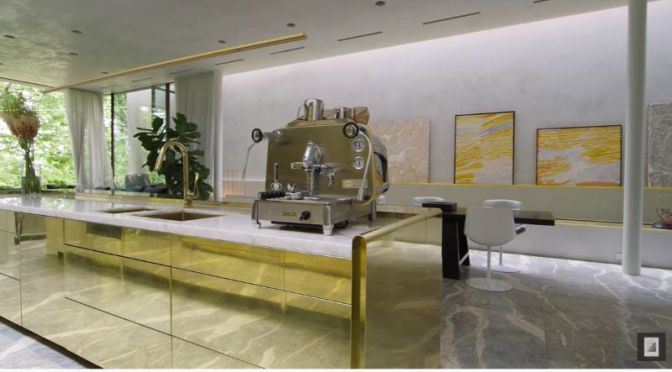
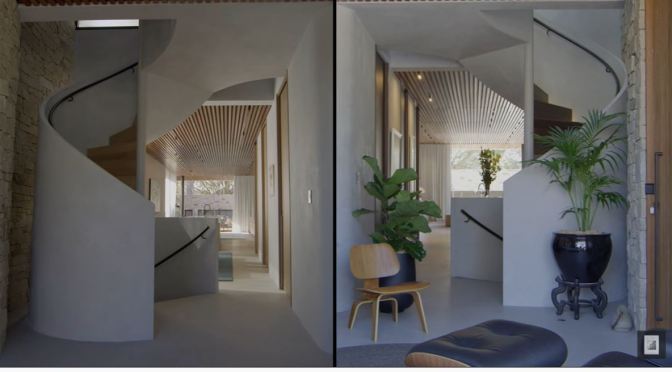
The interior design uses a minimal palette of stone, timber, stucco, glass and metal, with brass playing a large part in the design, especially in the kitchen where it is used extensively and effectively. This glamour and drama are at the heart of the interior design of the converted warehouse. A spiral staircase adds a sculptural element to the house, while also providing an efficient method of travelling between floors.

The office, which has an English aesthetic with lush yet classic-style furniture, features timber shutters that close off to create a focused environment or open to let in plenty of natural daylight. Close connections to nature were important to the architect, Rob Mills of Rob Mills Architecture and Interior Design. A water feature trickles through the living space of the converted warehouse, providing a meditative element to the room. Materials were chosen for their non-toxicity, with stucco walls specified as a natural alternative to paint.

An architect’s own converted warehouse home, Armadale Residence features designer furniture throughout that is carefully chosen to subtly fit with the shine and glamour of the materials. Architecture and Interior Design by Rob Mills Architecture and Interior Design. Filmed and Edited by Cheer Squad Film Co. Production by The Local Project.

Architectural Tours: ‘JARtB House’, Melbourne, Australia (4K Video)

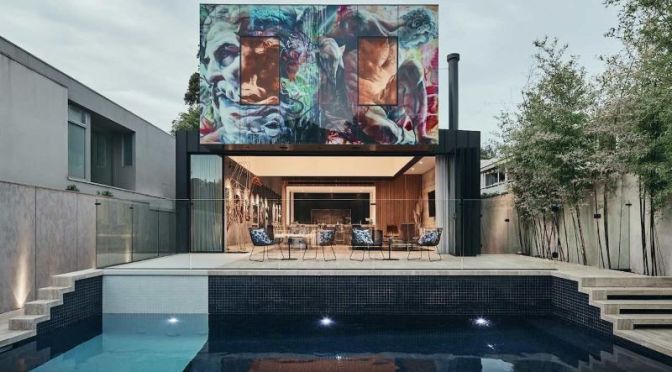
Nestled in a tree-lined street in the affluent suburb of Toorak in Melbourne, JARtB House is an architect’s home that explores art and architecture. Director of international award-winning architecture firm Kavellaris Urban Design (KUD), Billy Kavellaris designed his house with a view to creating both an art gallery and a family home.

The design explores the idea that art and architecture are separate disciplines but also that art can be fused with everyday life. A white circulation strip through the house doubles as a gallery, displaying the architect’s extensive art collection. Some pieces, such as the lofty giraffe sculptures, were designed especially for the space within the architect’s own home. The upper floor is ensconced in a custom mural created by Spanish artist duo PichiAvo.

Made up of 13 panels stitched together across the facade of the house, this artwork can be experienced from both inside and outside the house. The architecture and interior design can also be seen as art itself, with unusual and opulent staircases connecting floors, and uniquely shaped openings and furniture pieces. Bespoke timber flooring and panelling created by Made by Storey is used throughout the home on walls and floors, creating a sense of cohesion and warmth.

Other materials, such as concrete and steel, are carefully chosen for atmosphere and visual interest, while colour is largely provided by the artworks.

Architecture and Interior Design by Kavellaris Urban Design (KUD). Custom Timber Flooring, Stairs and Ceiling by Made by Storey. Video by Cheer Squad Film Co. Production by The Local Project.

Home Tours: ‘Tree House’ In Bronte Beach, Sydney, Australia’ By Madeleine Blanchfield Architects

Madeleine Blanchfield – Architect

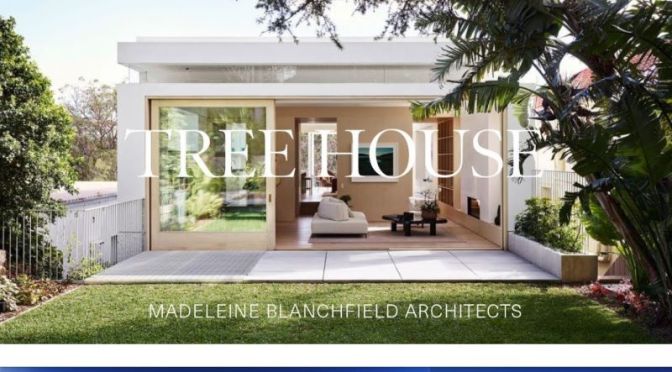
Tree House by Madeleine Blanchfield Architects is a light-filled family home near Bronte Beach in Sydney. As the architect’s own home, the project exemplifies the studio’s experiential design approach, which sees light, form and materiality coalesce to create an experience of place.

The architecture and interiors evoke mood and respond to the changes in light over the course of the day, while the elevated position within the treetops that gives Tree House its name creates a calming atmosphere. With the living space located at the top floor of the architect’s own home, a journey is created through the architecture via a sculptural staircase.

The sculptural forms created by the spiral staircase are balanced by the more pared back interiors, which take their cues from the natural setting. Pale timber, concrete and terracotta tiles, along with the careful approach to both natural and artificial light, reflect the design’s connection to the garden that surrounds it and the nearby beach. This use of few materials detailed to create a highly refined architectural response is characteristic of an architect’s own home.

It highlights how Madeleine Blanchfield Architects has created an experiential home in which simple elements such as materials, details, and changes in light can enhance the mood of a space, resulting in a family home whose architecture, interiors and garden work together to create a sense of lightness and calm.

For More from The Local Project: Website – https://thelocalproject.com.au/

Innovative Architecture: ‘Stealth Pavillion’ – An Australian Private Gym Blended Into A Garden

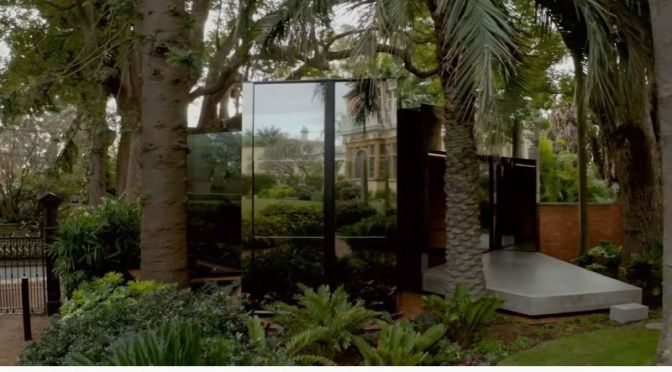
Stealth Pavilion is an architecturally designed private gym which sits suitably disguised in its landscape, concealing its presence through select materiality. Plus Minus Design carefully integrates a multifunction volume into an established heritage-listed garden setting, combining a refined and contemporary approach.

Stealth Pavilion and its location amongst significant listed trees came with its associated challenges, and through a clever approach to concealment, the result combines ingenuity and precision to the architecturally designed private gym which blends into the surrounding landscape.

The brief for the pavilion was for a structure that would house an architecturally designed private home gym and also have the capacity to be adapted to separate guest accommodation as required. After the consideration of a number of locations, the chosen siting was within the drop zone of four of the five listed trees and its surrounding landscape.

Externally, cladding of bronze mirror allows the structure of the architecturally designed private gym to reflect the surrounding foliage and landscape, and seem non-existent to the passer-by while internally the finishes reflect a robust warmth, suitable to its function.

Built by Robert Plumb Build, key to Stealth Pavilion’s integration into the existing was the carefully curated landscape by Dangar Barin Smith.

Architecture by Plus Minus Design.
Build by Robert Plumb Build.
Landscape by Dangar Barin Smith.
Production by The Local Project.
Video by Cheer Squad.