The race for the Democratic nomination looks much like it did a year ago—but previous contests prove that once voting starts, momentum can reshuffle the pack.
Iran has been roiling with protests following the accidental downing of an airliner; what should Iranians and the wider world expect now? And we examine how Bogotá’s once-adored public-transport system went so wrong.
From a The Economist magazine article and podcast:
The real California, though, the California of immigrant dreams that break and get reborn, of lives as they turn out not as they are planned, is the California of the eucalyptus.
Like his friend John Muir, Lukens believed that California desperately needed more forests. Since the mid-19th century forests, and their loss, had been the principal focus of conservationist thought in America. According to Jared Farmer, who traces the history of the eucalyptus in California in “Trees in Paradise” (2013), Lukens and Muir were particularly keen on growing forests as a way to provide water—always a key to power in the state. Trees brought rain and captured fog and moisture; without forests, the men feared the state’s great cities would dry up.
“EUCALYPTUS PROMISES TO BE GREAT INDUSTRY”, announced the front page of the San Luis Obispo Daily Telegram, later claiming that what the speculators following where Lukens had led were planting “will be the largest artificial forest in the world when completed”.
Researchers are using artificial intelligence techniques to invent medicines and materials—but in the process are they upending the scientific method itself? The AI approach is a form of trial-and-error at scale, or “radical empiricism”. But does AI-driven science uncover new answers that humans cannot understand? Host Kenneth Cukier finds out with James Field of LabGenius…
AHEAD OF the 2020 American presidential election, John Prideaux, The Economist‘s US editor, talks to Bill Weld, a former governor of Massachusetts, Joe Walsh, a talk radio host and former Illinois congressman, and Mark Sanford, a former governor of South Carolina. While Donald Trump enjoys near 90% approval ratings among his party, can anyone challenge him for the Republican presidential nomination? And how has he changed what it means to be a Republican?
There can be few applications of digital technology more worthwhile than saving lives, but integrating digital technology into healthcare systems is uniquely complex. This episode provides an introduction to some of the challenges that healthcare providers face in their pursuit of digital innovation, and explores some of the paths forward.
Host Pete Swabey is joined by Professor Ann Blandford, deputy director for digital health at the UCL Institute of Healthcare Engineering; by Jackie Hunter, chief executive, clinical programmes & strategic relationships at AI-powered drug development firm Benevolent.AI; and by Elizabeth Sukkar, managing editor and global editorial lead for healthcare at The EIU. Sponsored by DXC Technology.
MICHAEL BLOOMBERG, the billionaire former mayor of New York, has announced he is running for president. But he is late to join the race and not very popular with Democratic primary voters. We also look at TikTok, a wildly successful video-sharing app that some see as a threat to security in the Western world. And much of Switzerland is up in arms—about the reliability of the country’s coffee supply. Runtime: 20 min
The secretary general of the North Atlantic Treaty Organisation, Jens Stoltenberg, reacts to Emmanuel Macron’s stark warnings about the future of the alliance. Daniel Franklin, The Economist’s diplomatic editor, asks Mr Stoltenberg how NATO’s members can overcome their differences—should Europe have its own defence force and is Turkey at risk of drifting away from the alliance? Also, how should Article 5 be enforced in space?
A SELECTION of three essential articles read aloud from the latest issue of The Economist. This week, Hong Kong is not the only part of China’s periphery to resent the heavy hand of the Communist party. [9:20] What happens when McKinsey, the high priesthood of management consultancy, is itself disrupted? [16:51] And, if disaster strikes, the Swiss want to be caffeinated. Runtime: 20 min
America and China are edging closer to signing a deal in the trade war. But that won’t mark the end—the issues at the heart of the conflict will be very difficult to resolve.
The world’s leading superpowers are locking horns. Over the past 16 months America and China have been trading blows through tariffs on goods. The impact is being felt on industries worldwide. But what is the story behind the America-China trade war? So the trade war, what have you guys been looking at? The US doesn’t like that China is growing so fast and set to overtake America as the biggest economy in the world if it hasn’t already by certain measures. Basically China and the US are caught in this race of imposing tariffs on each other so the US slaps a high tariff on certain products then China retaliates.
A selection of three essential articles read aloud from the latest issue of The Economist. This week, Democrats want impeachment hearings to change the public’s view of Donald Trump. That will be difficult. (10:50) The tangled politics surrounding a killing and its aftermath in Gaza. (16:30) And, for aircraft-carriers, bigger isn’t better.
News, Views and Reviews For The Intellectually Curious

 Iran has been roiling with protests following the accidental downing of an airliner; what should Iranians and the wider world expect now? And we examine how Bogotá’s once-adored public-transport system went so wrong.
 The real California, though, the California of immigrant dreams that break and get reborn, of lives as they turn out not as they are planned, is the California of the eucalyptus.
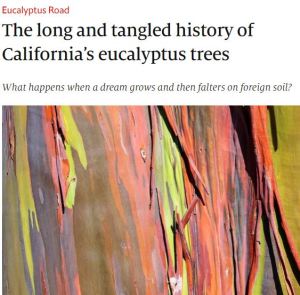 Like his friend John Muir, Lukens believed that California desperately needed more forests. Since the mid-19th century forests, and their loss, had been the principal focus of conservationist thought in America. According to Jared Farmer, who traces the history of the eucalyptus in California in “Trees in Paradise” (2013), Lukens and Muir were particularly keen on growing forests as a way to provide water—always a key to power in the state. Trees brought rain and captured fog and moisture; without forests, the men feared the state’s great cities would dry up.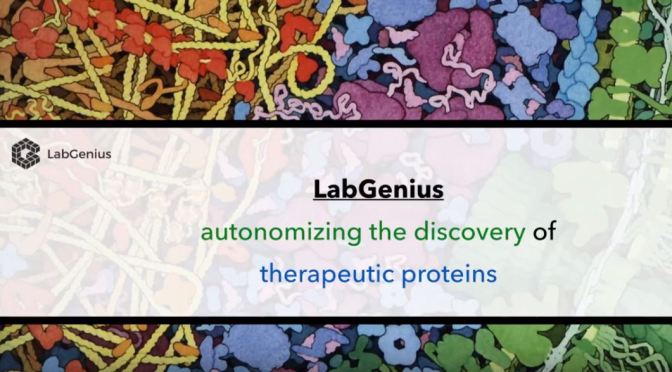
 Researchers are using artificial intelligence techniques to invent medicines and materials—but in the process are they upending the scientific method itself? The AI approach is a form of trial-and-error at scale, or “radical empiricism”. But does AI-driven science uncover new answers that humans cannot understand? Host Kenneth Cukier finds out with James Field of LabGenius…
 AHEAD OF the 2020 American presidential election, John Prideaux, The Economist‘s US editor, talks to Bill Weld, a former governor of Massachusetts,
  There can be few applications of digital technology more worthwhile than saving lives, but integrating digital technology into healthcare systems is uniquely complex. This episode provides an introduction to some of the challenges that healthcare providers face in their pursuit of digital innovation, and explores some of the paths forward.
 MICHAEL BLOOMBERG, the
 A SELECTION of three essential articles read aloud from the latest issue of The Economist. This week, Hong Kong is not the only part of China’s periphery to resent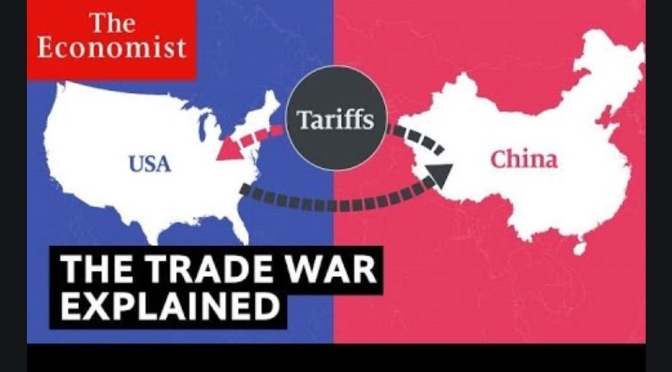
 Boomers Daily