Tag Archives: Science

Culture: New Humanist Magazine – Winter 2024-25

New Humanist's winter 2024 cover shows a futuristic blue face with the words: 'Our cyborg future?'

NEW HUMANIST MAGAZINE – WINTER 2024/2025 ISSUE: The new issue features ‘Our Cyborg Future?’

The new age of the cyborg?

Neurobiologist and journalist Moheb Costandi explores the rapidly-developing world of brain-computer interfaces. For some people, these devices are already transforming lives – but the technology is quickly overtaking the ethics.

A dangerous calculation

Peter Ward unpicks the dark philosophy of the tech billionaires and how it is infiltrating some of our most powerful organisations.

There’s a product for that

A recent film, The Substance, explored the growing pressure on all of us – particularly women – to modify our bodies, not only through make-up and cosmetic procedures but also through digital filters. Clare Chambers, professor of political philosophy at the University of Cambridge, talks to us about the power of resistance and allowing our bodies to be “good enough”.

New life in the veins

Peter Salmon recounts the bizarre history of blood transfusion – and why the super-rich remain fascinated by its possibilities.

How AI Is Revolutionising Science (The Economist)

The Economist (November 21, 2024): AI is driving a transformation across all fields of science, from developing drugs for incurable diseases and improving the understanding of animal communication to self-driving labs.

Video timeline: 00:00 – How AI is revolutionising science 02:53 – Drug discovery 04:31 – AlphaFold 05:30 – Adoption of AI in science 07:08 – Animal communication 09:26 – Scientific fraud 11:03 – Self-driving labs 14:36 – Future of AI in science

Could this prompt a new golden age of discovery? Video supported by @mishcon_de_reya

Politics: The Guardian Weekly – Nov. 22, 2024

Image

The Guardian Weekly (November 21, 2024): The new issue features ‘The crisis in the Church of England’…

Existentialist crises might more commonly be associated with some who seek out religion, rather than with those religions themselves, but that’s where the Church of England has found itself in recent days.

The resignation of Justin Welby, the archbishop of Canterbury, followed a damning report into the church’s shameful failures over the serial child abuser John Smyth, which detailed even more disturbing details of cover-ups by some senior clergy.

1

Spotlight | Trump’s shock-and-awe team
A flurry of controversial and extremist picks for Trump’s administration has provoked criticism and made heads spin. David Smith reports from Washington

2

Science | The inverse link between cancer and dementia
Scientists have long been aware of a curious connection between these common and feared diseases. At last, a clearer picture is emerging, writes Theres Lüthi

3

Feature | Kernels of hope
During the siege of Leningrad, botanists in charge of an irreplaceable seed collection, the first of its kind, had to protect it from fire, rodents – and hunger. By Simon Parkin

4

Opinion | Seven lessons from a long-serving economics editor
From Thatcher to Trump and Brexit, the Guardian’s outgoing economics editor, Larry Elliott, reflects on his 28 years in the role.

5

Culture | Faking history
Film and TV have a slippery relationship with the truth when it comes to historical epics. Simon Usborne meets the experts whose advice goes unheeded

MIT Technology Review – The Top Stories (11.17.24)

Ai gaping maw with teeth and two clawed hands swallows artworks which tiny artists have put poison symbols on the reverse side. One carries a flag with Ben Zhao's face
Ben Zhao remembers well the moment he officially jumped into the fight between artists and generative AI: when one artist asked for AI bananas. 

MIT Technology Review (Novemer 17, 2024): This week’s round up includes Generative AI taught a robot dog to scramble around a new environment; The AI lab waging a guerrilla war over exploitative AI; Life-seeking, ice-melting robots could punch through and Europa’s icy shell.

The AI lab waging a guerrilla war over exploitative AI

The tools Glaze and Nightshade are giving artists hope that they can fight back against AI that hoovers internet data to train. Are they enough?

Generative AI taught a robot dog to scramble around a new environment

A new system could help train robots entirely in generated worlds.

Why AI could eat quantum computing’s lunch

Rapid advances in applying artificial intelligence to simulations in physics and chemistry have some people questioning whether we will even need quantum computers at all.

AI search could break the web

Life-seeking, ice-melting robots could punch through Europa’s icy shell

Researchers are working on technology that could follow NASA’s Europa Clipper mission and hunt for life in the ocean of Jupiter’s moon.

World Economic Forum: Top Stories – Nov 16, 2024

World Economic Forum (November 16, 2024) – The top stories of the week include:

0:15 AI robot zaps weeds while saving crops – It’s called Concentrated Light Autonomous Weeding and Scouting or CLAWS for short. CLAWS uses AI-powered image processing to identify the crops, then targets weeds around the crop with blasts of concentrated light. This gets rid of unwanted intruders without damaging either crops or soil.

1:52 5 ways bioeconomy affects daily living – The bioeconomy uses renewable resources from land or sea to produce food, energy, and other resources. It focuses on leveraging nature’s processes and products to create sustainable economic outputs. The bioeconomy is already a part of our daily lives, influencing various sectors and industries.

6:08 Iceland sees benefit of a 4-day work week – The Nordic nation of 380,000 is rolling out a new way of working. Between 2020 and 2022, 51% of Iceland’s workers accepted an offer of shorter hours, such as a 4-day week for no loss of pay. The shift has had a positive impact on work-life balance and personal stress, new research shows.

8:17 Restored Amazon ecosystems beat logging – Amazon Sacred Headwaters Alliance is fighting to safeguard 35 million hectares of rainforest through a collaboration between 30 Indigenous nations of the Amazon basin. There’s an economic case for protecting the Amazon, says Atossa Soltani, Director of Global Strategy, Amazon Sacred Headwaters Alliance.

#WorldEconomicForum

Research Preview: Science Magazine – Nov. 15, 2024

Science issue cover

Science Magazine – November 14, 2024: The new issue features ‘AI learns the language of life’…..

The counterattack

An immune cell treatment that fights cancer is now taking aim at autoimmune disease

How to build a human: Piecing together the body’s cellular puzzle

Piecing together the body’s cellular puzzle

An island in a sea of palms

Oil palm plantations, pictured here in Thailand, have displaced native rainforests across Southeast Asia.PHOTO: OLEH_SLOBODENIUK ISTOCK

Oil palm plantations replace diverse tropical forests with monocultures, but restoration can bring biodiversity and ecosystem services back to these highly modified landscapes. 

Research Preview: Nature Magazine – Nov. 14, 2024

Volume 635 Issue 8038

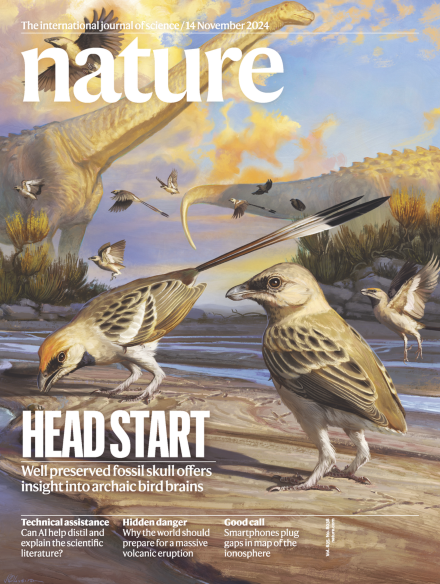
Nature Magazine – November 13, 2024: The latest issue features ‘Head Start’ – Well preserved fossil skull offers insight into archaic bird brains…

Don’t blame search engines for sending users to unreliable sites

Analysis of billions of pages of results from searches using the Bing algorithm suggests that reliable sites appear in search results 19 to 45 times more often than do sites with low-quality content.

China’s thriving forests are stockpiling vast amounts of carbon

Satellite observations validate national reports on forest coverage and carbon storage.

No hearing aids needed: bats’ ears stay keen well into old age

Elderly big brown bats showed little sign of age-related degradation in the inner ear.

World Economic Forum: Top Stories – Nov 9, 2024

World Economic Forum (November 9, 2024) – The top stories of the week include:

0:15 Finfluencer financial advice revolution – A finfluencer is a content creator on social media who shares information on budgeting, saving and financial investments, among other topics. Finfluencers use blogs, podcasts or videos to get their message out. They help widen financial access to groups who didn’t have it before.

3:49 These vegetables grow in-store without soil – Instead of soil, they use plugs of rockwool, irrigated with nutrient-rich water in a method called hydroponics. They come in different sizes producing from 2,000 to 15,000 plants monthly. These farms have a tiny environmental footprint. The largest models can grow as much as a 3-hectare farm.

5:44 Telehealth platform empowers millions – Altibbi offers 24/7 access to online doctors along with accessible, up-to-date medical information. It offers a cheaper, more accessible alternative to in-person consultations but it also aims to ‘change the narrative’ around the patient-doctor relationship.

8:43 ‘Underwater tractors’ replant seagrass – They were created by Reefgen, an UpLink Top Innovator. The robot scoots over the seabed, steadily and carefully restoring the ecosystem. Reefgen’s technology aims to aid conservation efforts by augmenting the efforts of human restorers.

#WorldEconomicForum

Research Preview: Science Magazine-Nov. 8, 2024

Science Magazine – November 7, 2024: The new issue features ‘Shake It Off’ – Light-touch mechanoreceptors mediate ‘wet dog shake’ behavior…

Bacteria divide to conquer antibiotics

High-level resistance to methicillin requires a distinct form of cell division

Research Preview: Nature Magazine – Nov. 7, 2024

Volume 635 Issue 8037

Nature Magazine – November 6, 2024: The latest issue features ‘Outside Influence’ – Exploring the contribution extrachromosomal DNA makes to cancer….

Naked mole rats vanquish genetic ghosts — and achieve long life

Comparison of the hairless animals’ genomes with those of several other mammals shows low activity of certain sequences.

The midlife crisis is not universal

Study of thousands of people in rural communities shows that many do not experience a slump in well-being during their forties and fifties.

The seas are on the rise — and that surge is accelerating

Sea-surface data show that the average sea-level rise in 2023 was more than double that in 1993.

Hidden wonders: laser data reveal a dense network of ancient Maya settlements

Survey pinpoints pyramids, rural settlements and a large city in an unstudied stretch of Mexico.