Tag Archives: Science Reviews

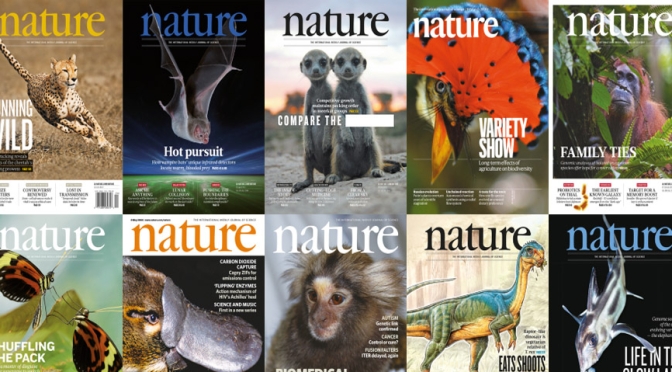
Cover Preview: Nature Magazine – May 19, 2022

Nature Magazine, May 19, 2022 – At industrial scales, chemical reactions are typically driven by applying continuous heat to the reactants. In this week’s issue, Liangbing Hu and his colleagues show that pulsed heating and quenching can enhance synthetic performance while also saving energy.
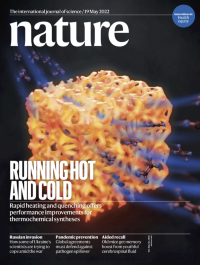
Volume 605 Issue 7910

The researchers use a programmable electric current to switch between high and low temperatures very quickly — typically 0.02 seconds on, 1.08 seconds off. Rapidly quenching the reaction gives high selectivity, maintains catalyst stability and reduces energy usage. The cover image illustrates the heater in action for the pyrolysis of methane — the model reaction the team tested. Methane molecules travel through the pores of the high-temperature heater and are selectively converted into useful products.
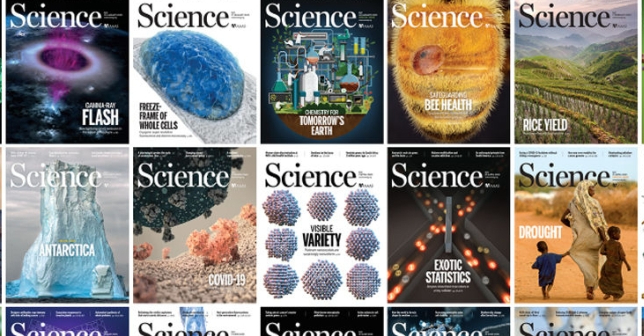
Cover Preview: Science Magazine – May 13, 2022

A survey of cell types across tissues as part of the Human Cell Atlas, mapped with single-cell transcriptomics in three papers in this issue, lays the foundation for understanding how cellular composition and gene expression vary across the human body in health, and for understanding how genes act in disease. 

Cover Previews: Nature Magazine – May 12, 2022

Volume 605 Issue 7909

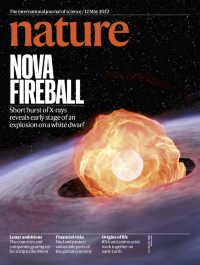
Nova explosions occur when a runaway thermonuclear reaction is triggered in a white dwarf that is accreting hydrogen from a companion star. The massive amount of energy released ultimately creates the bright light source that can be seen with a naked eye as a nova. But some of the energy has been predicted to be lost during the initial stages of the reaction as a flash of intense luminosity — a fireball phase — detectable as low-energy X-rays. In this week’s issue, Ole König and his colleagues present observations that corroborate this prediction. Using scans taken by the instrument eROSITA, the researchers identified a short, bright X-ray flash from the nova YZ Reticuli a few hours before it became visible in the optical spectrum. The cover shows an artist’s impression of the nova in the fireball phase. 

Previews: New Scientist Magazine – May 14, 2022

New Scientist Magazine, May 14, 2022

COVER STORIES

  • FEATURES Fascia: The long-overlooked tissue that shapes your health
  • FEATURES The grand plan to create a periodic table of all animal intelligence
  • FEATURES Have we been measuring the expansion of the universe wrong all along?
  • NEWS Simple webcam test could show whether you lack a mind’s eye
  • NEWS How quickly can you catch covid-19 again if you have already had it?

Cover Preview: Science Magazine – May 6, 2022

IN DEPTH

Bids for Anthropocene’s ‘golden spike’ emerge

Download PDFSites compete to mark global changes of the 1950s and define new geological age

Census aims for better U.S. statistical portrait

Download PDFAgency wants to retool its surveys and decennial census to improve efficiency and generate better data

Doubt cast on inflammation’s stop signals

Download PDFCritics challenge data underpinning “resolution immunology,” triggering university probes

Germany weighs whether culling excess lab animals is a crime

Download PDFAs prosecutors evaluate complaints from animal rights groups, labs try to reduce surplus

Balloon detects first signs of ‘sound tunnel’ in the sky

Download PDFAtmospheric analog to ocean’s acoustic channel could be used to monitor eruptions and bombs

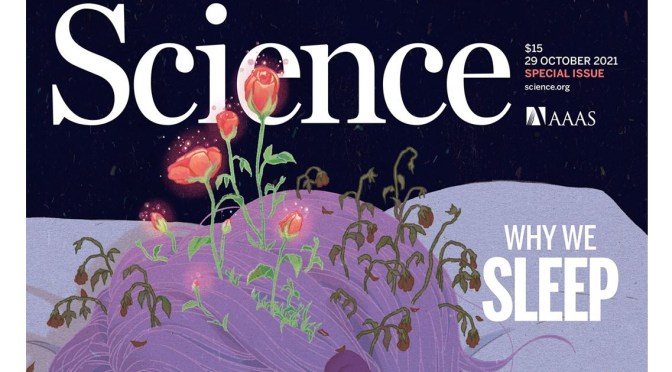
Science Magazine: “Why We Sleep” – October 29

Science: NASA’s First Moon Mission In 50 Years, Robots That Look, Act Like People

Staff Writer Paul Voosen talks with host Sarah Crespi about plans for NASA’s first visit to the Moon in 50 years—and the quick succession of missions that will likely follow. 

Next, Eileen Roesler, an engineering psychologist at the Technical University of Berlin, discusses the benefits of making robots that look and act like people—it’s not always as helpful as you would think. 

Journal Views: Science Magazine – July 23, 2021

Journal Views: ‘Science Magazine’ – July 16, 2021