A look at how Russian President Vladimir Putin maintains control over the country and critics like Alexey Navalny.
READ MORE: https://abcn.ws/3eGgAmH
A look at how Russian President Vladimir Putin maintains control over the country and critics like Alexey Navalny.
READ MORE: https://abcn.ws/3eGgAmH
St. Petersburg is a Russian port city on the Baltic Sea. It was the imperial capital for 2 centuries, having been founded in 1703 by Peter the Great, subject of the city’s iconic “Bronze Horseman” statue. It remains Russia’s cultural center, with venues such as the Mariinsky Theatre hosting opera and ballet, and the State Russian Museum showcasing Russian art, from Orthodox icon paintings to Kandinsky works.
We unpack Washington’s sanctions on Moscow after the Biden administration accuses Russian intelligence of poisoning Alexei Navalny. Plus: we look at what’s in the latest UK budget for arts and culture, and round up the latest tech news.
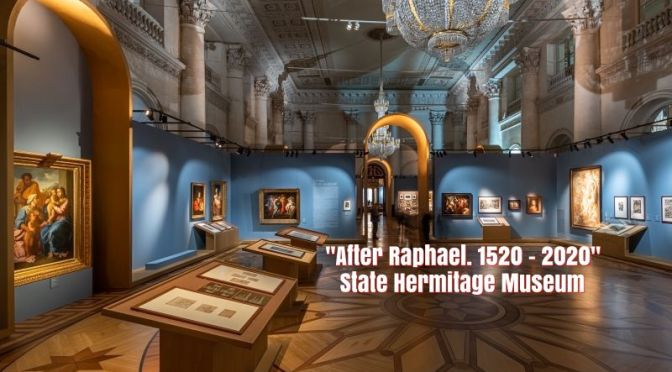
A film about the Exhibition “After Raphael. 1520 – 2020” at the State Hermitage Museum. Director of the film – Manas Sirakanyan. The film was made with the support of the U.S. Ambassadors Fund for Cultural Preservation, U.S. Embassy Moscow and the Hermitage Museum Foundation (USA)
Raphael is the most influential artist of the Modern Era. Over the course of five centuries, exponents of Mannerism and Academicism, Caravaggisti and masters of the Baroque, Romantics and Modernists have invariably compared their own work with Raphael’s legacy. What is the cause of such fame? What did his name represent in this or that historical period, and what does it represent today? What connects the artist’s followers in different centuries? The exhibition in the Hermitage is an attempt to answer those questions and to look at the art of the past 500 years through the lens of Raphael’s influence.
The large-scale display includes more than 300 exhibits – paintings, graphic art, sculpture and applied art from the Hermitage’s own stocks and twelve other collections in Russia and Western Europe. They include both famous masterpieces and previously unknown works. Dozens of paintings and pieces of graphic art are leaving the museum’s storerooms and being presented to the public for the first time, while a whole number of the exhibits are going on show after painstaking restoration in the Hermitage’s workshops.
The display opens with works by the master himself: a painting and drawings from European collections. Without claiming to be a full representation of the artist’s oeuvre, they serve to set the tone, as it were, and after viewers have “tuned themselves in” it will be easier for them to identify echoes of Raphaelesque harmony in the works from later centuries. The choice of graphic art for this purpose reveals another dimension to the main metaphor: it is specifically the beauty of the clear, precise line, so evident in the drawings made by the master’s own hand, that lies at the foundation of the aesthetics of Raphael himself and many of his followers.
Zyuratkul National Park is a Russian national park established in 1993 in the southern part of Satkinsky Raion (Chelyabinsk Oblast, Urals). The park lies about 30 km south of Satka and 200 km west of Chelyabinsk.
Notable features include Zyuratkul’ Lake, a rare mountainous body of water for the Urals 754 m above sea level, with a surface area of 13,2 km2 and a maximum depth of 8 m. Water is slightly mineralised (≈50 mg/L). Because of its clear water and spectacular landscape around, Zyuratkul’ is often called “Ural Ritsa“.[1]
Russia, or the Russian Federation, is a transcontinental country spanning Eastern Europe and Northern Asia. It covers over 17,125,191 square kilometres, consists of more than one-eighth of the Earth’s inhabited land area, extends to eleven time zones, and has borders with sixteen sovereign nations.
The Caucasus Mountains are a mountain system at the intersection of Europe and Asia. Stretching between the Black Sea and the Caspian Sea, it is surrounded by the Caucasus region and is home to Mount Elbrus, the highest peak in Europe at 5,642 metres above sea level.
President Biden has invited Senate Republicans to the White House to hear their response to his proposed $1.9 trillion relief package. Also, in Myanmar the military has staged a coup and taken control of the civilian government.
And, protests in Russia continued for a second weekend over the jailing of opposition leader Aleksei Navalny.
St. Petersburg is a Russian port city on the Baltic Sea. It was the imperial capital for 2 centuries, having been founded in 1703 by Peter the Great, subject of the city’s iconic “Bronze Horseman” statue. It remains Russia’s cultural center, with venues such as the Mariinsky Theatre hosting opera and ballet, and the State Russian Museum showcasing Russian art, from Orthodox icon paintings to Kandinsky works.
The world’s major powers agree: the resources of Antarctica should be exploited peacefully. They have promised to promote peace and scientific research in Antarctica, and to protect its environment. But is this spirit real, or just a lot of talk?
This documentary features interviews with researchers, activists, diplomats, and military personnel from Spain, Russia, Portugal, Chile, Argentina, and the United States. There’s been much debate over how to share control of resources in Antarctica, which is the world’s oldest ecosystem. Critics say that behind the scenes, a game of high-stakes poker is underway. Could this competition end in armed conflict? Or will Antarctica serve as a model for peaceful international cooperation? This film addresses these complicated issues with in-depth analysis, accompanied by magnificent images of the Antarctic landscape. The documentary’s soundtrack was composed by Javier Weyler, former drummer of the Welsh rock band, the Stereophonics.