
Tag Archives: Military

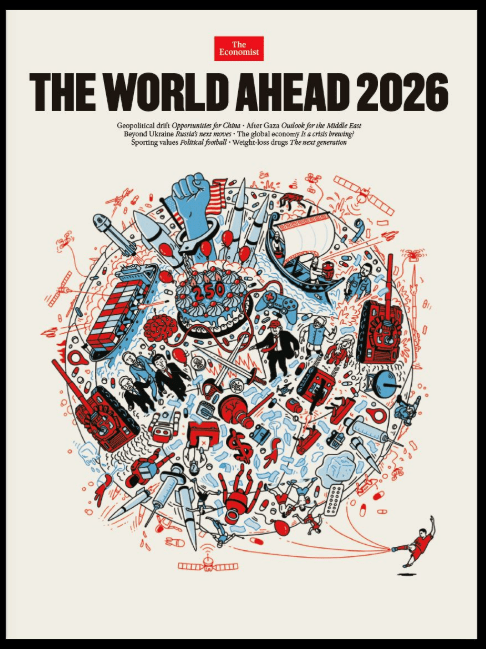
Analysis: The World Ahead In 2026 – The Economist

The Economist The World Ahead 2026 (November 13, 2025):

This is Donald Trump’s world—we’re all just living in it. The disruptor-in-chief was the biggest factor shaping global affairs in 2025, and that will be the case for as long as he remains in the White House. His norm-shattering approach has caused turmoil in some areas (as in trade) but has also delivered diplomatic results (as in Gaza) and forced necessary change (as with European defence spending). As the Trumpnado spins on in 2026, here are ten trends and themes to watch in the coming year.

1. America’s 250th.

Expect to hear wildly diverging accounts of America’s past, present and future, as Republicans and Democrats describe the same country in irreconcilably different terms to mark the 250th anniversary of its founding. Voters will then give their verdict on America’s future in the midterm elections in November. But even if the Democrats take the House, Mr Trump’s rule by bullying, tariffs and executive orders will go on.

2. Geopolitical drift.

Foreign-policy analysts are divided: is the world in a new cold war, between blocs led by America and China, or will a Trumpian deal divide the planet into American, Russian and Chinese “spheres of influence”, in which each can do as they please? Don’t count on either. Mr Trump prefers a transactional approach based on instinct, not grand geopolitical paradigms. The old global rules-based order will drift and decay further. But “coalitions of the willing” will strike new deals in areas such as defence, trade and climate.

3. War or peace? Yes.

With luck, the fragile peace in Gaza will hold. But conflicts will grind on in Ukraine, Sudan and Myanmar. Russia and China will test America’s commitment to its allies with “grey-zone” provocations in northern Europe and the South China Sea. As the line between war and peace becomes ever more blurred, tensions will rise in the Arctic, in orbit, on the sea floor and in cyberspace.

4. Problems for Europe.

All this poses a particular test for Europe. It must increase defence spending, keep America on side, boost economic growth and deal with huge deficits, even though austerity risks stoking support for hard-right parties. It also wants to remain a leading advocate for free trade and greenery. It cannot do all of these at once. A splurge on defence spending may lift growth, but only slightly.

5. China’s opportunity.

China has its own problems, with deflation, slowing growth and an industrial glut, but Mr Trump’s “America First” policy opens up new opportunities for China to boost its global influence. It will present itself as a more reliable partner, particularly in the global south, where it is striking a string of trade agreements. It is happy to do tactical deals with Mr Trump on soyabeans or chips. The trick will be to keep relations with America transactional, not confrontational.With rich countries living beyond their means, the risk of a bond-market crisis is growing

6. Economic worries.

So far America’s economy is proving more resilient than many expected to Mr Trump’s tariffs, but they will dampen global growth. And with rich countries living beyond their means, the risk of a bond-market crisis is growing. Much will depend on the replacement of Jerome Powell as chair of the Federal Reserve in May; politicising the Fed could trigger a market showdown.

7. Concerns over AI.

Rampant spending on infrastructure for artificial intelligence may also be concealing economic weakness in America. Will the bubble burst? As with railways, electricity and the internet, a crash would not mean that the technology does not have real value. But it could have wide economic impact. Either way, concern about AI’s impact on jobs, particularly those of graduates, will deepen.

8. A mixed climate picture.

Limiting warming to 1.5°C is off the table, and Mr Trump hates renewables. But global emissions have probably peaked, clean tech is booming across the global south and firms will meet or exceed their climate targets—but will keep quiet about it to avoid Mr Trump’s ire. Geothermal energy is worth watching.

9. Sporting values.

Sport can always be relied upon to provide a break from politics, right? Well, maybe not in 2026. The football World Cup is being jointly hosted by America, Canada and Mexico, whose relations are strained. Fans may stay away. But the Enhanced Games, in Las Vegas, may be even more controversial: athletes can use performance-enhancing drugs. Is it cheating—or just different?

10. Ozempic, but better.

Better, cheaper GLP-1 weight-loss drugs are coming, and in pill form, too. That will expand access. But is taking them cheating? GLP-1s extend the debate about the ethics of performance-enhancing drugs to a far wider group than athletes or bodybuilders. Few people compete in the Olympics. But anyone can take part in the Ozempic games.

Review: AI, Apathy, and the Arsenal of Democracy

Dexter Filkins is a Pulitzer Prize-winning American journalist and author, known for his extensive reporting on the wars in Afghanistan and Iraq. He is currently a staff writer for The New Yorker and the author of the book “The Forever War“, which chronicles his experiences reporting from these conflict zones. 

Is the United States truly ready for the seismic shift in modern warfare—a transformation that The New Yorker‘s veteran war correspondent describes not as evolution but as rupture? In “Is the U.S. Ready for the Next War?” (July 14, 2025), Dexter Filkins captures this tectonic realignment through a mosaic of battlefield reportage, strategic insight, and ethical reflection. His central thesis is both urgent and unsettling: that America, long mythologized for its martial supremacy, is culturally and institutionally unprepared for the emerging realities of war. The enemy is no longer just a rival state but also time itself—conflict is being rewritten in code, and the old machines can no longer keep pace.

The piece opens with a gripping image: a Ukrainian drone factory producing a thousand airborne machines daily, each costing just $500. Improvised, nimble, and devastating, these drones have inflicted disproportionate damage on Russian forces. Their success signals a paradigm shift—conflict has moved from regiments to swarms, from steel to software. Yet the deeper concern is not merely technological; it is cultural. The article is less a call to arms than a call to reimagine. Victory in future wars, it suggests, will depend not on weaponry alone, but on judgment, agility, and a conscience fit for the digital age.

Speed and Fragmentation: The Collision of Cultures

At the heart of the analysis lies a confrontation between two worldviews. On one side stands Silicon Valley—fast, improvisational, and software-driven. On the other: the Pentagon—layered, cautious, and locked in Cold War-era processes. One of the central figures is Palmer Luckey, the founder of the defense tech company Anduril, depicted as a symbol of insurgent innovation. Once a video game prodigy, he now leads teams designing autonomous weapons that can be manufactured as quickly as IKEA furniture and deployed without extensive oversight. His world thrives on rapid iteration, where warfare is treated like code—modular, scalable, and adaptive.

This approach clashes with the military’s entrenched bureaucracy. Procurement cycles stretch for years. Communication between service branches remains fractured. Even American ships and planes often operate on incompatible systems. A war simulation over Taiwan underscores this dysfunction: satellites failed to coordinate with aircraft, naval assets couldn’t link with space-based systems, and U.S. forces were paralyzed by their own institutional fragmentation. The problem wasn’t technology—it was organization.

What emerges is a portrait of a defense apparatus unable to act as a coherent whole. The fragmentation stems from a structure built for another era—one that now privileges process over flexibility. In contrast, adversaries operate with fluidity, leveraging technological agility as a force multiplier. Slowness, once a symptom of deliberation, has become a strategic liability.

The tension explored here is more than operational; it is civilizational. Can a democratic state tolerate the speed and autonomy now required in combat? Can institutions built for deliberation respond in milliseconds? These are not just questions of infrastructure, but of governance and identity. In the coming conflicts, latency may be lethal, and fragmentation fatal.

Imagination Under Pressure: Lessons from History

To frame the stakes, the essay draws on powerful historical precedents. Technological transformation has always arisen from moments of existential pressure: Prussia’s use of railways to reimagine logistics, the Gulf War’s precision missiles, and, most profoundly, the Manhattan Project. These were not the products of administrative order but of chaotic urgency, unleashed imagination, and institutional risk-taking.

During the Manhattan Project, multiple experimental paths were pursued simultaneously, protocols were bent, and innovation surged from competition. Today, however, America’s defense culture has shifted toward procedural conservatism. Risk is minimized; innovation is formalized. Bureaucracy may protect against error, but it also stifles the volatility that made American defense dynamic in the past.

This critique extends beyond the military. A broader cultural stagnation is implied: a nation that fears disruption more than defeat. If imagination is outsourced to private startups—entities beyond the reach of democratic accountability—strategic coherence may erode. Tactical agility cannot compensate for an atrophied civic center. The essay doesn’t argue for scrapping government institutions, but for reigniting their creative core. Defense must not only be efficient; it must be intellectually alive.

Machines, Morality, and the Shrinking Space for Judgment

Perhaps the most haunting dimension of the essay lies in its treatment of ethics. As autonomous systems proliferate—from loitering drones to AI-driven targeting software—the space for human judgment begins to vanish. Some militaries, like Israel’s, still preserve a “human-in-the-loop” model where a person retains final authority. But this safeguard is fragile. The march toward autonomy is relentless.

The implications are grave. When decisions to kill are handed to algorithms trained on probability and sensor data, who bears responsibility? Engineers? Programmers? Military officers? The author references DeepMind’s Demis Hassabis, who warns of the ease with which powerful systems can be repurposed for malign ends. Yet the more chilling possibility is not malevolence, but moral atrophy: a world where judgment is no longer expected or practiced.

Combat, if rendered frictionless and remote, may also become civically invisible. Democratic oversight depends on consequence—and when warfare is managed through silent systems and distant screens, that consequence becomes harder to feel. A nation that no longer confronts the human cost of its defense decisions risks sliding into apathy. Autonomy may bring tactical superiority, but also ethical drift.

Throughout, the article avoids hysteria, opting instead for measured reflection. Its central moral question is timeless: Can conscience survive velocity? In wars of machines, will there still be room for the deliberation that defines democratic life?

The Republic in the Mirror: A Final Reflection

The closing argument is not tactical, but philosophical. Readiness, the essay insists, must be measured not just by stockpiles or software, but by the moral posture of a society—its ability to govern the tools it creates. Military power divorced from democratic deliberation is not strength, but fragility. Supremacy must be earned anew, through foresight, imagination, and accountability.

The challenge ahead is not just to match adversaries in drones or data, but to uphold the principles that give those tools meaning. Institutions must be built to respond, but also to reflect. Weapons must be precise—but judgment must be present. The republic’s defense must operate at the speed of code while staying rooted in the values of a self-governing people.

The author leaves us with a final provocation: The future will not wait for consensus—but neither can it be left to systems that have forgotten how to ask questions. In this, his work becomes less a study in strategy than a meditation on civic responsibility. The real arsenal is not material—it is ethical. And readiness begins not in the factories of drones, but in the minds that decide when and why to use them.

THIS ESSAY REVIEW WAS WRITTEN BY AI AND EDITED BY INTELLICUREAN.

Analysis: What Trump Can & Can’t Do On Day 1 (WSJ)

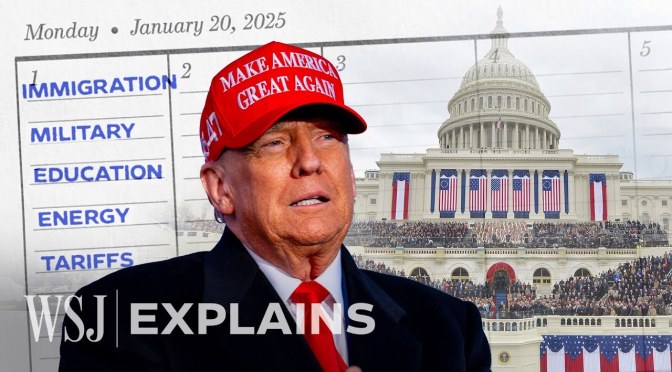
Wall Street Journal (November 22, 2024):President-elect Donald Trump has a long list of policy objectives that he wants to implement quickly including border policy for immigration, closing the Department of Education, implementing tariffs and more.

Video timeline: Chapters: 0:00 Trump’s second term 0:38 Immigration 2:23 Military 3:06 Education 4:34 Energy 5:32 Tariffs 6:48 Checks and balances

For most of Trump’s objectives for his second term, there are limitations including checks and balances within the process or limitations directly from Congress. WSJ explains which of these plans he can carry out on his own, which he’ll need help from Congress for, and what might end up in the courts.

Analysis: The World Ahead In 2025 – The Economist

Image

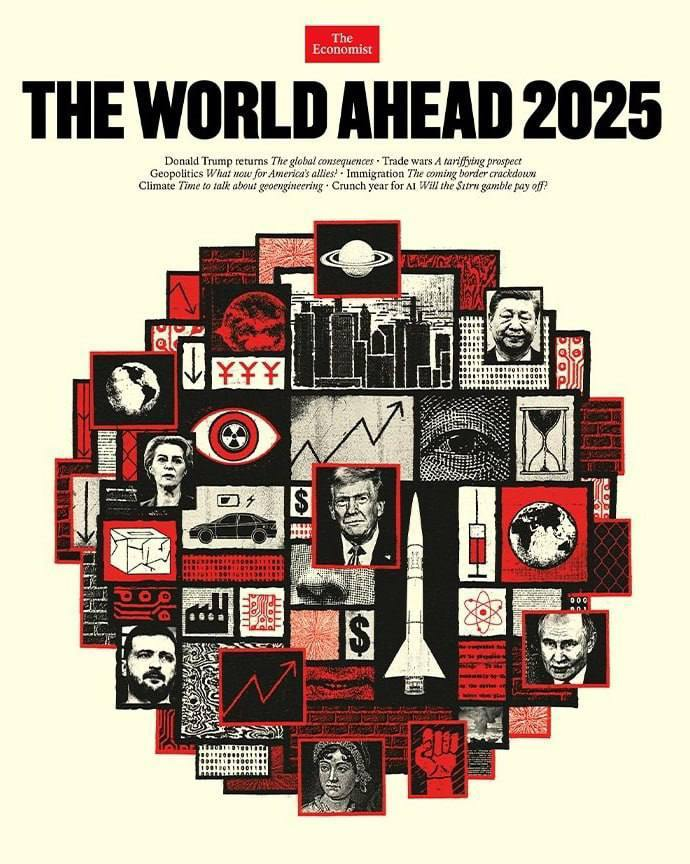
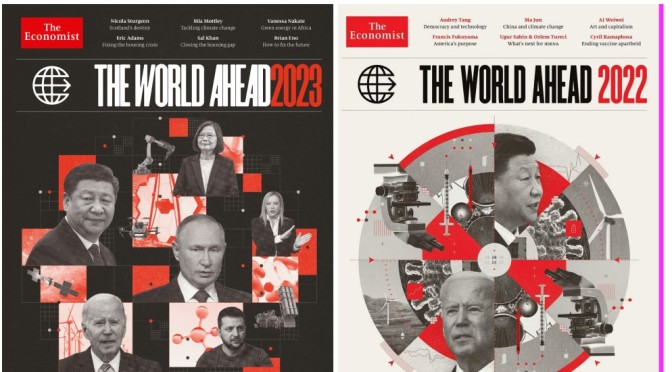
The Economist The World Ahead 2025 (November 20, 2024) : In 2025, as seen on the cover, the main event is Trump’s return to the White House and the global consequences of his policies, such as a new wave of trade wars with China. There is also an expected rise in technologies such as artificial intelligence and autonomous vehicles.

Tom Standage’s ten trends to watch in 2025

A letter from the editor of The World Ahead

The three forces that will shape 2025

Watch the interplay between Donald Trump, technology and radical uncertainty

The cover mentions climate issues and hints at a new phase in the fight for social equality, especially among women. Last year, the cover predicted geopolitical instability, an economic crisis, climate disasters, and the g

Military: U.S. Army Unveils Laser That Melts Drones

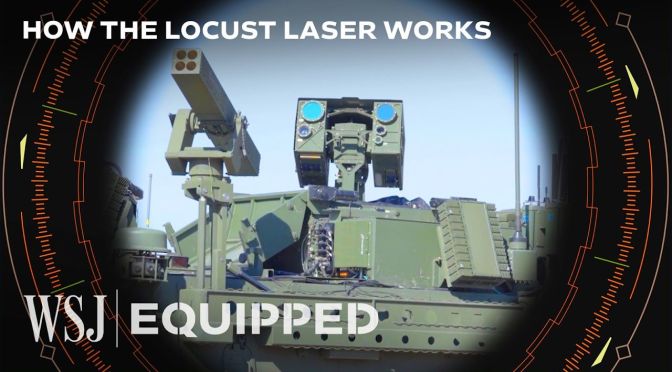
The Wall Street Journal (October 15, 2024): In Ukraine and the Red Sea, low-tech drones are changing the way wars are fought. The U.S. and other countries are investing in a new and inexpensive way to retaliate: lasers.

Chapters: 0:00 Laser weapon systems 1:03 The LOCUST 2:57 Targets 3:40 Weaknesses 4:56 Future challenges and deployment

Compared with traditional weapons, lasers present some key challenges: they have a shorter range, limited power and can be harder to fix when issues arise. WSJ explains how the BlueHalo LOCUST laser weapon system works and why the tech is so difficult to perfect.

#Russia #Ukraine #WSJ #Military #Laser

Preview: Military History Magazine – Oct/Nov 2024

Military History Matters 142 – The Past

MILITARY HISTORY MAGAZINE (September 12, 2024): The latest issue features ‘Napoleon At War’ – The Rise of a Military Colossus…

Napoleon: Rise of a military colossus

In our special two-part feature in this issue, Graham Goodlad explores, first, the part played by Napoleon’s generalship in his progress from unknown artillery officer to ruler of France. Then we analyses in depth two battles he fought in his…

Napoleon by numbers

Infographics: Calum Henderson

Lodi and Arcola: making the myth

Graham Goodlad analyses the clashes that made Napoleon’s name as a soldier of genius.

Hidden figures

The use of ‘native levies’ has long been a feature of foreign wars – but their employment and their sacrifice reached a peak during the British colonial era. Stephen Roberts…

Thunder in the East: Armoured warfare in South-East Asia and the Pacific, 1937-1945

From Burma to Iwo Jima, armoured fighting vehicles played a key role in some of World War II’s most challenging environments. Our military technology expert David Porter takes notes.

How “Kamikaze Drones” From Iran Are Wreaking Havoc In Ukraine & Israel

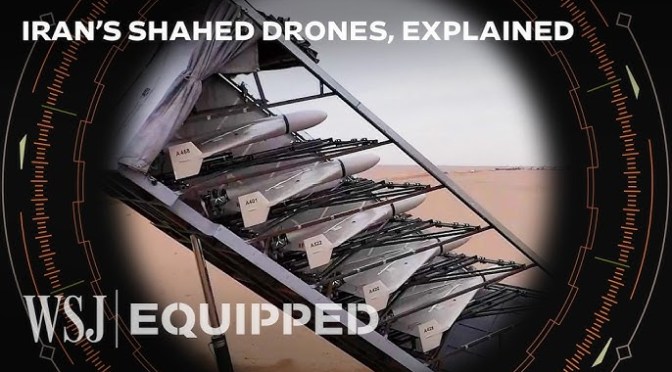
The Wall Street Journal (August 28, 2024): Iran’s Shahed drones have disrupted Red Sea shipping, threatened U.S. troops in the Middle East and caused chaos in Ukraine. These precise one-way attack suicide drones mark a major shift in drone warfare.

Chapters: 0:00 Shahed drones 0:31 What they are and how they work 2:45 How they stack up to other drones 4:01 Who’s using these drones? 6:02 Defenses against these drones

WSJ looks at how Iran’s kamikaze drones work, how they are being used across the globe by militant groups and Russia and the defense mechanisms used against them.

Strategy Behind Ukraine’s Invasion Of Russia (WSJ)

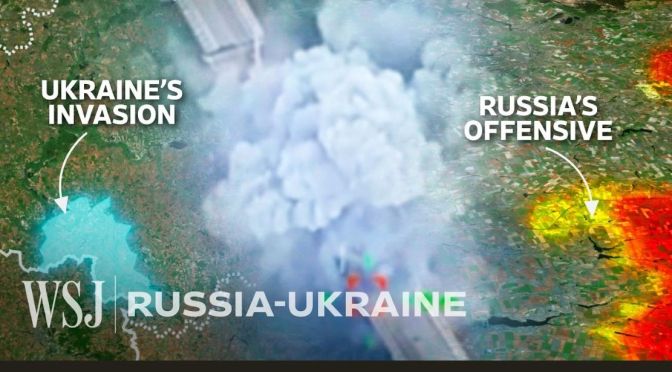
The Wall Street Journal (August 22, 2024): Ukraine’s invasion of Russia was a gamble for Kyiv as they push deeper into the Kursk region. But as Moscow intensifies its offenses on the strategic Ukrainian city of Pokrovsk in the Donetsk region, strategies on both sides are emerging.

Chapters: 0:00 Where the war stands 0:34 Ukraine tactics in Kursk 1:53 Russia’s response 2:53 What’s next?

If Pokrovsk falls, it will be the largest population center taken by the Russian military since Bakhmut in May 2023. WSJ explains the latest developments on how the Kursk invasions steps up the stakes for both Ukraine and Russia.

Military Analysis: USA Vs China Aircraft Carriers

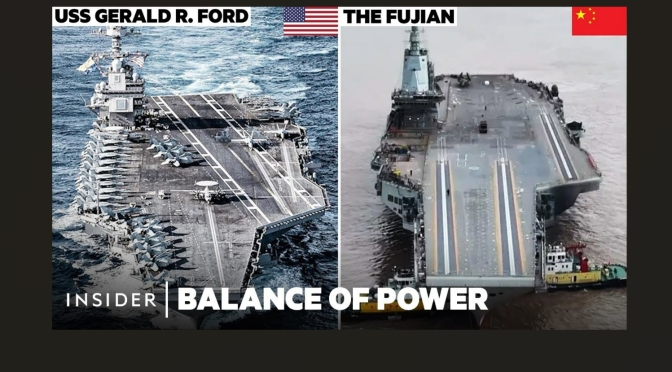
Insider(April 6, 2024): From the $13 billion USS Gerald R. Ford to the Chinese Fujian carrier, a high stakes race is underway between the US and China for aircraft carriers. We compare the two superpowers’ fleets, their capabilities and missions.

Video Timeline: 00:00 – Intro 00:26 – Carriers 02:06 – Technology 04:31 – Importance 05:28 – Background 06:03 – Future Plans 07:14 – Threats 08:15 – Balance Of Power 09:14 – Credits

The Israel-Hamas War: Is There A Path To Peace?

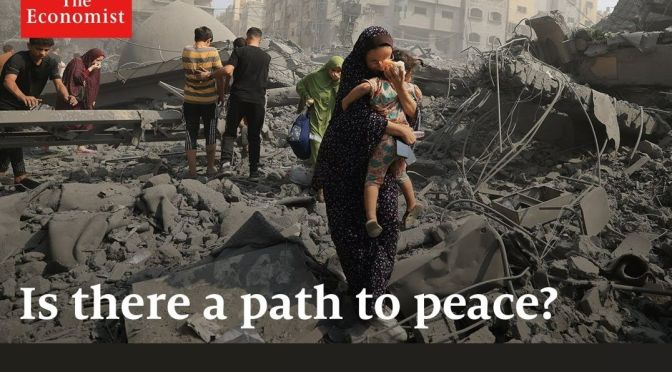
The Economist (February 8, 2024) – Things look bleak in the Middle East after Binyamin Netanyahu scorned America’s push for an end to the fighting. But in private he’s said to be more flexible. Could diplomacy actually work?

Video timeline: 00:00 – The Saudi normalisation deal 00:42 – Israel and Saudi Arabia’s history 01:10 – How to solve the Israeli-Palestinian conflict 02:26 – Will the deal happen?