

Tag Archives: Medicine

Science & Technology: Reviewing Caltech’s “Decade Of Discovery”
From a Caltech online article:
 During this decade, as in previous decades, Caltech scientists and engineers reinvented the landscape of scientific endeavor: from the first detection of gravitational waves and the discovery of evidence for a ninth planet in the solar system; to bold missions to explore and understand the solar system; to the development of new methods to see inside the body and the brain and understand the universe around us; to the invention of devices to improve human health, some taking inspiration from nature; to the initiation of a transformative new effort to support research into the most pressing challenges in environmental sustainability.
 Though the brain orchestrates how we experience the world, many questions remain about its complex workings. During the past 10 years, Caltech scientists have discovered how the brain recognizes faces and drives and quenches thirst, and learned about the pathways that govern sleep. A major focus has been on understanding the experience of non-neurotypical individuals, such as those who have autism or those who are missing a brain hemisphere. New realms of neuroscience research were made possible in 2016, when philanthropists Tianqiao and Chrissy Chen announced a gift to establish the Tianqiao and Chrissy Chen Institute for Neuroscience at Caltech.
 As modern technology advances, so do the possibilities for treating medical conditions that were previously considered untreatable. Caltech researchers used an electrode array to help a paralyzed patient stand and move his legs voluntarily and developed a novel method for preventing the spread of diseases, contact lenses for preventing blindness in diabetic patients, an app that monitors heart health, gene therapy for repairing nerves in the brain, and a robotic arm controlled by a paralyzed patient’s intent to move. The decade also saw the establishment of the Merkin Institute for Translational Research, which aims to advance medical technologies, and a continued commitment to the Donna and Benjamin M. Rosen Bioengineering Center.
To read more: https://www.caltech.edu/about/news/decade-of-discovery
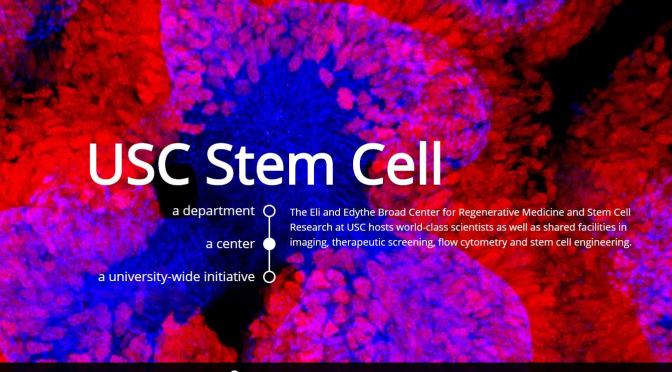
Research: USC Creates Organoids From Stem Cells To Treat Polycistic Kidney Disease (Video)
USC Stem Cell scientist Andy McMahon is using human stem cells to create mini-kidney structures known as organoids. His lab is using these organoids to study and find new drugs to treat polycystic kidney disease.
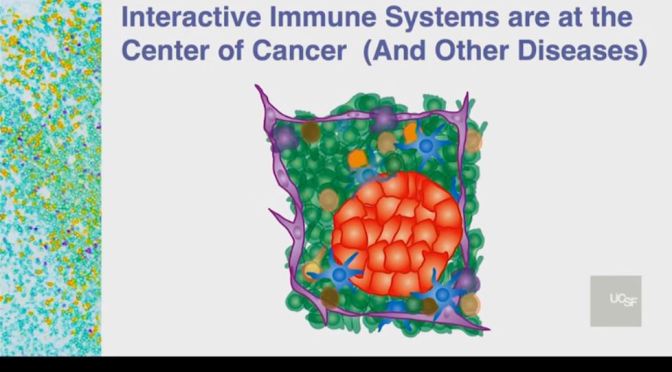
Health: “Treating Cancer And Other Diseases Through The Immune System” (UCTV Video)
Interactive immune systems are at the center of cancer and other diseases. Dr. Matthew Krummel explores how the immune system can regulate cancer progression. Recorded on 10/31/2019.
To read more: https://www.uctv.tv/shows/Understanding-and-Treating-Cancer-and-Other-Diseases-Through-the-Immune-System-35239
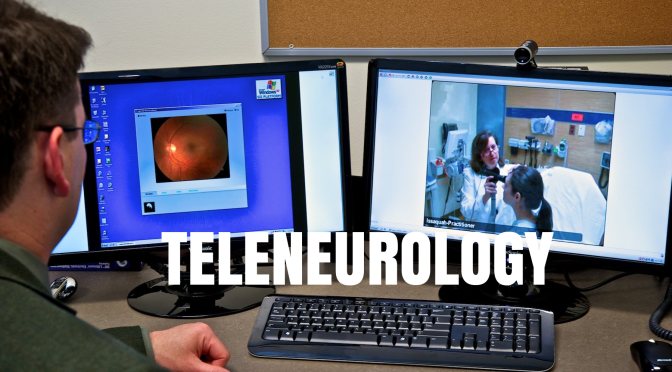
Medical Technology: “TeleNeurology” Remote Consultations Are As Effective As Office Visits
From a Becker’s Hospital Review online release:
 Telemedicine extends care accessibility to people with epilepsy, who may be unable to drive to appointments, as well as people with mobility issues stemming from neurologic disorders such as multiple sclerosis. Virtual care also helps address geographic barriers by allowing patients in rural areas to see a neurologist through telemedicine technology instead of having to travel hours for in-person care, said lead author Jaime Hatcher-Martin, MD, PhD, a member of AAN, according to the news release.
The studies’ analysis found that patients and their caregivers were equally satisfied with virtual physician visits and in-person appointments. Some studies showed that the use of telemedicine is as effective as in-person care to make accurate diagnoses. However, the researchers noted that there have been few randomized, controlled studies on telemedicine for neurology apart from stroke care.
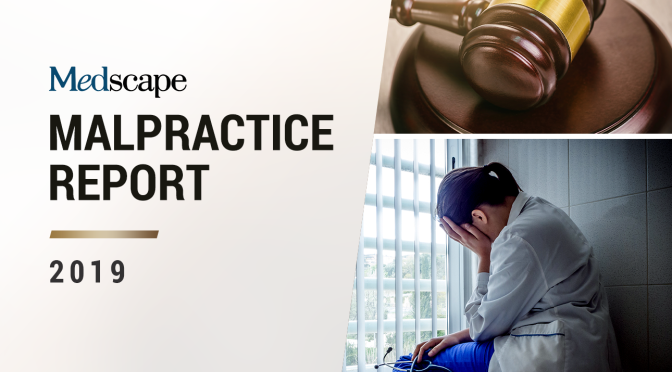
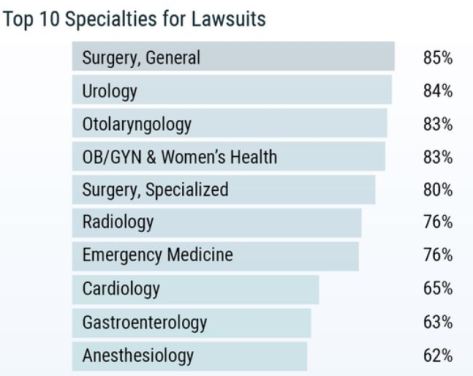
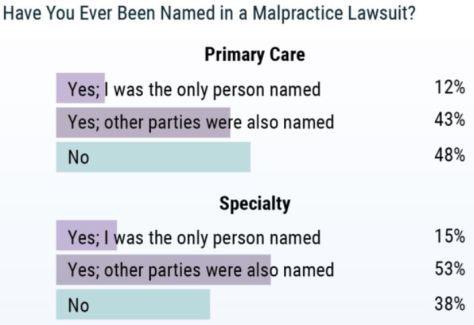
Medical Lawsuits: General Surgery And Urology Top List In “2019 Medscape Malpractice Report”
Top 10 Specialties for Lawsuits:
To read entire report: https://www.medscape.com/slideshow/2019-malpractice-report-6012303?src=wnl_physrep_191120_malpractice2019&uac=308500MT&impID=2174462&faf=1#5
Studies: “Blood-Based ‘Liquid Health Check’ Beats Traditional Predictors of Multiple Disease Risks” (Nature)
From a Genetic Engineering & Biotechnology News release:
 “This proof of concept study demonstrates a new paradigm that measurement of blood proteins can accurately deliver health information that spans across numerous medical specialties and that should be actionable for patients and their healthcare providers,” said Peter Ganz, MD, co-leader of this study and the Maurice Eliaser distinguished professor of medicine at UCSF and director of the Center of Excellence in Vascular Research at Zuckerberg San Francisco General Hospital and Trauma Center.
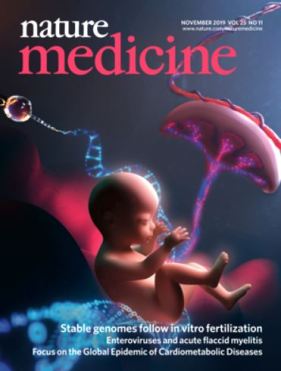
Specific patterns of protein levels in our blood could be used to provide a comprehensive “liquid health check” that gives a snapshot of health and potentially an indication of the likelihood that we will develop certain diseases or health risk factors in the future, according to research by scientists in the U.S. and U.K. working with SomaLogic. The results of their proof-of-concept study involving more than 16,000 participants, and published in Nature Medicine, showed that while the accuracy of models based on specific protein expression patterns varied, they were all either better predictors than models based on traditional risk factors, or would constitute more convenient and less expensive alternatives to traditional testing.
Study published in Nature Medicine: https://www.nature.com/articles/s41591-019-0665-2
Aging: “Healthy Longevity Global Grand Challenge” Offers $30 Million For “Audacious Proposals”
From a Harvard Gazette online article:
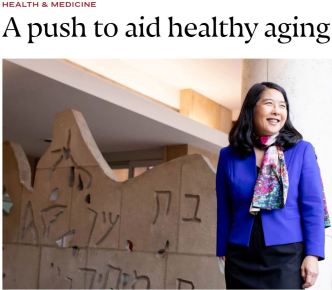 The Grand Challenge Prize is looking for bold, audacious innovations, ideas that can really change aging. We’re looking in science, in technology and engineering, in policy, social sciences, behavioral sciences, economic policy, in traditional medical science and health care, and in work focused on specific diseases. It’s really very broad. We’re looking for innovative thinking that can have global impact. The prizes are going to roll out on three levels. There will be 450 Catalyst Prizes awarded over a three-year period. The first of the three yearly calls will be in January 2020. Once it’s announced, there will be six weeks to submit your idea — just the idea, it doesn’t require any pilot work — and a two-page application. They’ll be reviewed within four months and prizes announced by July. The Catalyst Award is intended as seed funding to get the idea into its earliest stages of development. They’re relatively small in dollar amount, about $50,000 each, but they will give access to an annual meeting bringing together world experts in these fields.
The world’s aging population means there will be an increasing number of older and sicker people at a time when declining fertility will saddle a smaller working population with the burden of supporting them. One solution is to keep people healthier longer, living independently, and contributing to society. In pursuit of that goal, the National Academy of Medicine is mounting a $30 million Grand Challenge contest to foster innovation in science, medicine, public policy, the workplace, and elsewhere. Sharon Inouye, professor of medicine at Harvard Medical School and head of the Aging Brain Center at Harvard-affiliated Hebrew Senior Life, is a National Academy member and a member of the planning committee for the Grand Challenge for Healthy Longevity. She spoke to the Gazette about the contest and how she hopes it changes the nature of aging in the decades to come.
To read more: https://news.harvard.edu/gazette/story/2019/11/grand-challenge-encourages-innovation-in-aging/

To Improve Healthcare: A New, Unbiased “Health Information Agency” Would Transform System
From a HealthAffairs.org online article:
 This proposed agency could work like a seal of approval, like the Energy Star program run by the Environmental Protection Agency, for new software, apps, and vendors that will be handling sensitive health information. Just like dishwashers evaluated by Consumer Reports, apps that handle personal health information should have a similar unbiased review process.
The US health care system is finally at a tipping point of much needed and overdue modernization. While it promises a brave new world of streamlined and improved health care, we are facing nothing short of a revolutionary transformation that is based on a tsunami of readily accessible health information and digital tools.
Currently, there is no federal agency, public-private collaboration, or private industry mechanism that is prepared to handle the ensuing activity in its entirety. We need to get a handle on how best to protect our private health care data while also making sure that information is allowed to flow as freely as necessary to improve our delivery system and population’s health. We need a dedicated team of experts who speak the language of both information technology and public policy. We need a new federal agency that has jurisdiction and dedicated staff to oversee health information and the technology that will simplify and operationalize the information.
New Books On Aging: “Elderhood – Redefining Aging, Transforming Medicine, Reimagining Life” By Louise Aronson
From Louise Aronson’s website:
 Noted Harvard-trained geriatrician Louise Aronson uses stories from her quarter century of caring for patients and draws from history, science, literature, popular culture, and her own life to weave a vision of old age that’s neither nightmare nor utopian fantasy—a vision full of joy, wonder, frustration, outrage, and hope about aging, medicine, and life itself.
For more than 5,000 years, “old” has been defined as beginning between the ages of 60 and 70. Now that humans are living longer than ever before, many people alive today will be elders for 30 years or more. Yet at the very moment that most of us will spend more years in elderhood than in childhood, we’ve made old age into a disease, a condition to be dreaded, disparaged, neglected, and denied.
To read more: https://louisearonson.com/books/elderhood/
 Boomers Daily