
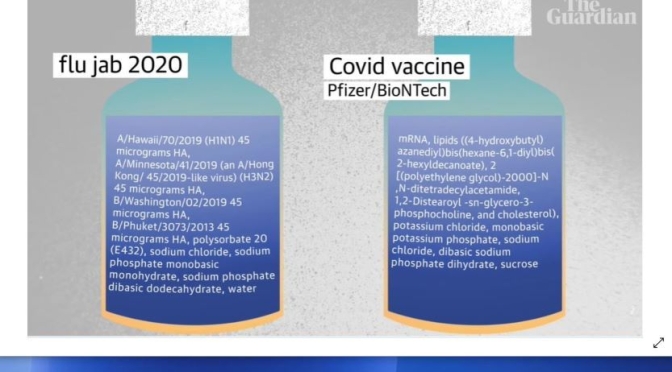
There are all sorts of different vaccines but many of them share specific types of ingredients. Josh Toussaint-Strauss talks to Professor Adam Finn to find out what is in most conventional vaccines, as well as what they do to our bodies when we take them – and why the mRNA Covid jabs from Pfizer/BioNTech, Oxford/AstraZeneca and Moderna work differently.
Tag Archives: Medicine
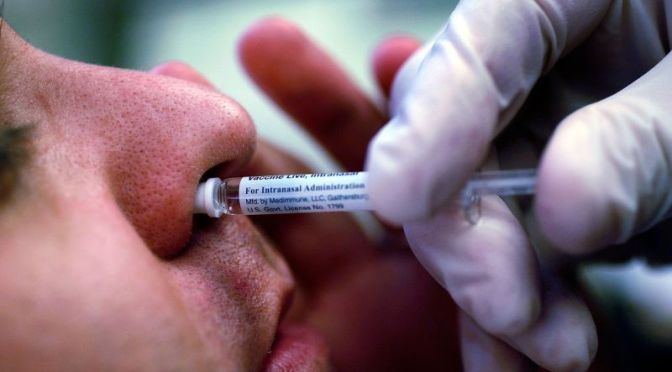
Covid-19: ‘Intranasal Vaccines’ Might Be More Effective Than Needles
From Scientific American (March 1, 2021):
Enter the intranasal vaccine, which abandons the needle and syringe for a spray container that looks more like a nasal decongestant. With a quick spritz up the nose, intranasal vaccines are designed to bolster immune defenses in the mucosa, triggering production of an antibody known as immunoglobulin A, which can block infection. This overwhelming response, called sterilizing immunity, reduces the chance that people will pass on the virus.
The development of highly effective COVID vaccines in less than a year is an extraordinary triumph of science. But several coronavirus variants have emerged that could at least partly evade the immune response induced by the vaccines. These variants should serve as a warning against complacency—and encourage us to explore a different type of vaccination, delivered as a spray in the nose. Intranasal vaccines could provide an additional degree of protection, and help reduce the spread of the virus.
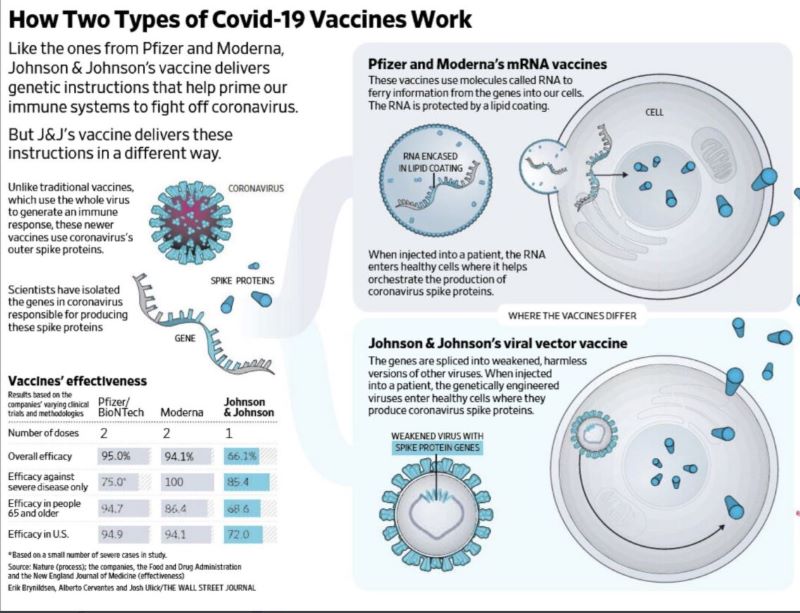
Covid-19 Infographic: ‘mRNA & Viral Vector Vaccine’ Differences

Covid-19: ‘Why Variants Are Spreading Faster’
As highly transmissible coronavirus variants sweep across the world, scientists are racing to understand why these new versions of the virus are spreading faster, and what this could mean for vaccine efforts. New research says the key may be the spike protein, which gives the coronavirus its unmistakable shape. Illustration: Nick Collingwood/WSJ
Medicine: Scientists Grow ‘Mini-Organs’ To Repair Damaged Human Livers
Scientists have used a technique to grow bile duct organoids – often referred to as ‘mini-organs’ – in the lab and shown that these can be used to repair damaged human livers. This is the first time that the technique has been used on human organs. Funding provided by European Research Council, the National Institute for Health Research and the Academy of Medical Sciences
Video: ‘How Covid-19 Vaccines Are Tested’
Vaccines are rigorously studied and tested — but there are challenges along the way.

PODCAST: ‘THE FUTURE OF DRUG PRICE TRANSPARENCY’
Interview with Dr. William Feldman on a new federal price-transparency rule and legal challenges to efforts to increase access to pricing information.
William Feldman is a physician and researcher in the Division of Pharmacoepidemiology and Pharmacoeconomics at Brigham and Women’s Hospital. Stephen Morrissey, the interviewer, is the Executive Managing Editor of the Journal.

Covid-19: Penn Medicine Explains mRNA Vaccines
Vaccines are about to change the world…again. mRNA Vaccines are currently being used to battle COVID-19, and have the potential to eradicate diseases like HIV, herpes, sickle cell anemia, and even cancer. Learn how the vaccines work and where the technology could be headed in this explainer video.
Currently, the Pfizer-BioNTech and Moderna vaccines for COVID-19 use the mRNA technology developed at Penn by infectious disease expert Drew Weissman, MD, PhD, along with longtime research collaborator Katalin Karikó, PhD, an adjunct associate professor. Dr. Weissman has been studying mRNA vaccines for decades. This technology could change the way future vaccines are made to prevent countless other diseases.
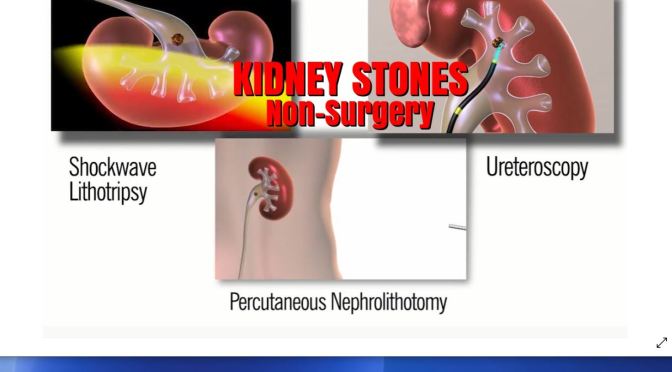
Medicine: ‘Non-Surgical Treatment Of Kidney Stones’ (Cleveland Clinic)
Observation is a non-surgical approach in which we allow the stone to pass on its own. The smaller the stone, the better the chance that it will pass. The benefit of observation is that you avoid having surgery.

 Boomers Daily