Tag Archives: Literature

Cervantes in the Cave — The Art of Illusion

From Lepanto to Algiers to Seville, he recast Plato’s cave: instead of fleeing, he trimmed the wick—using comedy and narrative to make honest light out of shadow.

By Michael Cummins, Editor, August 22, 2025

In a cave in Argamasilla de Alba, Spain, a man sits hunched over a manuscript. The air is damp; the light keeps deciding what to keep. He writes not with the flourish of a court poet but with the urgency of someone who has known confinement—who has lived among shadows and learned to speak their language. The man is Miguel de Cervantes. The cave, according to local legend, is where he began Don Quixote. Whether the story is true hardly matters. The image endures: Cervantes, imprisoned, wounded, obscure, writing the book that would fracture the very idea of literary realism.

He breaks the silence first, as if talking to the walls. “Engendrado en una cárcel, donde toda incomodidad tiene su asiento,” he says—begotten in a prison, where every discomfort keeps its chair. He smiles at his own choice of verb. Begotten. It gives hardship hands.

A foot scuffs the threshold. Mateo steps into the half-light, a fellow freed captive from a life the two men still carry like a watermark. He takes the cave in at a glance—the whitewash, the barred slit of window, the stone bench that knows the shape of a tired back.

“You write in the dark, Miguel,” Mateo says. “Still chasing shadows?”

“Not chasing,” Cervantes replies, without looking up. “Refracting. These shadows are more honest than the sunlit lies of court and empire.”

Plato’s prisoners mistook flicker for fact. Cervantes has no such innocence; he knows exactly what light can do and what it cannot. In Algiers he learned the cost of sunlight and the uses of a candle. “We invented stories to survive,” he says. “We imagined rescue. We became authors of unreality. And in doing so, we learned how unreality works.”

He had boarded a homeward ship in 1575 and sailed straight into a profession he did not apply for. Corsairs took the vessel. Letters of recommendation—ironically the very proof of his merit—made him valuable. Algiers swallowed him for five years. Four escape attempts, each with its choreography of bribes, whispers, and night boats, failed in turn; punishments followed with bureaucratic punctuality. In the baños he organized fellow captives, staged plays that felt like oxygen rations, and discovered a kind of command that requires neither rank nor drumrolls. The lesson was not transcendence. It was texture. Captivity did not reveal some pure, sunlit truth; it revealed illusion’s machinery: how shadows are cast, how they persuade, how they can be turned from weapon into instrument.

“So you believe captivity reveals truth?” Mateo asks.

“No,” Cervantes says. “It reveals illusion. But if you know you’re in a cave, illusion can be honest about itself.”

He speaks like a man who has balanced too many ledgers and decided to keep one for the soul. In his prologue to the Exemplary Novels he would boast with a craftsman’s pride: mías propias, no imitadas ni hurtadas—my own pieces, not imitated or stolen. After a life in which other people held the keys, authorship felt like a kind of lawful possession. He is not naïve about it; theft will come in a thousand copies. Still, he plants his flag in sentences.

Mateo lowers himself onto the bench. The cave keeps its cool.

“Begin earlier,” Mateo says softly. “Begin with the wound.”

Cervantes nods, as if paging back. “Lepanto,” he says. “Two shots to the chest, one to the hand. El mayor bien que me vino. The greatest favor that came to me.”

Mateo laughs—a short, incredulous bark. “Favor?”

“A hand is a tool,” Cervantes says, flexing his right, letting the left sleeve fall into its gentle emptiness. “So is a story. One broke and taught the other its work. I learned that honor is not trumpets; it is the bruise that stays after the sound goes.”

“What did it smell like—the battle?” Mateo asks, because some questions insist.

“Oak and salt and a fire that wandered,” Cervantes says. “The sea keeps bad accounts—always debits, never balance. We threw our bodies at its ledger and called it glory. I got a bill I could live with.”

The cave changes its mind about brightness by a single shade. Light climbs a little higher on the wall, as if memory has a temperature.

“After Algiers,” Mateo says, “you came home to paper.”

“To paper and suspicion,” Cervantes answers. “Spain wanted receipts more than epics.” He became a purchasing agent, then a tax collector—the sort of work that presses humility into a man’s pockets and takes the lint besides. A banker fell in Seville and the ground gave way beneath him. Jail happened the way weather happens. Bureaucracy, he discovered, is a prison with nicer pens.

He thumps the palm of his right hand on the bench, a quiet imitation of a ledger closing. “Always the same sum,” he says. “Loyalty plus wounds equals suspicion.”

“That arithmetic,” Mateo says, “taught you comedy.”

“It taught me instruments,” Cervantes corrects gently. “Comedy is a surgeon’s knife you can carry in public.”

He had tried other rooms. La Galatea (1585), a pastoral romance, sighs under painted trees and speaks expertly in a fashionable voice—too expertly for a man who had learned to breathe in iron. “A ceiling too low for the lungs,” he says. Failure did not embarrass him; it emancipated him. “I loved what books promised. I wrote the promise’s correction.”

“And then you choose another cave,” Mateo says, looking around.

“This time I brought the candle.” Cervantes nods at the stub trembling in its dish. “The cave is not a prison if you know you’re inside it. Fiction is not delusion if you wield it knowingly.”

“Is that freedom?” Mateo asks. “To live in fiction?”

Cervantes answers with a line he will later put in a knight’s mouth because knights carry sentences farther than taxmen do. “La libertad, Sancho, es uno de los más preciosos dones…” Freedom, Sancho, is one of the most precious gifts. He lets the clause hang and then adds the counterweight: captivity is the greatest evil. “But there is a third thing,” he says. “The discipline of the wick. Not everyone reaches the sun. Many of us live by hearth-light. So make the hearth honest.”

He laughs, not kindly but not unkindly, at the memory of a barber’s basin mistaken for a helmet. “A basin can be a helmet,” he says, “if the story is honest about the trick.” The joke is not cruelty; it’s consent. Illusions that confess their wages are allowed to work.

“You sound like Plato’s least obedient pupil,” Mateo says. “He wants the prisoner out of the cave. You stay.”

“Plato had less practice with caves,” Cervantes says. “I stay and trim the wick.”

The man who stays in the cave can tell you about the cost of zeal. He knows what happens when mercy runs faster than attention: chaos dresses up as freedom. He has written a scene in which a knight frees a chain gang of galley slaves with a fine speech and a flash of temper, and the liberated—unbriefed on narrative responsibility—repay the favor with stones. “Pity without comprehension,” he says, “is a door swinging in a storm. Freedom without narrative becomes a mess that lets tyrants say, ‘You see? Chains keep order.’”

Mateo’s eyes drift toward a wooden head in the corner, painted eyes arrested mid-glance. “Master Pedro,” Cervantes says, amused at the prop the cave has supplied. He tells the story of a puppet theater, a knight who cannot bear strings, a sword that corrects an illusion into splinters. Even illusions keep accounts, he reminds Mateo. Someone pays for the pleasure. “In that scene,” he says, “I taxed zeal. I sent the bill to laughter.”

“So your book is a theater?” Mateo asks.

“A theater that shows its ropes,” Cervantes says. “A historian with a wink in his ink. A narrator who argues with me, and I with him. A false sequel enters the room, and I absorb him into the play. If illusion is a crime, let the evidence be visible. If it is a craft, let the strings show and the audience decide.”

He keeps his quotes short and to the point, letting them behave like tools rather than trophies. “Yo sé quién soy,” he says, not to boast but to set a boundary—I know who I am. “And I know what I am not. I am not the sun. I am a candle with a good memory.”

Memory is a troublesome servant. “¡Oh memoria, enemiga mortal de mi descanso!,” he mutters with theatrical exasperation—Oh memory, mortal enemy of my rest—knowing full well he cannot do without her. In the deepest fold of the book he is writing, he lowers his knight into the Cave of Montesinos and gives him a private vision no one can verify. Minutes pass in the world; days unfold in the cave. Readers will fight about that descent for centuries: lie or parable? He shrugs. The rope held. The telling is what matters.

“What about truth?” Mateo asks. “You dodge it like a matador.”

“Truth is errant,” Cervantes says. “Like my knight. It wanders, stumbles, reinvents itself. La verdad adelgaza y no quiebra—truth thins but does not break. It lives in the flicker between shadow and flame.” He aims for a truth you can sit with, not a blaze you must worship. Even now, when the cave dims or brightens by a breath, he adjusts nothing in his voice. He trusts the room to keep up.

The room has heard other versions of this life. Soldier, captive, clerk, failed author—the catalogue is accurate and useless until you give it breath. He has learned that a life of refusals and humiliations can be rearranged into a lamp. “El que lee mucho y anda mucho, ve mucho y sabe mucho,” he says with a grin—he who reads much and travels much sees much and knows much—and Mateos’s chuckle bounces off the whitewash and returns as agreement.

If the cave is a theater, it is also a workshop. He places three objects on the bench as if laying out tools: a frayed rope (failed escape; lesson kept), a ledger (bureaucracy’s Bible, now a prop for comedy), and the puppet head (illusion, demystified and retained). He sets the rope across the ledger like a sash and props the puppet against both like a child asleep between two patient adults.

“You’re staging your own life,” Mateo says.

“Everything I own appears in my books,” Cervantes answers. “Better to put them to work than let them gather dust.”

He will put even injury to work. He has already done it. “There is no book so bad that it does not have something good,” he says—No hay libro tan malo que no tenga algo bueno—and he means, among other things, his own early efforts. He tried the fashion and failed; he learned to write beyond it. The failure cleared the room.

“And the counterfeit?” Mateo asks. “The other Quixote?”

“I made room,” Cervantes says, not quite happily. He doesn’t bother to call the rival by name. “I let the counterfeit into Part II and gave him the dignity of being wrong on the page. It is the politest way to win.”

Outside, late afternoon arranges itself. Inside, the candle practices its small weather. The conversation acquires the unhurried gravity of men who have been forced to wait before and know that waiting can be made useful. They speak of the Información de Argel—the sworn testimonies that stitched a biography out of scars and courage; of the petition to the Council of the Indies that asked for four possible offices across the ocean and delivered no; of Seville’s auditoriums of suspicion where a man could do arithmetic all day and still owe.

“You turned all that into a style,” Mateo says.

“I turned it into a temperament,” Cervantes corrects. Style is the residue. The temperament is the choice: to stay in the cave and make the light adjustable; to refuse the panic of transcendence in favor of the patience of attention; to let laughter be a form of moral accounting. “I wanted a book in which the strings show,” he says. “So when someone pulls, we know who is moving what.”

He reaches for the candle with wetted fingers and trims the wick. The flame tightens, steadies, sharpens the edges of the room with a surgeon’s manners. The gesture is mundane and feels like a thesis.

“Why not flee?” Mateo asks one last time, because some questions return until answered in the body.

“Because someone must tend the flame,” Cervantes says. “Because most people live by hearth-light. Because the cave tells the truth about limits, and I prefer honest rooms to lying palaces.”

He stands, and the bench acknowledges the change with a creak that has learned both complaint and loyalty. He touches the stone with the backs of his fingers, as one does a sleeping child. The puppet keeps its round attention. The rope adopts its length. The ledger decides to be heavy again.

“Begin,” Mateo says, suddenly shy of making a ceremony of it.

“I did,” Cervantes answers, and returns to his page.

He writes the opening lines of Don Quixote as the candle throws a peninsula of light bordered by ink. A poor gentleman with a head full of books starts out into a world that will bruise him into philosophy. A squire with a sack of proverbs learns to spend them one by one, after listening. Windmills declare their innocence; a basin negotiates a new title. Dukes turn out to be children who have learned cruelty by playing. Priests explain themselves into farce. Puppets are freed to their ruin, then repaired by a writer who has learned to apologize with laughter.

Cervantes does not flee illusion; he illuminates it. He does not reject reality; he reframes it. He does not promise truth; he escorts it, errant and sturdy, through rooms with honest walls. He turns shadows into stories and stories into a way of seeing that does not blind. He has stayed where Plato urged ascension and found, by staying, a different kind of ascent: the climb of attention, the charity of proportion, the courage to let strings show and still believe in the show.

Unlike Plato’s prisoner, Cervantes remains in the cave. He writes. He refracts. He talks to the walls and to the future, and both answer. His broken hand, his captive mind, his errant knight—everything he survived and everything he invented—gathers in the small weather of a candle and becomes, against all instruction, a form of daylight.

THIS ESSAY WAS WRITTEN AND EDITED UTILIZING AI

TIMES LITERARY SUPPLEMENT – AUGUST 22, 2025 PREVIEW

TIMES LITERARY SUPPLEMENT: The latest issue features Lawrence Durrell, “so many towns” that could “become Alexandria” – “founded”, as indeed so many were, “At the doors of Africa”, “Upon a parting”. Yet what other town could boast of anything to compare with that “last pale / Lighthouse”, the Pharos of Alexandria, “like a Samson blinded”?

Family of fabulists

Literary myth-making, from Alexandria to Corfu By Jonathan Keates

‘Celestial walnuts’

The pleasures and challenges of making – and describing – great wines By George Berridge

The path to Rome

Investigating the deathbed conversion of Oscar Wilde By Richard A. Kaye

More, now, again

To what extent are addicts responsible for their actions? By Crispin Sartwell

The Humanist Genius Of Boccaccio’s “Dirty Tales”

By Michael Cummins, Editor, August 8, 2025

The enduring literary fame of the Italian writer and humanist Giovanni Boccaccio (1313-1375) is a monument to paradox. His name has been synonymous with the ribald, lascivious, and often obscene tales of the Decameron, a reputation that stands in stark opposition to the scholarly humanist who devoted his life to promoting Dante, meticulously copying ancient manuscripts, and writing a monumental work of literary theory. This seemingly irreconcilable contradiction, however, was not a sign of a conflicted personality but a masterfully deployed strategy.

Boccaccio’s genius lay in his ability to harness this paradox—juxtaposing the vulgar with the profound, the entertaining with the intellectual, the vernacular with the classical—to achieve his most ambitious goals. As Barbara Newman writes in her review “Dirty Books,” Boccaccio “used the irresistible allure of obscenity as a Trojan horse” to advance a revolutionary literary and intellectual agenda, ultimately establishing a new standard for vernacular literature and its relationship with the reader. He even feared this reputation, fretting that female readers, to whom he had dedicated the book, would consider him:

“a foul-mouthed pimp, a dirty old man.”

It was this very anxiety, however, that Boccaccio would so expertly exploit. His work, far from being a moral compromise, was a brilliant act of subversion. It offered a compelling blend of popular entertainment and intellectual rigor, creating a new literary space that transcended the rigid social and intellectual hierarchies of his time. The Decameron was not just a collection of tales but a comprehensive literary project, a direct challenge to the staid Latin humanism of his peers, and a deliberate attempt to shape the future of a nascent Italian literary tradition.

The “Light Fare” of Romance

Boccaccio’s first and most crucial strategic maneuver was the deliberate choice to write for an audience that had been largely ignored by the literary establishment: the common people, and especially women. In an era dominated by humanists who saw the Latin language as the only worthy vehicle for serious intellectual thought, Boccaccio’s decision to compose his masterpiece in the Italian vernacular was a revolutionary act. The review of his biography notes that few women could read Latin, and that his vernacular works were, in part, a response to their plight, offering them a mind-broadening occupation beyond their cloistered chambers. The “light fare” of romance and other stories was the key that unlocked this new readership, and Boccaccio brilliantly understood that the most effective way to captivate this audience was through sheer entertainment.

The scandalous and titillating stories, such as the tale of Alibech and Rustico, served as an irresistible hook. These seemingly frivolous tales were the attractive exterior of the Trojan horse, designed to slip past the defenses of literary elitism and cultural propriety, and gain access to an audience that was hungry for engaging material. In doing so, Boccaccio laid the groundwork for a literary future where the vernacular would reign supreme and where the lines between high art and popular entertainment would be forever blurred. He openly admitted to this strategy, telling his critics:

“the fact is that ladies have already been the reason for my composing thousands of verses, while the Muses were in no way the cause.”

This statement, with its characteristic blend of humility and boldness, was both a gracious dedication to his female audience and a powerful declaration of his revolutionary purpose: to create a new form of literature for a new kind of reader.

Once inside the gates, Boccaccio’s Trojan horse began its true work, embedding profound scholarly and social critiques within the entertaining narratives. The first of these, and one of the most powerful, was his use of satire to expose the hypocrisies of popular piety and clerical corruption. The tale of Ser Ciappelletto, the heinous villain who, on his deathbed, fakes a pious confession to an unwitting friar, is not merely a funny story. It is a brilliant, inverted hagiography that exposes the emptiness of a religious system based on appearances rather than genuine faith.

a scholarly and theological examination of popular piety, raising serious questions about the nature of sin, redemption, and the efficacy of the Church’s authority.

Boccaccio’s meticulous description of Ciappelletto’s fabricated saintliness and the friar’s unquestioning credulity is a scathing critique of a society that would venerate a man based on a convincing lie. This tale, disguised as a vulgar joke, functions as a scholarly and theological examination of popular piety, raising serious questions about the nature of sin, redemption, and the efficacy of the Church’s authority. This intellectual core is hidden beneath the surface of a simple, bawdy tale, a testament to Boccaccio’s strategic genius.

Entertaining Tales to Present Shockingly Progressive Philosophical Ideas

Boccaccio also used his entertaining tales to present shockingly progressive philosophical ideas. The story of Saladin and the Jewish moneylender Melchisedek is a prime example. The core of this story is the “Ring Parable,” in which a father with three equally beloved sons has three identical rings made, so that no one son can prove he holds the “true” inheritance. Melchisedek uses this parable to cleverly sidestep Saladin’s theological trap about which of the three Abrahamic religions is the true one. This tale, with its message of religious tolerance and the indeterminacy of religious truth, is an astonishingly modern concept for the 14th century.

Boccaccio’s decision to embed this complex philosophical lesson within a compelling narrative about a clever Jewish moneylender and a benevolent sultan was a stroke of genius. It made a difficult and dangerous idea palatable and memorable, allowing it to be discussed and absorbed by an audience that would likely never have read a dry theological treatise. It is no wonder that centuries later, Gotthold Lessing would make this same parable the centerpiece of his own play, Nathan the Wise, an impassioned plea for interreligious peace.

“a Jewish man who converts to Christianity despite witnessing the total debauchery of the pope and his clerics. He reasons that no institution so depraved could have survived without divine aid.”

The most politically charged of Boccaccio’s embedded critiques is the tale of the Jewish man Abraham, who, after a visit to Rome, converts to Christianity despite witnessing the total debauchery of the pope and his clerics. He reasons that no institution so depraved could have survived without divine aid. While the tale is a humorous inversion of the traditional conversion story, its message is deeply subversive and profoundly serious.

It serves as a devastating critique of clerical corruption, an attack so potent that it resonated for centuries, even finding an admirer in the less-than-tolerant Martin Luther. The review notes that Luther preferred this story for its “vigorous anti-Catholic message,” a clear indication that Boccaccio’s seemingly simple tale had a scholarly and political weight far beyond mere entertainment. This tale, along with the others, reveals that the Decameron was not just a collection of stories but a well-orchestrated assault on the religious and social institutions of his day, all delivered under the guise of an amusing “dirty book.”

Shifting Moral Blame

Boccaccio’s most explicit defense of his method can be found in his own writings, where he articulated a revolutionary literary theory that placed the moral responsibility for a work squarely on the reader. In the introduction to Book 4 and his conclusion to the Decameron, Boccaccio confronts his prudish critics head-on. He disarmingly accepts their accusations that he wrote to please women, arguing that the Muses themselves are ladies. But his most significant contribution is his groundbreaking theory of “reader responsibility.” Drawing on St. Paul, he argues that “to the pure all things are pure,” and that a corrupt mind sees nothing but corruption everywhere. This was not a flimsy excuse for his bawdy tales but a serious philosophical statement about the nature of interpretation and the autonomy of fiction. He drove this point home with a pointed command to his detractors:

“the lady who is forever saying her prayers or baking… cakes for her confessor should leave my tales alone,”

Boccaccio was, in effect, defending the right to write for amusement while simultaneously ensuring that those who sought a deeper meaning would be rewarded with profound truths.

The “Feminine” Chain

This revolutionary theory was not an isolated thought but was, as the review so eloquently puts it, “braided together and gendered feminine.” This final act cemented his position as a far-sighted innovator, one who saw the future of literature not in the elitist cloisters of humanism but in the hands of the wider public. Boccaccio’s defense of vernacularity, writing for entertainment, and reader responsibility all coalesced into a single, cohesive argument about the nature of literature. In his Latin masterpiece, the Genealogy of the Pagan Gods, Boccaccio defined poetry as a:

“fervent and exquisite invention” proceeding from the bosom of God.

By dedicating his works to women, by championing the vernacular language they could read, and by giving them the power to interpret the stories for themselves, Boccaccio was creating a new and enduring literary canon. He was not only writing for a new audience; he was creating it, and he was giving it the tools to appreciate literature on its own terms, free from the conservative constraints of his era.

Conclusion

Boccaccio’s reputation as a purveyor of “dirty” tales is not a stain on his scholarly legacy, but the very tool he used to forge it. His strategic use of popular, entertaining stories was a brilliant, multilayered gambit to achieve his most ambitious goals: to create a new literary audience, to disseminate challenging intellectual and philosophical ideas, and to articulate a groundbreaking theory of literature itself. By packaging his sharp wit, profound social critiques, and revolutionary ideas within the guise of a “commedia profana,”

His genius, as a biographer would later note, lay in his “psychological fragility” that led to a restlessness and a willingness to “experiment in genre and style.”

Boccaccio bypassed the conservative gatekeepers of his time and proved that literature could be both enjoyable and intellectually rigorous. His genius, as a biographer would later note, lay in his “psychological fragility” that led to a restlessness and a willingness to “experiment in genre and style.” This willingness, combined with his strategic mind, secured his place as a foundational figure of the Renaissance and as a truly modern writer—one who understood that the most effective way to change minds was to first capture hearts and imaginations, even with the “dirtiest” of stories.

Boccaccio’s influence stretches far beyond his immediate contemporaries. His work became a cornerstone for a new literary tradition that valued realism and human psychology. Writers like Chaucer, despite his reluctance to name him, were clearly influenced by Boccaccio’s narrative structures and characterizations. Later, in the English Renaissance, Shakespeare drew inspiration from Boccaccio’s plots for plays like All’s Well That Ends Well and Cymbeline. The development of the modern novel, with its emphasis on detailed character portraits and the use of dialogue to drive the plot, owes a significant debt to Boccaccio’s innovations. He was among the first to give voice to the full spectrum of humanity, from the most pious to the most profane, laying the groundwork for the rich, multifaceted characters we see in literature today. His legacy is not merely that of a storyteller, but of a literary architect who built the foundations of a new, more expansive, and more humanistic form of writing.

Works Cited: Newman, Barbara. “Dirty Books.” Review of Boccaccio: A Biography, by Marco Santagata, and Boccaccio Defends Literature, by Brenda Deen Schildgen. London Review of Books, 14 August 2025.

THIS ESSAY WAS WRITTEN AND EDITED UTILIZING AI
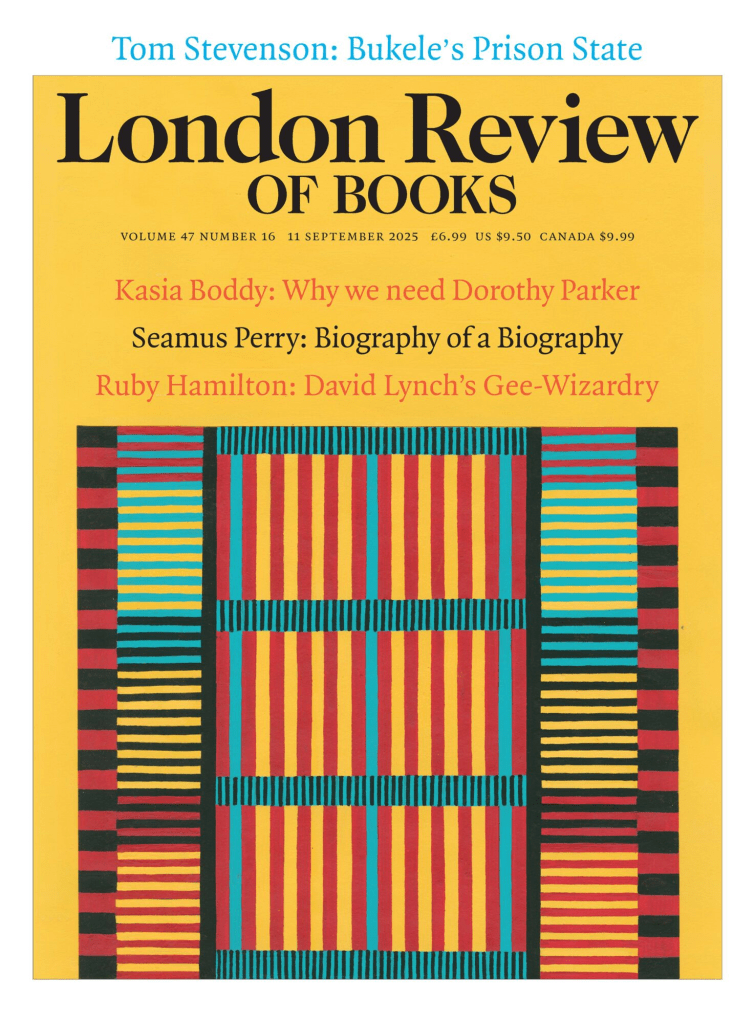
LONDON REVIEW OF BOOKS – AUGUST 14, 2025 PREVIEW

LONDON REVIEW OF BOOKS: The latest issue features Tariffs Before Trump; Boccaccio’s Dirty Book and Constance Marten’s Defiance

Exile Economics: If Globalisation Fails by Ben Chu

No Trade Is Free: Changing Course, Taking on China and Helping America’s Workers by Robert Lighthizer

White Light: The Elemental Role of Phosphorus – in Our Cells, in Our Food and in Our World by Jack Lohmann

Boccaccio: A Biography by Marco Santagata, translated by Emlyn Eisenach

Boccaccio Defends Literature by Brenda Deen Schildgen

TIMES LITERARY SUPPLEMENT – AUGUST 8, 2025 PREVIEW

TIMES LITERARY SUPPLEMENT: The latest issue features ‘Tech Bro Utopia’ – Why Bacon’s New Atlantis is Peter Thiel’s favorite book; The monarch who built Britain; Charles and the carbuncles; The miseries of Victor Hugo’s daughter…

LITERARY REVIEW – AUGUST 2025 NEW BOOKS PREVIEW

LITERARY REVIEW (August 2, 2025): The latest issue features ‘Mark Twain’s American Odyssey’…

The Bard & the Builders: The Dream Factory: London’s First Playhouse and the Making of William Shakespeare By Daniel Swift

Hannibal’s Lament: Carthage: A New History of an Ancient Empire By Eve MacDonald

Colosseum Confidential: Those Who Are About to Die: Gladiators and the Roman Mind By Harry Sidebottom

TIMES LITERARY SUPPLEMENT – AUGUST 1, 2025 PREVIEW

TIMES LITERARY SUPPLEMENT: The latest issue features Daniel Karlin about his twelve-month abstinence from the printed word. As one of his friends remarked, he must have been the first person to make a New Year’s resolution to read less.

Life beyond literature

A year without reading By Daniel Karlin

What lies ahead for fiction?

AI, literary theory and traditional storytelling By Benjamin Markovits

Maggots as meat

The ethics of industrial insect farming By Simone Gubler

A right to choose

Efforts to prohibit abortion down the ages By Elizabeth Abbott

Moby-Dick, Perpetual Inquiry, and the Sublime

By Intellicurean, July 25, 2025

“Call me Ishmael.”

This iconic first line anchors one of the most enduring openings in American literature. Yet before it is spoken, before Ishmael’s voice emerges on the page, we encounter something more unusual: a kind of literary invocation. The opening pages of Moby-Dick—those dense, eclectic “Extracts” quoting scripture, classical literature, scientific treatises, and forgotten travelogues—do not serve as a traditional preface. Instead, they operate like a ritual threshold. They ask us to enter the novel not as a narrative, but as a vast textual cosmos.

Melville’s fictional “sub-sub-librarian” gathers fragments from Job to Shakespeare to obscure whaling reports, assembling a chorus of voices that have, across centuries, spoken of the whale. This pre-narrative collage is more than ornamentation. It proposes a foundational idea: that the whale lives not only in the ocean, but in language. Not only in myth, but in memory. Not only in flesh, but in thought.

Before the Pequod ever sets sail, Melville has already charted his central course—into the ocean of human imagination, where the whale swims through texts, dreams, and questions that refuse easy resolution.


Proof of Two Lives

“There’s something I find strangely moving about the ‘Extracts’ section,” remarks literary critic Wyatt Mason on The World in Time, a podcast hosted by Lewis Lapham. “It’s proof of two kinds of life. The life of the creature itself, and the life of the mind—the attention we pay over time to this creature.”

Mason’s comment offers a keel for the voyage ahead. In Moby-Dick, the whale is not simply an animal or antagonist. It becomes a metaphysical magnet, a mirror for human understanding, a challenge to the limits of knowing. The “Extracts” and “Etymologies,” often dismissed as digressions, are in fact sacred rites—texts that beg to be read with reverence.

In teaching the novel to incarcerated students through the Bard Prison Initiative, Mason and fellow writer Donovan Hohn describe how these obscure, labyrinthine sections are received not as trivia but as scripture. The students descend into the archive as divers into a shipwreck—recovering fragments of forgotten wisdom, learning to breathe in the pressure of incomprehensibility. “The whale,” Mason repeats, “resides or lives in texts.” And what a library it is.


The Whale as Philosophy

“All my means are sane, my motive and my object mad.”

Harold Bloom, the late sage of literary criticism, would have nodded at Mason’s insight. For Bloom, Moby-Dick was not merely a novel, but “a giant Shakespearean prose poem.” Melville, he believed, was a tragedian of the American soul. Captain Ahab, mad with self-reliance, became for Bloom a Promethean figure—bound not by divine punishment, but by his own obsessive will.

In Bloom’s classroom at Yale in 2011, there were no lecture notes. He taught Moby-Dick like a jazz solo—improvised, living, drawn from a lifetime of memory and myth. “It’s very unfair,” he said, reflecting on the whale hunts—great mammals hunted with harpoons and lances. Yet the Pequod’s most moral man, Starbuck, is also its most proficient killer. A Quaker devoted to peace, he is also the ship’s deadliest lance. This contradiction—gentleness and violence braided together—is the essence of Melville’s philosophy.

The whale, in Bloom’s reading, is sublime not because it symbolizes any one thing—God, evil, justice, nature—but because it cannot be pinned down. It is an open question. An unending inquiry. A canvas for paradox. “Heaven help them all,” Bloom said of the Pequod’s doomed crew. “And us.”


Melville the Environmentalist

“There she blows! There she blows! A hump like a snow-hill! It is Moby Dick!”

Where Bloom heard Melville’s music in metaphor and myth, Richard J. King hears it in science. In Ahab’s Rolling Sea: A Natural History of Moby-Dick (2019), King charts a different map—overlaying Melville’s imagined ocean onto real tides, real whales, real voyages. He sails replica whalers, interviews marine biologists, pores over Melville’s notebooks.

His inquiry begins with a straightforward question: could a sperm whale really destroy a ship? Historical records suggest yes. But King doesn’t stop at anatomy. His portrait of Melville reveals a proto-environmentalist, someone who revered the sea not just as symbol but as system. Melville’s whale, King argues, is a creature of wonder and terror, not just prey but presence.

In an age of ecological crisis, King reframes Moby-Dick as a book not just of metaphor but of environmental ethics. Ishmael’s meandering digressions become meditations on the ocean as moral agent—an entity capable of sustaining and destroying. The sea is no backdrop; it is a character, a god, an intelligence. Melville’s ocean, King suggests, humbles the hubris of Ahab and calls readers to ecological humility.


Rediscovery in Dark Times

“Strike through the mask! How can the prisoner reach outside except by thrusting through the wall?”

Aaron Sachs, in Up From the Depths: Herman Melville, Lewis Mumford, and Rediscovery in Dark Times (2022), picks up the whale’s trail in the 20th century. In 1929, as the world plunged into the Great Depression, the writer and historian Lewis Mumford resurrected Melville from literary oblivion. His biography of the long-forgotten author recast Melville not as a failure, but as a visionary.

For Mumford, Melville was a kindred spirit—a man who, long before the term “modernity” took hold, had already seen its psychic cost. As Mumford watched the rise of industry, mass production, and spiritual exhaustion, he found in Melville a dark prophet. Ahab’s fury was not personal—it was civilizational.

Critics have praised Sachs’s biography as timely and thoughtful. Its thesis is clear: in times of disorientation, literature does more than reflect the world—it refracts it. It preserves vital truths, repurposing them when our present crises demand older insights.

In Sachs’s telling, Moby-Dick is not just a classic; it’s a living text. A lighthouse in the storm. A warning bell. A whale-shaped mirror reflecting our fears, failures, and persistent hope.


The Whale in the Classroom

“Ignorance is the parent of fear.”

The classroom, as Sachs and Mason both suggest, becomes a site of literary resurrection. In prison education programs, students discover themselves in the “Extracts”—not despite their difficulty, but because of it. The very act of grappling with Melville’s arcane references, strange structures, and encyclopedic digressions becomes an act of reclamation.

To teach Moby-Dick in a prison is to raise a sunken ship. Its sentences, like salvaged artifacts, reveal new meaning. Forgotten knowledge becomes fuel for rediscovery. Students, many of whom have been dismissed by society, see in Melville’s endless inquiry a validation of their own intelligence and complexity.

Harold Bloom taught Moby-Dick the same way. Every reading was new. No fixed script, only the swell of thought. He modeled Melville’s method: trust the reader, trust the text, trust the mystery.

The whale resists capture—literal and interpretive. It is not a symbol with a key, but a question without an answer. That resistance is what makes Moby-Dick enduring. It insists on being re-read. Re-thought. Re-discovered.


The Archive That Breathes

“It is not down in any map; true places never are.”

Taken together, the voices of Wyatt Mason, Harold Bloom, Richard J. King, and Aaron Sachs reveal Moby-Dick as something more than literature. It is a breathing archive—a repository of imagination, inquiry, and paradox.

Within its pages dwell theologies and taxonomies, drama and digression, sermons and sea shanties. It houses the ethical weight of ecology, the fury of Ahab, the wonder of Ishmael, and the ghosts of Melville’s century. It defies genre, resists reduction, and insists on complexity.

Melville did not write to close arguments but to open them. He did not believe in neat endings. His whale is the quintessential “true place”: uncapturable, immeasurable, endlessly sublime.

And yet we return. We keep hunting—not with harpoons, but with attention. With interpretation. With awe.


A Final Breach

What, then, do we do with Moby-Dick in the twenty-first century? How do we reconcile Ahab’s consuming fury with Ishmael’s contemplative awe? How do we carry Bloom’s Prometheus, King’s Leviathan, Sachs’s resurrected Melville, and Mason’s classroom in a single imagination?

We read. We reread. We become “sub-sub-librarians”—archivists of ambiguity, curators of complexity. We do not read Moby-Dick for closure. We read it to learn how to remain open—to contradiction, to paradox, to mystery.

But what if we, like Captain Ahab, set off to find Moby Dick and never found the whale?

What if all our intellectual harpoons missed their mark? What if the whale was never there to begin with—not as symbol, not as certainty, not as prize?

Would we call that failure?

Or might we discover, like Ishmael adrift on the coffin-raft, that survival is not about conquest, but endurance? That truth lives not in the kill, but in the quest?

Perhaps Melville’s greatest lesson is that the whale must never be caught. Its sublimity lies in its elusiveness—in its capacity to remain just beyond the reach of definition, control, and meaning. It breaches in metaphor. It disappears in digression. It waits—not to be captured, but to be considered.

We will never catch it. But we must keep following.

For in the following, we become something more than readers.
We become seekers.

THIS ESSAY WAS WRITTEN BY INTELLICUREAN UTILIZING AI

TIMES LITERARY SUPPLEMENT – JULY 25, 2025 PREVIEW

TIMES LITERARY SUPPLEMENT: The latest issue features All change is for the worse? Pessimists will find evidence in Joad Raymond Wren’s The Great Exchange: Making the news in early modern Europe, reviewed for the TLS by Noel Malcolm.

The news that was fit to print

Where newspapers came from By Noel Malcolm

Light of the right

A cultural conservative who paved the way for Ronald Reagan By Christopher J. Scalia

Through bushes and briars

Ancient rural skills in a modern world By Norma Clarke

Away from it all

Restfully contemplative holiday reading By Irina Dumitrescu

Why “Hamlet” Matters In Our Technological Age

INTELLICUREAN (JULY 22, 2025):

“The time is out of joint: O cursed spite, / That ever I was born to set it right!” — Hamlet, Act I, Scene V

In 2025, William Shakespeare’s Hamlet no longer reads as a distant Renaissance relic but rather as a contemporary fever dream—a work that reflects our age of algorithmic anxiety, climate dread, and existential fatigue. The tragedy of the melancholic prince has become a diagnostic mirror for our present: grief-stricken, fragmented, hyper-mediated. Written in a time of religious upheaval and epistemological doubt, Hamlet now stands at the crossroads of collective trauma, ethical paralysis, and fractured memory.

As Jeremy McCarter writes in The New York Times essay Listen to ‘Hamlet.’ Feel Better., “We are Hamlet.” That refrain echoes across classrooms, podcasts, performance spaces, and peer-reviewed journals. It is not merely identification—it is diagnosis.

This essay weaves together recent scholarship, creative reinterpretations, and critical performance reviews to explore why Hamlet matters—right now, more than ever.

Grief and the Architecture of Memory

Hamlet begins in mourning. His father is dead. His mother has remarried too quickly. His place in the kingdom feels stolen. This grief—raw, intimate, but also national—is not resolved; it metastasizes. As McCarter observes, Hamlet’s sorrow mirrors our own in a post-pandemic, AI-disrupted society still reeling from dislocation, death, and unease.

In Hamlet, architecture itself becomes a mausoleum: Elsinore Castle feels less like a home and more like a prison of memory. Recent productions, including the Royal Shakespeare Company’s Hamlet: Hail to the Thief and the Mark Taper Forum’s 2025 staging, emphasize how space becomes a character. Set designs—minimalist, surveilled, hypermodern—render castles as cages, tightening Hamlet’s emotional claustrophobia.

This spatial reading finds further resonance in Jeffrey R. Wilson’s Essays on Hamlet (Harvard, 2021), where Elsinore is portrayed not just as a backdrop but as a haunted topography—a burial ground for language, loyalty, and truth. In a world where memories are curated by devices and forgotten in algorithms, Hamlet’s mourning becomes a radical act of remembrance.

Our own moment—where memories are stored in cloud servers and memorialized through stylized posts—finds its counter-image in Hamlet’s obsession with unfiltered grief. His mourning is not just personal; it is archival. To remember is to resist forgetting—and to mourn is to hold meaning against its erasure.

Madness and the Diseased Imagination

Angus Gowland’s 2024 article Hamlet’s Melancholic Imagination for Renaissance Studies draws a provocative bridge between early modern melancholy and twenty-first-century neuropsychology. He interprets Hamlet’s unraveling not as madness in the theatrical sense, but as a collapse of imaginative coherence—a spiritual and cognitive rupture born of familial betrayal, political corruption, and metaphysical doubt.

This reading finds echoes in trauma studies and clinical psychology, where Hamlet’s soliloquies—“O that this too too solid flesh would melt” and “To be, or not to be”—become diagnostic utterances. Hamlet is not feigning madness; he is metabolizing a disordered world through diseased thought.

McCarter’s audio adaptation of the play captures this inner turmoil viscerally. Told entirely through Hamlet’s auditory perception, the production renders the world as he hears it: fragmented, conspiratorial, haunted. The sound design enacts the “nutshell” of Hamlet’s consciousness—a sonic echo chamber where lucidity and delusion merge.

Gowland’s interdisciplinary approach, melding humoral theory with neurocognitive frameworks, reveals why Hamlet remains so psychologically contemporary. His imagination is ours—splintered by grief, reshaped by loss, and destabilized by unreliable truths.

Existentialism and Ethical Procrastination

Boris Kriger’s Hamlet: An Existential Study (2024) reframes Hamlet’s paralysis not as cowardice but as ethical resistance. Hamlet delays because he must. His world demands swift vengeance, but his soul demands understanding. His refusal to kill without clarity becomes an act of defiance in a world of urgency.

Kriger aligns Hamlet with Sartre’s Roquentin, Camus’s Meursault, and Kierkegaard’s Knight of Faith—figures who suspend action not out of fear, but out of fidelity to a higher moral logic. Hamlet’s breakthrough—“The readiness is all”—is not triumph but transformation. He who once resisted fate now accepts contingency.

This reading gains traction in modern performances that linger in silence. At the Mark Taper Forum, Hamlet’s soliloquies are not rushed; they are inhabited. Pauses become ethical thresholds. Audiences are not asked to agree with Hamlet—but to wait with him.

In an era seduced by velocity—AI speed, breaking news, endless scrolling—Hamlet’s slowness is sacred. He does not react. He reflects. In 2025, this makes him revolutionary.

Isolation and the Politics of Listening

Hamlet’s isolation is not a quirk—it is structural. The Denmark of the play is crowded with spies, deceivers, and echo chambers. Amid this din, Hamlet is alone in his need for meaning.

Jeffrey Wilson’s essay Horatio as Author casts listening—not speaking—as the play’s moral act. While most characters surveil or strategize, Horatio listens. He offers Hamlet not solutions, but presence. In an age of constant commentary and digital noise, Horatio becomes radical.

McCarter’s audio adaptation emphasizes this loneliness. Hamlet’s soliloquies become inner conversations. Listeners enter his psyche not through spectacle, but through headphones—alone, vulnerable, searching.

This theme echoes in retellings like Matt Haig’s The Dead Father’s Club, where an eleven-year-old grapples with his father’s ghost and the loneliness of unresolved grief. Alienation begins early. And in our culture of atomized communication, Hamlet’s solitude feels painfully modern.

We live in a world full of voices but starved of listeners. Hamlet exposes that silence—and models how to endure it.

Gender, Power, and Counter-Narratives

If Hamlet’s madness is philosophical, Ophelia’s is political. Lisa Klein’s novel Ophelia and its 2018 film adaptation give the silenced character voice and interiority. Through Ophelia’s eyes, Hamlet’s descent appears not noble, but damaging. Her own breakdown is less theatrical than systemic—borne from patriarchy, dismissal, and grief.

Wilson’s essays and Yan Brailowsky’s edited volume Hamlet in the Twenty-First Century (2023) expose the structural misogyny of the play. Hamlet’s world is not just corrupt—it is patriarchally decayed. To understand Hamlet, one must understand Ophelia. And to grieve with Ophelia is to indict the systems that broke her.

Contemporary productions have embraced this feminist lens. Lighting, costuming, and directorial choices now cast Ophelia as a prophet—her madness not as weakness but as indictment. Her flowers become emblems of political rot, and her drowning a refusal to play the script.

Where Hamlet delays, Ophelia is dismissed. Where he soliloquizes, she sings. And in this contrast lies a deeper truth: the cost of male introspection is often paid by silenced women.

Hamlet Reimagined for New Media

Adaptations like Alli Malone’s Hamlet: A Modern Retelling podcast transpose Hamlet into “Denmark Inc.”—a corrupt corporate empire riddled with PR manipulation and psychological gamesmanship. In this world, grief is bad optics, and revenge is rebranded as compliance.

Malone’s immersive audio design aligns with McCarter’s view: Hamlet becomes even more intimate when filtered through first-person sensory experience. Technology doesn’t dilute Shakespeare—it intensifies him.

Even popular culture—The Lion KingSons of Anarchy, countless memes—draws from Hamlet’s genetic code. Betrayal, grief, existential inquiry—these are not niche themes. They are universal templates.

Social media itself channels Hamlet. Soliloquies become captions. Madness becomes branding. Audiences become voyeurs. Hamlet’s fragmentation mirrors our own feeds—brilliant, performative, and crumbling at the edges.

Why Hamlet Still Matters

In classrooms and comment sections, on platforms like Bartleby.com or IOSR Journal, Hamlet remains a fixture of moral inquiry. He endures not because he has answers, but because he never stops asking.

What is the moral cost of revenge?
Can grief distort perception?
Is madness a form of clarity?
How do we live when meaning collapses?

These are not just literary questions. They are existential ones—and in 2025, they feel acute. As AI reconfigures cognition, climate collapse reconfigures survival, and surveillance reconfigures identity, Hamlet feels uncannily familiar. His Denmark is our planet—rotted, observed, and desperate for ethical reawakening.

Hamlet endures because he interrogates. He listens. He doubts. He evolves.

A Final Benediction: Readiness Is All

Near the end of the play, Hamlet offers a quiet benediction to Horatio:

“If it be now, ’tis not to come. If it be not to come, it will be now… The readiness is all.”

No longer raging against fate, Hamlet surrenders not with defeat, but with clarity. This line—stripped of poetic flourish—crystallizes his journey: from revenge to awareness, from chaos to ethical stillness.

“The readiness is all” can be read as a secular echo of faith—not in divine reward, but in moral perception. It is not resignation. It is steadiness.

McCarter’s audio finale invites listeners into this silence. Through Hamlet’s ear, through memory’s last echo, we sense peace—not because Hamlet wins, but because he understands. Readiness, in this telling, is not strategy. It is grace.

Conclusion: Hamlet’s Sacred Relevance

Why does Hamlet endure in the twenty-first century?

Because it doesn’t offer comfort. It offers courage.
Because it doesn’t resolve grief. It honors it.
Because it doesn’t prescribe truth. It wrestles with it.

Whether through feminist retellings like Ophelia, existential essays by Kriger, cognitive studies by Gowland, or immersive audio dramas by McCarter and Malone, Hamlet adapts. It survives. And in those adaptations, it speaks louder than ever.

In an age where memory is automated, grief is privatized, and moral decisions are outsourced to algorithms, Hamlet teaches us how to live through disorder. It reminds us that delay is not cowardice. That doubt is not weakness. That mourning is not a flaw.

We are Hamlet.
Not because we are doomed.
But because we are still searching.
Because we still ask what it means to be.
And what it means—to be ready.

THIS ESSAY WAS WRITTEN AND EDITED BY INTELLICUREAN USING AI