Tag Archives: Literature

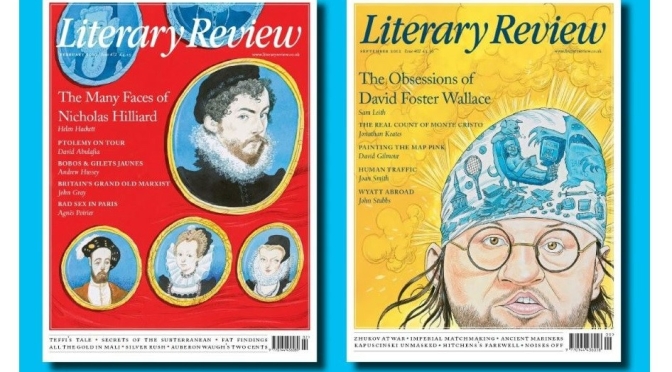
LITERARY REVIEW – DECEMBER 2025

LITERARY REVIEW : The latest issue features  Peter Marshall on Holbein * Joanna Kavenna on Camus * Sophie Oliver on Margaret Atwood * Dorian Lynskey on George Orwell * Daisy Dunn on Clodia of Rome * David Andress on Jean-Paul Marat * John Foot on the Spanish Civil War * Jerry White on high-rise buildings * Edward Shawcross on Mexico * Daniel A Bell on the Chinese examination system * Anna Reid on Russian women * Charles Darwent on Barnett Newman * Robert Crawford on T S Eliot * Ian Sansom on William Golding * Mark Lawson on John Updike * Charles Shaar Murray on musicians * Patrick Porter on NATO * Thomas Morris on Renaissance diagrams * Diane Purkiss on palmistry *  Nigel Andrew on penguins * John Mullan on pedants * Molly Pepper Steemson on Anthony Bourdain * Mark Ford on Helen Vendler * Emma Smith on book

Holbein: Renaissance Master By Elizabeth Goldring

It’s an irony to savour: the man who invented the Tudors was a German. If Henry VIII, his wives and courtiers exercise a stronger hold on the public imagination than their Plantagenet precursors or Stuart successors, it is because we can all picture them so clearly. That, in turn, is due to an extraordinary sequence of portraits and drawings produced between the late 1520s and early 1540s by Hans Holbein of Augsburg (c 1497–1543), many of which have become instantly recognisable. 

Doublethink & Doubt

Orwell: 2+2=5 By Raoul Peck (dir)

George Orwell: Life and Legacy By Robert Colls

Nobody under the age of seventy-five has heard George Orwell’s voice. The only extant video footage is in a silent movie of the Eton Wall Game. None of his many wartime recordings for the BBC Eastern Service has survived. By all accounts his voice, damaged by a bullet to the throat during the Spanish Civil War, was thin, flat and weak. In fact, the controller of the BBC Overseas Service complained that putting on ‘so wholly unsuitable a voice’ made the BBC appear ‘ignorant of the essential needs of the microphone and of the audience’. 

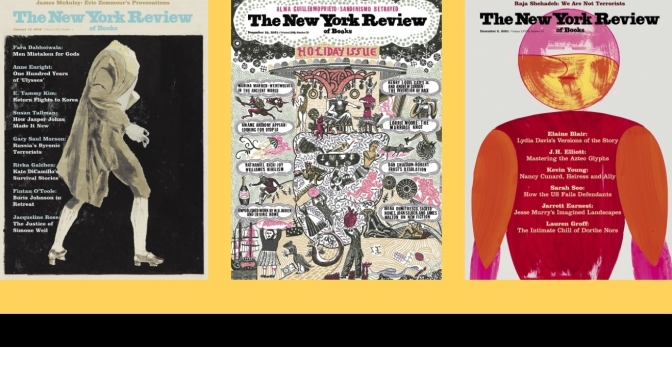
THE NEW YORKER MAGAZINE – DECEMBER 8, 2025

Trump admires a Christmas tree in his cavernous gilded ballroom.

THE NEW YORKER MAGAZINE: The latest cover features ‘Klaas Verplancke’s “White House of Gold” – Mar-a-Lago extravagance on Pennsylvania Avenue.

In the Line of Fire

During the Trump era, political violence has become an increasingly urgent problem. Elected officials from both parties are struggling to respond. By Benjamin Wallace-Wells

The Undermining of the C.D.C.

The Department of Health and Human Services maintains that it is hewing to “gold standard, evidence-based science”—doublespeak that might unsettle Orwell. By Dhruv Khullar

What Makes Goethe So Special?

The German poet’s dauntingly eclectic accomplishments were founded on a tireless interrogation of how a life should be lived. By Merve Emre

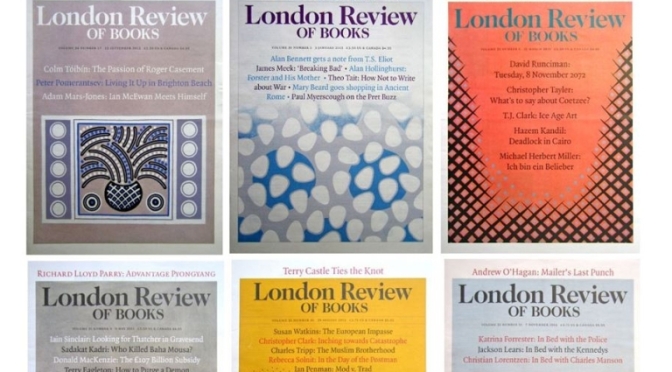
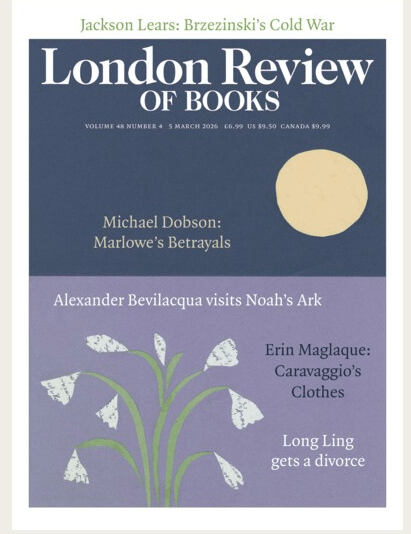
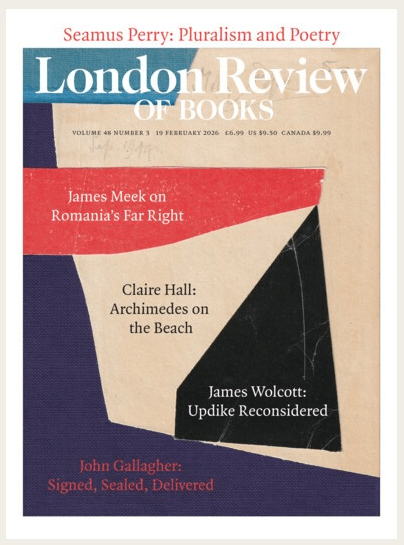
LONDON REVIEW OF BOOKS – DECEMBER 4, 2025 PREVIEW

LONDON REVIEW OF BOOKS: The latest issue features ‘Robert Frost’s ugly feelings’….

Love and Need: The Life of Robert Frost’s Poetry by Adam Plunkett

Short Cuts: A Bridge across the Humber

Undaunted Mind: The Intellectual Life of Benjamin Franklin by Kevin J. HayesIngenious: A Biography of Benjamin Franklin, Scientist by Richard Munson

A Common Grave: Being Catholic in English America by Susan Juster

THE NEW YORKER MAGAZINE – DECEMBER 1, 2025

A woman with a headscarf turns away from a butterfly to look at the reader. A reprint of the original cover by Rea Irvin...

THE NEW YORKER MAGAZINE: The latest cover features Malika Favre’s and Rea Irvin’s Eustace Tilley – The covers for the fourth and final centenary special issue.

The Justice Department Hits a New Low with the Epstein Files

Not only is the department’s behavior not normal; it is also, as is becoming increasingly clear, self-defeating. By Ruth Marcus

Disappeared to a Foreign Prison

The Trump Administration is deporting people to countries they have no ties to, where many are being detained indefinitely or forcibly returned to the places they fled. By Sarah Stillman

The Airport-Lounge Wars

When you’re waiting for a flight, what’s the difference between out there and in here? By Zach Helfand

THE NEW YORKER MAGAZINE – NOVEMBER 24, 2025

The cover for the November 24 2025 issue of The New Yorker in which a man sits outside an antique store early in the...

THE NEW YORKER MAGAZINE: The latest cover features Kenton Nelson’s “Early Morning” – Opening hours.

The Meaning of Trump’s Presidential Pardons

The President granted two hundred and thirty-eight pardons and commutations in his first term; less than a year into his second, he has issued nearly two thousand. By Benjamin Wallace-Well

Stephen Fry Is Wilde at Heart

The polymathic entertainer has had a lifelong bond with the wittiest—and the most tortured—of writers. And now he’s starring in “The Importance of Being Earnest.” By Rebecca Mead

Why the Time Has Finally Come for Geothermal Energy

It used to be that drawing heat from deep in the Earth was practical only in geyser-filled places such as Iceland. But new approaches may have us on the cusp of an energy revolution. By Rivka Galchen

LONDON REVIEW OF BOOKS – NOVEMBER 20, 2025 PREVIEW

LONDON REVIEW OF BOOKS: The latest issue features ‘Will We Still Google It?’; Syntax of Slavery and Habsburg Legacies…

Will we still google it?

I’m starting to feel some pre-emptive nostalgia when I do a Google search. Yes, it’s true, search can sometimes take you to places you don’t want to go. But at least a ‘classical’ search engine like Google in the 2000s and 2010s took you outside itself, and perhaps implicitly prompted you to evaluate critically what you found there. by Donald MacKenzie

Syntax of Slavery

Slavery was accepted across most of the early modern world. No one wanted to be a slave, except when the alternative was being executed after a battle, or made a human sacrifice, but the institution was taken for granted until the growth of abolitionism in the later 18th century. Liverpool could hardly be an exception when the slave trade was so embedded in its economy.  By John Kerrigan

Habsburg Legacies

We still live in the long shadow of Habsburg disintegration. In addition to the lingering legacy of 19th-century state formations, European and global politics are shaken by continuing reverberations in states that have disappeared from Europe since 1990: Yugoslavia, Czechoslovakia, the GDR and, above all, the Soviet Union. By Holly Case

TIMES LITERARY SUPPLEMENT – NOVEMBER 14, 2025

TIMES LITERARY SUPPLEMENT: The latest issue features ‘Roy Foster on Seamus Heaney’s miraculous poems.

Blazing graft

Charting Seamus Heaney’s Wordsworthian journey By Roy Foster

What the public wants?

Writing novels by AI – and committee By Gordon Fraser

Books of the Year 2025

Our contributors choose their favourites

Touching the void

Simone Weil’s ethical life class By A. Rebecca Rozelle-Stone

THE NEW YORKER MAGAZINE – NOVEMBER 17, 2025

Edel Rodriguez's “Mayor Mamdani” | The New Yorker

THE NEW YORKER MAGAZINE: The latest cover features Edel Rodriguez’s “Mayor Mamdani”

The Mamdani Era Begins

His opponents tried to smear him for his youth, inexperience, and leftist politics. But New Yorkers didn’t want a hardened political insider to be mayor—they wanted Zohran Mamdani.

Dick Cheney’s Brand of Conservatism

For years before taking office, the former Vice-President appeared less dogmatic than he was.

The Dishy Operatics of Lily Allen’s Breakup Album

On “West End Girl,” all the gritty bits are there: messages with a husband’s mistress, the discovery of a cache of sex toys.

THE NEW YORKER MAGAZINE – NOVEMBER 10, 2025

New Yorkers walk by a tree on a rainy day.

THE NEW YORKER MAGAZINE: The latest cover features ‘Sudden Shower’ by Sergio-Garcia Sanchez.

The Case That A.I. Is Thinking

ChatGPT does not have an inner life. Yet it seems to know what it’s talking about. By James Somers

Voting Rights and Immigration Under Attack

The President’s goals were clear on the first day of his term, when he issued an executive order overruling the Fourteenth Amendment’s birthright-citizenship clause. By Jelani Cobb

Mobsters We Have Seen on High

The jewel heist at the Louvre reminded Brooklynites of the time, in 1952, when two bejewelled crowns were swiped from a beloved local church—the one with a Mob boss on the ceiling. By Susan Mulcahy

LITERARY REVIEW – NOVEMBER 2025

LITERARY REVIEW : The latest issue features Jeremy Noel-Tod on Seamus Heaney * Kathryn Murphy on Vermeer * Kirsten Tambling on two 18th-century artists * Sophie Oliver on Katherine Mansfield * Lucy Lethbridge on reading * Tom Shippey on the first king of England * Daniel Rey on Christopher Columbus * Nigel Jones on U-boats * Richard Vinen on the Second World War * John Phipps on John le Carré * Julian Baggini on effective altruism 

The Pen & the Spade

The Poems of Seamus Heaney By Rosie Lavan, Bernard O’Donoghue and Matthew Hollis (edd.)

Vermeer: A Life Lost and Found By Andrew Graham-Dixon

A woman stands, oblivious to our gaze, absorbed entirely in her activity – reading, pouring, weighing, holding out her pearls. A window to the left admits a radiance, which falls variously on the common stuff the room contains. The light enters as an absolute blank, but infuses colour as it illuminates the scene. 

Katherine Mansfield: A Hidden Life By Gerri Kimber

The rush to tell the story of Katherine Mansfield’s short, fascinating life began as soon as she died. Her husband, John Middleton Murry, a gifted editor, notoriously turned the publication of her writing into an industry.