London Review of Books (LRB) – December 9, 2022: Among the Ancients, with Emily Wilson and Thomas Jones, which we’ll be re-running from January next year. With a new episode each month, Among the Ancients will consider some of the greatest works of Ancient Greek and Roman literature, from Homer to Horace. In this sample Emily and Tom discuss the Iliad.
A sample from the first episode of the Close Readings series from Emily Wilson and Thomas Jones.
Dating to the ninth century B.C., Homer’s timeless poem still vividly conveys the horror and heroism of men and gods wrestling with towering emotions and battling amidst devastation and destruction, as it moves inexorably to the wrenching, tragic conclusion of the Trojan War. Renowned classicist Bernard Knox observes in his superb introduction that although the violence of the Iliad is grim and relentless, it coexists with both images of civilized life and a poignant yearning for peace.
@Shakespeare_Co Podcast, December 2, 2022: The Hunchback of Notre-Dame Special Podcast! To celebrate our exclusive S&Co edition of The Hunchback of Notre-Dame, Adam is joined by Krista Halverson, S&Co Publishing Director, and artist @neiljgower to discuss this classic of French literature.
🍫NEW PODCAST EPISODE🍫 This week Adam is joined by @jonathancoe for a conversation about charting the state of the nation over seven decades – jubilees, World Cup wins, chocolate wars, pandemics and all! 🎧: https://t.co/fA8kK6EVFDpic.twitter.com/G4DAhKC38j
From the bestselling, award-winning author of Middle England comes a profoundly moving, brutally funny and brilliantly trueportrait of Britain told through four generations of one family
In Bournville, a placid suburb of Birmingham, sits a famous chocolate factory. For eleven-year-old Mary and her family in 1945, it’s the centre of the world. The reason their streets smell faintly of chocolate, the place where most of their friends and neighbours have worked for decades. Mary will go on to live through the Coronation and the World Cup final, royal weddings and royal funerals, Brexit and Covid-19. She’ll have children and grandchildren and great-grandchildren. Parts of the chocolate factory will be transformed into a theme park, as modern life and the city crowd in on their peaceful enclave.
In anticipation of the first episode of Friends of Shakespeare and Company Read Ulysses we talk to former S&Co tumbleweed @PMHastings Patrick Hastings about The Guide to James Joyce’s Ulysses, his essential companion to this modernist classic. Listen: https://t.co/69xIskkY8Rpic.twitter.com/6NsOsvbNg4
This week Adam Biles is joined by the brilliant @legroff to discuss her @nationalbook shortlisted novel MATRIX, a wild (re)imagining of the life of Marie de France. Search "Shakespeare and Company" in your podcast app, or click here: https://t.co/17TsOIxFqNpic.twitter.com/dyreTuxLgU
Lauren Groff is the author of six books of fiction, the most recent the novel MATRIX (September 2021). Her work has won The Story Prize, the ABA Indies’ Choice Award, and France’s Grand Prix de l’Héroïne, was a three time finalist for the National Book Award for Fiction and twice for the Kirkus Prize, and was shortlisted for the National Book Critics Circle Prize, the Southern Book Prize, and the Los Angeles Times Prize.
She has received fellowships from the Guggenheim Foundation and the Radcliffe Institute for Advanced Study, and was named one of Granta’s Best of Young American Novelists. Her work has been translated into over thirty languages. She lives in Gainesville, Florida.
NPR’s Scott Simon reflects on the legacy of F. Scott Fitzgerald’s The Great Gatsby. The literary classic’s copyright expired on the first day of 2021.
The copyright on F. Scott Fitzgerald’s The Great Gatsby expired on the first stroke of 2021 and the book entered the public domain.
The classic 1925 novel of love foiled, ambitions foisted, class and betrayal sold fewer than 25,000 copies before Fitzgerald died. It has since sold nearly 30 million. I gave our daughter the copy I had in high school when she read it last year. The Great Gatsby has been turned into stage productions, an opera, five film versions, a Taylor Swift song and inspired innumerable prequels, spinoffs and variations.
In the public domain, Gatsby may now become even more familiar. Two new editions are about to come out and who knows what kind of projects — a Gatsby rom-com? Gatsby joins The Avengers? — might now get a green light, which recalls the imperishably eloquent last passage of the book: “Gatsby believed in the green light, the orgastic future that year by year recedes before us.”
Gatsby’s Jazz Age Long Island may not look like a microcosm of contemporary America. Neither does Don Quixote, The Scarlet Letter, Macbeth or Their Eyes Were Watching God. We want young readers to be able to see themselves in stories; but literature can also show us that people we don’t think are much like us at all turn out to have some of the same heart, blood and dreams. That can be the power of empathy in art.
In the latest episode in their series of Close Readings, Seamus Perry and Mark Ford look at the life and work of Robert Frost, the great American poet of fences and dark woods.
(August 4, 2020)
They discuss Frost’s difficult early life as an occasional poultry farmer and teacher, his arrival in England in 1912 amid the flowering of Georgian poetry, and his emergence as the first 20th-century professional poet, whose version of the American wilderness myth, full of mischief and foreboding, took him to packed concert halls and a presidential inauguration.
It is probably best not to take advice direct and unfiltered from the animal kingdom – but lemurs are, I think, an exception. They live in matriarchal troops, with an alpha female at their head.
The first lemur I ever met was a female, and she tried to bite me, which was fair, because I was trying to touch her, and humans have done nothing to recommend themselves to lemurs. She was an indri lemur, living in a wildlife sanctuary outside Antananarivo; she had an infant, which was riding not on her front, like a baby monkey, but on her back, like a miniature Lester Piggott. She had wide yellow eyes. William Burroughs, in his lemur-centric eco-surrealist novella Ghost of Chance, described the eyes of a lemur as ‘changing colour with shifts of the light: obsidian, emerald, ruby, opal, amethyst, diamond’. The stare of this indri resembled that of a young man at a nightclub who urgently wishes to tell you about his belief system, but her fur was the softest thing I have ever touched. I was a child, and the indri, which is the largest extant species of lemur, came up to my ribs when standing on her hind legs. She looked, as lemurs do, like a cross between a monkey, a cat, a rat and a human.
Gaby Wood reads her diary from the latest issue of the LRB, in which she tries to draw an albatross using a camera lucida.
By the time I used the camera lucida in the museum, I’d spent several months grappling with the strange proposition offered by its prism. I’d read that the image was sharper if you held it over a dark drawing surface, but that didn’t make any sense to me until the smoked metal etching plate was beneath my hand. Suddenly the albatross skeleton appeared on it: bright, spectral. The process was different from the way I’d imagined it. There was a drag, almost a dance, under the needle – a tiny jump of resistance in the copper. Without seeing what you were doing, you could feel it more keenly. It wasn’t like ice-skating at all.
A camera lucida is an optical device used as a drawing aid by artists. The camera lucida performs an optical superimposition of the subject being viewed upon the surface upon which the artist is drawing. The artist sees both scene and drawing surface simultaneously, as in a photographic double exposure.
The latest episode of the Octavian Report – Rostrum coronavirus crisis podcast features Wayne Rebhorn. The latest episode of our coronavirus crisis podcast features Wayne Rebhorn of the University of Texas at Austin. Wayne is the author of an acclaimed translation of Giovanni Boccaccio’s Decameron, perhaps the paradigmatic work of pandemic literature.
The Decameron is set among a group of witty, earthy social isolators who have fled the plague ravaging Florence. We spoke with Wayne about Boccaccio and his most famous work, the conditions that helped birth it, and what we can learn from them in our current situation.









 In the latest episode in their series of Close Readings, Seamus Perry and Mark Ford look at the life and work of Robert Frost, the great American poet of fences and dark woods.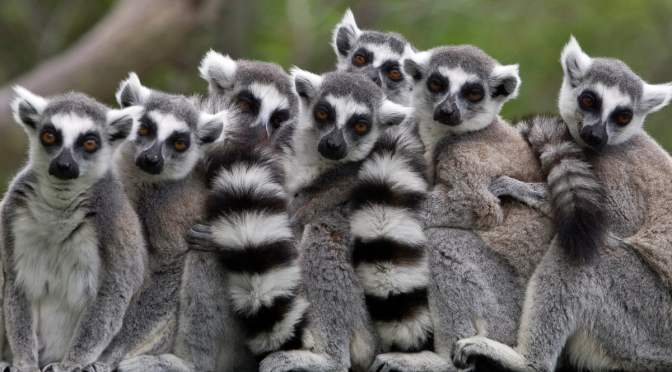
 The first lemur I ever met was a female, and she tried to bite me, which was fair, because I was trying to touch her, and humans have done nothing to recommend themselves to lemurs. She was an indri lemur, living in a wildlife sanctuary outside Antananarivo; she had an infant, which was riding not on her front, like a baby monkey, but on her back, like a miniature Lester Piggott. She had wide yellow eyes. William Burroughs, in his lemur-centric eco-surrealist novella Ghost of Chance, described the eyes of a lemur as ‘changing colour with shifts of the light: obsidian, emerald, ruby, opal, amethyst, diamond’. The stare of this indri resembled that of a young man at a nightclub who urgently wishes to tell you about his belief system, but her fur was the softest thing I have ever touched. I was a child, and the indri, which is the largest extant species of lemur, came up to my ribs when standing on her hind legs. She looked, as lemurs do, like a cross between a monkey, a cat, a rat and a human.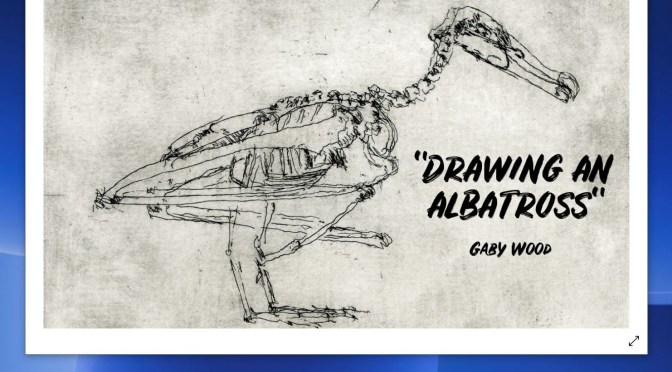
 By the time I used the camera lucida in the museum, I’d spent several months grappling with the strange proposition offered by its prism. I’d read that the image was sharper if you held it over a dark drawing surface, but that didn’t make any sense to me until the smoked metal etching plate was beneath my hand. Suddenly the albatross skeleton appeared on it: bright, spectral. The process was different from the way I’d imagined it. There was a drag, almost a dance, under the needle – a tiny jump of resistance in the copper. Without seeing what you were doing, you could feel it more keenly. It wasn’t like ice-skating at all.
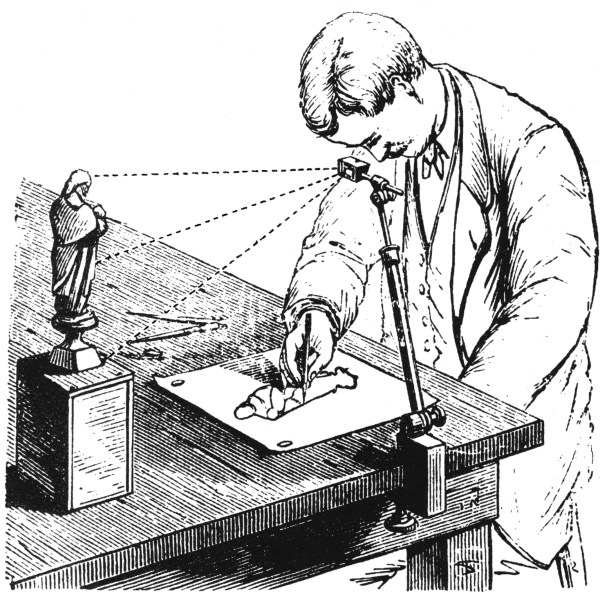 A camera lucida is an optical device used as a drawing aid by artists. The camera lucida performs an optical superimposition of the subject being viewed upon the surface upon which the artist is drawing. The artist sees both scene and drawing surface simultaneously, as in a photographic double exposure.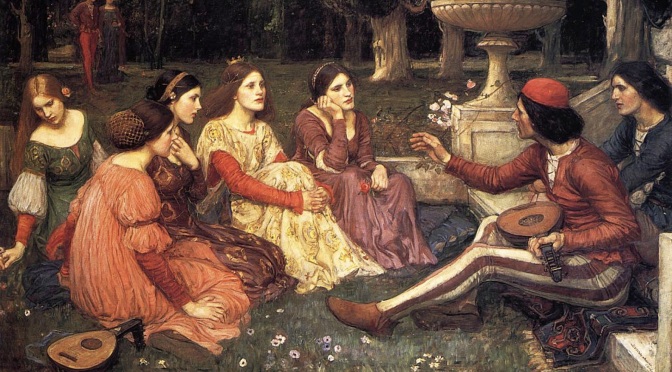
 Boomers Daily