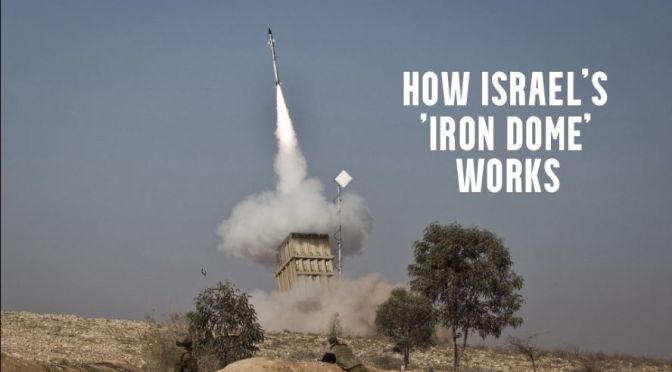
After 11 days of fierce fighting, Israel and Hamas agreed to a ceasefire beginning in the early hours of Friday morning. But will the quiet last? In July, China’s Communist Party will mark the 100th anniversary of its victory in the revolution that brought it to power.
But it’s not easy for a dictatorship to celebrate a revolt. And, we look back at the life of Asfaw Yemiru, an Ethiopian educator who transformed the lives of more than 120,000 children.
Israel’s Iron Dome missile-defense system is designed to intercept and destroy short-range rockets and mortars. During the recent conflict, it has been used to destroy more than 200 rockets bound for Israeli cities. Here’s how it works. Photo: Ilia Yefimovich/Getty Images
Five stories to know for May 17: Israel-Gaza fighting continues, Los Angeles blaze, train derails in Iowa, CDC mask guidelines, and coronavirus in India.
1. Israel bombed what it said were underground tunnels used by Hamas and Palestinian militants fired rocket barrages at Israeli cities as fighting spilled into a second week.
2. A wildfire in Los Angeles, California, gained momentum on Sunday and about 1,000 residents were put under evacuation orders. Two suspects were detained as arson investigators and police looked into the cause of the blaze.
3. A Union Pacific train hauling hazardous materials derailed and then caught fire in the city of Sibley, Iowa, authorities said.
4. New U.S. guidance allowing people to go without masks in most places provided one more topic of disagreement among Americans who have found little common ground throughout the pandemic.
5. India reported a further decline in new coronavirus cases on Monday but daily deaths remained above 4,000, and experts said the data was unreliable due to a lack of testing in rural areas where the virus is spreading fast.
A.M. Edition for May 13. WSJ’s Felicia Schwartz discusses what is behind the fighting unfolding in Israel. The Colonial Pipeline restarts operations after a cyberattack.
WSJ’s Caitlin Ostroff has more on Tesla’s decision to suspend bitcoin payments. Marc Stewart hosts.
Dozens are dead as violence between Israelis and Palestinians intensifies. Israel launched more devastating airstrikes in Gaza as Hamas continues to respond with rockets.
House Republicans will meet this morning to vote on whether to remove Wyoming Congresswoman Liz Cheney from her leadership role. And, price hikes for consumer goods are stoking fears of inflation.
Tension in the holy city of Jerusalem has been rising for weeks, amid the attempted eviction of Palestinians and a march by Jewish nationalists. Yesterday it erupted into the worst violence in years, as Hamas rockets fired at Israel from Gaza prompted retaliatory air strikes.
A cyber-attack that shut down one of America’s largest fuel pipelines reflects the growing problem of ransomware. And in China, authorities are clamping down on a spurt of grave robbing.
Five stories to know for May 10: Shootings in Colarado and New York’s Times Square, China’s rocket debris, clashes in Israel, and COVID in India.
1. A man fatally shot six people including his girlfriend before turning the gun on himself at a birthday party in Colorado Springs, Colorado.
2. Remnants of China’s biggest rocket landed in the Indian Ocean, with most of its components destroyed upon re-entry into the atmosphere.
3. Three people including a four-year-old girl were shot in New York City’s Times Square after gunfire broke out in a dispute that they were apparently not involved in, the city’s top police official said.
4. Palestinian protesters threw rocks and Israeli police fired stun grenades and rubber bullets in clashes outside al-Aqsa mosque in Jerusalem, as Israel marked the anniversary of its capture of parts of the city in the 1967 Arab-Israeli war.
5. Indian coronavirus infections and deaths held close to record daily highs on Monday, increasing calls for the government of Prime Minister Narendra Modi to lock down the country.
Armed drones are growing in military importance as conflicts around the world have proven the utility of these effective tools of war. Companies in China, Turkey, and Russia, among others, have developed advanced remotely piloted aircraft that can use guided weapons on and off the battlefield.
The widespread use of drones in Iraq and Afghanistan by the United States to target and kill insurgents jump started a new chapter in the history of conflict. These high flying and remotely piloted aircraft could engage targets with impunity while the operators were safely working in a ground control station. Keeping the crews out of danger also made the drones politically cheap to use over dangerous skies.
Now more and more countries are gaining this military capability for their own purposes. “At the moment, we’ve seen over 100 states worldwide using military drones and that number is growing significantly” said Wim Zwijnenburg, Project leader, Humanitarian Disarmament at PAX. “We have over 20 states that are using armed drones in conflicts or outside of armed conflicts.”
Although larger and more complex drones, like the General Atomics MQ-9 Reaper are not cheap to develop or operate, smaller drones are becoming more ubiquitous in conflict zones. Limiting the proliferation of these smaller drones, and the ability to weaponize them, is a regulatory nightmare for government agencies around the world.
“Drones are just model airplanes with great sensors on them. And all of these are dual use and have been used in the civilian realm” said Ulrike Franke, a Senior Policy Fellow at the European Council on Foreign Relations. “And in fact, drones have risen enormously in the civilian realm over the last five to 10 years. And so controlling their export is really difficult.”
News, Views and Reviews For The Intellectually Curious