Tag Archives: Island Views

Cinematic Travel: The Island Of Corfu, Greece

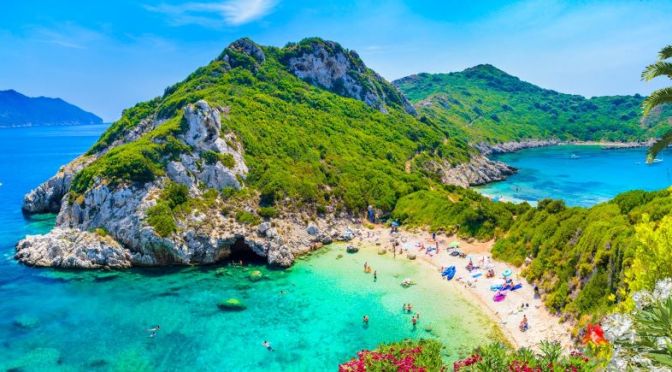
With the passage of time the island may have changed, but we can still feel the spirit of a distant glorious past. Its rich multi-cultural heritage, its historic monuments, its stunning natural landscape, its crystal clear seas, and its excellent weather all year round explain why Corfu is one of the most cosmopolitan Mediterranean destinations weaving a powerful spell on its visitors.

Corfu (Kerkyra in Greek), unlike the rest of Greece, never fell under the Ottoman oppression. Due to the successive dominations of the Venetians, the French and the British over the centuries, the island has primarily become part of the Western rather the Levantine world. Their culture wielded strong influence in the city: it was here that the first Greek University (the Ionian Academy), the first Philharmonic Orchestra and the First School of Fine Arts were founded.
Island Views: Belle-Île-en-Mer Off Brittany, France

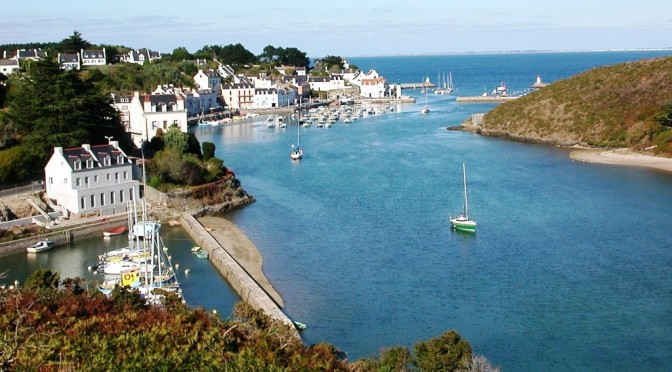
Off the coast of the French region of Brittany is a picturesque island for all those who want to disconnect. A 45-minute ferry ride separates the island of Belle-Île-en-Mer from the mainland, making it a world apart that attracts 100,000 visitors a year. Tourists also appreciate Belle-île’s food, especially its fish. We take a closer look at the island in summer.

Belle-Île is an island off the coast of Brittany in northwest France. In the main town La Palais, Citadelle Vauban is a star-shaped fortress. The fort at Pointe des Poulains, the island’s northern tip, houses a museum dedicated to 19th-century actress Sarah Bernhardt. Sandy Donnant Beach lies on the rugged west coast. Nearby, the Grand Phare lighthouse looks out over the needles rock formations of Port-Coton.

Views: Yogyakarta On Island Of Java, Indonesia

Yogyakarta (often called “Jogja”) is a city on the Indonesian island of Java known for its traditional arts and cultural heritage. Its ornate 18th-century royal complex, or kraton, encompasses the still-inhabited Sultan’s Palace. Also within the kraton are numerous open-air pavilions that host classical Javanese dance shows and concerts of gamelan music, characterized by gongs, chimes and plucked string instruments.

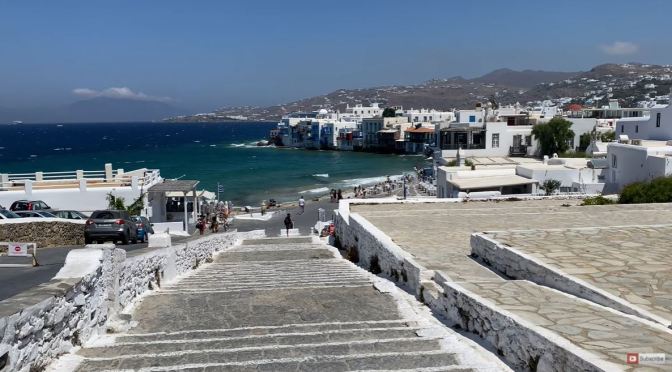
Island Views: A Walking Tour In Mykonos, Greece

Mýkonos, also spelled Míkonos, island, dímos (municipality), and perifereiakí enótita (regional unit), South Aegean (Modern Greek: Nótio Aigaío) periféreia (region), southeastern Greece. Mýkonos is one of the smaller of the eastern Cyclades (Kykládes) group of Greek islands in the Aegean Sea.

According to legend, it is the piece of rock thrown by Heracles to destroy the Giants. It is a rugged granite mass, about 33 square miles (85 square km) in area, lying next to Delos (Dílos) and between Tínos to the northwest and Náxos (Náchos) and Páros to the south. Mýkonos has several beaches, and on the north coast the Gulf of Pánormos forms a deep indentation. Located on the west side of the island is its capital, Mýkonos town; the town is the centre of a thriving tourism industry and is renowned for its nightlife.

Filmed in September 2022.

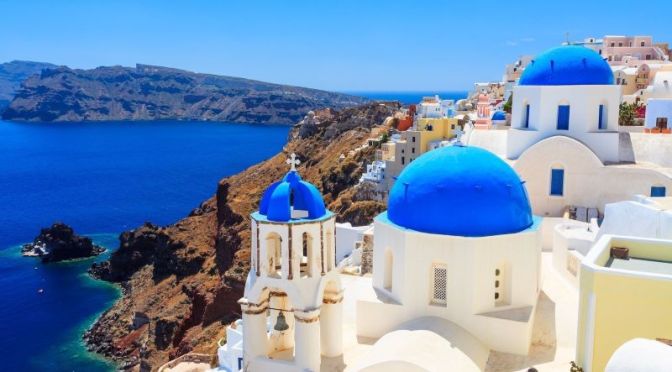
Summer Walks: Santorini In The Aegean Sea, Greece

Thera, Modern Greek Thíra, also called Santorin, or Santoríni, island, southernmost island of the Cyclades (Modern Greek: Kykládes) group, southeastern Greece, in the Aegean Sea, sometimes included in the Southern Sporades group. It constitutes a dímos (municipality) within the South Aegean (Nótio Aigaío) periféreia (region).

Geologically, Thera is the remaining eastern half of an exploded volcano. Its bow-shaped rim and the remnant isles of Thirasía and Aspronísi form an open lagoon that measures 37 miles (60 km) in circumference. In the centre of the lagoon are two active volcanic islets, Néa Kaméni (“New Burnt Island”) and Palaía Kaméni (“Old Burnt Island”). Thera proper consists largely of lava and pumice, the latter of which is the island’s main export. Red-wine grapes are also grown. The lagoon is rimmed by red-, white-, and black-striped volcanic cliffs rising to almost 1,000 feet (300 metres). The summit of Thera is the 1,857-foot (566-metre) limestone Mount Profítis Ilías in the southeast. The chief town, Thíra (locally called Firá), was badly damaged by an earthquake in 1956. Other settlements include Emboríon and Pírgos to the south and the port of Oía at the north entrance to the lagoon, which was destroyed by the 1956 earthquake.

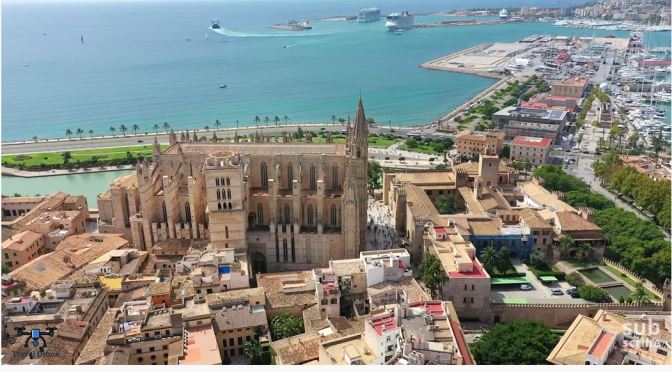
Island Views: Mallorca Off The Coast Of Spain

Mallorca (Majorca) is one of Spain’s Balearic Islands in the Mediterranean. It’s known for beach resorts, sheltered coves, limestone mountains and Roman and Moorish remains. Capital Palma has nightlife, the Moorish Almudaina royal palace and 13th-century Santa María Cathedral. Stone-built villages include Pollença, with its art galleries and music festival, and hillside Fornalutx, surrounded by citrus plantations.

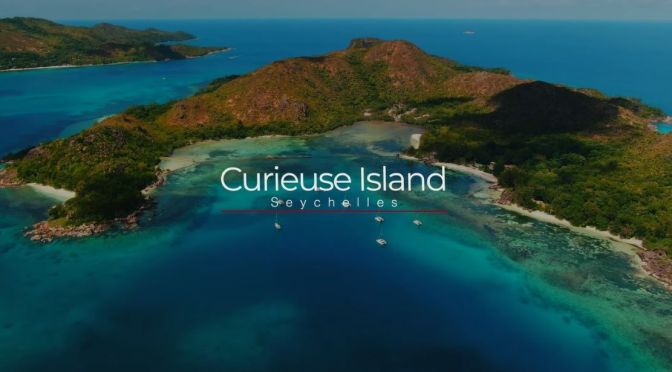
Aerial Views: Curieuse Island In The Seychelles

Curieuse Island is a small granitic island 1.13 sq mi in the Seychelles close to the north coast of the island of Praslin. Curieuse is notable for its bare red earth intermingled with the unique coco de mer palms, one of the cultural icons of the Seychelles, only growing on the two neighboring islands.

Island Views: A Van Tour Around Corsica, France

Corsica, a mountainous Mediterranean island, presents a mix of stylish coastal towns, dense forest and craggy peaks (Monte Cinto is the highest). Nearly half the island falls within a park whose hiking trails include the challenging GR 20. Its beaches range from busy Pietracorbara to remote Saleccia and Rondinara. It’s been part of France since 1768, but retains a distinct Italian culture. 

Island View: St. Kilda In The Outer Hebrides, Scotland

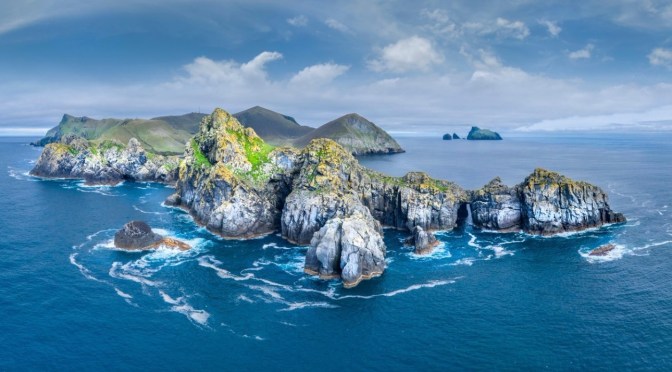
There is no place like St Kilda. Towering out of the storm-tossed waters of the Atlantic Ocean, its cliffs and sea stacks clamour with the cries of hundreds of thousands of seabirds.

Internationally recognised for its birdlife, St Kilda is no less famous for its human history. A community existed here for at least 4,000 years, exploiting the dense colonies of gannets, fulmars and puffins for food, feathers and oil.

The final 36 islanders were evacuated in 1930. Now uninhabited, visitors can brave the weather to sail to the ‘islands at the edge of the world’ for the experience of a lifetime.

360° Views: Sakhalin Island

Sakhalin is a Russian island in the Pacific Ocean, north of Japan. In the capital of Yuzhno-Sakhalinsk, a pagoda-style building houses the Sakhalin Regional Museum. On display are indigenous artifacts and a rich paleontology collection. Nearby, the Chekhov Book Museum explores writer Anton Chekhov’s time on the island. In a stately 1930s building, the Sakhalin Art Museum focuses on 19th-century Russian paintings.