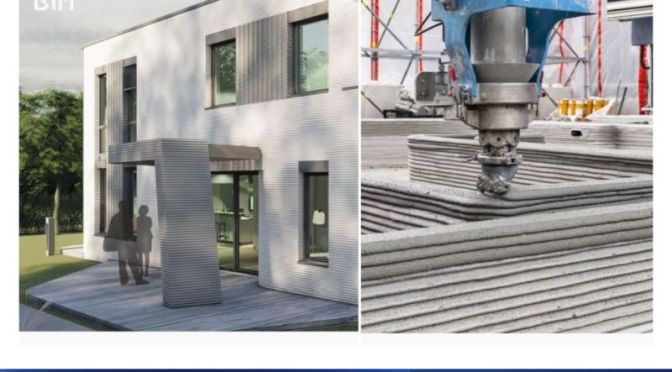
The impact of this 3D-printing breakthrough for construction and for the buildings we all use could be huge.
See more of PERI’s 3D-printing process – http://bit.ly/3gRCsus
Full story here – https://www.theb1m.com/video/why-this…

The impact of this 3D-printing breakthrough for construction and for the buildings we all use could be huge.
See more of PERI’s 3D-printing process – http://bit.ly/3gRCsus
Full story here – https://www.theb1m.com/video/why-this…
2020 is officially the busiest hurricane season on record and flooding is one of a storm’s most devastating consequences. FEMA estimates one inch of flood water can cause up to $25,000 in damage. The U.S. began offering nationalize flood insurance in 1968 but the program, called the NFIP, is now over $20 billion in debt. Private companies are starting to offer flood insurance as well. However, flood insurance is more complicated than it may appear. Watch the video to better understand how flood insurance works, and doesn’t work, in the U.S.
From an Oakland warehouse, startup company Mighty Buildings constructs prefab homes with their Big-G Printer, a 20-foot-tall 3D printer that, at speeds of 120 millimeters per second, can print a 350-square-foot studio in less than 24 hours. The homes are made of Light Stone, a thermoset composite material that hardens when exposed to UV light.
Instead of 3D printing sections of each home for on-site assembly, the machine maximizes cost savings by printing the home’s entire structural shell—thus automating the building process by up to 80% with cost savings of 20% to 30% compared to traditional prefab methods.
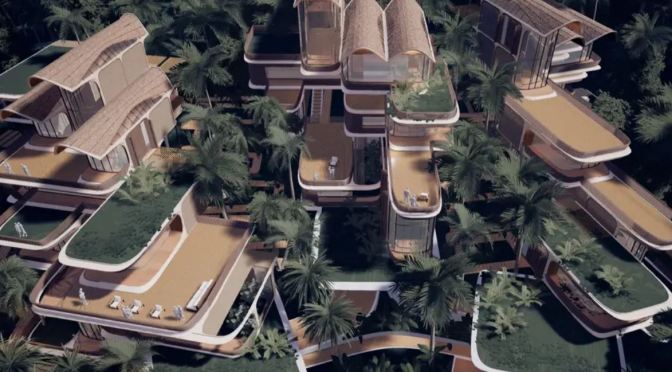
 The first residential units on Roatán Próspera are a case study in local sustainability and global integration. Combining the most advanced modular construction techniques with sustainably-sourced local materials, the design and planning for the first dwellings in Próspera is a tangible example of the dramatic shift in development methodologies taking place around the world.
The people of neighboring settlements will take part in construction and management and part of the purchase of each residence goes toward the construction of a sister residence in the neighboring community.
Roatán Próspera rethinks the whole design and conventional delivery approach to development, starting from understanding the local supply chain, logistics, energy and economical aspects as a basis to engage technologically-curious, ecologically-minded, entrepreneurial building contractors. Local labor and methods are engaged for construction methodologies and logistics of supply, procurement, and assembly in Roatán.
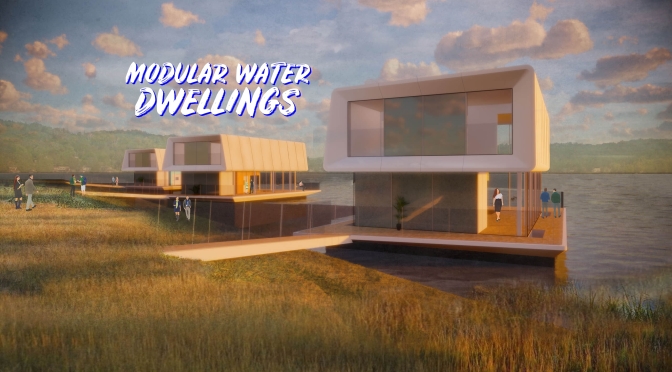
The Water Dwellings use minimal energy, with well-insulated and shaded lower pontoons and upper stories, and energy provided by solar roof panels and heat exchangers built into base boxes below the waterline. By developing a communal energy supply, the Water Dwellings’ environmental efficiency has the potential to achieve near zero energy use.
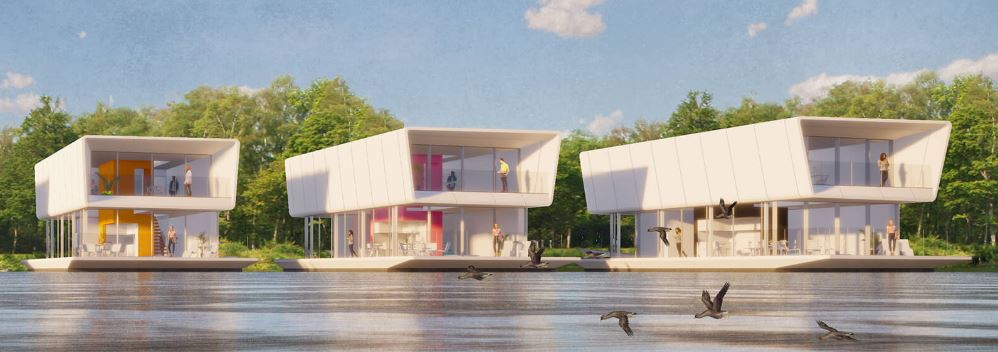
Global design practice Grimshaw and Dutch manufacturing specialists Concrete Valley have developed an innovative design for Modular Water Dwellings, in response to the growing risks of climate change and the challenges of increasing urbanisation.
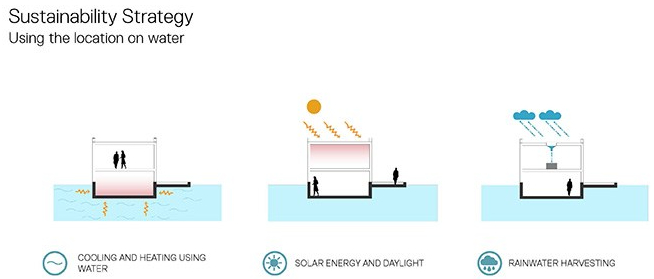
 The Modular Water Dwellings incorporate standardised components that provide efficiency in manufacturing, while still allowing a variety of internal layouts for occupants’ individual requirements. The Dwellings can be orientated and spaced in different ways, responding to varying site contexts, local conditions, light sources and primary views. They also maximise the use of durable and non-corroding materials, such as concrete and glass, ensuring a long design life that anticipates multiple occupants.
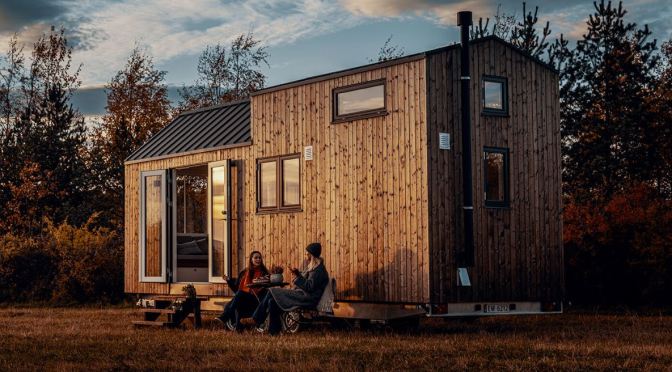
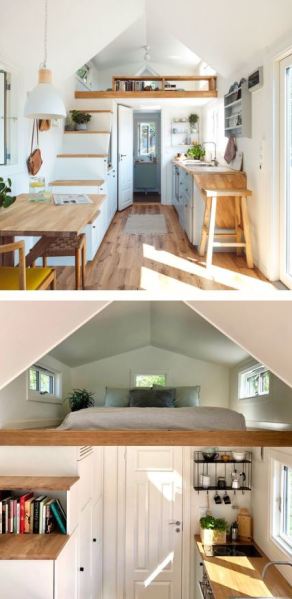 Norske Mikrohus is a Norwegian tiny home producer focused on the future and the climate. Our micro homes are built from natural materials, have a moderate energy consumption and a minimal footprint. Micro homes show us that it is possible to build small yet maintain a comfortable living standard.
We build houses of high quality, made with natural materials by skilled carpenters. We build for the harsh Norwegian climate and our homes are comfortable year around.
Micro homes are functional, complete dwellings with a space for daily activities, sleeping and a full size kitchen and bathroom. We have space for both a dishwasher and a washing machine. We aim for smart, multi-functional solution and build the furniture ourselves for better use of the space.
 Our houses comes with electric floor heating as standard, and combined with a small oven or a wood stove, you are guaranteed to stay warm all thought winter. Our biggest model has a total of 22 square meters floor area.
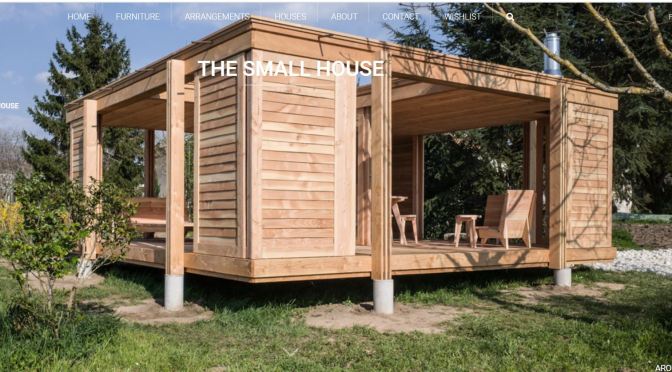
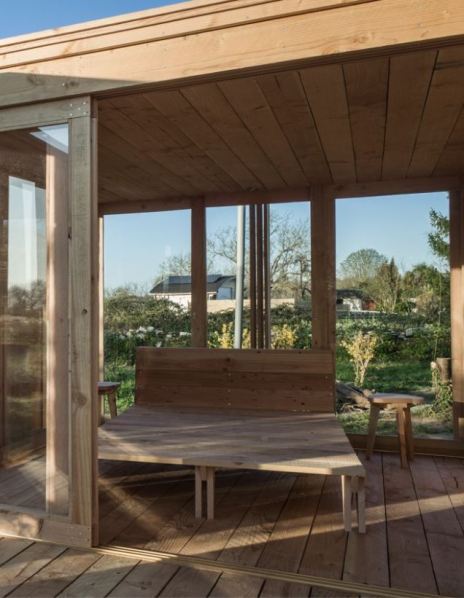 From reception pavilion to proper house, 2m26’s houses are unique pieces. They are produced made to measure, on demand. They absolutely fit to the landscape. The houses are made of pine planks, rough cuted. The structure is protected with linseed oil to resist to weather conditions and walnut stain can be added to obtain a dark color.
 The building process / prefab gives the opportunity to prepare all the pieces at the Atelier. Moreover, it reduces on site time of construction, damages on plants and minimizes noise pollution. On site construction can be scheduled from a week to a month.
Techniques used are mostly cutting, drilling, screwing, so that the assembly work can be done together with the customer, reducing costs for him.
About 2m26: Born in 2015, 2m26 summarizes ten years of researches and experiments about inhabiting.
Proceeding between design and architecture, 2m26 offers tools for living / handmade, thrifty and luxury / unique pieces designed and produced on demand / raw materials, natural processings and mastered development / simple, handsome and functional.
The crew :
mélanie heresbach / artist / architect.
sébastien renauld / artist / architect.
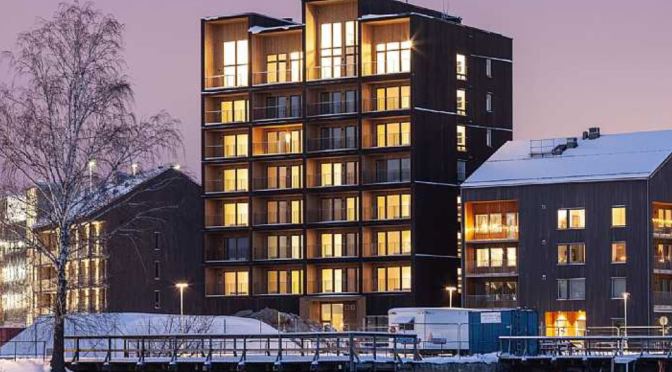
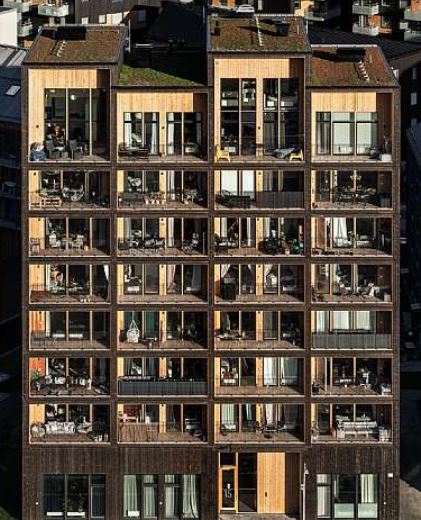 The Tall Timber Building residence has become a landmark and, during construction, became Sweden’s tallest solid wooden building in the new district of Kajstaden at Lake Mälaren in Västerås. All parts of the building consist of cross-laminated wood, which includes the walls, joists and balconies as well as the lift and stairwell shafts.
Kajstaden – Tall Timber Building is an important landmark for sustainable construction and a reference project that shows that conversion to climate conscious architecture is possible. Through research projects and several active wood projects, C.F. Møller Architects has focused on innovation as well as developing and implementing multi-storey buildings with solid wood frames. In Kajstaden, an active decision was made to prioritise industrial timber techniques for the building material to influence and take responsibility for the impact of the construction industry on the environment and climate change. A crucial advantage of wood, unlike other building materials, is that the production chain for the material produces a limited amount of carbon dioxide emissions. Instead, it is part of a closed cycle, where carbon is retained in the frame of the building.
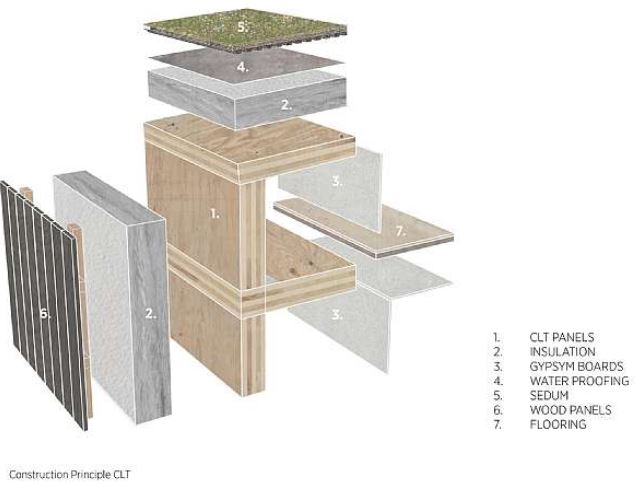
Research also shows that buildings with a wooden frame make a positive contribution to human health and well-being- thanks to better air quality and acoustic qualities.
A look back at our top 5 Tiny House videos of 2019! From unique tiny houses on wheels to a skoolie homestead, we share viewer favorites from the past year.
From a The Economist magazine article and podcast:
 The real California, though, the California of immigrant dreams that break and get reborn, of lives as they turn out not as they are planned, is the California of the eucalyptus.
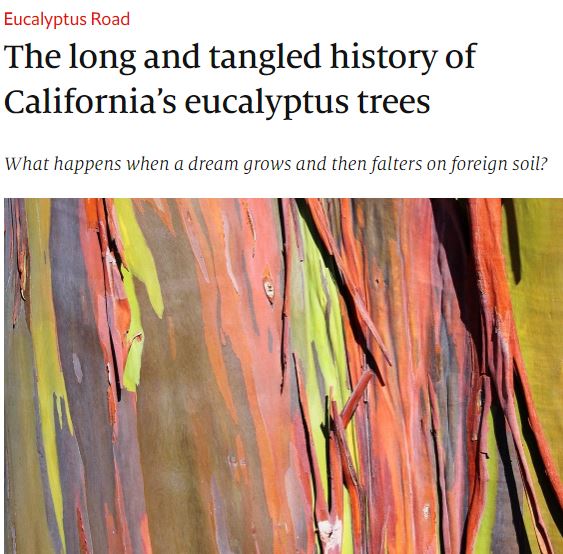 Like his friend John Muir, Lukens believed that California desperately needed more forests. Since the mid-19th century forests, and their loss, had been the principal focus of conservationist thought in America. According to Jared Farmer, who traces the history of the eucalyptus in California in “Trees in Paradise” (2013), Lukens and Muir were particularly keen on growing forests as a way to provide water—always a key to power in the state. Trees brought rain and captured fog and moisture; without forests, the men feared the state’s great cities would dry up.
“EUCALYPTUS PROMISES TO BE GREAT INDUSTRY”, announced the front page of the San Luis Obispo Daily Telegram, later claiming that what the speculators following where Lukens had led were planting “will be the largest artificial forest in the world when completed”.


 Boomers Daily