
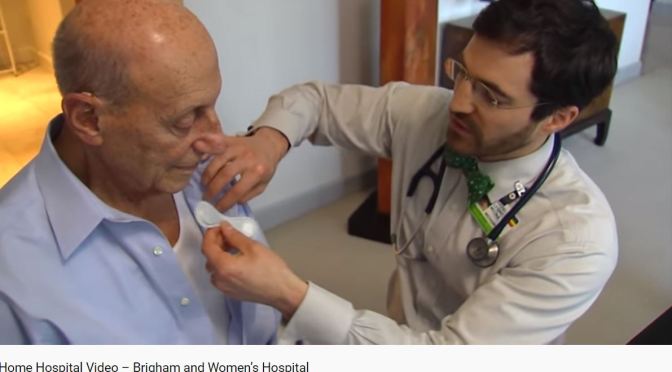
From a Harvard Gazette online article:
“This work cements the idea that, for the right patients, we can deliver hospital-level care outside of the four walls of the traditional hospital, and provides more of the data we need to make home hospital care the standard of care in our country,” said corresponding author David Levine, a physician and researcher in the Division of General Internal Medicine and Primary Care.
“It opens up so many exciting possibilities — it’s exciting for patients because it gives them the opportunity to be in a familiar setting, and it’s exciting for clinicians because we get to be with a patient in that person’s own surroundings. As a community-minded hospital, this is a way for us to bring excellent care to our community.”
The home hospital model of care — in which select patients receive hospital-level care for an acute illness from the comfort of their own home instead of in a traditional hospital — has become increasingly popular across the U.S.
To read more: https://news.harvard.edu/gazette/story/2019/12/home-hospital-model-reduces-costs-by-38-improves-care/
 This systematic review and meta-analysis of 11 studies involving 21 517 physicians demonstrated an association between physician depressive symptoms and an increased risk for perceived medical errors (RR, 1.95; 95% CI, 1.63-2.33). We also found that the magnitude of the associations of physician depressive symptoms and perceived medical errors were relatively consistent across studies that assessed training and practicing physicians, providing additional evidence that physician depression has implications for the quality of care delivered by physicians at different career stages.
 Health spending in the U.S. grew to $3.6 trillion in 2018, according to a new report from the federal government. The rate of growth — 4.6% — was up slightly from 2017’s 4.2%, despite the fact that nearly a million more Americans lacked insurance.
 A third of the nurses who took the survey are baby boomers and 20% of survey takers said they planned to retire in the next five years. More than a quarter, 27%, said they were unlikely to be working at their current job in a year.
 This proposed agency could work like a seal of approval, like the Energy Star program run by the Environmental Protection Agency, for new software, apps, and vendors that will be handling sensitive health information. Just like dishwashers evaluated by Consumer Reports, apps that handle personal health information should have a similar unbiased review process.
 But greater use of biosimilars could create significantly more savings. If biosimilars obtained a 75 percent market share, less than the share of these medicines in many European Union nations, the resulting annual savings for the U.S. healthcare system could be nearly $7 billion, based on Winegarden’s analysis.
 Health care is a big business, and our system reimburses hospitals and health care workers for caring for the sickest people rather than healthiest ones. This process depletes healers’ energy and often causes them to become exhausted and sick. That means all of us who work in or study to work in health care are at risk. To break this vicious cycle, we need self-scrutiny and willingness to change.
 Boomers Daily