No bloc of countries has, for the past 75 years, been as umbilically tied to the United States as Europe. First, its western half and, since the end of the Cold War, much of its eastern half have prospered under the world’s most extensive bonds in trade, finance, and investment. Europe could also depend on the U.S. military’s iron commitment—enshrined in the 75-year-old NATO alliance—to come to its defense. Together with a few other nations, the United States and Europe defined many of the institutions that comprise what we call the Western-led order. The U.S.-European alliance has arguably been the bedrock of the global system as we know it today.
Without Washington’s embrace, the continent could revert to an anarchic and illiberal past. By HAL BRANDS
Which is the real Europe? The mostly peaceful, democratic, and united continent of the past few decades? Or the fragmented, volatile, and conflict-ridden Europe that existed for centuries before that? If Donald Trump wins the U.S. presidential election in November, we may soon find out.
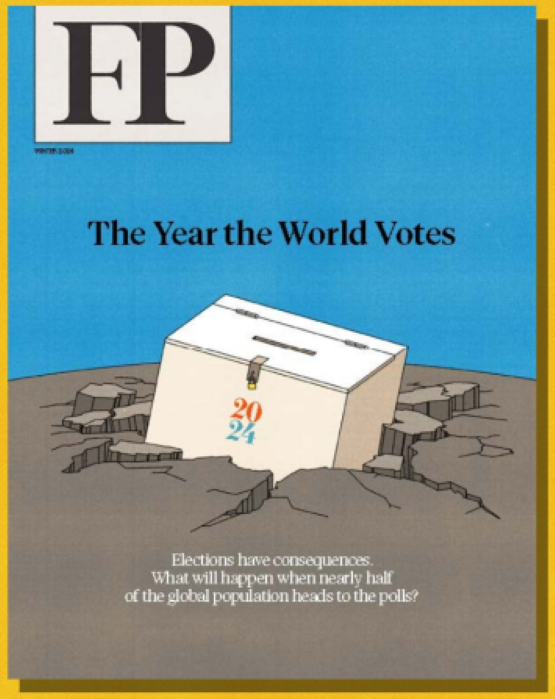
Foreign Policy Magazine – December 28, 2023: The new issue features ‘The Year The World Votes’ – Elections have consequences. What will happen when nearly half of the global population heads to the polls?
The world’s most dismal science could make Eurasia safe for illiberalism and predation—or protect it from those forces.
By Hal Brands, a professor of global affairs at the Johns Hopkins School of Advanced International Studies.
Alexander Dugin is a bit of a madman. The Russian intellectual made headlines in the West in 2022, when his daughter was killed, apparently by Ukrainian operatives, in a Moscow car bombing likely meant for Dugin himself. Dugin would have been targeted because of his unapologetic, yearslong advocacy for a genocidal war of conquest in Ukraine. “Kill! Kill! Kill!” he screeched after Russian President Vladimir Putin’s first invasion of that country in 2014, adding: “This is my opinion as a professor.” Even at his daughter’s funeral, Dugin stayed on message. Among her first words as an infant, he claimed, were “our empire.”
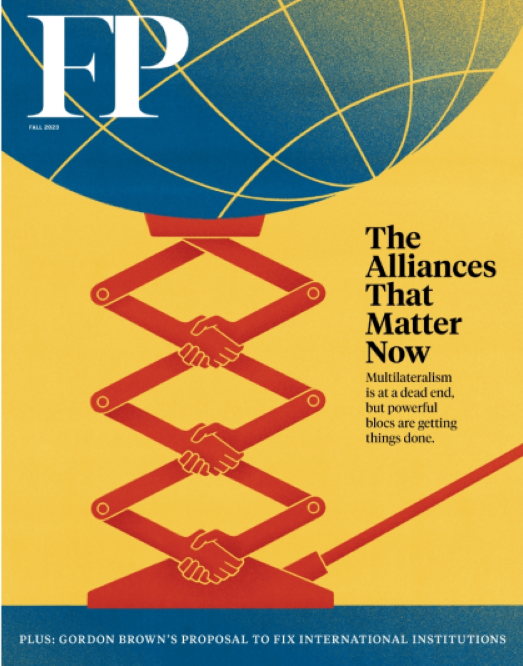
Foreign Policy Magazine – Fall 2023: The new issue features The G-7 Becomes a Power Player – Russia’s war and China’s rise are turning a talking shop into a fledgling alliance of democracies; Vivek Ramaswamy’s Foreign Policies Raise Eyebrows in Washington – The GOP’s rising star offers up a grab bag of ideas cribbed from Eminem to Richard Nixon and more…
Russia’s war and China’s rise are turning a talking shop into a fledgling alliance of democracies.
By G. John Ikenberry, a professor of politics and international affairs at Princeton University.
Time and again over the last century, the United States and the other liberal democracies in Europe, East Asia, and elsewhere have found themselves on the same side in grand struggles over the terms of the world order. This political grouping has been given various names: the West, the free world, the trilateral world, the community of democracies. In one sense, it is a geopolitical formation, uniting North America, Europe, and Japan, among others. It is an artifact of the Cold War and U.S. hegemony, anchored in NATO and Washington’s East Asian alliances.
End American dependence on Taiwan’s semiconductor factories. Declare economic independence from China. Give India an AUKUS-like submarine deal. And stage a dramatic visit to Moscow to broker a deal to end Russia’s full-scale invasion of Ukraine.
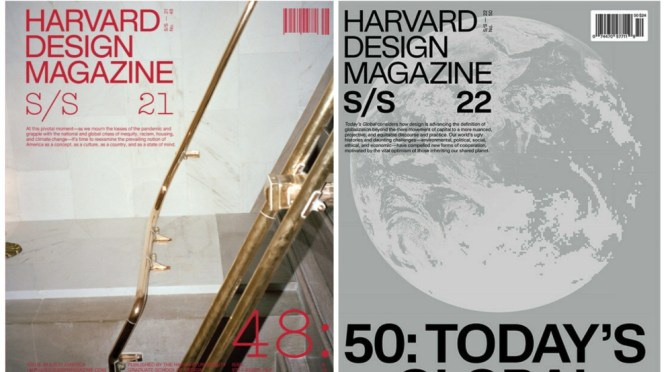
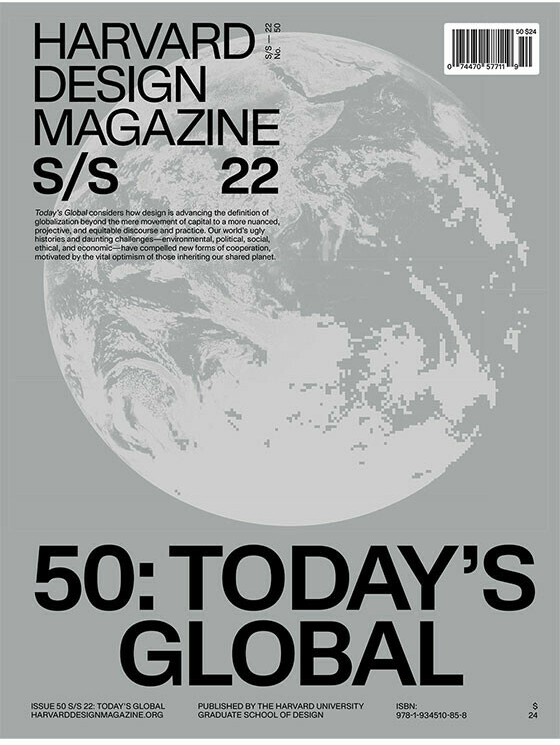
Harvard GSD – HARVARD DESIGN MAGAZINE S/S 22 (SUMMER 2023) – ISSUE 50: TODAY’S GLOBAL – How is design advancing the definition of globalization beyond the mere movement of capital to a more nuanced, projective, and equitable discourse and practice? Our world’s ugly histories and daunting challenges—environmental, political, social, ethical, and economic—have compelled new forms of cooperation, motivated by the vital optimism of those inheriting our shared planet.
Lewis Mumford in introducing his now-classic study The City in History wrote, “This book opens with a city that was, symbolically, a world: it closes with a world that has become, in many practical aspects, a city.”1 He saw among the chief functions of the city the conversion of energy into culture. Indeed, the city of old was the anchor of the surrounding culture and synonymous with it. However in the decades since he wrote, the energies of cities have been fueled by an increasingly diverse population with increasingly diverse cultures. Cities are the very places where we see the effects of global migration and face the questions of identity in a complex multicultural society. Today there are a multitude of cities that are, symbolically, the world with all its diversity. Not just New York and London, but Minneapolis and Leeds are today’s world-cities. And the globalization of people, communications, and transportation has created a world that is, in many ways, a city.
The architectural profession is in the midst of a long-overdue ethical reckoning. For years, it could ride the tidal wave of globalization to bigger and better commissions while still claiming that it was fighting the good fight. Nowadays, architects are more likely to be on the defensive. Our most celebrated architectural minds are routinely chastised in the media for placing personal vanity above the interests of the general public. And the fact that many of them have been far too willing to brush aside a client’s dubious ethics for the right commission has done little to dispel that perception.
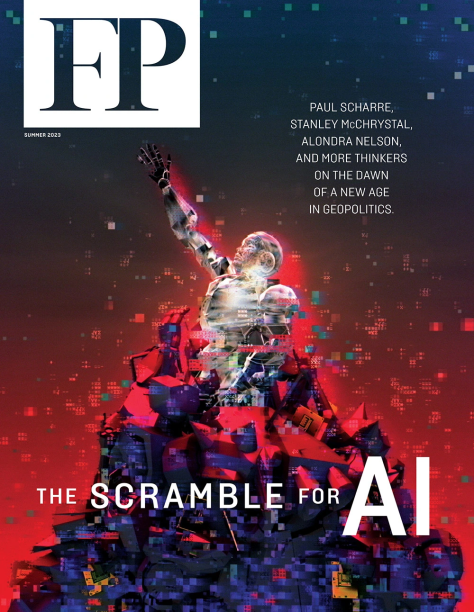
Foreign Policy Magazine – Summer 2023: Artificial intelligence is suddenly everywhere. It seems as though no conversation about jobs, education, health care, technology, or politics happens without an inevitable question about how AI could disrupt it all.
January 16, 2023 – Three essential articles read aloud from the latest issue of The Economist: the destructive new logic that threatens globalisation, how Brazil should deal with the bolsonarista insurrection (11:55) and a review of Prince Harry’s autobiography (16:45).
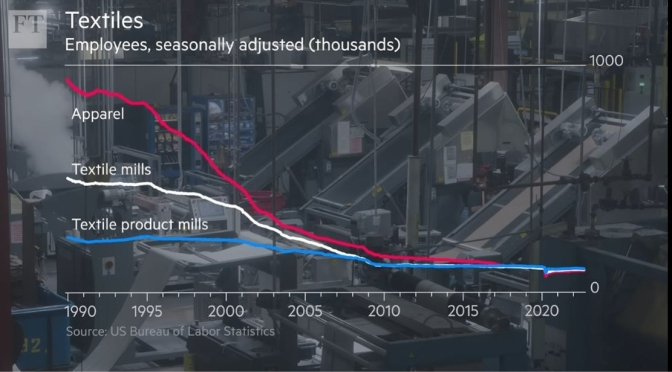
Financial Times – The FT’s global business columnist Rana Foroohar looks at why the US should bring manufacturing jobs back home. In the second of three films based on her new book, ‘Homecoming: the path to prosperity in a post-global world’, she follows the all-American supply chain of clothing company American Giant, to see how it impacts jobs, businesses and communities
Video timeline: 00:00 Made in America, Again 01:20 An all-American supply chain starts here 03:17 What went wrong with globalization? 07:00 The cotton gin – a risky business 09:53 Automation at a high-tech mill 13:16 Why manufacturing is important 19:59 The family-run finishing factory 23:21 Worker innovation at the sewing factory 27:33 Education, training and community 29:07 A moment for change?














 Boomers Daily