Tag Archives: Future of Work

World Economic Forum: Top Stories – Feb 25, 2023

World Economic Forum (February 25, 2023) – This week’s top stories of the week include:

0:15 This zero-emission truck drives itself – The truck is made by Swedish firm Einride. It says autonomous trucks could succeed where self-driving cars, so far, haven’t because freight trucks follow specific routes. Unlike car drivers, who often want freedom and spontaneity and specific, predictable routes require less complex autonomous technology. “But for a lot of transport, it’s actually the exact opposite. You don’t want it to be spontaneous. You don’t want it to suddenly be in another part of the country than it’s expected to be. [Trucks] need predictability. And they need to make sure that it actually arrives on time.”

2:48 Plastic-eating enzymes help recycle clothing – Scientists at the University of Portsmouth have identified more than 70 plastic-eating enzymes. This could divert millions of tonnes of textiles from landfill.

3:59 Why the ‘nowhere office’ is the future of work – This author thinks work will no longer be defined by a fixed time and place and that the culture of office presenteeism is over. The pandemic has changed people’s work habits forever. Many workers now see flexibility as a right, not a privilege. 40% of workers say they wouldn’t take a job without remote or hybrid options. Hobsbawm says we should be campaigning for new ways to value and pay for work, based around set outcomes rather than fixed hours as part of a momentous culture shift she calls ‘the great re-evaluation’.

7:04 Spain approves menstrual leave – It’s the first ‘menstrual leave’ law in Europe. People can take up to 3 days of leave a month paid for by the state if they suffer from cramps, nausea, dizziness or vomiting. In extreme cases, it can even be extended to 5 days. The sick leave will require a doctor’s note and will not cover those in mild discomfort. Similar laws exist in South Korea, Japan, Zambia and Indonesia

_____________________________________________

The World Economic Forum is the International Organization for Public-Private Cooperation. The Forum engages the foremost political, business, cultural and other leaders of society to shape global, regional and industry agendas. We believe that progress happens by bringing together people from all walks of life who have the drive and the influence to make positive change.
Future Of Work: Office Design Is Changing Cities

The pandemic and hybrid working have changed the very idea of the office. This is not only changing the design and purpose of offices, but the look of cities too.

Chapters 00:00 – The office: a shifting concept 00:57 – What do future offices look like? 02:30 – The office as a social destination 03:20 – The rising demand for flexible work 04:06 – How should hybrid employees be managed? 06:01 – Will hybrid work worsen gender inequality? 06:36 – How will flexible working reshape cities?

Global News: A Worker’s World, Amazon Effect On Sports, Japanese Poetry

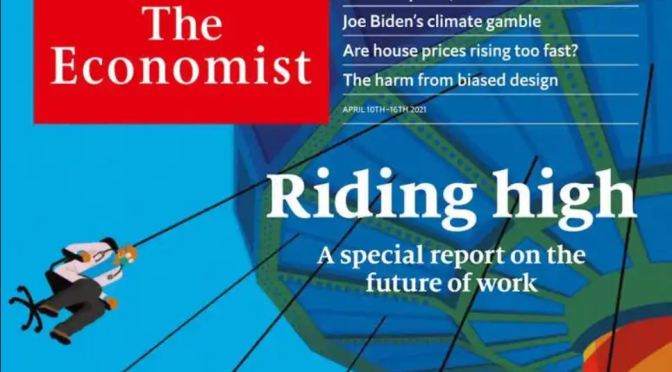
A selection of three essential articles read aloud from the latest issue of The Economist. This week, riding high in a workers’ worldthe Amazon effect on live sport (9:45) and even transience is mutating (17:35).

Podcast: The ‘Future Of Work’ (The Economist)

The pandemic has fuelled an explosion of unemployment and a transformation in how many people work, especially in richer countries. Many of these changes are promising and there are many reasons for optimism about the labour market

Also, the prospects for working from home and MIT labour economist David Autor on the effect of covid-19 on automation. Simon Long hosts

Employment: ‘How Small Cities Are Attracting Remote Workers’ (Video)

As the pandemic changes how — and where — professionals work, some smaller cities and regions are offering hefty relocation incentives to attract remote workers to help jumpstart their local economies. WSJ met one family who accepted an offer to make a new home in the Ozarks. Photo: Craig Kauffman for the Wall Street Journal

Telework: Large Exodus Of Workers From North To South Italy (Video)

In Italy, more than 100,000 people working in the north have returned to their native villages in the south because of the Covid-19 pandemic. They are continuing to work for their employers based in the north, but remotely. As a result, large northern cities are losing their workforces. Milan, an important business hub, has lost more than 12,000 inhabitants since February 2020. Meanwhile, towns in the south are benefitting from the arrival of these young remote working professionals, in a north-south exodus previously unheard of in Italy. Our correspondents report from Sicily.

The Future Of Work: ‘Is Working From Home A Long-Term Trend?’ (Video)

The white-collar world has been forced by Covid-19 into a “work from home” experiment, and the results are in. It turns out we can be just as productive at home, if not more so, and many don’t want to go back to the office — at least not full time. So what will happen to the office? Will we see workers coming in only when they have to? And if so, what does that mean to the multibillion- dollar commercial real estate industry?

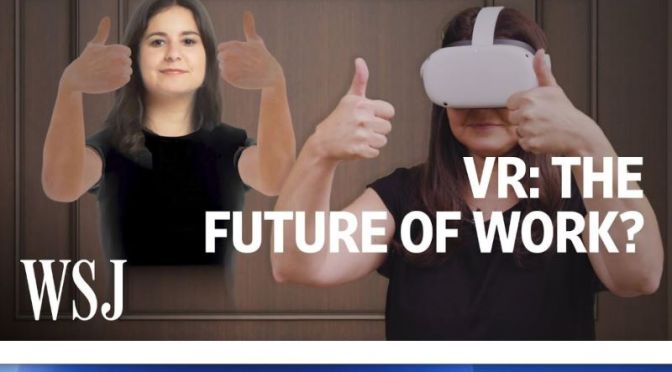
Future Of Work: ‘Virtual-Reality Headsets’ May Be The Next ‘Office’ (Video)

With a virtual-reality headset and a virtual meeting platform like Spatial, you can meet up and collaborate with your colleagues as if you were in a real office space. WSJ’s Joanna Stern transformed into a holographic avatar and got in a virtual elevator to test it out.

Photo illustration: Adam Falk