
Tag Archives: Freedom

Preview: Philosophy Now Magazine January 2025

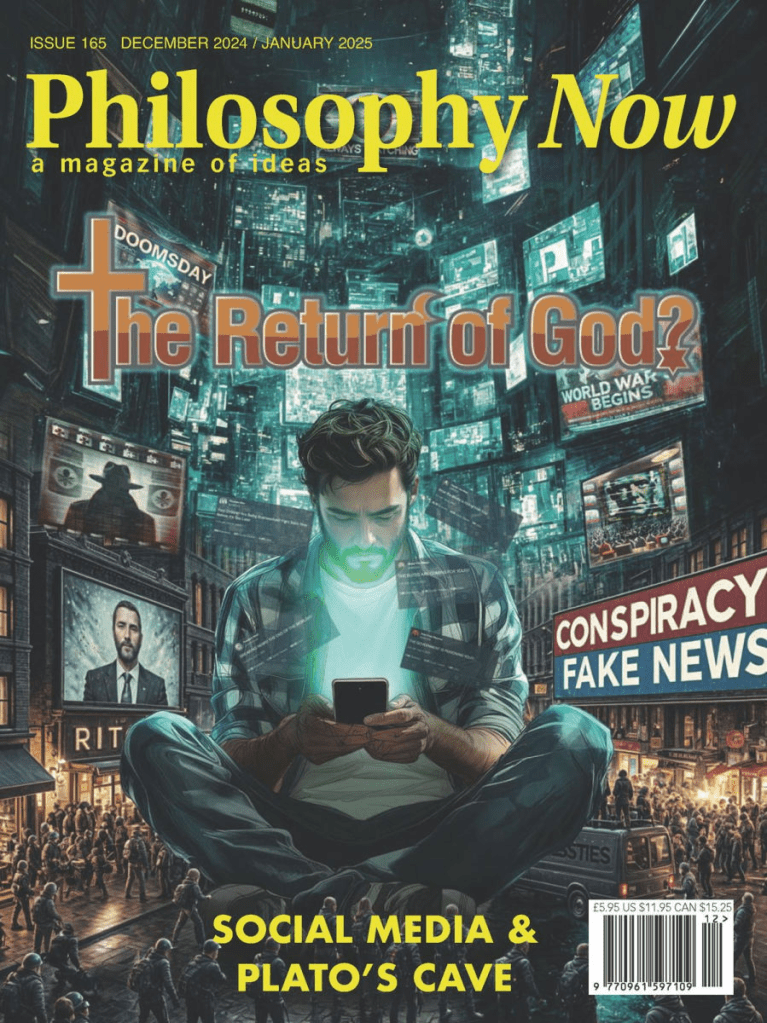
Philosophy Now Magazine (December 11,2024)The new issue features ‘The Return of God?’ and Social Media & Plato’s Cave…

Return to God?

by Rick Lewis

NEWS

News: December 2024 / January 2025

Lost Hegel lecture notes now being digitized • Professor Ted Honderich dead at 91 — News reports by Anja Steinbauer

SOCIAL MEDIA

Plato’s Cave & Social Media

Seán Radcliffe asks, has Plato’s Allegory of the Cave been warning us of social media for 2,400 years?

Trolls, Skeptics & Philosophers

Rosemary Twomey questions our online epistemology.

THE RETURN OF GOD?

Exploring Atheism

Amrit Pathak gives us a run-down of the foundations of modern atheism.

A Critique of Pure Atheism

Andrew Likoudis questions the basis of some popular atheist arguments.

Evil & An Omnipotent, Benevolent God

Zdeněk Petráček looks at the biggest problem facing monotheism.

A God of Limited Power

Philip Goff grasps hold of the problem of evil and comes up with a novel solution.

The Best Possible World, But Not For Us

Mohsen Moghri gives a Godless but principled response to the problem of evil.

Medieval Islam & the Nature of God

Musa Mumtaz meditates on two maverick medieval Muslim metaphysicians.

ARTICLES

Metaphors & Creativity

Ignacio Gonzalez-Martinez has a flash of inspiration about the role metaphors play in creative thought.

Seeing & Knowing

Shashwat Mishra explores the limits of perception via the Molyneux problem.

Perpetuating the Santa Deception

Jimmy Alfonso Licon wonders whether pretending there’s a Santa is naughty or nice.

Volney (1757-1820)

John P. Irish travels the path of a revolutionary mind.

How Can We Make A Computer Conscious?

Each answer below receives a random book. Apologies to the entrants not included.

INTERVIEWS

Robert Stern

Robert Stern talks with AmirAli Maleki about philosophy in general, and Kant and Hegel in particular.

LETTERS

Letters

Thoughts on Thoughts on Thoughts • Get Smarter • Decoding A Decoding • A Swift Rebuttal • Basic Arithmetic • A Message on Meaning

COLUMNS

Xenophanes (c.570-c.478 BCE)

by Terence Green

Philosophers on Dance

by Matt Qvortrup

“I refute it thus”

Raymond Tallis kicks immaterialism into touch.

Seneca On Anger

Massimo Pigliucci tells us how to avoid becoming irate.

REVIEWS

Too Late To Awaken by Slavoj Žižek

T.W.J Moxham reads Slavoj Žižek’s little book of Hegelian horrors.

Barriers to Entailment by Gillian Russell

Christopher John Searle recommends a study of which moves are allowed in logical arguments.

It’s A Wonderful Life

Becky Lee Meadows considers questions of guilt, innocence, and despair in this classic Christmas movie.
World Affairs: Trend Magazine – Fall 2024

Image

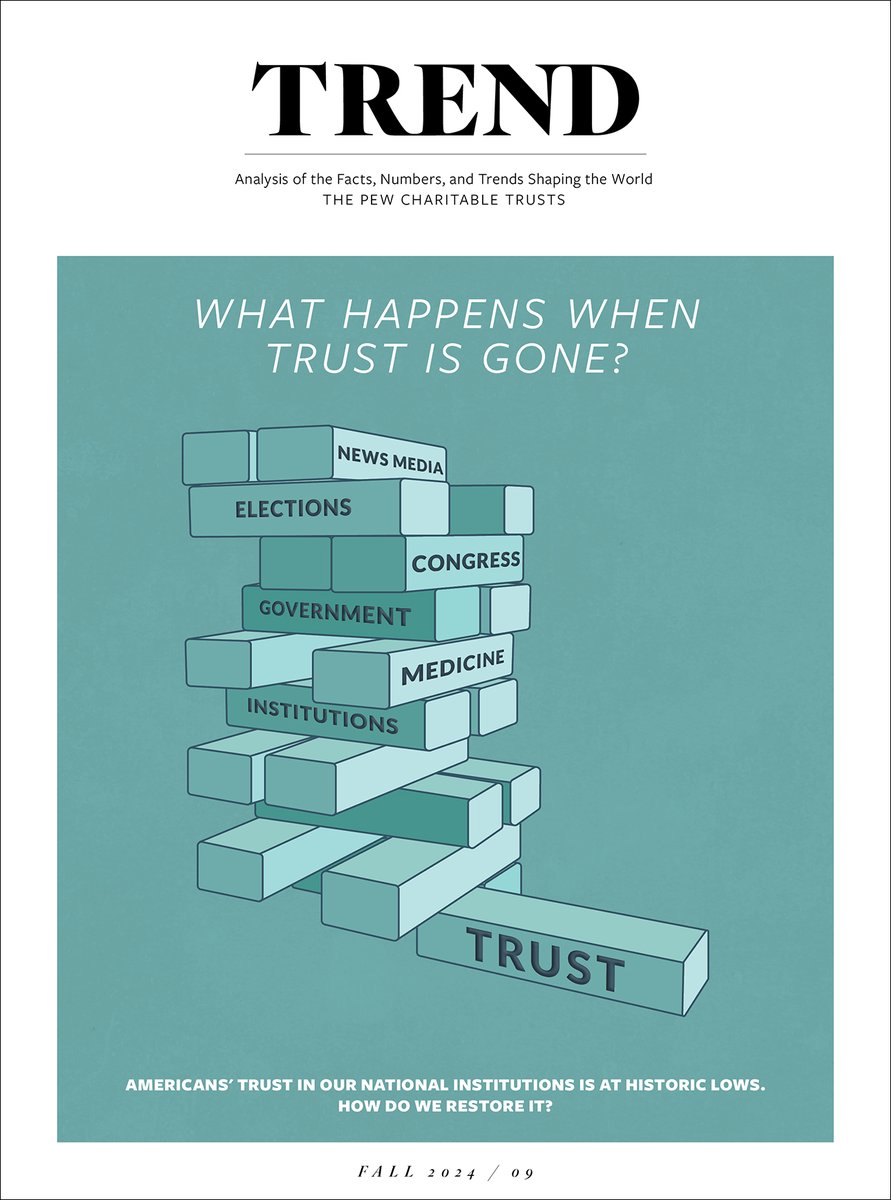
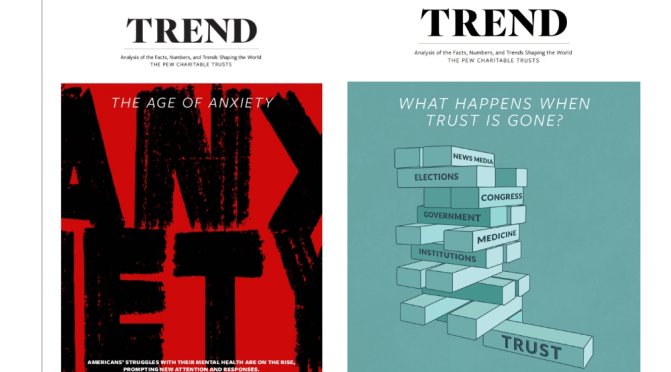
Trend Magazine (October 17, 2024) – How to Restore Trust in Elections, Media Mistrust Has Been Growing for Decades, Can Science and Health Care Gain What’s Missing?; How Better Policies Can Help Build Trust

Americans’ Mistrust of Institutions

Trust in our nation’s institutions has never been lower. And experts tend to blame our politically polarized society, which certainly contributes to the deep unease that is being felt by a majority of…

Data Behind Americans’ Waning Trust in Institutions

If mistrust were a disease, the United States would be facing an epidemic. Over the last half-century, trust in American institutions has steadily declined, and this mistrust has rapidly increased in…

The Founding Debate on Trust in America

As our nation grapples with growing mistrust of all institutions, including the federal government, it’s important to remember that this is not a new debate, but one that has been embedded in the American…

5 Ways to Rebuild Trust in Government

Only 1 in 5 Americans trust the federal government—so how do we restore public confidence? For more than two decades, the Partnership for Public Service has worked across presidential administrations to…

Nobody Roots for Goliath: Why Americans Trust Small Business

We root for David, the underdog facing impossible odds, who stands in contrast to Goliath, the big bully. So maybe it’s not surprising that Americans root for small business in contrast to big business.

Archive

Fall 2023

Winter 2022

Winter 2021

Spring 2020

Spring 2019

Winter 2018

Browse Pa

Preview: Philosophy Now Magazine October 2024

Philosophy Now Magazine (September 30,2024)The new issue features ‘The Thoughts on Thoughts Issue’….

Atomism & Smallism

Raymond Tallis wonders what the world is made from.

Preview: Philosophy Now Magazine Aug/Sept 2024

Philosophy Now Magazine (August 12,2024)The new issue features ‘The Politics of Freedom’…

The Politics of Freedom

by Rick Lewis

News: August/September 2024

Elixir of extended life for mice • Nicholas Rescher mini obituary • Nietzsche exhibition in his childhood home — News reports by Anja Steinbauer

Freedom & State Intervention

Audren Layeux follows the doomed quest for state emancipation of the self.

Value Pluralism & Plurality of Choice

Christophe Bruchansky looks at maximising the diversity of choice.

The Unfreedom of Liberty

Arianna Marchetti reflects on the limits of political freedom.

On Retributive Punishment

Oliver Waters asks, is retributive justice justified in a modern society?

The Domesticated Foxes of Bastøy

Veronique Aïcha considers the ideology of imprisonment.

Preview: Philosophy Now Magazine June/July 2024

Image

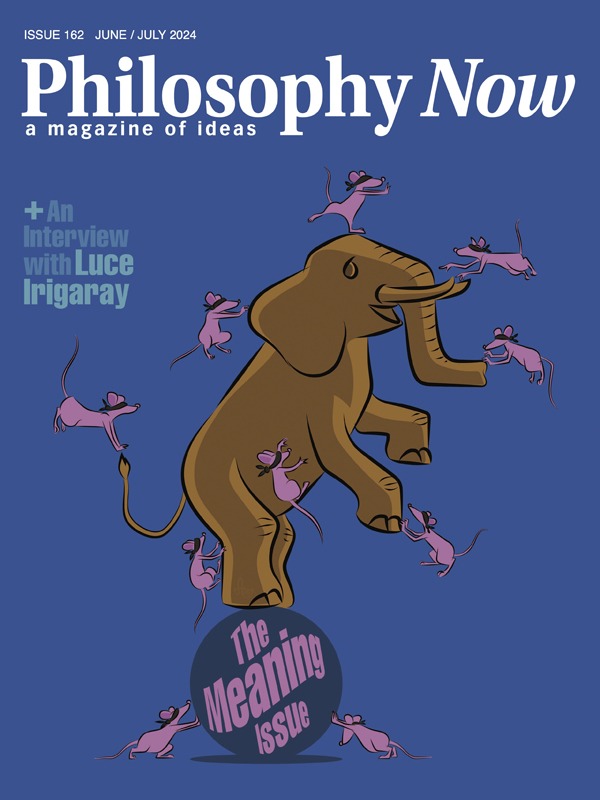
Philosophy Now Magazine (June/July 2024)The new issue features ‘The Meaning Issue’…

The Search for Meaning

by Rick Lewis

A famous parable dating back to ancient India involves some blind monks encountering an elephant. The monks each touch just one part of the elephant, and afterwards they compare notes. One declares that the creature feels like a snake, another that it has a shape like a tree trunk and so on. Like many parables, you can interpret it in different ways, but it seems to be saying that even for something that is an objectively real part of the world, like an elephant, it is possible to have different subjective views of it, all of which may be valid.

Luce Irigaray interviewed by Octave Larmagnac-Matheron and translated by Mélanie Salvi.

Philosophers Exploring The Good Life

Jim Mepham quests with philosophers to discover what makes a life good.

The Present Is Not All There Is To Happiness

Rob Glacier says don’t just live in the now.

What Is Life Worth?

Michael Allen Fox wonders whether life really is ‘a precious gift’.

Preview: Philosophy Now Magazine April/May 2024

Image

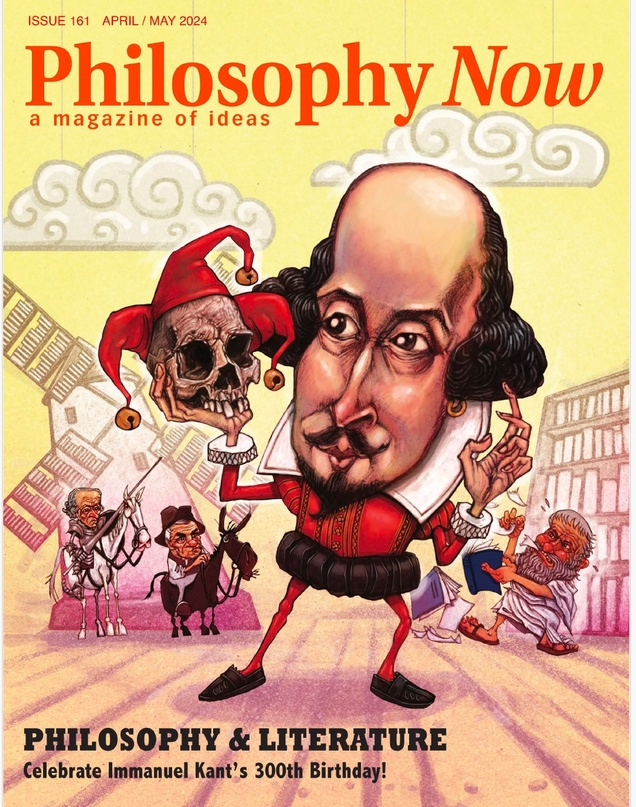
Philosophy Now Magazine (April/May 2024)The new issue features ‘Philosophy & Literature’ – Celebrate Immanuel Kant’s 300th Birthday….

How to Have a Good Life

Meena Danishmal asks if Seneca’s account of the good life is really practical.

According to the Oxford English Dictionary, the adjective ‘stoical’ means “resembling a Stoic in austerity, indifference, fortitude, repression of feeling and the like”. This gives us some idea of what it is like to be a Stoic. Indeed, the key teaching, arguably the fundamental point, of Stoicism, is that we should focus on controlling the things that are under our control, such as our thoughts, emotions, and actions, whilst accepting those things we cannot control, such as most things that are happening in the world. How did they get there?

To consider this question let’s look at the ideas of the Roman philosopher and statesman Lucius Annaeus Seneca the Younger (4 BCE-65 CE). As a top advisor to the paranoid and murderous Emperor Nero, he probably found Stoicism a particularly practical guide to life.

As a Stoic, Seneca believed the soul (Latin: anima or animus) to be a finer form of matter than the body; but matter it is. It was also described as a spark of the fire which had consumed the original matter. With such an understanding of the soul, where does the soul reside within the body? Stoics provided a rather simple answer: everywhere. The soul was considered to be a vital force that animates the whole body. The soul was also the source of reason, virtue, and moral character, which is what Stoic philosophy is built upon, as the rational soul guides individuals towards living in accordance with nature.

For us to understand this concept further, it’s vital to grasp the Stoic conception of reality. Stoics see the universe as interconnected and interwoven, and this unified cosmos as governed by rational principles. Within this holistic perspective, the soul is seen as part of the divine rational order of the universe. This understanding forms the basis of Stoic ethics, which emphasises the importance of cultivating reason and virtue in all aspects of life. This encouragement to align thoughts, actions, and desires with principles of reason, is a way for the soul to flourish.

Preview: Philosophy Now Magazine February 2024

Image

Philosophy Now Magazine (February/March 2024)The new issue features ‘Irish Philosophy’ – Pure Philosophy, No Blarney; Steven Pinker – On Violence and Metaphors…

Steven Pinker

Steven Pinker is the Johnstone Family Professor of Psychology at Harvard University, and a popular writer on linguistics and evolutionary psychology. Angela Tan interviews him about politics, language, death, and reasons to be optimistic.

Thomas Duddy & Irish Philosophy

Tim Madigan travels through time to seek the essential nature of Irish thought.

Irish Philosophy & Me

Cathy Barry charts her journey through historical Irish thought.

Edmund Burke & the Politics of Reform

Jon Langford outlines conservative insights gained from revolutionary failures.

Philip Pettit & The Birth of Ethics

Peter Stone thinks about a thought experiment about how ethics evolved.

Preview: Philosophy Now Magazine January 2024

Image

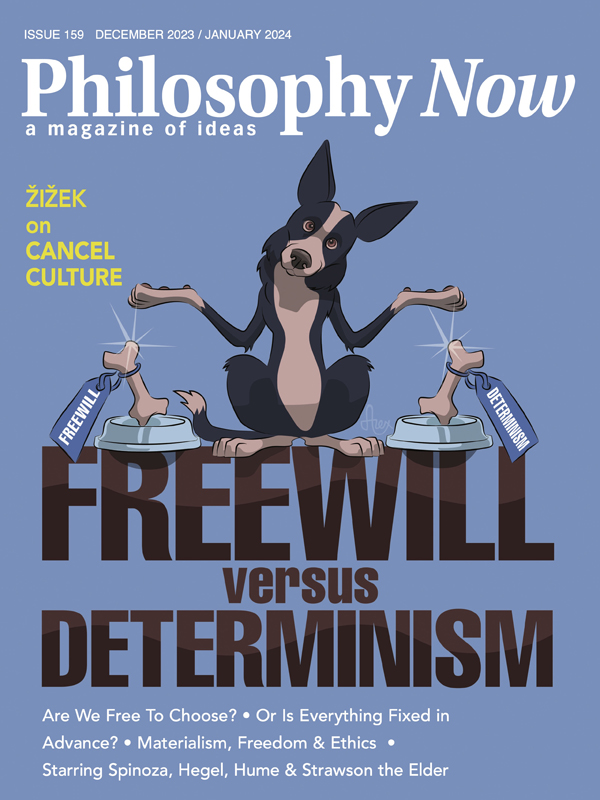
Philosophy Now Magazine (December 2023/January 2024) – The new issue features Freewill versus Determinism – Are we free to choose? Or is Everything Fixed In Advance?; Materialism, Freedom and Ethics; Žižek on Cancel Culture; Spinoza, Hume and other Determinists, and more…

Spinoza & Other Determinists

Myint Zan compares different ways of denying free will.

What Is Free Will?

Grant Bartley wants to know what the problem with freedom is all about.

Criticising Strawson’s Compatibilism

Nurana Rajabova is wary of an attempt to dismiss determinism to keep free will.

Materialism, Freedom & Ethics

Philip Badger constructs a materialist ethical theory, with the help of John Rawls.

The Will Is Not Free: You Have To Earn It

Basil Gala on what it takes to free ourselves from our formative factors.

Covid-19: Patients Dying In Name Of Vaccine Freedom

In the video above, Alexander Stockton, a producer on the Opinion Video team, explores two of the main reasons the number of Covid cases is soaring once again in the United States: vaccine hesitancy and refusal. “It’s hard to watch the pandemic drag on as Americans refuse the vaccine in the name of freedom,” he says. Seeking understanding, Mr. Stockton travels to Mountain Home, Ark., in the Ozarks, a region with galloping contagion and — not unrelated — abysmal vaccination rates. He finds that a range of feelings and beliefs underpins the low rates — including fear, skepticism and a libertarian strain of defiance. This doubt even extends to the staff at a regional hospital, where about half of the medical personnel are not vaccinated — even while the intensive care unit is crowded with unvaccinated Covid patients fighting for their lives. Mountain Home — like the United States as a whole — is caught in a tug of war between private liberty and public health. But Mr. Stockton suggests that unless government upholds its duty to protect Americans, keeping the common good in mind, this may be a battle with no end.

Morning News: Tokyo Olympics Controversies, V.P. Politics & Freedom

The Olympics are less than three weeks away and over this past weekend we saw three big headlines, all having to do with restrictions that have primarily affected women of color and intersex people. 

And it’s left many fans wondering who these Olympic rules are actually serving.

  • And, infighting in the Vice President’s office.
  • Plus, Noah Feldman — and you — on what freedom means in America now.

Guests: Axios’ Ina Fried, Margaret Talev and Harvard University constitutional law professor Noah Feldman.