Tag Archives: Education

THE GUARDIAN WEEKLY – NOVEMBER 7, 2025 PREVIEW

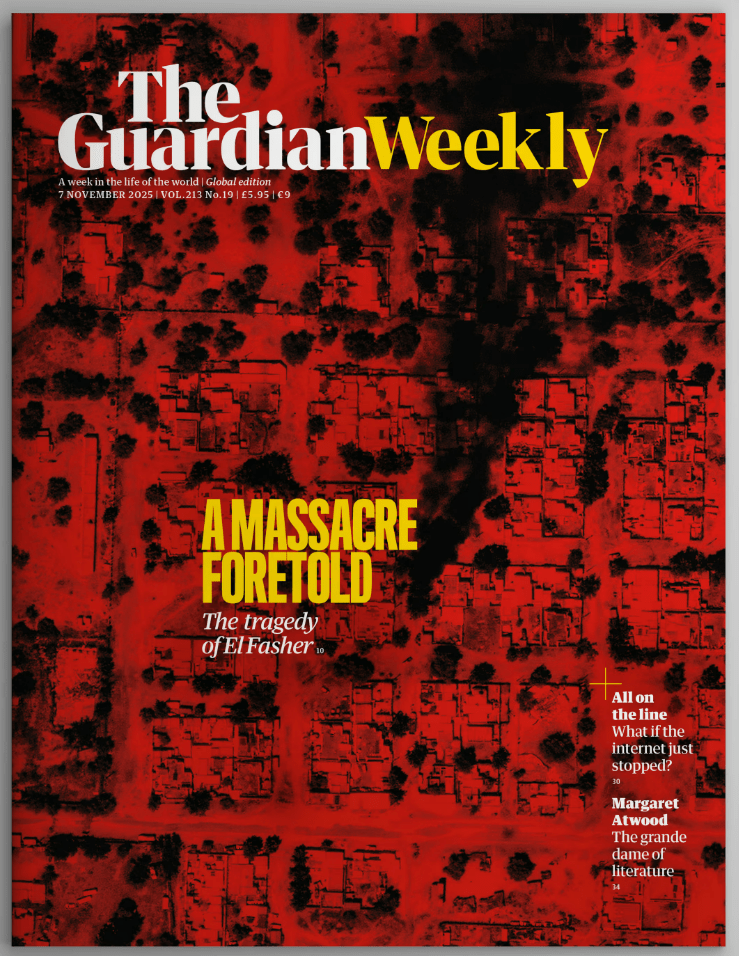
THE GUARDIAN WEEKLY: The latest issue features ‘A Massacre Foretold’ – The Tragedy of El Fasher’

For some time now, El Fasher in Sudan has been a city beyond the reach of journalists. But the haunting satellite image on our cover this week, of smoke billowing from fires near El Fasher’s airport, told its own story as starkly as anything that could be reported from the ground.

Other satellite images showed clusters of burned-out vehicles, and what appeared to be pools of blood beside piles of bodies on the ground. A massacre was under way that could be seen from space.

The last major city in Darfur to fall to the Rapid Support Forces (RSF) was already the scene of catastrophic levels of human suffering, but has “descended into an even darker hell”, senior UN officials warned last week. This key moment in the two-and-a-half-year-long civil war has unfolded in plain sight with minimal intervention from the international community, unless you count the United Arab Emirates, which has been arming the RSF paramilitaries.

Spotlight | The Andrew formerly known as a prince
Stupidity and self-entitlement sank King Charles III’s disgraced younger brother – and the royal reckoning may not be over yet, writes Stephen Bates

Technology | What if the internet just … stopped working?
Could everything suddenly go offline and if so, how? Aisha Down goes inside the fragile system holding the modern world together

Interview | Margaret Atwood puts the world to rights
At 85, she’s a literary seer and saint – and queen of the Canadian resistance. So what does the writer make of our dystopian society? Lisa Allardice finds out

Opinion | World leaders: Cop30 could be your great legacy
With the US backing away from the climate crisis, now is the moment when other nations must step up, says former British prime minister Gordon Brown

Culture | Back to black with Lynne Ramsay
The Scottish film director burst on to the scene with Ratcatcher and terrified audiences with We Need to Talk About Kevin. Her latest film stars Hollywood darling Jennifer Lawrence, but it doesn’t flinch from the dark side of family life, finds Amy Raphael

THE GUARDIAN WEEKLY – OCTOBER 31, 2025 PREVIEW

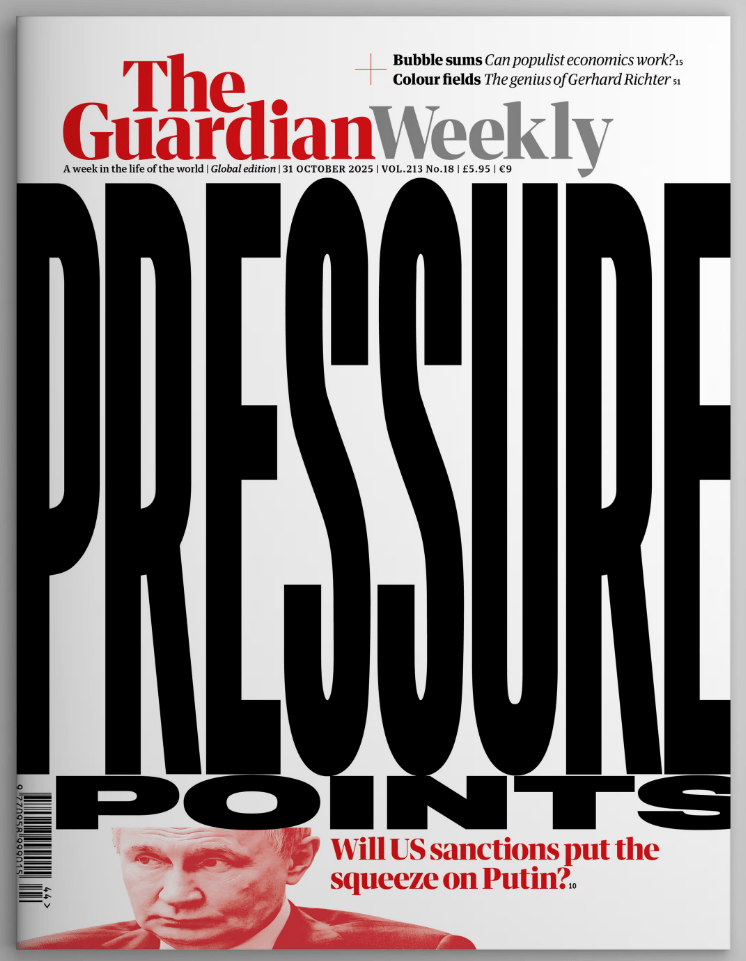
THE GUARDIAN WEEKLY: The latest issue features ‘Pressure Points’ – Will US sanctions put the squeeze on Putin?

Donald Trump’s sudden decision last week to sanction Russian oil producers suggested the US president has finally lost patience with Vladimir Putin after a series of fruitless talks over ending the war in Ukraine.

Could it break the deadlock? Oil sanctions have the potential to genuinely damage Moscow’s finances, as the Russian president himself admitted last week. It remains to be seen, though, whether economic pressure alone can bend Putin’s arm over a conflict he views as defining to his legacy.

In this week’s big story, Guardian Russia affairs reporter Pjotr Sauer asks whether sanctions could succeed where diplomacy has failed, while Christopher S Chivvis of the Carnegie Endowment for International Peace argues that a negotiated settlement remains the likeliest way to bring nearly four years of fighting to a halt.

In the frontline Ukrainian city of Kupiansk, senior reporter Peter Beaumont finds little hope of a quick resolution, with much of the population having left and the remaining soldiers stuck in a war they believe is “going nowhere for either side”.

Five essential reads in this week’s edition

Spotlight | The populist leaders’ economic playbook
From Milei to Meloni, are the economics of populism always doomed to failure? This long read from economics editor Heather Stewart tries to bridge the gaps between populist aspiration and fiscal reality

Environment | The deadly migration routes of elephants
Human-wildlife conflict has overtaken poaching as a cause of fatalities among elephants – and is deadly for people too. Now some villages are finding new ways to live alongside the mammals, reports Patrick Greenfield

Interview | Is Jimmy Wales the good guy of the internet?
The Wikipedia founder stands out from his contemporaries for being driven by more than money. But can the people’s encyclopedia withstand attacks from AI and Elon Musk? By David Shariatmadari

Opinion | Without genuine truth and justice, the war in Gaza cannot end
A fragile ceasefire is in place, but what’s needed is an international tribunal for resolution and reparation. That’s the only route to lasting peace, argues Simon Tisdall

Culture | The electrifying genius of Gerhard Richter
He has painted everything from a candle to 9/11, walked his naked wife through photographic mist, and turned Titian into a sacred jumble. A new Paris show reveals the German artist in all his contradictory brilliance, says Adrian Searle

THE GUARDIAN WEEKLY – OCTOBER 24, 2025 PREVIEW

THE GUARDIAN WEEKLY: The latest issue features ‘Youth Quake’ – How Gen Z protesters toppled Madagascar’s leader.

Madagascar rarely makes front page news but the toppling of its president by protesters led by Gen Z Madagascar is part of a phenomenon that stretches from Nepal to Indonesia and the Philippines to Morocco. Leaderless groups, formed online, have learned from one another as they take to the streets to vent their frustration against what they see as corrupt older elites and a lack of economic opportunity for their generation.

Our southern Africa correspondent, Rachel Savage, explains how a tumultuous month unfolded on the Indian Ocean island and explores the deep-seated discontent that led to the military siding with student demonstrators to force President Andry Rajoelina out of power.

Five essential reads in this week’s edition

Spotlight | A far-right fight club on their hands
Ben Makuch reports on security service monitoring of ‘active clubs’ as they move across borders to spread extremism, mixing the behaviour of football hooligans with the ideology of the Third Reich

Benin bronzes at the Metropolitan Museum of Art in New York.
Benin bronzes at the Metropolitan Museum of Art in New York. Photograph: Art2010/Alamy

Spotlight | Nothing to see here?
Due to open within weeks, Nigeria’s Museum of West African art is intended to showcase the Benin bronzes and other masterpieces stolen by 19th-century colonisers. But the project has been beset by political rows that mean, as Philip Oltermann and Eromo Egbejule report, visitors will see more replicas than original pieces

Science | Waiting for graphene to explode
Two decades after the material was first produced and then much hyped, graphene has dropped from business and general discussion. Julia Kollewe reports on the successes and setbacks of taking it from lab to mainstream use

Opinion | An A-level in English won’t make integration work
A government demand that immigrants get a qualification that most British citizens don’t have if they want to earn the right to stay is the latest absurd way to focus on ‘outsiders’ rather than address domestic problems, argues Nesrine Malik

Culture | The hardest part
David Harewood reflects on returning to play Othello after almost 20 years and with fellow Black actors looks at how attitudes to Shakespeare’s most difficult tragedy have changed


What else we’ve been reading

The year’s Stirling prize has gone to a social housing complex for older people in south-east London. Catherine Slessor writes with great enthusiasm about how the award-winning architects Witherford Watson Mann have completely reimagined accommodation for later life. Out with disorientating corridors, in with bright, informal, nature filled spaces, described by the Stirling judges as “a provision of pure delight”. Emily El Nusairi, deputy production editor

Kathryn Lewek as the Queen Of The Night in The Magic Flute at the Royal Opera House.
Kathryn Lewek as the Queen Of The Night in The Magic Flute at the Royal Opera House. Photograph: Tristram Kenton/The Guardian

I saw The Magic Flute in Paris last year, and it was fascinating to see how different opera houses interpret the staging. This review of a London production made me reflect on the way different directors handle staging and sound to bring the story to life. It reminded me of listening to the Queen of the Night’s aria when I was growing up and the experience of seeing opera live. Hyunmu Lee, CRM executive

HARPER’S MAGAZINE – NOVEMBER 2025 PREVIEW

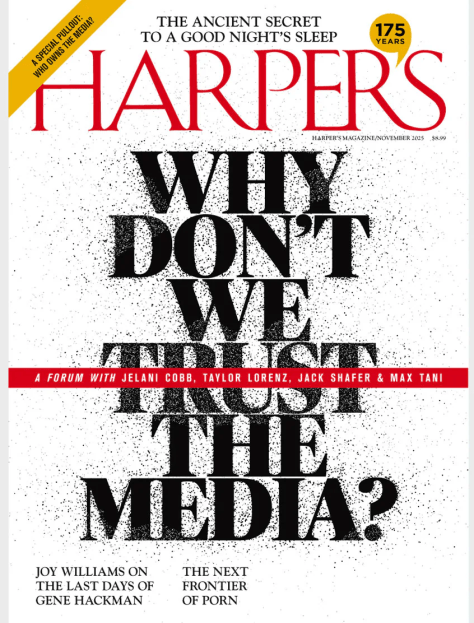
HARPER’S MAGAZINE: The latest issue features ‘Why Don’t We Trust The Media?’

Why Doesn’t Anyone Trust the Media?

Anatomy of a credibility crisis by Jelani CobbTaylor LorenzJack ShaferMax Tani

The Goon Squad

Loneliness, porn’s next frontier, and the dream of endless masturbation by Daniel Kolitz

One Four Two Five Old Sunset Trail

On the last days of Gene Hackman by Joy Williams

HARVARD MAGAZINE – NOVEMBER/DECEMBER 2025

November-December 2025 | Harvard Magazine

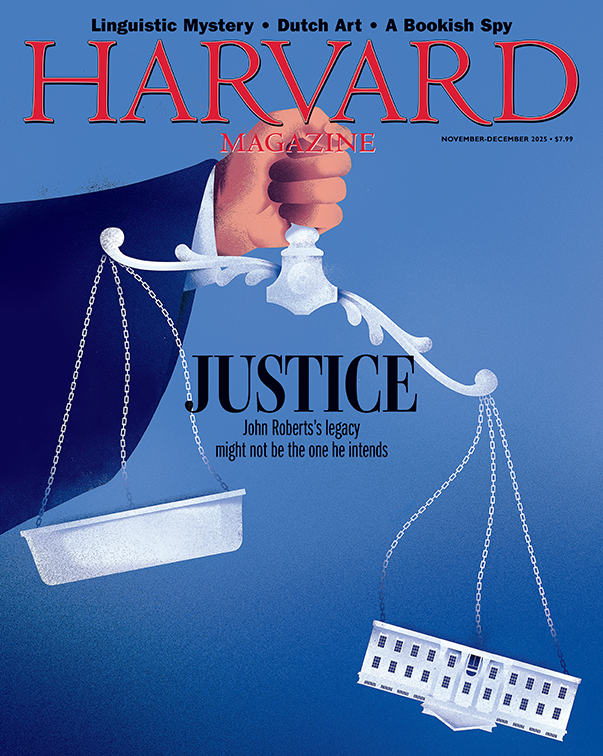
HARVARD MAGAZINE: The latest issue features ‘Justice’ – John Roberts legacy might not be the one he intends.

What Trump Means for John Roberts’s Legacy

Executive power is on the docket at the Supreme Court. by Lincoln Caplan

This Harvard Scientist Is Changing the Future of Genetic Diseases

David Liu has pioneered breakthroughs in gene editing, creating new therapies that may lead to cures. by Veronique Greenwood

Why America’s Strategy For Reducing Racial Inequality Failed

Harvard professor Christina Cross debunks the myth of the two-parent Black family.

HARPER’S MAGAZINE – OCTOBER 2025 PREVIEW

HARPER’S MAGAZINE: The latest issue features ‘Soldiers Of Misfortune’ – Why the world’s richest military keeps losing wars.

Mission Impossible

The sad state of the American armed forces by Seth Harp

The Good Pervert

A friend’s life, a brutal death by David Velasco

Bedside Manners

Can empathy be taught in medicine? by Rachel Pearson

The One-Room Rebellion

How Arizona’s microschool boom is reshaping the American classroom—and reviving old questions about freedom, equity, and the gaze of the state.

By Michael Cummins, Editor, August 21, 2025

Jeremy Bentham never saw his  panopticon built. The English philosopher imagined a circular prison with a central watchtower, where a single guard could observe every inmate without being seen. Bentham saw it as a triumph of efficiency: if prisoners could never know when they were being watched, they would behave as though they always were. A century later, Michel Foucault seized on the design as metaphor. In Discipline and Punish, he argued that the panopticon revealed the true mechanics of modern institutions—not brute force, but the internalization of surveillance. The gaze becomes ambient. The subject becomes self-regulating.

This, in many ways, is the story of the American public school. The common school movement of the mid-nineteenth century, led by Horace Mann, sought standardization: children from Boston to St. Louis would recite the same lessons, read the same primers, and adopt the same civic habits. As cities grew, schools scaled up. By the twentieth century, especially in the wake of A Nation at Risk, the classroom had become a site of discipline. Bells regulated time. Grades ranked performance. Administrators patrolled hallways like wardens. Testing regimes quantified ability. The metaphor was not lost on Foucault. Brown University notes that his vision of the panopticon extended beyond prisons to schools: a “system of surveillance where individuals internalize the feeling of being constantly watched, leading to self-regulation of behavior” (Brown University).

Every American child knows this regime. The bell rings. The roll is called. The test is bubbled and scanned. Hall passes are signed like parole slips. Cameras blink in cafeteria corners. Laptops carry software that tracks keystrokes. Even silence becomes an instrument of order.

Bentham saw efficiency. Foucault saw discipline. Students often see only the weight of the watchtower.

What happens when families walk out of the circle?

In the far suburbs of Phoenix, on the edge of the White Tank Mountains, a converted casita serves as the Refresh Learning Center. Founded in 2023 by a pastor and his wife, it doesn’t look like much—aluminum siding, recycled chairs, a wall chart that places the birth of the universe at 4004 B.C. Yet, as Chandler Fritz wrote in the September 2025 issue of Harper’s Magazine, the little school has become an emblem of a movement reshaping American education.

Its existence rests on a radical policy shift. In 2022, Arizona launched the nation’s most expansive Empowerment Scholarship Account (ESA) program. Unlike traditional vouchers, which could be redeemed only at approved institutions, ESA funds flow directly to parents—roughly $7,500 per student, sometimes more. Families can spend the money on almost anything that counts as “educational”: a cello, a VR headset, a trampoline, or, increasingly, a place in one of the microschools sprouting across the state.

The metaphor of the frontier clings naturally to Arizona. Here, in the desert’s glare, families are homesteading education in much the same spirit as settlers once claimed land. A garage becomes a classroom. A supply closet, a high school. A church basement, an academy. In his Harper’s piece, Fritz describes a child attending class in a room where chickens wandered the yard outside, and another high-school seminar meeting in a closet stacked with supply boxes. Parents pull their children not only for ideology but for intimacy, pace, or simple safety. “Without ESA, this school would not—could not—exist,” one founder told him.

For advocates, the program represents liberation from a failing system. For critics, it siphons resources from public schools already parched of funding. But for the families gathered in little schoolhouses like Refresh, the stakes feel simpler: children freed from the gaze of bureaucracy, from endless testing and administrative oversight, given room to learn like human beings again.

Microschools are not new. Before the rise of the common school, most American children learned in homes, barns, or one-room cabins where a single teacher instructed a dozen children of all ages. Reformers dismissed those spaces as unsystematic, unjust. The standardized school, they argued, would correct inequities and prepare citizens for democracy.

Today, the pendulum swings back. Inside Refresh’s aluminum-sided room, teenagers do crafts next to six-year-olds. Grade levels blur: a thirteen-year-old may still be in second grade; another, the same age, reads at a high school level. Students spend mornings mucking chicken coops and afternoons in shop class. A boy named Aaron, dyslexic and restless in traditional schools, thrives in the workshop, building desks and repairing tools. He dreams of becoming an Air Force mechanic. One teacher observed that he learned fractions by cutting lumber and measuring shelves—mathematics discovered in wood grain and sawdust.

Another student, Hailey, is quick with skepticism. She listens to indie rock from her AirPods between classes, balances her faith with her friendships, and rolls her eyes at biblical literalism. “Stop comparing everything to religion,” she wrote in a survey. “I know it’s a Christian school, but it’s annoying learning about history when it’s asking about the Bible.”

And then there is Canaan, a foster child, the oldest in the room. During a discussion of To Kill a Mockingbird, he startled his peers by pressing the point of segregation. “What if everyone were actually given the same resources?” he asked. The question, naïve and profound, echoed the legal logic of Brown v. Board of Education, though he had never heard of it. His teachers had worried about whether he was “ready” for a seminar text. Yet here he was, articulating the problem of equality with more clarity than many adults.

Their stories recall sepia-toned photographs of America’s one-room schoolhouses, where a teacher might balance a baby on one hip while drilling older students in long division. Nostalgia clings to such places, but for children like Aaron and Hailey and Canaan, the sense of being known—of not being lost in the machinery of standardization—is more than nostalgia. It is survival.

The ESA marketplace, though, has the volatility of a boomtown. Alongside earnest shop classes and backyard literature circles, Fritz encountered vendors offering tongue-posture therapy for ADHD, pirate-themed cooking classes tied to multilevel marketing schemes, even sword-making courses. In one Tucson suburb, a “Kids in the Kitchen” class doubled as an advertisement for a health supplement brand. Fraud has siphoned hundreds of thousands of dollars from taxpayers (Arizona Central).

More troubling is fragmentation. Public schools, for all their flaws, force pluralism: children from different families, faiths, and incomes learning together under one roof. In microschools, communities splinter. Wealthier families claim ESA funds for private tuition; poorer families scrape together what they can. Evangelical churches convert Sunday schools into full-time academies. A Southern Baptist initiative now urges every church with a basement to consider opening a weekday school. For some, ESAs represent not escape from the panopticon, but an opportunity to build new watchtowers of ideological oversight.

And yet—the children remain. Their stories suggest that the most powerful escape is not from testing regimes or surveillance, but from anonymity. In a one-room schoolhouse, a teacher cannot forget you. Your hands matter. Your questions land. You are not a datapoint in a dashboard but a voice in a circle.

The paradox of the new homestead is that it is subsidized by the very state it seeks to escape. Every ESA contract is drawn from public funds, even as public schools wither under declining enrollment and teacher shortages. Arizona’s superintendent warned in 2024 that the state’s teacher shortage, already in the thousands, could “eventually lead to zero teachers” (Arizona Policy). Meanwhile, parents swipe ESA debit cards for pianos, VR headsets, or ski passes.

But the deeper paradox is philosophical. The panopticon teaches that institutions discipline by watching. Yet children, it turns out, discipline themselves when unseen, too. In one seminar, Canaan insisted that segregation was the true injustice, not just a false verdict. Without oversight, a conversation about reparations and justice unfolded around plastic tables in a desert conversation.

Could it be that the very fragmentation critics fear might also produce unexpected awakenings? That freedom from the gaze of the state could allow children to stumble, clumsily but genuinely, into civic consciousness?

The question is not whether microschools should exist—they already do, enrolling as many students as Catholic schools nationwide. The question is how to balance their intimacy with the democratic promise of education for all. Some states experiment with guardrails: Georgia ties funds to low-performing districts; Iowa requires accreditation and assessments. Arizona, the boldest frontier, remains laissez-faire. The experiment is still young, and the stakes enormous.

Bentham dreamed of efficiency. Foucault warned of discipline. But neither accounted for what happens when the watchtower is abandoned, when families strike out into the desert to build little schools of their own. The panopticon dissolves, and in its place rises the homestead, the one-room schoolhouse, the handmade desk, the boy who lights up in shop class.

Public education was once America’s grandest democratic experiment: the poor man could reach into the rich man’s pocket and demand an education, as Emerson put it, “not as you will, but as I will” (Ralph Waldo Emerson, Education). That dream is endangered—not only by privatization, but by the creeping sense that children are means rather than ends, data points rather than persons.

The frontier metaphor cuts both ways. It can justify privatization, sectarianism, inequality. But it also gestures toward freedom, self-reliance, discovery. The challenge now is to reclaim the best of the homestead spirit—education as intimate, child-centered, alive—without abandoning the pluralistic commons that democracy requires.

Wallace Stegner once called life on the frontier a “homemade education.” He meant not only the Bible lessons of pioneer families but the curriculum of the land itself—children learning resilience from drought, ingenuity from scarcity, curiosity from the wide sky. The graduates of such an education—Lincoln, Twain, Cather, John Wesley Powell—proved that learning could be stitched together from books, rivers, and conversation. Powell, chastised in school for his parents’ abolitionist views, was pulled from the classroom and tutored privately. He learned geology by picking up stones, ornithology by watching birds, justice by watching neighbors turn cruel. The lessons carried him down the Colorado River, into history.

Perhaps the future lies not in the panopticon or the homestead alone, but in something more fluid: a system where every child is seen not from above, but up close. Where accountability measures ensure equity without strangling individuality. Where the workshop and the test, the prayer and the debate, the child who loves Jesus and the child who loves indie rock can share the same fragile, human classroom.

Education is not a prison, nor a frontier settlement. It is, at its best, a river: wide enough to carry all, winding enough to follow curiosity, strong enough to shape the land it touches. The question is whether we will keep damming it with watchtowers—or whether we will learn, finally, to let it flow.

THIS ESSAY WAS WRITTEN AND EDITED UTILIZING AI

HARPER’S MAGAZINE – SEPTEMBER 2025 PREVIEW

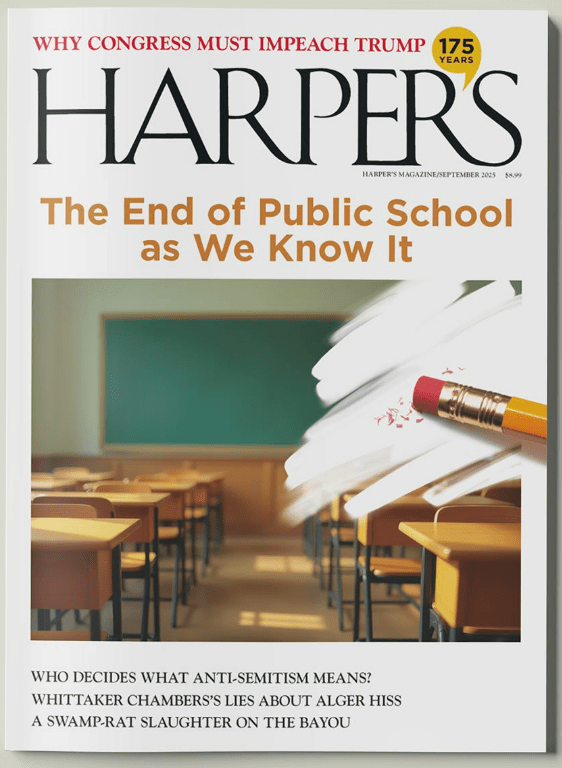
HARPER’S MAGAZINE: The latest issue features ‘The End of Public School as We Know It’

The Homemade Scholar

A new frontier in American education By Chandler Fritz

Ecological Warfare

A swamp-rat slaughter on the bayou By Nathaniel Rich

The Decisive Moment

Why Congress must impeach Trump By Chris Lehmann

AI, Smartphones, and the Student Attention Crisis in U.S. Public Schools

By Michael Cummins, Editor, August 19, 2025

In a recent New York Times focus group, twelve public-school teachers described how phones, social media, and artificial intelligence have reshaped the classroom. Tom, a California biology teacher, captured the shift with unsettling clarity: “It’s part of their whole operating schema.” For many students, the smartphone is no longer a tool but an extension of self, fused with identity and cognition.

Rachel, a teacher in New Jersey, put it even more bluntly:

“They’re just waiting to just get back on their phone. It’s like class time is almost just a pause in between what they really want to be doing.”

What these teachers describe is not mere distraction but a transformation of human attention. The classroom, once imagined as a sanctuary for presence and intellectual encounter, has become a liminal space between dopamine hits. Students no longer “use” their phones; they inhabit them.

The Canadian media theorist Marshall McLuhan warned as early as the 1960s that every new medium extends the human body and reshapes perception. “The medium is the message,” he argued — meaning that the form of technology alters our thought more profoundly than its content. If the printed book once trained us to think linearly and analytically, the smartphone has restructured cognition into fragments: alert-driven, socially mediated, and algorithmically tuned.

The philosopher Sherry Turkle has documented this cultural drift in works such as Alone Together and Reclaiming Conversation. Phones, she argues, create a paradoxical intimacy: constant connection yet diminished presence. What the teachers describe in the Times focus group echoes Turkle’s findings — students are physically in class but psychically elsewhere.

This fracture has profound educational stakes. The reading brain that Maryanne Wolf has studied in Reader, Come Home — slow, deep, and integrative — is being supplanted by skimming, scanning, and swiping. And as psychologist Daniel Kahneman showed, our cognition is divided between “fast” intuitive processing (System 1) and “slow” deliberate reasoning (System 2). Phones tilt us heavily toward System 1, privileging speed and reaction over reflection and patience.

The teachers in the focus group thus reveal something larger than classroom management woes: they describe a civilizational shift in the ecology of human attention. To understand what’s at stake, we must see the smartphone not simply as a device but as a prosthetic self — an appendage of memory, identity, and agency. And we must ask, with urgency, whether education can still cultivate wisdom in a world of perpetual distraction.


The Collapse of Presence

The first crisis that phones introduce into the classroom is the erosion of presence. Presence is not just physical attendance but the attunement of mind and spirit to a shared moment. Teachers have always battled distraction — doodles, whispers, glances out the window — but never before has distraction been engineered with billion-dollar precision.

Platforms like TikTok and Instagram are not neutral diversions; they are laboratories of persuasion designed to hijack attention. Tristan Harris, a former Google ethicist, has described them as slot machines in our pockets, each swipe promising another dopamine jackpot. For a student seated in a fluorescent-lit classroom, the comparison is unfair: Shakespeare or stoichiometry cannot compete with an infinite feed of personalized spectacle.

McLuhan’s insight about “extensions of man” takes on new urgency here. If the book extended the eye and trained the linear mind, the phone extends the nervous system itself, embedding the individual into a perpetual flow of stimuli. Students who describe feeling “naked without their phone” are not indulging in metaphor — they are articulating the visceral truth of prosthesis.

The pandemic deepened this fracture. During remote learning, students learned to toggle between school tabs and entertainment tabs, multitasking as survival. Now, back in physical classrooms, many have not relearned how to sit with boredom, struggle, or silence. Teachers describe students panicking when asked to read even a page without their phones nearby.

Maryanne Wolf’s neuroscience offers a stark warning: when the brain is rewired for scanning and skimming, the capacity for deep reading — for inhabiting complex narratives, empathizing with characters, or grappling with ambiguity — atrophies. What is lost is not just literary skill but the very neurological substrate of reflection.

Presence is no longer the default of the classroom but a countercultural achievement.

And here Kahneman’s framework becomes crucial. Education traditionally cultivates System 2 — the slow, effortful reasoning needed for mathematics, philosophy, or moral deliberation. But phones condition System 1: reactive, fast, emotionally charged. The result is a generation fluent in intuition but impoverished in deliberation.


The Wild West of AI

If phones fragment attention, artificial intelligence complicates authorship and authenticity. For teachers, the challenge is no longer merely whether a student has done the homework but whether the “student” is even the author at all.

ChatGPT and its successors have entered the classroom like a silent revolution. Students can generate essays, lab reports, even poetry in seconds. For some, this is liberation: a way to bypass drudgery and focus on synthesis. For others, it is a temptation to outsource thinking altogether.

Sherry Turkle’s concept of “simulation” is instructive here. In Simulation and Its Discontents, she describes how scientists and engineers, once trained on physical materials, now learn through computer models — and in the process, risk confusing the model for reality. In classrooms, AI creates a similar slippage: simulated thought that masquerades as student thought.

Teachers in the Times focus group voiced this anxiety. One noted: “You don’t know if they wrote it, or if it’s ChatGPT.” Assessment becomes not only a question of accuracy but of authenticity. What does it mean to grade an essay if the essay may be an algorithmic pastiche?

The comparison with earlier technologies is tempting. Calculators once threatened arithmetic; Wikipedia once threatened memorization. But AI is categorically different. A calculator does not claim to “think”; Wikipedia does not pretend to be you. Generative AI blurs authorship itself, eroding the very link between student, process, and product.

And yet, as McLuhan would remind us, every technology contains both peril and possibility. AI could be framed not as a substitute but as a collaborator — a partner in inquiry that scaffolds learning rather than replaces it. Teachers who integrate AI transparently, asking students to annotate or critique its outputs, may yet reclaim it as a tool for System 2 reasoning.

The danger is not that students will think less but that they will mistake machine fluency for their own voice.

But the Wild West remains. Until schools articulate norms, AI risks widening the gap between performance and understanding, appearance and reality.


The Inequality of Attention

Phones and AI do not distribute their burdens equally. The third crisis teachers describe is an inequality of attention that maps onto existing social divides.

Affluent families increasingly send their children to private or charter schools that restrict or ban phones altogether. At such schools, presence becomes a protected resource, and students experience something closer to the traditional “deep time” of education. Meanwhile, underfunded public schools are often powerless to enforce bans, leaving students marooned in a sea of distraction.

This disparity mirrors what sociologist Pierre Bourdieu called cultural capital — the non-financial assets that confer advantage, from language to habits of attention. In the digital era, the ability to disconnect becomes the ultimate form of privilege. To be shielded from distraction is to be granted access to focus, patience, and the deep literacy that Wolf describes.

Teachers in lower-income districts report students who cannot imagine life without phones, who measure self-worth in likes and streaks. For them, literacy itself feels like an alien demand — why labor through a novel when affirmation is instant online?

Maryanne Wolf warns that we are drifting toward a bifurcated literacy society: one in which elites preserve the capacity for deep reading while the majority are confined to surface skimming. The consequences for democracy are chilling. A polity trained only in System 1 thinking will be perpetually vulnerable to manipulation, propaganda, and authoritarian appeals.

The inequality of attention may prove more consequential than the inequality of income.

If democracy depends on citizens capable of deliberation, empathy, and historical memory, then the erosion of deep literacy is not a classroom problem but a civic emergency. Education cannot be reduced to test scores or job readiness; it is the training ground of the democratic imagination. And when that imagination is fractured by perpetual distraction, the republic itself trembles.


Reclaiming Focus in the Classroom

What, then, is to be done? The teachers’ testimonies, amplified by McLuhan, Turkle, Wolf, and Kahneman, might lead us toward despair. Phones colonize attention; AI destabilizes authorship; inequality corrodes the very ground of democracy. But despair is itself a form of surrender, and teachers cannot afford surrender.

Hope begins with clarity. We must name the problem not as “kids these days” but as a structural transformation of attention. To expect students to resist billion-dollar platforms alone is naive; schools must become countercultural sanctuaries where presence is cultivated as deliberately as literacy.

Practical steps follow. Schools can implement phone-free policies, not as punishment but as liberation — an invitation to reclaim time. Teachers can design “slow pedagogy” moments: extended reading, unbroken dialogue, silent reflection. AI can be reframed as a tool for meta-cognition, with students asked not merely to use it but to critique it, to compare its fluency with their own evolving voice.

Above all, we must remember that education is not simply about information transfer but about formation of the self. McLuhan’s dictum reminds us that the medium reshapes the student as much as the message. If we allow the medium of the phone to dominate uncritically, we should not be surprised when students emerge fragmented, reactive, and estranged from presence.

And yet, history offers reassurance. Plato once feared that writing itself would erode memory; medieval teachers once feared the printing press would dilute authority. Each medium reshaped thought, but each also produced new forms of creativity, knowledge, and freedom. The task is not to romanticize the past but to steward the present wisely.

Hannah Arendt, reflecting on education, insisted that every generation is responsible for introducing the young to the world as it is — flawed, fragile, yet redeemable. To abdicate that responsibility is to abandon both children and the world itself. Teachers today, facing the prosthetic selves of their students, are engaged in precisely this work: holding open the possibility of presence, of deep thought, of human encounter, against the centrifugal pull of the screen.

Education is the wager that presence can be cultivated even in an age of absence.

In the end, phones may be prosthetic selves — but they need not be destiny. The prosthesis can be acknowledged, critiqued, even integrated into a richer conception of the human. What matters is that students come to see themselves not as appendages of the machine but as agents capable of reflection, relationship, and wisdom.

The future of education — and perhaps democracy itself — depends on this wager. That in classrooms across America, teachers and students together might still choose presence over distraction, depth over skimming, authenticity over simulation. It is a fragile hope, but a necessary one.

THIS ESSAY WAS WRITTEN AND EDITED UTILIZING AI

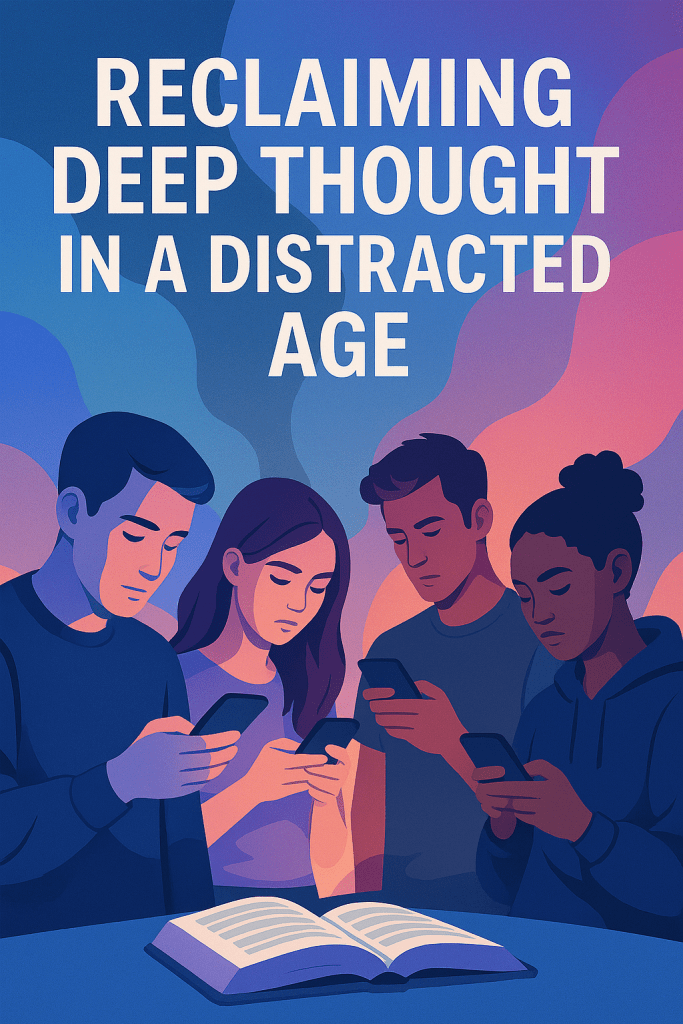
Reclaiming Deep Thought in a Distracted Age

This essay was written and edited by Intellicurean utilizing AI:

In the age of the algorithm, literacy isn’t dying—it’s becoming a luxury. This essay argues that the rise of short-form digital media is dismantling long-form reasoning and concentrating cognitive fitness among the wealthy, catalyzing a quiet but transformative shift. As British journalist Mary Harrington writes in her New York Times opinion piece “Thinking Is Becoming a Luxury Good” (July 28, 2025), even the capacity for sustained thought is becoming a curated privilege.

“Deep reading, once considered a universal human skill, is now fragmenting along class lines.”

What was once assumed to be a universal skill—the ability to read deeply, reason carefully, and maintain focus through complexity—is fragmenting along class lines. While digital platforms have radically democratized access to information, the dominant mode of consumption undermines the very cognitive skills that allow us to understand, reflect, and synthesize meaning. The implications stretch far beyond classrooms and attention spans. They touch the very roots of human agency, historical memory, and democratic citizenship—reshaping society into a cognitively stratified landscape.


The Erosion of the Reading Brain

Modern civilization was built by readers. From the Reformation to the Enlightenment, from scientific treatises to theological debates, progress emerged through engaged literacy. The human mind, shaped by complex texts, developed the capacity for abstract reasoning, empathetic understanding, and civic deliberation. Martin Luther’s 95 Theses would have withered in obscurity without a literate populace; the American and French Revolutions were animated by pamphlets and philosophical tracts absorbed in quiet rooms.

But reading is not biologically hardwired. As neuroscientist and literacy scholar Maryanne Wolf argues in Reader, Come Home: The Reading Brain in a Digital World, deep reading is a profound neurological feat—one that develops only through deliberate cultivation. “Expert reading,” she writes, “rewires the brain, cultivating linear reasoning, reflection, and a vocabulary that allows for abstract thought.” This process orchestrates multiple brain regions, building circuits for sequential logic, inferential reasoning, and even moral imagination.

Yet this hard-earned cognitive achievement is now under siege. Smartphones and social platforms offer a constant feed of image, sound, and novelty. Their design—fueled by dopamine hits and feedback loops—favors immediacy over introspection. In his seminal book The Shallows: What the Internet Is Doing to Our Brains, Nicholas Carr explains how the architecture of the web—hyperlinks, notifications, infinite scroll—actively erodes sustained attention. The internet doesn’t just distract us; it reprograms us.

Gary Small and Gigi Vorgan, in iBrain: Surviving the Technological Alteration of the Modern Mind, show how young digital natives develop different neural pathways: less emphasis on deep processing, more reliance on rapid scanning and pattern recognition. The result is what they call “shallow processing”—a mode of comprehension marked by speed and superficiality, not synthesis and understanding. The analytic left hemisphere, once dominant in logical thought, increasingly yields to a reactive, fragmented mode of engagement.

The consequences are observable and dire. As Harrington notes, adult literacy is declining across OECD nations, while book reading among Americans has plummeted. In 2023, nearly half of U.S. adults reported reading no books at all. This isn’t a result of lost access or rising illiteracy—but of cultural and neurological drift. We are becoming a post-literate society: technically able to read, but no longer disposed to do so in meaningful or sustained ways.

“The digital environment is designed for distraction; notifications fragment attention, algorithms reward emotional reaction over rational analysis, and content is increasingly optimized for virality, not depth.”

This shift is not only about distraction; it’s about disconnection from the very tools that cultivate introspection, historical understanding, and ethical reasoning. When the mind loses its capacity to dwell—on narrative, on ambiguity, on philosophical questions—it begins to default to surface-level reaction. We scroll, we click, we swipe—but we no longer process, synthesize, or deeply understand.


Literacy as Class Privilege

In a troubling twist, the printed word—once a democratizing force—is becoming a class marker once more. Harrington likens this transformation to the processed food epidemic: ultraprocessed snacks exploit innate cravings and disproportionately harm the poor. So too with media. Addictive digital content, engineered for maximum engagement, is producing cognitive decay most pronounced among those with fewer educational and economic resources.

Children in low-income households spend more time on screens, often without guidance or limits. Studies show they exhibit reduced attention spans, impaired language development, and declines in executive function—skills crucial for planning, emotional regulation, and abstract reasoning. Jean Twenge’s iGen presents sobering data: excessive screen time, particularly among adolescents in vulnerable communities, correlates with depression, social withdrawal, and diminished readiness for adult responsibilities.

Meanwhile, affluent families are opting out. They pay premiums for screen-free schools—Waldorf, Montessori, and classical academies that emphasize long-form engagement, Socratic inquiry, and textual analysis. They hire “no-phone” nannies, enforce digital sabbaths, and adopt practices like “dopamine fasting” to retrain reward systems. These aren’t just lifestyle choices. They are investments in cognitive capital—deep reading, critical thinking, and meta-cognitive awareness—skills that once formed the democratic backbone of society.

This is a reversion to pre-modern asymmetries. In medieval Europe, literacy was confined to a clerical class, while oral knowledge circulated among peasants. The printing press disrupted that dynamic—but today’s digital environment is reviving it, dressed in the illusion of democratization.

“Just as ultraprocessed snacks have created a health crisis disproportionately affecting the poor, addictive digital media is producing cognitive decline most pronounced among the vulnerable.”

Elite schools are incubating a new class of thinkers—trained not in content alone, but in the enduring habits of thought: synthesis, reflection, dialectic. Meanwhile, large swaths of the population drift further into fast-scroll culture, dominated by reaction, distraction, and superficial comprehension.


Algorithmic Literacy and the Myth of Access

We are often told that we live in an era of unparalleled access. Anyone with a smartphone can, theoretically, learn calculus, read Shakespeare, or audit a philosophy seminar at MIT. But this is a dangerous half-truth. The real challenge lies not in access, but in disposition. Access to knowledge does not ensure understanding—just as walking through a library does not confer wisdom.

Digital literacy today often means knowing how to swipe, search, and post—not how to evaluate arguments or trace the origin of a historical claim. The interface makes everything appear equally valid. A Wikipedia footnote, a meme, and a peer-reviewed article scroll by at the same speed. This flattening of epistemic authority—where all knowledge seems interchangeable—erodes our ability to distinguish credible information from noise.

Moreover, algorithmic design is not neutral. It amplifies certain voices, buries others, and rewards content that sparks outrage or emotion over reason. We are training a generation to read in fragments, to mistake volume for truth, and to conflate virality with legitimacy.


The Fracturing of Democratic Consciousness

Democracy presumes a public capable of rational thought, informed deliberation, and shared memory. But today’s media ecosystem increasingly breeds the opposite. Citizens shaped by TikTok clips and YouTube shorts are often more attuned to “vibes” than verifiable facts. Emotional resonance trumps evidence. Outrage eclipses argument. Politics, untethered from nuance, becomes spectacle.

Harrington warns that we are entering a new cognitive regime, one that undermines the foundations of liberal democracy. The public sphere, once grounded in newspapers, town halls, and long-form debate, is giving way to tribal echo chambers. Algorithms sort us by ideology and appetite. The very idea of shared truth collapses when each feed becomes a private reality.

Robert Putnam’s Bowling Alone chronicled the erosion of social capital long before the smartphone era. But today, civic fragmentation is no longer just about bowling leagues or PTAs. It’s about attention itself. Filter bubbles and curated feeds ensure that we engage only with what confirms our biases. Complex questions—on history, economics, or theology—become flattened into meme warfare and performative dissent.

“The Enlightenment assumption that reason could guide the masses is buckling under the weight of the algorithm.”

Worse, this cognitive shift has measurable political consequences. Surveys show declining support for democratic institutions among younger generations. Gen Z, raised in the algorithmic vortex, exhibits less faith in liberal pluralism. Complexity is exhausting. Simplified narratives—be they populist or conspiratorial—feel more manageable. Philosopher Byung-Chul Han, in The Burnout Society, argues that the relentless demands for visibility, performance, and positivity breed not vitality but exhaustion. This fatigue disables the capacity for contemplation, empathy, or sustained civic action.


The Rise of a Neo-Oral Priesthood

Where might this trajectory lead? One disturbing possibility is a return to gatekeeping—not of religion, but of cognition. In the Middle Ages, literacy divided clergy from laity. Sacred texts required mediation. Could we now be witnessing the early rise of a neo-oral priesthood: elites trained in long-form reasoning, entrusted to interpret the archives of knowledge?

This cognitive elite might include scholars, classical educators, journalists, or archivists—those still capable of sustained analysis and memory. Their literacy would not be merely functional but rarefied, almost arcane. In a world saturated with ephemeral content, the ability to read, reflect, and synthesize becomes mystical—a kind of secular sacredness.

These modern scribes might retreat to academic enclaves or AI-curated libraries, preserving knowledge for a distracted civilization. Like desert monks transcribing ancient texts during the fall of Rome, they would become stewards of meaning in an age of forgetting.

“Like ancient scribes preserving knowledge in desert monasteries, they might transcribe and safeguard the legacies of thought now lost to scrolling thumbs.”

Artificial intelligence complicates the picture. It could serve as a tool for these new custodians—sifting, archiving, interpreting. Or it could accelerate the divide, creating cognitive dependencies while dulling the capacity for independent thought. Either way, the danger is the same: truth, wisdom, and memory risk becoming the property of a curated few.


Conclusion: Choosing the Future

This is not an inevitability, but it is an acceleration. We face a stark cultural choice: surrender to digital drift, or reclaim the deliberative mind. The challenge is not technological, but existential. What is at stake is not just literacy, but liberty—mental, moral, and political.

To resist post-literacy is not mere nostalgia. It is an act of preservation: of memory, attention, and the possibility of shared meaning. We must advocate for education that prizes reflection, analysis, and argumentation from an early age—especially for those most at risk of being left behind. That means funding for libraries, long-form content, and digital-free learning zones. It means public policy that safeguards attention spans as surely as it safeguards health. And it means fostering a media environment that rewards truth over virality, and depth over speed.

“Reading, reasoning, and deep concentration are not merely personal virtues—they are the pillars of collective freedom.”

Media literacy must become a civic imperative—not only the ability to decode messages, but to engage in rational thought and resist manipulation. We must teach the difference between opinion and evidence, between emotional resonance and factual integrity.

To build a future worthy of human dignity, we must reinvest in the slow, quiet, difficult disciplines that once made progress possible. This isn’t just a fight for education—it is a fight for civilization.