
Tag Archives: Carbon Emissions

Previews: The New Yorker Magazine – Oct 23, 2023

Daniel Clowess “Quiet Luxury”

The New Yorker – October 23, 2023 issue: The new issues cover features Daniel Clowes’s “Quiet Luxury” – The artist discusses patronage, in-home pillars, and what he’d do with a billion dollars.

Beyond the Myth of Rural America

Grant Woods sister Nan Wood Graham and his dentist Byron McKeeby stand by the painting for which they had posed...

Its inhabitants are as much creatures of state power and industrial capitalism as their city-dwelling counterparts.

By Daniel Immerwahr

Demanding that your friend pull the car over so you can examine an unusual architectural detail is not, I’m told, endearing. But some of us can’t help ourselves. For the painter Grant Wood, it was an incongruous Gothic window on an otherwise modest frame house in Eldon, Iowa, that required stopping. It looked as if a cottage were impersonating a cathedral. Wood tried to imagine who “would fit into such a home.” He recruited his sister and his dentist as models and costumed them in old-fashioned attire. The result, “American Gothic,” as he titled the painting from 1930, is probably the most famous art work ever produced in the United States.

When Foster Parents Don’t Want to Give Back the Baby

In many states, lawyers are pushing a new legal strategy that forces biological parents to compete for custody of their children.

American ChroniclesBeyond the Myth of Rural America

Its inhabitants are as much creatures of state power and industrial capitalism as their city-dwelling counterparts.

What Happened to San Francisco, Really?

It depends on which tech bro, city official, billionaire investor, grassroots activist, or Michelin-starred restaurateur you ask.By Nathan Heller

The Great Cash-for-Carbon Hustle

Offsetting has been hailed as a fix for runaway emissions and climate change—but the market’s largest firm sold millions of credits for carbon reductions that weren’t real.

Climate Change: Threats Of Ocean Acidification

The Economist (February 2, 2023) – As carbon emissions change the chemistry of the seas, ocean acidification threatens marine life and human livelihoods. How worried should you be about climate change’s so-called “evil twin”?

Video timeline: 00:00 The other carbon problem 00:50 How does the ocean’s deepest point reveal its past? 02:55 Why are baby oysters dying? 04:08 Is the ocean acidic? 05:21 What is causing ocean acidification? 06:01 Why are corals dissolving? / Will deep sea ecosystems survive? 08:35 A threat to human livelihoods 10:42 What are the ‘potato chips of the sea’? 12:04 What is the solution?

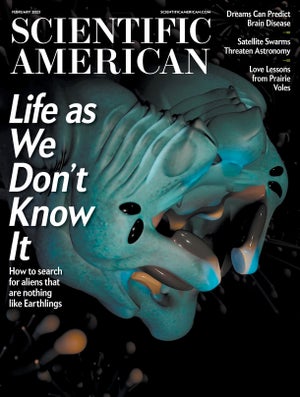
Cover Preview: Scientific American – February 2023

February 2023

Scientific American – February 2023:

The Search for Extraterrestrial Life as We Don’t Know It

Scientists are abandoning conventional thinking to search for extraterrestrial creatures that bear little resemblance to Earthlings

Satellite Constellations Are an Existential Threat for Astronomy

Growing swarms of spacecraft in orbit are outshining the stars, and scientists fear no one will do anything to stop it

Solving Cement’s Massive Carbon Problem

New techniques and novel ingredients can greatly reduce the immense carbon emissions from cement and concrete production

Sustainability: Fertilizers From Biomass In France

As the world’s population grows, the need to feed billions of mouths mean our use of synthetic fertilisers will almost certainly increase significantly. The FT’s Anna Gross explores two innovative French companies that could ultimately reduce our reliance on artificial fertilisers by offering less carbon-intensive options. But how viable are these alternatives?

Ecology: Importance Of Peatlands In CO2 Capture

As more of the world’s forests are destroyed, it makes you wonder: what’s going to absorb CO2 in their place?! In an ironic twist of fate, one of Earth’s “deadest” habitats might be our best hope for an ongoing supply of breathable air.

Called peatlands, these wetland environments are named for their tendency to accumulate decayed plant matter. Unlike most other ecosystems, like forests, where branches and leaves typically decompose in a matter of months… in peatlands, that plant material can stay intact for millenia. You see, peatlands mostly exist in high altitude places where temps are low and there’s not much water flow. This results in their having extremely low oxygen and high acidity levels.

These harsh conditions aren’t very hospitable to microbes and fungi, which are instrumental to the whole decomposition process. So without them around, the plant material sort of… just sits. Over time, that it globs together to form peat, a thick, spongy material that can soak up 20x its weight in water. Peat also soaks up loads of carbon. Through a process known as the Calvin cycle, living plants absorb CO2 from the air and convert it into organic molecules that they can then use as energy to grow.

Through decomposition, the carbon that’s “fixed” in a plant’s structure gets released but since peat doesn’t decompose, that carbon can stay put! It’s estimated that peatlands contain 550 gigatonnes of organic carbon, which is twice as much organic carbon as all the world’s forests combined. That’s absolutely wild, considering that forests cover about 30% of the world’s land area… and peatlands only account for 3%! Like most of the world’s habitats, peatlands aren’t immune to the threats of human development and exploitation.

Peat is also are a very in-demand resource. Its incredible water holding capacity makes it a favorite amongst horticulturists; If you’ve ever picked up a bag of soil amendment, chances are it’s full of the stuff. Since peat is also a fossil fuel with a long burn, it’s used in some parts of the world. Peatlands are also often drained to accommodate other land use activities, like agriculture.

Environment: Investing In Carbon Capture Systems

The system could be one answer to slashing Earth’s carbon emissions. A Swiss startup has created a giant vacuum cleaner to capture carbon dioxide from the air, helping companies offset their emissions. WSJ visits the facility to see how it traps the gas for sale to clients like Coca-Cola, which uses it in fizzy drinks. Composite: Clément Bürge.

Climate Change: What Are Covid-19’s Impacts? (Video)

When Covid-19 sparked lockdowns around the world, emissions of one of the greenhouse gases responsible for climate change, atmospheric carbon dioxide, plummeted. But is this record drop a short-term effect of the 2020 pandemic or a ‘new normal’? BBC Weather’s Ben Rich explores the impact of coronavirus on the global climate.

Motion graphics by Jacqueline Galvin

Produced by Soraya Auer