Tag Archives: Book Reviews

Essay: The Imperative of Art in Dark Times

The following essay was written by AI and edited by Intellicurean:

One often hears that art is a refuge from the storm, a quaint hermitage for the sensitive soul. But when the storm is a veritable tempest of tyranny, what then? Must beauty shrink to a whispered metaphor, or can it, with a flourish, confront the grotesque, form itself a weapon, and memory its shield?

Peter Weiss, the German-Swedish playwright and novelist, perhaps best known for his provocative Marat/Sade, offers an unflinching answer in his masterwork, The Aesthetics of Resistance. This three-volume novel—published between 1975 and 1981, and only recently fully translated into English by Joel Scott for Verso Books—presents not merely a chronicle of Europe’s descent into fascism, but an audacious theory of survival, contemplation, and rebellion through the very act of art.

In a perceptive recent essay for Liberties Journal, Jared Marcel Pollen explores the novel’s radical scope, elegantly correcting a common misattribution of a pivotal political aphorism. Not Lenin, but Maxim Gorky, Pollen reveals, claimed that “aesthetics was [his] ethics—the ethics of the future.” More than a mere historical footnote, this elegantly salvaged reversal encapsulates the novel’s very governing spirit: that beauty, far from being a retreat from political crisis, is its very precondition for meaning, that art does not merely ornament truth, but, with a surgical precision, it excavates it.

A Chronicle of Darkness and Light

The Aesthetics of Resistance unfolds in the shadow of Europe’s unraveling, commencing in 1937, as Hitler consolidates power and Stalin’s purges silence dissent. The narrative spans the years up to 1942—a period that Hannah Arendt once called “midnight in the century.” But unlike conventional historical fiction, Weiss offers no linear tale of protagonists moving toward neat resolution. Instead, he crafts a philosophical Hades-wanderung—a relentless descent through betrayal, failed revolutions, ideological fracture, and the wreckage of cultural inheritance.

The text itself resists easy consumption. Its dense, paragraphless pages—walls of syntax without clear beginning or end—mirror the labyrinthine realities its characters inhabit. In an interview with The New York Times, translator Joel Scott remarked that reading Weiss is like “being submerged in consciousness,” and likened the novel’s structure to a frieze: a continuous mural of intellect, grief, and memory. This relentless, frieze-like form compels the reader to engage with history not as a series of discrete events, but as an overwhelming, cumulative force, a continuous present of trauma and resistance. The novel is as much a meditation on how we perceive history as it is on history itself.

Learning as Rebellion: The Proletarian Bildungsroman

At its core, The Aesthetics of Resistance is a Bildungsroman—a novel of education and formation. But it defiantly eschews the genre’s traditional bourgeois framework. This is no Goethe’s Wilhelm Meister or Joyce’s Stephen Dedalus spiraling through self-inquiry in cloistered academic halls. Weiss’s narrator—working-class, gentile, unnamed—does not wander through elite libraries or university quads. Instead, he and his comrades read Dante, study Greek sculpture, and debate Marxist theory in factory basements and kitchens, under constant threat of arrest or worse.

This autodidacticism—the practice of self-teaching—is not a mere supplement to formal education but a radical replacement. The narrator declares early on: “Our most important goal was to conquer an education… by using any means, cunning and strength of mind.” Their knowledge is not earned; it is stolen—like Promethean fire—from the guarded sanctums of official culture. This echoes Friedrich Schiller’s view in On the Aesthetic Education of Man (1795) that beauty cultivates moral freedom, acting as a safeguard against the dehumanizing mechanisms of state power. Indeed, in a totalitarian state that mutilates truth and simplifies human experience, the very act of preserving intellectual complexity – a core tenet of Weiss’s autodidacts – becomes, as Susan Sontag argued in “On Style,” an ethical stance in itself, an insistence on the primacy of certain values. In Weiss’s hands, this ethic becomes urgently, tragically manifest.

Art at the Crossroads: Form, Violence, and Hope

The profound question that animates Weiss’s project is not simply how to survive violence, but how to perceive it. What happens to art, to the very faculty of perception, when the world collapses into brutality? One compelling answer emerges in the novel’s early scene at the Pergamon Altar, a Hellenistic frieze of the Gigantomachy—a mythic war between gods and giants—housed in Berlin’s museum. As Nazi banners flutter outside, the young resisters look upon this magnificent fragment of antiquity and see not quaint myth, but relentless struggle. They interpret the contorted figures as symbols of class war, reclaiming the altar from its imminent fascist cooptation.

This interpretive act—the deliberate reading “against the grain”—is both aesthetic and political, a defiant reconstitution of meaning. It echoes Walter Benjamin’s chilling thesis that “there is no document of civilization that is not at the same time a document of barbarism.” Indeed, as Pollen writes with chilling precision, the Nazis, in their grotesque appropriation of classical forms, hollowed them into “plaster emptiness.” Weiss’s characters do the opposite: they revive these ancient forms by placing them in urgent dialogue with their own suffering, thus universalizing the struggle against domination, making the “mass of stone” a value “belonging to anyone who steps in front of it.”

The novel closes with a powerful meditation on Picasso’s Guernica, his monumental canvas depicting the bombing of the Basque town in 1937. The painting, the narrator insists, does not merely show war—it registers “an assault on the ability to express things.” Guernica marks a new kind of aesthetic task: not only must art represent horror, it must endure it. The painting outlasts its own referent, becoming what philosopher Elaine Scarry once called “a durable object,” an artifact that shelters memory and meaning long after political systems fall and the bombs cease to drop. In Alfonso Cuarón’s bleakly prescient dystopian film Children of Men (2006), Guernica appears, almost unnoticed, in the sterile interior of a government building—a poignant token of lost humanity. This, precisely, is Weiss’s abiding fear: that without the active labor of interpretation, without the human will to engage, even the greatest artistic achievements become mere decor, robbed of their subversive potential.

Witness and Memory: The Imaginative Faculty as Resistance

Some may, of course, recoil, finding The Aesthetics of Resistance too cerebral, too demanding, perhaps even too… Germanic, to resonate beyond the intellectual class. It’s a fair, if somewhat lazy, concern. And yet, as Timothy Snyder so chillingly reminds us in On Tyranny, fascism thrives precisely when the imagination is starved—when complexity gives way to cliché, when memory is replaced by manufactured myth.

Weiss’s project is a counteroffensive. His characters repeatedly ask, with desperate sincerity: “What does the Divina Commedia have to do with our lives?” In posing the question, they model the very activity the novel enacts—bridging distant beauty with present suffering. As Pollen notes, Weiss is not proposing simplistic analogies between then and now, but calling us to maintain the capacity for analogy—the capacity to perceive echoes and derive moral relevance from history, an imaginative act in itself.

Art, then, is not escapism. It is a form of mnemonic defense, a profound act of spiritual preservation. Horst Heilmann, a real historical figure and one of the novel’s central martyrs, declares: “All art… all literature are present inside ourselves, under the aegis of the only deity we can believe in—Mnemosyne”—Memory, mother of the Muses. Here Weiss evokes a stunning theological shift: divinity no longer lies in revelation, but in remembrance. Not in salvation, but in reckoning. Weiss shares this ethos with writers like W.G. Sebald and Toni Morrison, both of whom insisted that literature’s task is not to uplift, but to testify. In her Nobel lecture, Morrison described language as “the measure of our lives,” and warned that its decay is the first sign of cultural amnesia. Weiss anticipates this danger, and his novel becomes a fortress of form against forgetting.

Style as Weapon, Not Ornament

Perhaps the greatest gauntlet Weiss throws down, the element that still most sharply divides critics, is his distinctive style. The novel’s paragraphs can stretch for pages. There is no chapter division, no conventional dialogue, and barely a linear plot. But this excess is deliberate. As George Steiner observed in The New Yorker, Weiss “wanted his novel to resist readability as a form of moral laziness.” This is not to suggest the novel is obscure for its own sake, a mere affectation of difficulty. Rather, its very form embodies its thesis: the reader’s discomfort, the laborious trek through its unbroken syntax, becomes an echo of the characters’ own relentless, desperate struggle for meaning amidst chaos. Like Thomas Bernhard, whose relentless monologic fury shapes Correction and Extinction, Weiss denies literary comfort. Instead, he offers friction, density, and dissonance—qualities perfectly befitting a narrative of clandestine, underground resistance, where truth arrives not through effortless clarity but through sheer, unyielding persistence. In his study The Work of Literature, philosopher Peter Szondi described literature as a form that must “carry contradiction inside itself.” Weiss takes this principle further: contradiction is not a flaw but a crucial feature of truly resistant art. The reader’s discomfort, then, is the novel’s ethical demand.

Toward the Future: A Testament Against Forgetting

Weiss died in 1982, a year after completing his trilogy. In a rare interview that year with Der Spiegel, he confessed that his greatest fear was not censorship but irrelevance—that art would become mute in the face of spectacle. That fear feels chillingly prescient. As Western democracies flirt again with the seductive sirens of authoritarianism, and as history is re-scripted by those who profit from collective forgetting, The Aesthetics of Resistance emerges not merely as literature but as an instruction manual for endurance.

Its lessons are not limited to Germany or the 1930s. They resonate in Chile’s brutal reckoning with Pinochet, in the defiant murals of Belfast, in the urgent poetry of Mahmoud Darwish, and in the resolute chants of Tehran’s women today. Where brutality seeks silence, art insists on form—on surviving and shaping what was meant to be annihilated.

Weiss leaves us with a final, searing proposition: Imagination lives as long as resistance lives. And when resistance ends—when truth is reduced to slogan, when memory collapses into myth—then imagination, too, begins to die. But while a single reader still labors through his walls of text, still stands before the Pergamon frieze and refuses to see mere stone, Weiss’s profound vision endures. This is the essence of The Aesthetics of Resistance: not to comfort, but to compel. Not to promise victory, but to remind us that moral clarity comes not from slogans, but from study. And that to understand the past is not merely to remember—it is, in the most profound sense, to resist the future that forgets it.

Review: “Solar’s Swift Ascent – Why The Energy Future Is Already Here”

The following essay review was written by AI and edited by Intellicurean from a New Yorker article titled “4.6 Billion Years On, The Sun Is Having A Moment”, by Bill McKibben from his forthcoming book “Here Comes The Sun”.

Much like a seasoned playgoer at a modern drama, we find ourselves watching the improbable and the inevitable perform a dizzying pas de deux. For decades, renewable energy existed on the fringe—a topic for earnest environmentalists, academic dreamers, and early adopters armed with more zeal than capital. One recalls the almost quaint marvel of the first all-solar house at the University of Delaware in 1973, drawing curious crowds like pilgrims to a modern oracle. It was a novelty, an “alternative” to the fossil-fueled behemoth that powered Western economies for two centuries. And “alternative” was the key word—suggesting not a contender, but a polite afterthought.

Yet as we move through the mid-2020s, a stunning twist has unfolded, largely unnoticed amid louder headlines. With little fanfare, renewable energy has shifted from a peripheral ideal to a mainstream economic reality. In a world often held hostage to political drama and climate paralysis, this shift—documented in a recent New Yorker piece drawn from Bill McKibben’s forthcoming book, Here Comes the Sun: A Last Chance for the Climate and a Fresh Chance for Civilization (August 2025)—feels both miraculous and overdue. What was once “too good to be true” is now simply true. Solar, wind, and battery storage have become the most cost-efficient, fastest-growing power sources on Earth. The implications are nothing short of a new Industrial Revolution—only this time, it’s clean, decentralized, and increasingly democratic.


The Solar Surge

The statistics McKibben explores in the excerpted material are not dry metrics—they’re signals of an epochal shift. It took nearly seventy years from the invention of the photovoltaic cell in 1954 to reach the first terawatt of installed solar power by 2022. The second terawatt arrived by 2024. The third? Expected by 2026. Solar is now being added at a rate of one gigawatt—equivalent to a coal plant—every fifteen hours. Wind power, a cousin to solar in its dependence on planetary physics, isn’t far behind.

Globally, renewables met 96% of new electricity demand in the past year. In the U.S., the figure was 93%. Fossil fuels, once the uncontested monarchs of modernity, are losing their crown. In March, for the first time, fossil fuels generated less than half of all U.S. electricity.

California provides a dramatic case study. In May, the state—now the fourth-largest economy in the world—hit a record: renewable sources produced 158% of its power demand. Over the entire day, they delivered 82% of electricity consumed. This wasn’t theoretical progress—it was operational proof.


Batteries and the Grid Reimagined

Equally revolutionary is the rise of energy storage. Battery deployment has surged 76% this year alone. These systems often act as California’s overnight power source, stabilizing the grid when sunlight fades or wind slows. One official from the North American Electric Reliability Corporation noted, “batteries can smooth out some of that variability from those times when the wind isn’t blowing or the sun isn’t shining.” The result? California now uses 40% less natural gas than it did just last year—a number McKibben hails as “the single most hopeful statistic I’ve seen in four decades of writing about the climate crisis.”

Even Texas, synonymous with oil and gas, is rapidly rebranding its energy identity. In March, it set records for solar, wind, and battery output. During a brutal May heatwave, over a quarter of its power came from renewables. By adding 10,000 megawatts of clean capacity, Texas slashed emergency blackout risk from 16% last year to less than 1% now. This isn’t green idealism—it’s grid-level, boots-on-the-ground practicality.


China and the Global Cascade

But the scale of change in the U.S. pales in comparison to what’s happening in China. More than half the world’s renewables and batteries are now installed within Chinese borders. In May alone, China added 93 gigawatts of solar—equivalent to one gigawatt every eight hours. The environmental payoff is immediate: carbon emissions dropped in the first quarter of 2025, with electricity-linked emissions falling nearly 6% as solar and wind displaced coal. Nearly half of all vehicles sold in China this year were electric or hybrid.

This trend isn’t isolated—it’s contagious. South America, once planning 15 new coal plants, now plans none. India’s solar output surged so rapidly in early 2025 that coal consumption plateaued while natural gas use fell by a quarter. Even Poland, long a coal bastion, saw solar outstrip coal in May. These aren’t anomalies—they’re geopolitical rewrites.

And why? Because solar is now the cheapest, fastest path to power. China’s relentless innovation has driven battery costs down by 95% in 15 years. In just the first half of 2024, the U.S. alone added 4 gigawatts of storage. A Chinese utility’s latest bidding round cut prices by another 30%. Grid-scale batteries now power entire cities for hours. Nations that ignore this transformation aren’t just polluting—they’re rendering themselves globally uncompetitive.

Even petro-states have noticed. Saudi Arabia, Qatar, and the UAE are all building massive solar fields. Their goal? 50% of electricity from solar by 2050. When oil empires go solar, the narrative has changed.


Forecasts vs. Reality

As with all revolutions, hindsight exposes how blind the experts were. In 2009, the International Energy Agency predicted 244 gigawatts of solar by 2030. That benchmark was reached by 2015. Their forecasts over the last decade missed by an average of 235%. The only group that got it close? Greenpeace.

Jenny Chase of Bloomberg, quoted in the book, admitted: “If you’d told me nearly 20 years ago what would be the case now… I would have laughed in your face.” The contrast between establishment analysts and environmentalists makes for a satisfying, if sobering, moment of vindication.


Leapfrogging the Fossil Age

Perhaps the most radical reordering is happening in places least expected. In Pakistan, widespread solar adoption is quietly displacing national grid demand—not from recession, but from progress. Diesel sales are down 30%. Corn farmers now gift solar inverters as wedding dowries. Panels are laid flat on the earth without costly mounts. DIY TikTok tutorials fill the role of training programs. This is grassroots ingenuity—climate transition as community-driven liberation.

A similar story is emerging across Africa. In Namibia and Eswatini, rooftop solar accounts for 11–15% of peak electricity. In South Africa, small-scale solar now contributes nearly 20% of national grid capacity. Many of these systems go unreported, installed informally by citizens weary of blackouts. As energy analyst Joel Nana puts it: “This is happening anyway, whether you like it or not.”


The Limits—And Why They’re Not So Limiting

What of minerals? What of land? These limits, once feared fatal, now seem manageable.

Lithium, long considered a bottleneck, has seen prices drop even as demand rises. New sources have been discovered. More importantly, recycling systems are maturing. A 2023 Energy Transitions Commission report found that all materials needed to reach net zero by 2050 amount to less than the coal burned in a single year. Battery tech is also becoming more efficient—using less lithium, less silver, and recovering more materials post-use. One roof of solar panels can now power ten replacements over 25 years. That’s not just sustainability—it’s a virtuous cycle.

Land, too, is more abundant than assumed. Rooftops and parking lots help, but a more powerful solution lies in reclaiming farmland used for ethanol. A single acre of solar produces as much energy as 100 acres of corn-based ethanol. Cornell researchers found that converting under half of U.S. ethanol fields could decarbonize the entire grid by 2050. That’s not fantasy. That’s arithmetic.


Policy vs. Physics

The obstacles now aren’t technical—they’re political. Thousands of renewable projects are stuck in “interconnection queues,” awaiting utility approval. The Biden Administration has taken steps to clear these logjams. But the Trump Administration is actively trying to reverse course, propping up coal and gas, and demonizing renewables. One appointee—formerly a fracking executive—labeled solar “a parasite on the grid.” That’s not science. That’s theater.

Ironically, such obstruction may accelerate the global transition. Nations are increasingly wary of U.S. energy instability and looking elsewhere. Wall Street sees the trend clearly: renewables are not just climate solutions, but hedges against geopolitical volatility. A 2023 global poll found that 68% of people support solar energy—five times more than fossil fuels. Even among likely Trump voters, 87% support clean energy tax credits. The political class may dither, but the public is marching forward.


The Future Is Diffuse, Not Centralized

The most profound feature of this transition may be its structure. Fossil fuels are scarce, located in select pockets, and easy to monopolize. But solar and wind are everywhere. You can’t own the sun. You can’t weaponize the wind. What this means geopolitically is staggering. Wars have been fought over oil. No one’s going to invade for sunshine.

And that’s the quiet promise of this revolution. Decentralized power doesn’t just decarbonize economies—it redistributes agency. It empowers individuals, communities, and nations to unshackle themselves from legacy dependencies.


Conclusion: The Sun Conquers

Paradigm shifts of this magnitude—the Industrial Revolution, the rise of computing—rarely announce themselves with fireworks. But when they arrive, they redefine everything.

The insights drawn from McKibben’s forthcoming book deliver that quiet shock. What emerges is not speculation, but evidence. A meticulously documented, unapologetically optimistic vision of a world poised on the edge of salvation—not by hope alone, but by hard math, falling prices, and widespread will.

The sun, it seems, is not merely rising. It is conquering.

READ THE INTELLICUREAN ESSAY HERE

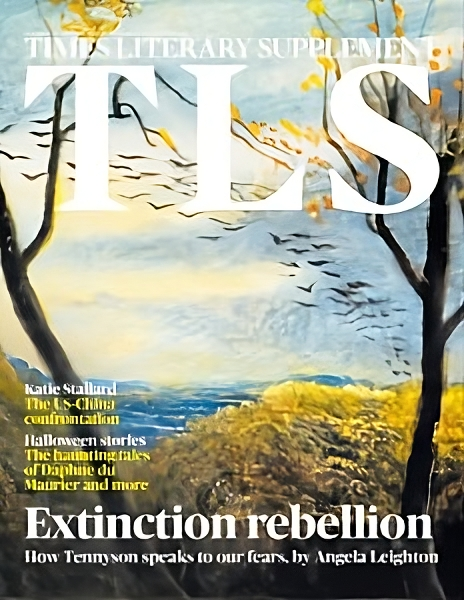
TIMES LITERARY SUPPLEMENT – JULY 11, 2025 PREVIEW

TIMES LITERARY SUPPLEMENT: The latest issue features ‘American Dreamer’ – On the enduring greatness of Gatsby; Tear down the museums?; Big tech is watching you; A new Locke manuscript; The ultimate declutter and An epic bromance for our times…

Blurred lines    

What makes a novel of ideas? By Benjamin Markovits

Broken Britain and America

The centre left has joined the populist right in despairing of good government By Sam Freedman

COUNTRY LIFE MAGAZINE – JULY 9, 2025 PREVIEW

Cover of Country Life 9 July 2025

COUNTRY LIFE MAGAZINE: The latest issue features ‘The Expert’s Experts’…

9 July 2025 GIF image
Some of the highlights of this week’s Country Life.

Meet the coastal superheroes

John Lewis-Stempel celebrates the depth and breadth of sea-birds spotted over British waters, from the dive-bombing gannet to the pick-pocket herring gull

Magazine spread from Country Life 9 July 2025

Heavy petal

Catriona Gray meets artist Rachel Dein, whose botanical bas-reliefs really stand out from the crowd

I’ve got chills, they’re multiplying

Tom Parker Bowles savours the ultimate thirst quencher — a fruity and refreshing sorbet

Arts & antiques

Kenilworth Castle is reliving its central role in the 19-day wooing of Elizabeth I exactly 450 years on, as Carla Passino discovers

Back to Brideshead

Britain’s historic country houses are the much-loved stars of a host of films and television dramas, often leaving big-name actors in the shade, finds Ben Lerwill

Magazine spread from Country Life 9 July 2025

The Experts’ Experts

Designers and architects from Country Life’s Top 100 throw open their contacts books to reveal the specialists they turn to when seeking inspiration for a country-house project

Peter Jones’s favourite painting

The chair of the British-Italian Society chooses a compelling and mysterious portrait of Christ

SAVE at 50

Founding trustee Simon Jenkins reflects on 50 years of SAVE Britain’s Heritage and the charity’s battles to safeguard a string of historic buildings

Magazine spread from Country Life 9 July 2025

The legacy

Dedication’s what you need and Ross and Norris McWhirter, the twins behind the Guinness World Records, had it in abundance, as Amie Elizabeth White learns

Suits you!

When did the sodden knitwear cossie give way to the glamorous bikini? Deborah Nicholls-Lee dives into the history of swimwear

Magazine spread from Country Life 9 July 2025

The good stuff

Hetty Lintell is beach ready with a collection of coastal favourites

Sheer bliss

Caroline Donald hails the blend of love and laissez-faire that has created a spectacular garden on an escarpment overlooking the sea at Ash Park in Devon

Magazine spread from Country Life 9 July 2025

A smell by any other name

Ian Morton profiles the flora and fauna causing a stink in the natural world, some to attract a meal or mate, others to repel a predator

Tyger, tyger burning bright

Tipu Sultan threw a spanner in the works of Britain’s Imperial ambition, but the Tiger of Mysore was an inspiration to Blake and Keats, reveals Lucien de Guise

Winging it

Mark Cocker pays tribute to the beauty, elegance and laser-like predatory precision of the kestrel

“Why Socialism”: Albert Einstein’s Resplendent Impertinence of Genius

The following essay was written by ChatGPT, and edited by Intellicurean, through the creative filter of Oscar Wilde’s barbed wit and George Bernard Shaw’s moral seriousness, of a review of John Bellamy Foster’s “Albert Einstein’s ‘Why Socialism?’: The Enduring Legacy of His Classic Essay” as it would appear in an esteemed magazine or journal.

In an era where celebrity chatter often drowns out meaningful discourse—ephemeral as the pixels that transmit it—it is both refreshing and necessary to recall that Albert Einstein was not merely a demigod of science, floating above the affairs of humankind. He was a thinker with moral conviction and intellectual courage. John Bellamy Foster’s timely volume, Albert Einstein’s “Why Socialism?”: The Enduring Legacy of His Classic Essay (Monthly Review, July 2025), excavates an overlooked manifesto whose radical clarity remains provocatively undiminished by time.


Unpacking Einstein’s Socialist Vision

More than seventy-five years have passed since Einstein contributed his essay Why Socialism? to the inaugural issue of Monthly Review in May 1949—right in the throes of America’s Red Scare. In that climate of ideological hysteria, even reason itself was suspect. Yet Einstein, with characteristic directness, named capitalism as the source of modern spiritual and economic malaise. “The economic anarchy of capitalist society,” he wrote, “is, in my opinion, the real source of the evil.”

This was no armchair abstraction. It was an act of moral and intellectual defiance in an era of conformity. Rather than tempering his critique to placate the political climate, Einstein diagnosed capitalism as a system that cripples the individual, erodes social cohesion, and mistakes profit for purpose. His socialism, then, was not bureaucratic dogma, but a humane vision: a call for solidarity, responsibility, and human dignity.

Foster’s introduction accomplishes three critical feats. First, it confirms Einstein’s consistent—if unfashionable—commitment to socialist ideals. Second, it situates Why Socialism? within a contemporary moment of deepening ecological and geopolitical crisis, not unlike the postwar anxieties Einstein addressed. Third, and most compellingly, Foster refuses to treat Einstein’s words as nostalgic artifacts. Instead, he reads them as instruments of moral interrogation for the present.


Einstein’s Moral Urgency in a Cynical Age

A powerful moment recounted in Foster’s commentary draws from a recently unearthed interview transcript titled, YES, ALBERT EINSTEIN WAS A SOCIALIST. In it, Einstein recounts a chilling conversation: a friend, contemplating nuclear annihilation, casually asks why Einstein is so concerned about humanity’s extinction. The question is as nihilistic as it is sincere—eerily prefiguring today’s fatalism disguised as realism.

Einstein’s response was telling. He saw this resignation not as philosophical sophistication, but as a symptom of capitalism’s emotional deadening. A world driven by profit, he argued, had alienated people not only from one another but from their very capacity to find joy. “The naive, simple and unsophisticated enjoyment of life,” he mourned, had become a casualty. The resulting solitude, he observed, was not noble introspection but a prison built of egotism and insecurity.

In Why Socialism?, Einstein extends this observation: “Man is, at one and the same time, a solitary being and a social being… As a social being, he seeks to gain the recognition and affection of his fellow human beings… and to improve their conditions of life.” The essay thus offers not just an economic critique, but a portrait of the spiritual crisis induced by capitalism.


A Socialism of Decency, Not Dogma

Einstein did not envision socialism as the rigid apparatus of state control feared by his critics. Instead, he imagined a cultural and moral transformation—one that would replace competition with cooperation, and empty success with meaningful contribution. “In addition to promoting his own innate abilities,” he wrote, “education would attempt to develop in [the individual] a sense of responsibility for his fellow man in place of the glorification of power and success in our present society.”

This human-centered socialism bears more resemblance to George Bernard Shaw’s ethical idealism than to any centralized Leninist command structure. It’s a socialism that asks not only how society is organized, but what kind of people it produces.


Economic Insecurity and the Specter of Waste

Foster’s commentary reaches its most powerful moments when it highlights the relevance of Einstein’s critique in light of today’s contradictions. Technological progress has not delivered leisure or security—it has exacerbated anxiety. “The worker is constantly in fear of losing his job,” Einstein observed. “Technological progress frequently results in more unemployment rather than an easing of the burden of work for all.”

The implications are strikingly modern. The rise of AI, automation, and gig economies has done little to stabilize human life. Meanwhile, the grotesque spectacle of billionaires launching vanity rockets while basic needs go unmet seems to fulfill Einstein’s warning: “Private capital tends to become concentrated in few hands… at the expense of smaller ones.”

Einstein’s insights cut deeper than economics. He warned that unbridled competition produces “a huge waste of labor and… crippling of the social consciousness of individuals.” Foster echoes this, showing how the very mechanisms that promise efficiency often produce alienation and redundancy. In a world where millions remain hungry while supply chains overflow, the diagnosis of “planned chaos” is tragically apt.


The Courage to Imagine a Better World

To Foster’s credit, the book does not shy away from the difficulties of implementing socialism. It acknowledges Einstein’s own candor: that centralized systems can create new forms of domination. “How can the rights of the individual be protected,” he asked, “and therewith a democratic counterweight to the power of bureaucracy be assured?”

Foster does not offer easy answers, nor does he romanticize Einstein’s views. But what he recovers is the philosopher’s refusal to retreat into cynicism. Einstein, like Shaw, understood that history does not advance through comfort or caution. It advances through the courage to propose—and live by—dangerous ideals.

This moral clarity is what makes Why Socialism? enduring. In an era when capitalism insists that no alternatives exist, Einstein reminds us that alternatives are always possible—so long as we preserve the moral imagination to conceive them.


No Middle Ground—And That’s the Point

If one criticism can be leveled at Foster’s approach, it is that he leaves little room for ambiguity. This is no quiet meditation on gradual reform. It is a call to judgment. In a time when readers often seek the past as comfort, Foster compels us to read it as confrontation. The result is not a nostalgic ode to Einstein’s politics but a provocation: What kind of civilization do we want?

Einstein wrote, “I am convinced there is only one way to eliminate these grave evils, namely through the establishment of a socialist economy, accompanied by an educational system which would be oriented towards social goals.” The boldness of that sentence still stings in a society that treats cooperation as utopian and hoarding as genius.

Foster’s restraint is notable throughout—he avoids both hagiography and polemic. He invites the reader to wrestle with Einstein’s ideas, not worship them. The book’s greatest achievement is that it makes us take Einstein seriously—not just as a physicist, but as a moral thinker who challenged the logic of his time and, perhaps, still ours.


Conclusion: A Dangerous Hope

To read Why Socialism? in 2025 is to hear a still-resonant signal from a thinker who refused to let go of the future. Einstein’s socialism was never about bureaucracies—it was about the possibility of decency, of cooperation, of lives lived without fear. And if that vision sounds naive today, then perhaps the problem lies not in the vision, but in the world that has taught us to dismiss it.

As Foster’s book makes clear, the choice remains what it was in 1949: between solidarity and atomization, between a society built on care or one cannibalized by competition. It is, at bottom, a choice between life and extinction.

One imagines Einstein, ever the pragmatist with a poet’s soul, would have approved.

THE NEW YORK REVIEW OF BOOKS – JULY 24, 2025

Image

THE NEW YORK REVIEW OF BOOKS: The latest issue features Joyce Carol Oates on serial killers and toxic metals, Fintan O’Toole on Trump’s domestic army, David Shulman on the second Nakba, Regina Marler on the Brothers Grimm, Michelle Nijhuis on what we save, Peter Canby on the murder of a priest, Ruth Bernard Yeazell on Albert Barnes’s art sense, Ian Johnson on Xi père, Lola Seaton on Sheila Heti’s deceptive ease, James Gleick on AI nonsense, poems by Milan Děžinský and Devon Walker-Figueroa, and much more.

‘I Am the Heir to Delacroix’

Jack Whitten’s brilliantly restless innovation is a rigorous interrogation and a surging expansion of what painting can do.

Jack Whitten: The Messenger an exhibition at the Museum of Modern Art, New York City, March 23–August 2, 2025

Jack Whitten: Notes from the Woodshed, Second Edition edited by Katy Siegel

The Parrot in the Machine

The artificial intelligence industry depends on plagiarism, mimicry, and exploited labor, not intelligence.

The AI Con: How to Fight Big Tech’s Hype and Create the Future We Want by Emily M. Bender and Alex Hanna

The Line: AI and the Future of Personhood by James Boyle

Locked Up by Erdogan

For his work as an activist and philanthropist, Osman Kavala has been unjustly imprisoned in Turkey for seven and a half years.

LITERARY REVIEW – JULY 2025

Image

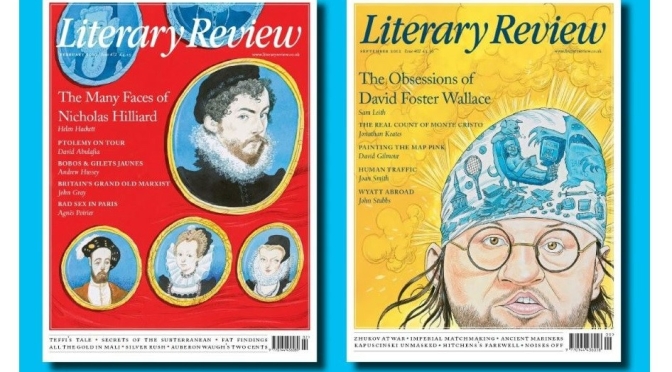
LITERARY REVIEW (July 1, 2025): The latest issue features ‘Will Wiles on the Art of Purism…

Hung, Drawn & Courted – Family Romance: John Singer Sargent and the Wertheimers By Jean Strouse

John Singer Sargent: The Charcoal Portraits By Richard Ormond

No Sketching! – Monsieur Ozenfant’s Academy By Charles Darwent

Artists on Tour – Art on the Move in Renaissance Italy By David Landau

Literary Lives

THE INDEPENDENT REVIEW – SUMMER 2025 PREVIEW

Book Review: Creative Destruction: An Introduction, John T. Dalton and  Andrew J. Logan

THE INDEPENDENT REVIEW (June 26, 2025): The latest issue features ‘Corporate America’s Ideological Tilt’….

Corporate America’s Ideological Tilt: An Introduction

Rosolino A. Candela, Caleb S. Fuller

Beyond Interest: What May Motivate DEI

Douglas J. Den Uyl

Philosophy, Law and Culture of Liberal Democracy and the Authoritarian Challenge

By Suri Ratnapala

Reviewed by  Paul Dragos Aligica

Martin Van Buren: America’s First Politician

By James M. Bradley

Reviewed by  Garion Frankel

Capitalism: The Story Behind the Word

By Michael Sonenscher

Reviewed by Richard M. Salsman

WORLD LITERATURE TODAY – JULY 2025 PREVIEW

WORLD LITERATURE TODAY (June 26, 2025): The latest issue features Writing with Light – The 2025 Puterbaugh Lecture, by Guadalupe Nettel

Gaza Voices

Introduction: Eyes of the Pen, Voices of the Cameraby Yousef Khanfar

Writing on War’s Edgeby Yousri Alghoul

They Call It Displacement—In Reality, It’s Hell (This Is My Story)by Nour Abo-Rokb

This Is What I Haveby Shrouq Mohammed Doghmosh

Nun and War (She and War)by Kifah Salama Al-Ghseen

CREATIVE NONFICTION

Ghost by Basem Nabres

Ringtones of My Mobile Phoneby Omar Hammash