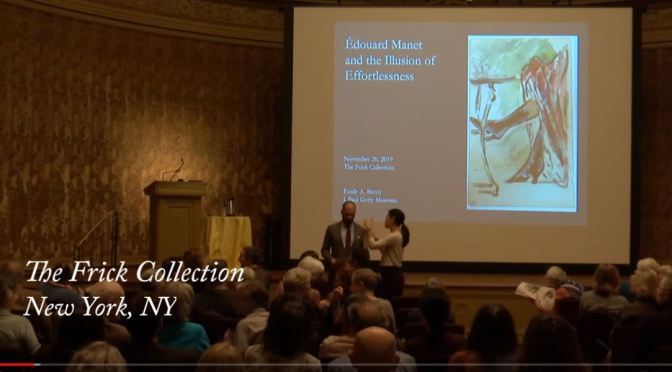
Claude Monet once remarked that Manet “always wanted his painting to look as if done at the first attempt,” but the truth was more complicated. Manet went to great lengths to perfect his work and even greater lengths to conceal the effort involved. From his earliest oil paintings to his late watercolors, this lecture contrasts Manet’s cultivation of a reputation for effortlessness with the arduous reality of his practice.
Emily A. Beeny, Associate Curator of Drawings, The J. Paul Getty Museum, Los Angeles
The new MoMA opens. Cherished works return to the walls of the galleries in brand new frames, while curators and artists watch the completion of the reinstallation. After being closed for four months, MoMA reopens its doors to the public.
TABLE OF CONTENTS
0:13 – Associate sculpture conservator Roger Griffith and sculpture conservation fellow Joy Bloser clean Arthur Young’s Bell-47D1 Helicopter.
0:52 – Senior curator of Painting and Sculpture Anne Umland and chief curator of Painting and Sculpture Ann Temkin oversee the hanging of Pablo Picasso’s “Les Demoiselles d’Avignon.”
1:20 – Peter Perez, frame shop foreman, discusses “The Starry Night’s” new, black frame.
2:53 – Artist Amy Sillman explains how she curated and arranged “The Shape of Shape,” part of the long-running Artist’s Choice exhibition series in which artists selects works to show from the Museum’s collection
4:17 – Photography curator Sarah Meister and conservator Lee Ann Daffner adjust the lighting on Joseph-Philibert Girault de Prangey’s “Rome. Arch of Septimus Severus and Capitoline Lion.”
5:02 – Senior deputy director of exhibitions and collections Ramona Bronkar Bannayan and director of exhibition design and production Lana Hum make a final checklist of things to accomplish before the opening.
5:32 – Artist Betye Saar sees her exhibition for the first time.
7:11 – Manager of enterprise applications Rik Vanmechelen and developer Ryan Sprott check the new ticket machines.
8:04 – Chief facilities and safety officer Tunji Adeniji welcomes the public to the new MoMA on opening day.
8:30 – Silent film accompanist Ben Model improvises a live piano soundtrack for Frank Powell’s 1915 film “A Fool There Was.”
9:12 – Security supervisor Chet Gold greets volunteer Fred Liberman. Gold returns to his favorite room in the new MoMA.
This exhibition traces the first sixty years of the etched print (circa 1490 to circa 1560), from its emergence in the workshop of the German printmaker and armor decorator Daniel Hopfer to the years when a range of artists from Germany, Flanders, Italy, and France began experimenting with etching. Approximately 125 etchings, produced by both renowned and lesser-known artists, are displayed alongside a number of drawings, printing plates, illustrated books, and armor.
The history of printmaking has been punctuated by moments of great invention that have completely changed the course of the medium. The beginning of etching in Europe in the late fifteenth and early sixteenth centuries—when the technique moved out of the workshop of armor decorators and into those of printmakers and painters—represents one of those pivotal moments. Etching, essentially drawing on the surface of a metal plate, had an ease that opened the door for all kinds of artists to make prints. The pioneers of the medium included some of the greatest painters of the Renaissance, such as Albrecht Dürer, Parmigianino, and Pieter Bruegel the Elder.
Today’s edition features Harvard professor Steven Pinker. As an experimental psychologist, Steven has written extensively about violence – and for his choice from the gallery’s collection he has selected two of Pablo Picasso’s most gruesome depictions of man’s inhumanity, Charnel House and Guernica, now housed in Madrid.
Radio 3 presents a radiophonic art exhibition, as 30 of the world’s most creative minds choose a favourite work from the Museum of Modern Art in New York. Ep5 Pinker and Picasso.
“The Way I See It” is a co-production of the BBC and the Museum of Modern Art, New York.
Masterpieces of Painting surveys more than one hundred of the most exquisite and significant paintings displayed in the museum’s famed, daylight-suffused galleries. Vibrant full-color illustrations and engaging descriptions of these masterworks reveal their fascinating histories and cultural, social, and religious meanings. Sure to enchant and edify all art lovers, this book is a spellbinding tour through the history of Western painting.
Rooted in a passion for the Italian Renaissance as well as Dutch and Flemish Baroque works, the original collection of J. Paul Getty (1892–1976) has been transformed over four decades to include seminal pieces by celebrated masters such as Masaccio, Titian, Parmigianino, Cranach, El Greco, Rubens, van Dyck, Rembrandt, Poussin, Canaletto, Fragonard, Turner, Manet, Degas, Renoir, Monet, van Gogh, Cézanne, and Ensor.
Davide Gasparotto is senior curator in the Department of Paintings at the J. Paul Getty Museum, where Scott Allan is associate curator and Anne T. Woollett is curator. Peter Björn Kerber is curator at the Dulwich Picture Gallery in London.
I became engrossed in Mitchell’s drawings while browsing the book—they’re vivid, intimate—but her handwritten lyrics and poems are just as revelatory. It’s hard not to think about art-making of any kind as an alchemical process, in which feelings and experiences go in and something else comes out. Whatever happens in between is mysterious, if not sublime: suddenly, an ordinary sensation is made beautiful. Our most profound writers do this work with ease, or at least appear to. Mitchell’s lyrics are never overworked or self-conscious, and she manages to be precise in her descriptions while remaining ambiguous about what’s right and what’s wrong; in her songs, the cures and the diseases are sometimes indistinguishable.
Joni Mitchell, in the foreword to “Morning Glory on the Vine,” her new book of lyrics and illustrations, explains that, in the early nineteen-seventies, just as her fervent and cavernous folk songs were finding a wide audience, she was growing less interested in making music than in drawing. “Once when I was sketching my audience in Central Park, they had to drag me onto the stage,” she writes. Though Mitchell is deeply beloved for her music—her album “Blue” is widely considered one of the greatest LPs of the album era and is still discussed, nearly fifty years later, in reverent, almost disbelieving whispers—she has consistently defined herself as a visual artist. “I have always thought of myself as a painter derailed by circumstance,” she told the Globe and Mail, in 2000. At the very least, painting was where she directed feelings of wonderment and relish. “I sing my sorrow and I paint my joy,” is how she put it.
There’s also a special focus on architecture and design in this new approach to the collection: Several galleries are devoted to various aspects of those fields, including “The Vertical City,” an examination of skyscraper construction that includes photos by Berenice Abbott, Hugh Ferriss’s architectural drawings, and other ephemera. Elsewhere, building models of the Guggenheim and a spec design of MoMA by modernist master William Lescaze emphasize the importance of architecture to museums, and vice versa.
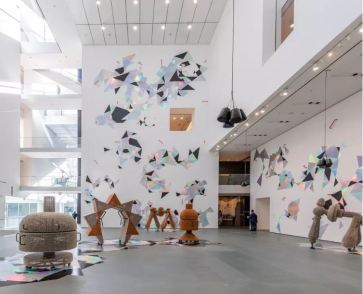
…the museum is about to reveal its most ambitious revamp yet: On October 21, MoMA will open its expanded headquarters, which now takes up most of the block on 53rd Street between Fifth and Sixth avenues. The museum has pushed westward, opening more than 40,000 square feet of fresh galleries in both a ground-up building (which rose from the ashes of the Tod Williams Billie Tsien Architects-designed American Folk Art Museum) and the base of Jean Nouvel’s supertall skyscraper next door.
The galleries aren’t all that’s been added, though: The museum has also opened a new, expansive lobby—which has two galleries that can be visited free of charge—as well as a spacious gift shop that has been relocated below street level. A wall of windows gives passersby a glimpse into the space, and is intended as a gesture of “increased transparency,” according to the museum.
Things take an even stranger turn when he gets to Egypt, and his own features still appear again and again; not, as before, as a barely significant detail in an otherwise busy composition, but as a principal element. In a series of fine single-figure paintings brought together at the Watts Gallery, Lewis represents himself as a Syrian sheikh scanning the horizon of the Sinai desert; as the suave ‘bey’ of a Cairene household, lowering his eyelids as his servant offers him a water pipe; as an impassive carpet-seller in the Bezestein bazaar. In none of these, however, does he quite meet our eye.
In his mid thirties, an age at which most ambitious artists were making themselves as visible as possible, John Frederick Lewis (1804–76), a successful painter of sporting subjects and Mediterranean scenes, vanished from London for more than a decade. It was an audacious move. He spent two years in Italy, then followed in Lord Byron’s footsteps, travelling through Albania, Corfu, Athens and Smyrna, and after a year in Constantinople he sailed for Egypt. Once there Lewis fell in love with Cairo, and rather than returning to England with his sketchbooks he set up home, staying until 1851. Those years might have been something of a biographical blank had it not been for a visit in 1844 from his old friend William Makepeace Thackeray, who included a somewhat excitable account in his travel book Notes of a Journey from Cornhill to Grand Cairo(1846).
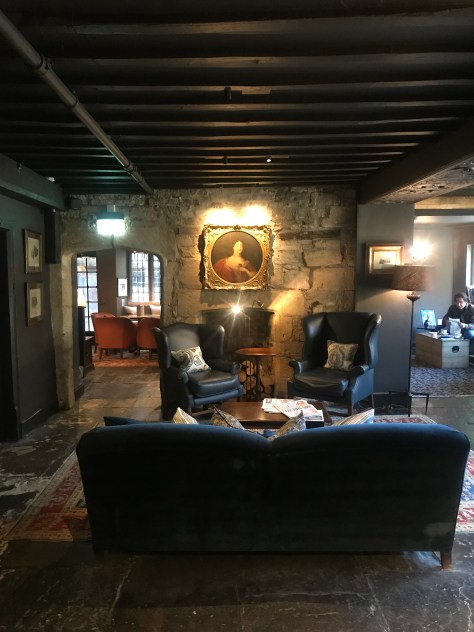
A brisk 2.9 mile walk (yes, 2.9 miles) in mildly drizzly weather from The Swan Hotel door back to the breakfast room set up a perfect day.
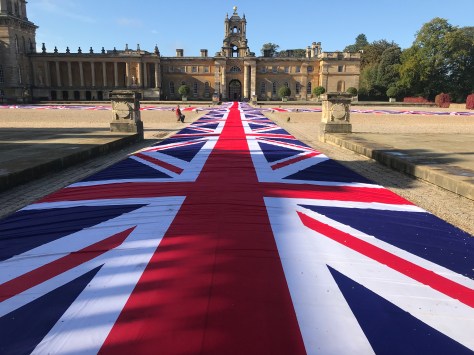
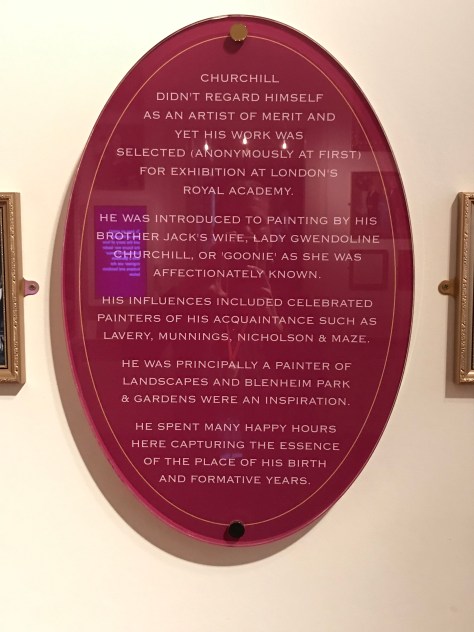
Drove to Blenheim Palace and arrived at the 10:00 am opening time. Gorgeous grounds and gated entrance.
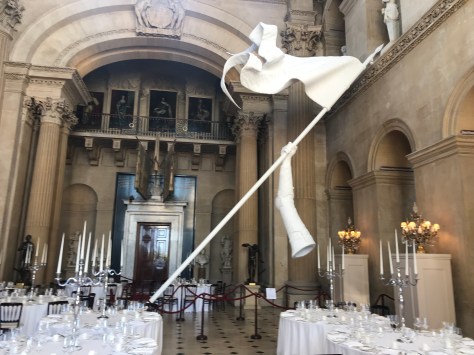
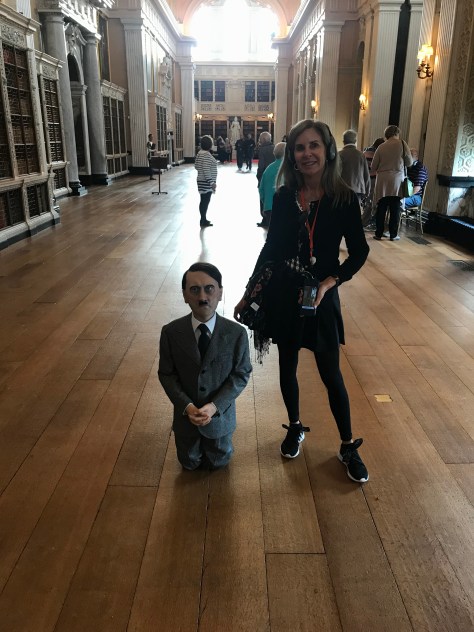
Famed Italian Artist Mauricio Cattelan was featured throughout the Palace and grounds which added to the spectacle.
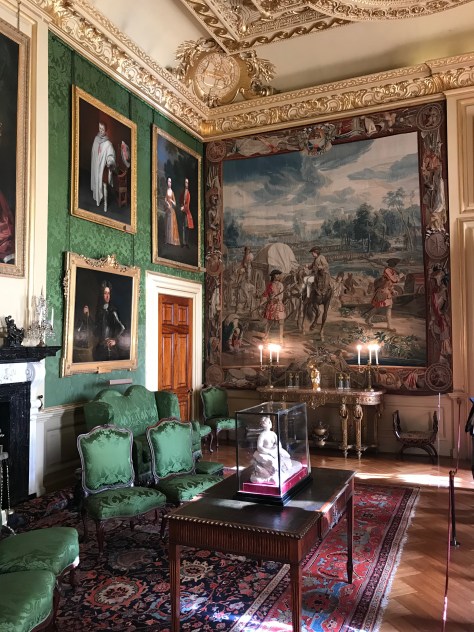
We entered the palace at 10:30 and were swept up in an amazing tour of the Duke of Marlborough’s residence.
The audio tour was very informative and kept your interest in every room.
Cattelan’s very humorous exhibits were meant to convey the very accidental and interactive nature life and art, with the aim of softening the imposing feel of the castle. Amazing.
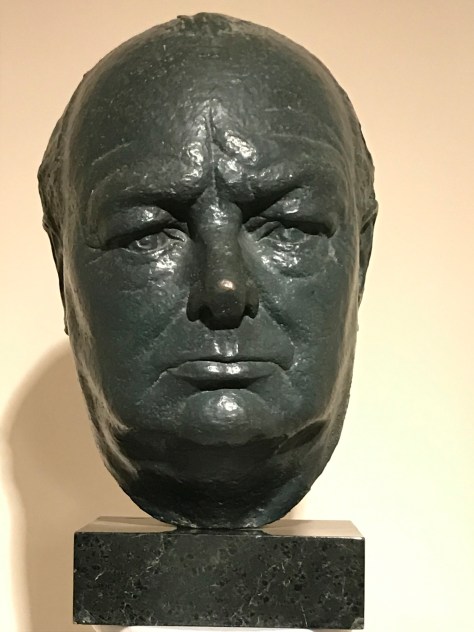
The Winston Churchill exhibits at the end were spectacular in breadth and scope.
We left at 1:00 and drove to Broadway and a walk of the very polished town, full of art galleries, custom shops and elite hotels.
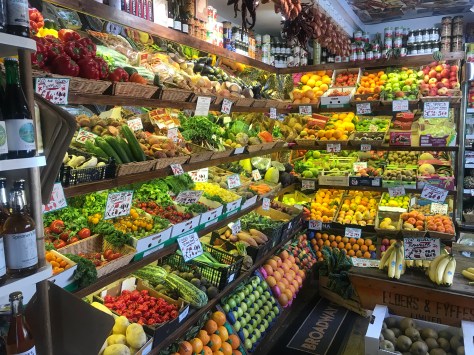
A great sandwich and salad at a deli on the Main Street was followed by a drive to the Broadway Tower.
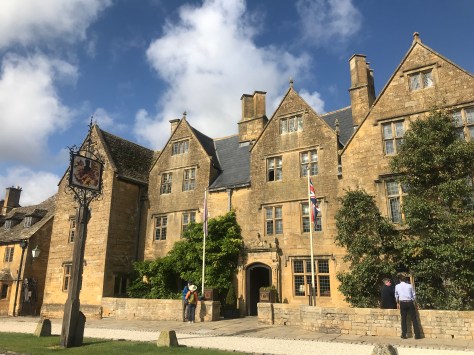
We headed back to Bibury and a glass of Rose in the small park in front of The Swan Hotel.
But there is nothing quite like the mind-bending spectacle now on display at dusk in the hills of Paso Robles here, a popular wine destination. That is the witching hour when thousands of solar-powered glass orbs on stems, created by the artist Bruce Munro, enfold visitors in an earthbound aurora borealis of shifting hues.
Since it opened in May, “Field of Light at Sensorio” — the 60-year-old British artist’s largest such installation to date — has drawn thousands of tourists and become an Instagram phenomenon. The subtly changing patterns of this light safari, activated by a nebula of fiber-optic cables attached to hidden projectors, seem to inspire a cathedral-like awe among ticket-holders, who pay $19 to $30 for an evening stroll along 15 acres of illuminated walkways.


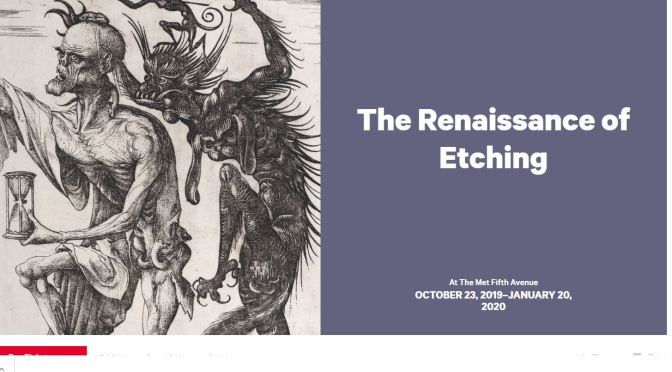
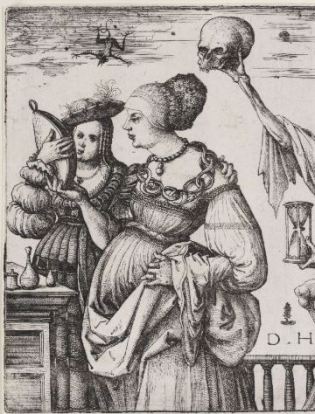 This exhibition traces the first sixty years of the etched print (circa 1490 to circa 1560), from its emergence in the workshop of the German printmaker and armor decorator Daniel Hopfer to the years when a range of artists from Germany, Flanders, Italy, and France began experimenting with etching. Approximately 125 etchings, produced by both renowned and lesser-known artists, are displayed alongside a number of drawings, printing plates, illustrated books, and armor.
 Today’s edition features Harvard professor Steven Pinker. As an experimental psychologist, Steven has written extensively about violence – and for his choice from the gallery’s collection he has selected two of Pablo Picasso’s most gruesome depictions of man’s inhumanity, Charnel House and Guernica, now housed in Madrid.
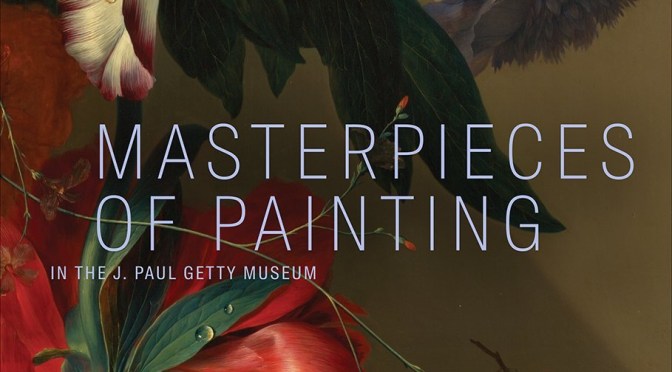
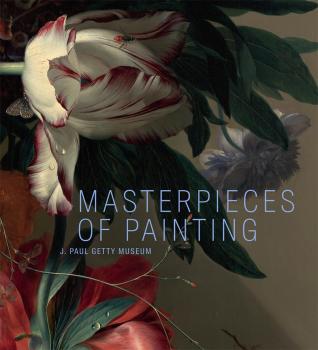 Masterpieces of Painting surveys more than one hundred of the most exquisite and significant paintings displayed in the museum’s famed, daylight-suffused galleries. Vibrant full-color illustrations and engaging descriptions of these masterworks reveal their fascinating histories and cultural, social, and religious meanings. Sure to enchant and edify all art lovers, this book is a spellbinding tour through the history of Western painting.
 Rooted in a passion for the Italian Renaissance as well as Dutch and Flemish Baroque works, the original collection of J. Paul Getty (1892–1976) has been transformed over four decades to include seminal pieces by celebrated masters such as Masaccio, Titian, Parmigianino, Cranach, El Greco, Rubens, van Dyck, Rembrandt, Poussin, Canaletto, Fragonard, Turner, Manet, Degas, Renoir, Monet, van Gogh, Cézanne, and Ensor.
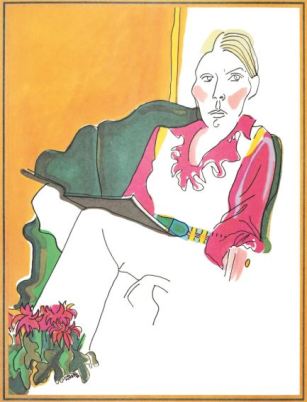 I became engrossed in Mitchell’s drawings while browsing the book—they’re vivid, intimate—but her handwritten lyrics and poems are just as revelatory. It’s hard not to think about art-making of any kind as an alchemical process, in which feelings and experiences go in and something else comes out. Whatever happens in between is mysterious, if not sublime: suddenly, an ordinary sensation is made beautiful. Our most profound writers do this work with ease, or at least appear to. Mitchell’s lyrics are never overworked or self-conscious, and she manages to be precise in her descriptions while remaining ambiguous about what’s right and what’s wrong; in her songs, the cures and the diseases are sometimes indistinguishable.
 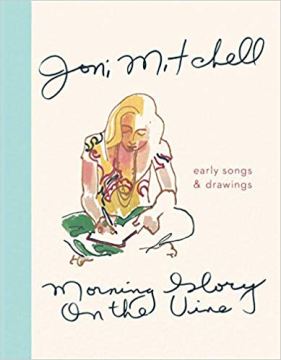 Joni Mitchell, in the foreword to “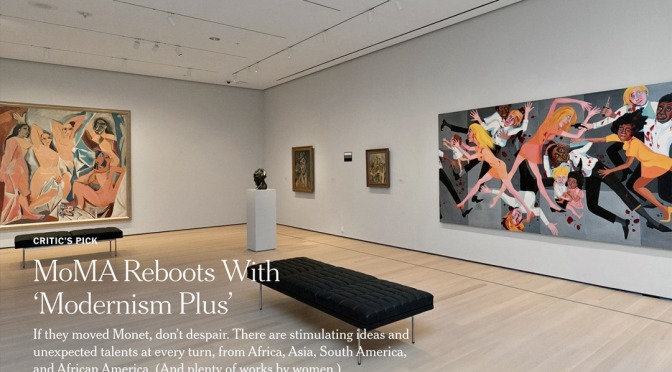
 There’s also a special focus on architecture and design in this new approach to the collection: Several galleries are devoted to various aspects of those fields, including “The Vertical City,” an examination of skyscraper construction that includes photos by Berenice Abbott, Hugh Ferriss’s architectural drawings, and other ephemera. Elsewhere, building models of the Guggenheim and a spec design of MoMA by modernist master William Lescaze emphasize the importance of architecture to museums, and vice versa.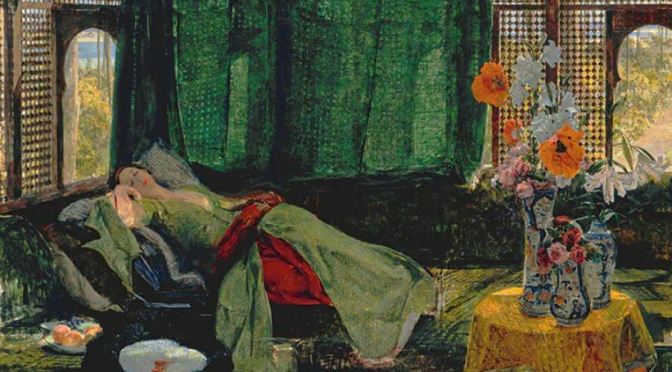
 Things take an even stranger turn when he gets to Egypt, and his own features still appear again and again; not, as before, as a barely significant detail in an otherwise busy composition, but as a principal element. In a series of fine single-figure paintings brought together at the Watts Gallery, Lewis represents himself as a Syrian sheikh scanning the horizon of the Sinai desert; as the suave ‘bey’ of a Cairene household, lowering his eyelids as his servant offers him a water pipe; as an impassive carpet-seller in the Bezestein bazaar
 A brisk 2.9 mile walk (yes, 2.9 miles) in mildly drizzly weather from The Swan Hotel door back to the breakfast room set up a perfect day.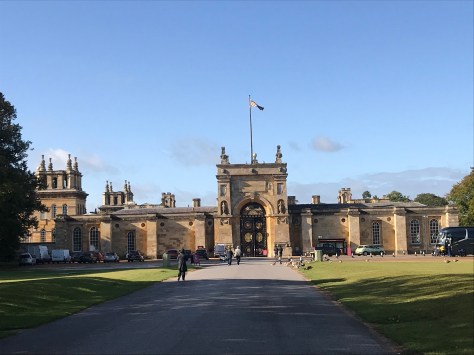









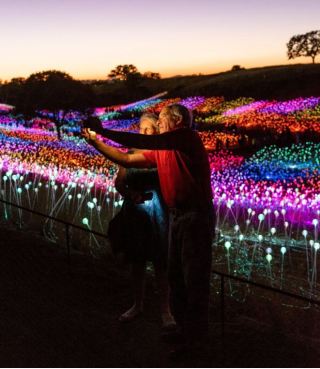 But there is nothing quite like the mind-bending spectacle now on display at dusk in the hills of Paso Robles here, a popular wine destination. That is the witching hour when thousands of solar-powered glass orbs on stems, created by the artist Bruce Munro, enfold visitors in an earthbound aurora borealis of shifting hues.
 Boomers Daily