Tag Archives: Architectural Design

Design: ‘Jewel Changi Airport’, Singapore By Safdie Architects (Video)

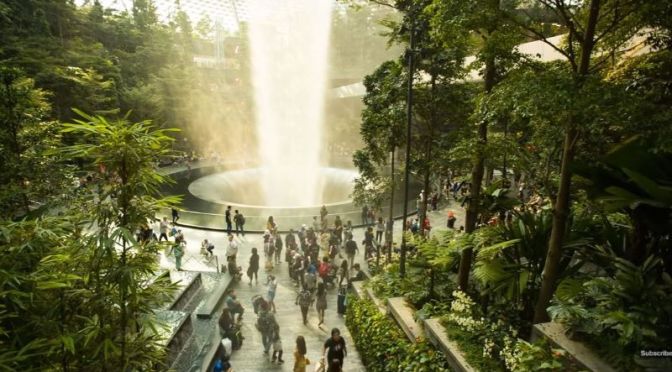
Fulfilling its mission as a connector between the existing terminals, Jewel combines two environments—an intense marketplace and a paradise garden—to create a new community-centric typology as the heart, and soul, of Changi Airport. Jewel re-imagines the center of an airport as a major public realm attraction. Jewel offers a range of facilities for landside airport operations, indoor gardens, leisure attractions, retail offerings and hotel facilities, all under one roof. A distinctive dome-shaped façade made of glass and steel adds to Changi Airport’s appeal as one of the world’s leading air hubs.

Based on the geometry of a torus, the building shape accommodates the programmatic need for multiple connections in the airport setting. At the heart of its glass roof is an oculus that showers water through a primary multistory garden, five stories through to the forest-valley garden at ground level. The core of the program is a 24-hour layered garden attraction that offers many spatial and interactive experiences for visitors. Four cardinal axes—north, south, east, and west—are reinforced by four gateway gardens, which orient visitors and offer visual connections to the internal surroundings and other airport terminals. By night, the glazed facade helps dematerialize the building, revealing the glowing garden within.
Future Of Ecotourism: ‘Cocoon Hotel & Resort’ – Tulum, Mexico (Video)

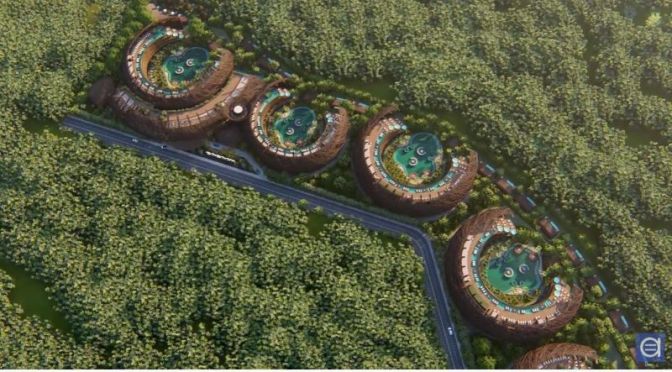
The “Cocoon Hotel & resort”, Tulum, Mexico– a new concept of eco-tourism, and a great opportunity of connection with Nature, Community, Ourselves, inspired by the sea and the exotic forest. The project consists of 46.181 m2 offering 3 residential and 2 hotel buildings “COCOON” with 204 apartments and 167 rooms as well as 16 private villas.Every feature serves to give a unique experience and create a magical place for the guest, at the same time making him identify what is Mexico.

The complex offers luxury community spaces integrated into nature such as jungle gardens, magical outdoor living spaces-villas, multipurpose pavilion, indoor community spaces, leisure areas, restaurant, and a panoramic Nest with unrestricted and breath-taking views. All to achieve a wide vocabulary of visual elements to mutate into designing language, in materials and shapes, for a bio-mimicry architecture.

The idea was to create “Cenotes”- natural freshwater ponds, to which the Mayans gave a sacred use, thus allowing to experience the real Mayan´s rituals. The project makes an emphasis on sustainability concept respecting ecosystem and biodiversity, contributing to the usage of natural materials that minimizes the impact of building and generation of waste. The water collection concept is also respected and represents a recovery of rainwater for sewage treatment. The solar panels are implemented to achieve sustainable electricity.

Finally, the “dry” construction system is used, meaning no wet binders, shorter execution time, and increased safety and sustainability. Source by dna Barcelona.

A As Architecture – Discover Architecture http://aasarchitecture.com/

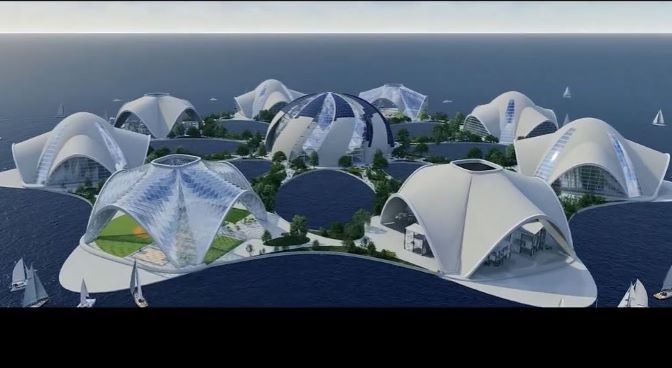
Future Of Ocean Living: ‘Lillyana’ – A Hydrophytic Model For Urban Design

LILLYANA : Architecture & Innovation for the Sea

Author : Arthur Seibert and Clemens Lindner
Nationality : German
Year : 2019
Location : Shanghaï, China

In the context of a rapidly increasing global population growth and the associated shortage of living space, alternative urban concepts in a marine environment are gaining importance under ecological and sustainable aspects. The concept- guideline “renaturation instead of soil sealing” is an effort to react on the challenges of current megatrends in the context of the sea. The underwater city structure is designed for up to 15,000 inhabitants in the vicinity of a large coastal city. “Lillyana” represents an ideal system that can be applied to various geographical and climatic conditions and their specific demands. The form is inspired by hydrophytes – plants that grow above and below the water and benefit from their environment. Through their biometric and biological mechanisms, the shape has been improved for energy efficiency, buoyancy and stability. Thus, the wind-, water- and solar energy production is directly embedded in the design language. The main challenge of this project was to develop a self-sufficient system that could also allow different forms of social life at the same time. To achieve this, we have tried to understand the factors that make an attractive city: “Living”, “working”, “mobility”, “supply” and “recreation” These fields of action provide the framework for our design: Therefore, a superior supply organ will be placed in the centre, from which radially arranged bridge systems will form connections to floating platforms. These are anchored beneath the seabed and represent the quarter centres. From the platforms, supply pipelines, on which various spheres are suspended, lead into the depths. They shift private, professional and social life below the water surface. High attractiveness, beneath as well as above the sea level, is achieved by providing well-located and spatially qualitative living and working areas with a recreation and leisure area, as well as an intelligent infrastructure via a pipeline network.

Descriptive of Author : Splendour of life beneath the surface: “Lillyana” – A hydrophytic model for urban design

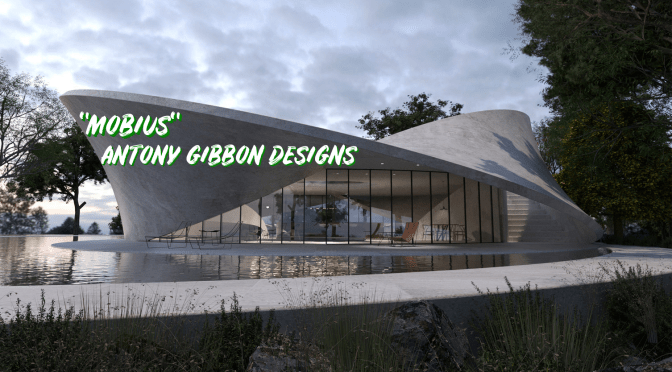
Top Architectural Design: Antony Gibbon Designs “Pushing The Boundaries”

Antony Gibbon Designs logoEmbracing nature’s forms as a source of inspiration and pushing the boundaries of architectural design, Antony’s body of work has gained world-wide recognition and been featured in Vanity Fair, New York Times, Huffington Post, Dezeen, Dwell, Designboom and the Secret Homes Television series.

Antony sees the environment as an important driving force behind his work, each structure is individually created to consider the surroundings using sustainable materials wherever possible. He aims to create the connection between Nature & Nurture, seeking a path to merge one into the other. To combine each unique, bespoke structure and its individual habitat and to develop harmony, so they grow together.

Antony Gibbon Designs Work

Wherever you are based, the team works with you to create a design that meets your exact needs. Working with a selection of the best building companies around the world to deliver the highest quality service tailored to each individual project.

Website