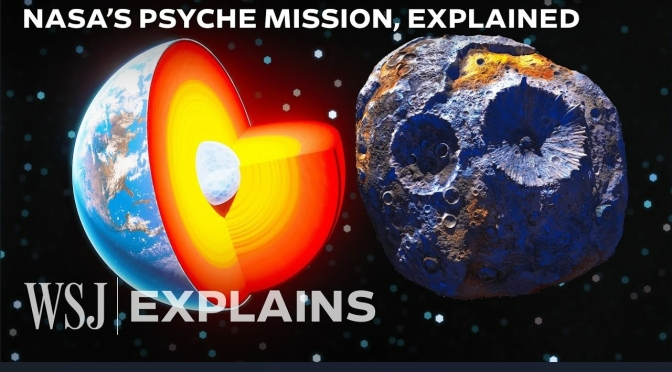
Wall Street Journal (October 13, 2023) – NASA launched a spacecraft on Friday to study the Psyche asteroid, which is believed to be made out of metal.
Video timeline: 0:00 NASA’s mission 0:46 The psyche asteroid 1:45 Why metal matters 3:04 What we can learn from the mission
The rocky inner planets of our solar system are thought to have mostly metallic cores. WSJ breaks down why this mission matters and what it could tell us about Earth’s origins.
‘Editor’s Picks’ Podcast (October 2, 2023) – A selection of three essential articles read aloud from the latest issue of The Economist. This week, the search for the antidote to ageing, why a bigger EU is a better EU (11:30), and Japan’s world-leading toilet culture (25:30).
“Xi’s sense of personal destiny entails significant risk of war…”
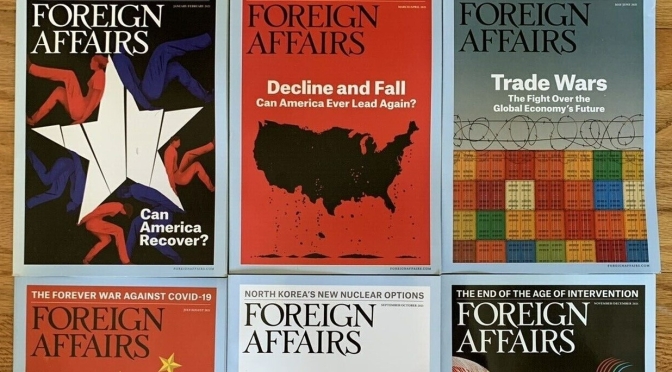
Foreign Affairs (September 29, 2023):The United States now confronts graver threats to its security than it has in decades, perhaps ever. Never before has it faced four allied antagonists at the same time—Russia, China, North Korea, and Iran—whose collective nuclear arsenal could within a few years be nearly double the size of its own. Not since the Korean War has the United States had to contend with powerful military rivals in both Europe and Asia. And no one alive can remember a time when an adversary had as much economic, scientific, technological, and military power as China does today.
The problem, however, is that at the very moment that events demand a strong and coherent response from the United States, the country cannot provide one. Its fractured political leadership—Republican and Democratic, in the White House and in Congress—has failed to convince enough Americans that developments in China and Russia matter. Political leaders have failed to explain how the threats posed by these countries are interconnected. They have failed to articulate a long-term strategy to ensure that the United States, and democratic values more broadly, will prevail.
‘Editor’s Picks’ Podcast (September 25, 2023) – A selection of three essential articles read aloud from the latest issue of The Economist. This week, how to win a long war in Ukraine, what Asia’s economic revolution means for the world (11:05) and why a disgraced comedian is the symbol of a cruel, misogynistic and politically vacant era in Britain (18:52).
‘Editor’s Picks’ Podcast (September 18, 2023) – Three essential articles read aloud from the The Economist. This week, an analysis of how AI can revolutionize scienceand how a fresh wave of hard-right populism is stalking Europe.
‘Editor’s Picks’ Podcast (September 18, 2023) – Three essential articles read aloud from the The Economist. This week, the future of the Middle East, Wall Street’s race to wealth management (10:00), and how London’s bus drivers revolutionised health (17:40).
The Economist (September 7, 2023) – Rampant inflation, a booming black market for US dollars and crippling debt – welcome to Argentina, one of the world’s most dysfunctional economies. How did it end up like this?
Video timeline:00:00 – Argentina’s economy is in crisis 01:21 – What is happening now? 04:16 – Why is this happening? 05:52 – Overspending 07:00 – Printing money 08:03 – Borrowing money 08:51 – Trade controls 11:06 – What are the solutions?
Wall Street Journal (September 7, 2023) – Meta. PayPal. X. All of these tech companies have made attempts at a “super app” in the U.S., following the success of WeChat in China, but have yet to get one off the ground. Tech leaders have struggled to combine elements like social media, messaging, payment and more into one place.
Video timeline: 0:00 App efficiency 0:37 The appeal 2:18 U.S. issues 4:03 Regulation 4:48 What’s next?
So what’s holding the U.S. back from having a super app available? WSJ explains why, despite challenges, companies still see it as their holy grail product.







 Boomers Daily