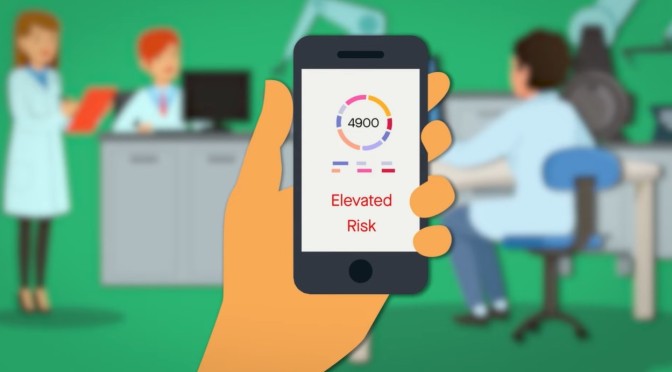
Scripps Research (April 11, 2023) – From smartwatches and fitness bands to glucose monitors and in-home ultrasounds, the proliferation of digital devices is igniting a revolution in healthcare and medical research.
Patients can now collect thousands of data points about themselves and share that information with their healthcare providers. At the Scripps Research Translational Institute, researchers are taking advantage of new technology to study disease in novel ways.
Their projects include a platform for early detection of disease outbreaks, a sleep quality study, and even a way to predict and individual’s risk of certain disease based on their genetics. In this video, hear directly from the team about this exciting new frontier.
World Economic Forum (April 8, 2023) – This week’s top stories of the week include:
0:15 Vanuatu takes the World to Court – The island state pushed through a historic UN motion which calls on the International Court of Justice, the world’s highest court to establish countries’ legal duties to address the climate crisis. The ICJ will provide an ‘opinion’ on what countries can do to cut emissions and protect people and protect climate-vulnerable people. Although the opinion won’t be legally binding, it will carry huge weight and could be used in climate negotiations and future climate lawsuits.
1:43 Japanese workers just got a historic payrise – Every year, unions of major companies negotiate wages in Spring, for shorter hours and better pay. This year, the parties agreed to a 3.8% wage rise, the biggest raise since 1993. For part-time and contract workers, the raise was even larger, 5.91% per hour. A rise in the cost of living drove the agreements. Consumer prices in Japan have risen 4.2% in a year, The sharpest rise for 40 years. And the real value of wages fell 4.1% in January for the tenth consecutive month.
3:03 Latvia has the most female inventors in Europe – A new study charted the gender gap in European inventors from 1978 to today by counting the women named in patent applications. From 2010-2019, 30.6% of Latvia’s inventors were women. Portugal took second place with 26.8% and third was Croatia, where 25.8% of inventors were women. 4:39 Friends are key to reducing inequality – Researchers wanted to know why some people climb the economic ladder faster than others. So they looked at the Facebook friendships of 72 million people. Here’s what they found.
_____________________________________________
The World Economic Forum is the International Organization for Public-Private Cooperation. The Forum engages the foremost political, business, cultural and other leaders of society to shape global, regional and industry agendas. We believe that progress happens by bringing together people from all walks of life who have the drive and the influence to make positive change.
World Economic Forum (April 1, 2023) – This week’s top stories of the week include:
0:15What happened in the Credit Suisse takeover – The Swiss government has brokered an emergency takeover of Credit Suisse by rival bank UBS. Experts are calling it the ‘most dramatic moment in global banking’ since the 2008 crisis. The deal was worth $3.2 billion, that’s 6% less than what Credit Suisse was worth last Friday and wiped out $17 billion in additional tier 1(AT1) bonds. So what are AT1 bonds? AT1 bonds were created after the 2008 financial crisis when the banking industry became more regulated. They are a type of hybrid debt issued by banks. AT1 bonds can offer high returns. Watch to learn more about how the AT1 bonds were related to the Credit Suisse crisis.
1:48The world’s lightest paint – It was inspired by butterflies’ wings. It’s so light that you could coat a Boeing 747 with just 1.5 kg of paint, rather than the 500 kg of paint typically used. Its inventors say it’s light enough to make cars and planes more energy-efficient. It absorbs less heat than standard paint and keeps underlying surfaces up to 16˚C cooler. So it could help us cut down on energy used for air conditioning
3:05Belgium’s Artificial Energy Island – Belgium is building a new island in the North Sea to transform offshore wind energy. Princess Elisabeth Island will be 45km off the coast and will serve as a hub for the Princess Elisabeth Zone, a planned 3.5GW offshore wind farm. This artificial wind energy island will be 6 hectares in size, equivalent to around 12 football pitches. It will collect all the electricity generated by turbines, then send it to the mainland through undersea cables. The artificial wind energy island will also host interconnectors from the UK and Denmark, which will, in turn, connect to other North Sea wind farms. Construction is set to begin next year, and the island is due to be fully operational by 2030. Watch to learn more about Belgium’s artificial wind energy island.
4:11Switzerland’s Solar Railway – Start-up Sun-Ways has collaborated with the Federal Institute of Technology Lausanne for a pilot project testing the panels on a section of rail near Buttes in Western Switzerland. If rolled out to the country’s entire 5,000km rail network they could supply 2% of Switzerland’s electricity. Sun-Ways believes 50% of the world’s railways could be equipped with its system.
_____________________________________________
The World Economic Forum is the International Organization for Public-Private Cooperation. The Forum engages the foremost political, business, cultural and other leaders of society to shape global, regional and industry agendas. We believe that progress happens by bringing together people from all walks of life who have the drive and the influence to make positive change.
World Economic Forum (March 25, 2023) – This week’s top stories of the week include:
0:15 NASA launches space based pollution monitor – It’s called TEMPO, which stands for Tropospheric Emissions: Monitoring of Pollution. Built by Ball Aerospace, TEMPO will measure levels of major air pollutants every hour from a geostationary orbit 22,000 miles above the equator. It will monitor a huge region of North America from Canada’s oil sands in northern Alberta to below Mexico City at a resolution of up to 4 square miles. Air pollution poses a major threat to human and planetary health as 99% of the global population breathes air that exceeds WHO health guidelines. Air pollution carries a total economic cost of more than $8 trillion. Therefore, monitoring it is critical to understanding its impacts. Though TEMPO is due to launch in April 2023, watch to learn more about how it will monitor air pollution from space.
1:58 8 best countries for working women – The Economist ranked 29 OECD nations according to the role and influence of women in the workplace. Iceland scores well on numerous factors. From low childcare costs to education attainment for women to female representation at senior levels. At the current rate, it will take 132 years to close the global gender gap How does your country support women at work?
3:23 What is the polycrisis? – Today we are once again beset by seemingly unconnected crises. Such as the war in Ukraine, the climate crisis and the aftermath of COVID-19. “So economics, politics, geopolitics and then the natural environment blowing back at us – and those 4 things, they don’t reduce to a single common denominator. They don’t reduce to a single factor. And that’s why I think the polycrisis term has a real utility descriptively as much as anything else, because it’s kind of hand-waving, of course, it’s kind of arm waving. It’s going, look, there’s a lot of stuff happening here all at once. And that precisely is what we’re trying to wrap our minds around.”
6:54 Are Chatbots going to take our jobs? – “I get this question asked 10 times a week, which is that, look, is conversational AI going to take away jobs? And my consistent answer is no. And the best analogy I will give to you is banks and ATMs. So prior to the technology of ATMs, the most common reason why people would walk into a bank would be to take out money. So imagine there’s no ATMs and 90% of the reason why somebody goes inside the bank is to say, I need to take out some cash, I need to take out some money. As a result, you know, you and I don’t even remember these days, but banks used to be crowded. There used to be long lines and so on. Here comes the ATM, which automates really what should be a very simple task.”
_____________________________________________
The World Economic Forum is the International Organization for Public-Private Cooperation. The Forum engages the foremost political, business, cultural and other leaders of society to shape global, regional and industry agendas. We believe that progress happens by bringing together people from all walks of life who have the drive and the influence to make positive change.
World Economic Forum (March 18, 2023) – This week’s top stories of the week include:
0:15Silicon Valley Bank collapse explained – On 10 March, Silicon Valley Bank (SVB) failed after a ‘run’ on the bank from customers wishing to draw cash. The bank didn’t have enough funds to pay them. So federal regulators had to step in and shut it down. Silicon Valley Bank is the biggest US bank to fail since the 2008 financial crisis and the second-biggest ever. Just a few days ago, it was a respected player in the tech space, with thousands of venture capital-backed start-ups among its customers. So how did things go wrong so quickly? Watch the video to learn more about the Silicon Valley Bank collapse.
2:14Aviation will be net zero by 2050 – Altogether, aviation is currently responsible for 2.5% of global emissions. Without action to reduce emissions, demand could see this soar 300% by 2050. 65% of the way to net zero will come from switching to sustainable aviation fuels (SAF). Its production uses a fraction of the carbon footprint generated by petroleum fuel.
3:49AI detects lung cancer better than humans – It reads routine chest X-rays to highlight up to 29 abnormalities. Including the patient’s risk of lung cancer so a radiologist can take a look. Usually, human radiologists scour X-rays by eye. But 20% of lung cancer risks go undetected this way, causing a potential delay in diagnosis and poorer outcomes. The new tool was developed by Qure.ai and is being scaled up in partnership with AstraZeneca. The tool was trained using over 4 million X-rays. In trials, it was 17% more sensitive than a human. Early data indicates impressive accuracy for identifying risk of malignancy
5:18Researchers restore movement for stroke victims – Doctors implant electrodes in the patient’s neck. These stimulate undamaged parts of the spinal cord and bring movement back to paralyzed arms and hands.
_____________________________________________
The World Economic Forum is the International Organization for Public-Private Cooperation. The Forum engages the foremost political, business, cultural and other leaders of society to shape global, regional and industry agendas. We believe that progress happens by bringing together people from all walks of life who have the drive and the influence to make positive change.
National Science Foundation (March 13, 2023) – Harnessing the power of AI, researchers calculate our brain’s age leading to earlier detection of Alzheimer’s and other cognitive diseases.
Researchers at USC have developed a new artificial intelligence model that more accurately captures brain age. This study could result in earlier detection of Alzheimer’s and other cognitive diseases and provide important information about how quickly our brains age.
World Economic Forum (March 11, 2023) – This week’s top stories of the week include:
0:15These ‘robo-boots’ may improve balance – They provide a super-quick blast of assistance to your muscles helping you to stay upright. Scientists asked a healthy participant to stand on a moving floor wearing the exo-boots. Then ‘pulled the rug’ out from under them. They programmed the boots to work using the same delay as human reflexes or artificially faster than humanly possible. The exo-boots only improved balance when they worked faster than our natural response. It means that, one day, wearable exoskeletons could deploy lightning-quick reflexes to help people with balance impairment.
1:35This new telescope could help explain dark energy – A new space telescope is being launched by the European Space Agency to help scientists build a 3D map of the universe by photographing billions of galaxies up to 10 billion light years away – across more than a third of the sky. Around 95% of the universe is ‘dark matter’ or ‘dark energy’ which doesn’t fit into our cosmological models. The super-sensitive telescope will effectively enable us to look back in time to how distant galaxies looked 10 billion years ago and to see how dark energy accelerated the expansion of the universe.
3:10How to build earthquake proof buildings – When an earthquake strikes, it creates horizontal forces that shake the building from left to right. Concrete is very strong when compressed, but it has little flexibility, and when stretched, as it is during an earthquake, it’s liable to crack. So to create earthquake resistant buildings, designers add a flexible steel skeleton known as rebar. The steel is elastic and springs the building back into shape. Sometimes, when tension is too high, the steel may warp permanently. This is advantageous, though, because it keeps the building upright, enabling people to escape. There are other ways to make earthquake resistant buildings. Watch the video to learn more.
4:34Climate doom is a dangerous myth – It’s the most common false claim about climate change, especially among young people. Some experts believe it’s more damaging than climate denialism. In fact, scientists say, it’s not too late to arrest global warming. Global temperatures will stabilize a few years after we reach net zero and the belief that it’s pointless trying to stop climate change only leads to inaction. Making it as unhelpful as denying climate change altogether.
_____________________________________________
The World Economic Forum is the International Organization for Public-Private Cooperation. The Forum engages the foremost political, business, cultural and other leaders of society to shape global, regional and industry agendas. We believe that progress happens by bringing together people from all walks of life who have the drive and the influence to make positive change.
‘What is lost is (not) lost forever’ imagines how extraordinary species which have become extinct in the last few centuries would look today, had they survived.
Hydrodamalis gigas (also called Steller’s sea cow): extinct large aquatic mammal
designboom (March 6, 2023) – To visualize this new AI-generated series, Italian architect Angelo Renna looks to scientific research and characteristic descriptions of these animals and plants, feeding them as text prompts to Midjourney to visualize their appearances. The project, he notes, is not de-extinction or a revival of extinct species but is instead an educative process to learn about other forms of life in history.
Conilurus albipes: extinct white-footed rabbit rat — a rodent related to rats, mice, and squirrels
Arthropleura: extinct millipede arthropods that lived in North America and Europe around 345 to 290 million years ago














 Conilurus albipes: extinct white-footed rabbit rat — a rodent related to rats, mice, and squirrels
 Boomers Daily