

Black holes eat information – an impossible act that current theories of
— New Scientist (@newscientist) September 23, 2021
physics are at a loss to explain. Can the paradox be resolved?
This week's magazine is available now in shops, in our app and at https://t.co/ac10dFW3yX. Cover image by Andy Gilmore. pic.twitter.com/KFEgJeH3Ua
Category Archives: Science
Science: Floating ‘Seed’ Sensors, Human Walking Pace, Genome Editing
How tiny seed-like sensors could monitor the environment, and the latest from the Nature Briefing.
In this episode:
00:45 Spinning seeds inspire floating electronics
Researchers have developed miniature electronic-chips with wings that fall like seeds, which could be a new way to monitor the environment.
Research article: Kim et al.
Video: Seed-inspired spinners ride the wind and monitor the atmosphere
06:02 Research Highlights
How humans can adjust to an energy-efficient walking pace almost without thinking, and the viral shell that excels at delivering genome-editing tools.
Research Highlight: Humans walk efficiently even with their heads in the clouds
Research Highlight: A CRISPR fix for muscles hatches from a viral shell
08:34 Briefing Chat
We discuss some highlights from the Nature Briefing. This time, the mystery of the Sun’s super-hot corona, and the latest efforts to toilet-train cows.
Physics World: The enduring mystery of the solar corona
The Guardian: Cows ‘potty-trained’ in experiment to reduce greenhouse gas emissions
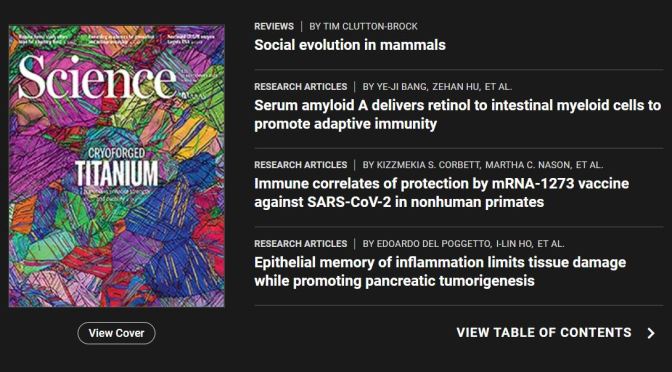
Front Covers: Science Magazine – September 17

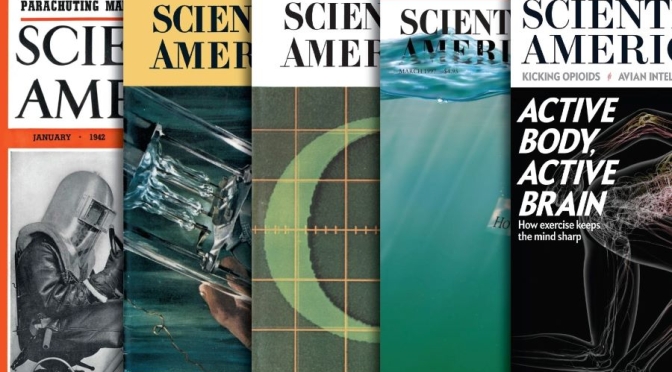
Front Covers: Scientific American – October 2021
Science: Potty-Trained Cows, Massive Sardines Run Off South Africa
Online News Editor David Grimm joins host Sarah Crespi to talk about the health and environmental benefits of potty training cows.
Next, Peter Teske, a professor in the department of zoology at the University of Johannesburg, joins us to talk about his Science Advances paper on origins of the sardine run—a massive annual fish migration off the coast of South Africa.

Front Cover Preview: New Scientist Magazine – SEP 18
Science: Aquatic Foods To Aleviate World Hunger, Australian Wildfires
How aquatic foods could help tackle world hunger, and how Australian wildfires spurred phytoplankton growth in the Southern Ocean.
In this episode:
00:45 The role of aquatic food in tackling hunger
Ahead of the UN’s Food Systems Summit, Nature journals are publishing research from the Blue Food Assessment, looking at how aquatic foods could help feed the world’s population in a healthy, sustainable and equitable way.
We speak to Ismahane Elouafi, Chief Scientist at the Food and Agriculture Organization of the United Nations, who tells us about the role of blue foods in future food systems.
Immersive feature: Blue Foods
12:27 Research Highlights
The ingestible capsule that injects drugs straight into stomach tissue, and a soft material that changes colour when twisted.
Research Highlight: An easily swallowed capsule injects drugs straight into the gut
Research Highlight: Flowing crystals for quick camouflage
14:52 How Australian wildfires spurred phytoplankton blooms
The devastating Australian wildfires of 2019-2020 released plumes of iron-rich aerosols that circled the globe, fertilizing oceans thousands of miles away. New research suggests that these aerosols ultimately triggered blooms of microscopic phytoplankton downwind of the fires, in the Southern Ocean.
Research Article: Tang et al.

Covid-19: The Booster Shot Debate (CNBC Video)
The delta variant of Covid-19 took the U.S. by surprise. Months after the first vaccines rolled out, Covid-19 infections surged as the delta variant overwhelmed the unvaccinated population and even broke through the immunity from the shots from Moderna, Pfizer and Johnson & Johnson. Now, the White House has a new plan to fight the delta variant, including booster shots and vaccine mandates. Here’s where we stand in the debate over booster shots, and in the fight against the delta variant.
Science: NASA’s First Moon Mission In 50 Years, Robots That Look, Act Like People
Staff Writer Paul Voosen talks with host Sarah Crespi about plans for NASA’s first visit to the Moon in 50 years—and the quick succession of missions that will likely follow.
Next, Eileen Roesler, an engineering psychologist at the Technical University of Berlin, discusses the benefits of making robots that look and act like people—it’s not always as helpful as you would think.


 Boomers Daily