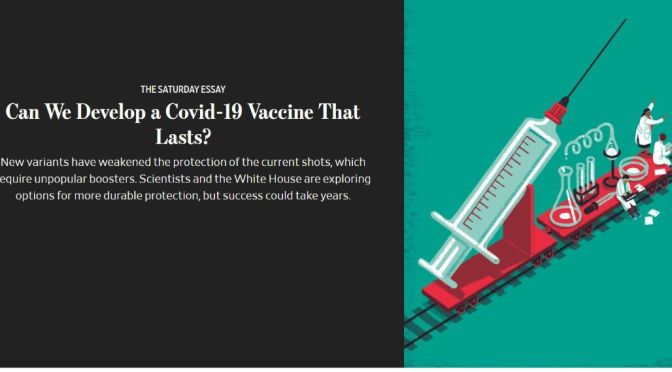
“Roughly two and a half years into the pandemic, White House officials and health experts have reached a pivotal conclusion about Covid-19 vaccines: The current approach of offering booster shots every few months isn’t sustainable.
Though most vaccines take years to develop, the Covid shots now in use were created in record time—in a matter of months. For health authorities and a public desperate for tools to deal with the pandemic, their speedy arrival provided a huge lift, preventing hospitalizations and deaths while helping people to escape lockdowns and return to work, school and many other aspects of pre-Covid life.”
A previously unidentified population of polar bears documented on the southeast coast of Greenland uses glacier ice to survive despite limited access to sea ice.
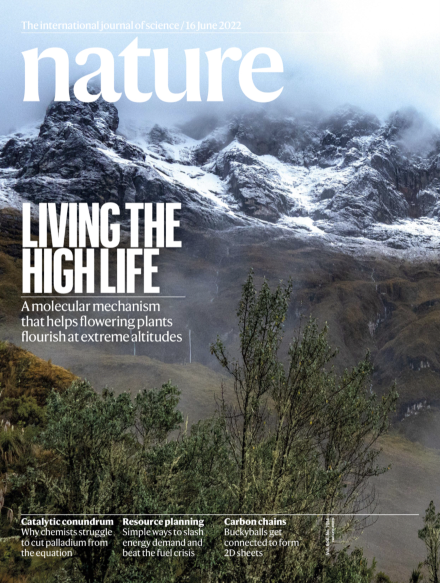
The cover image shows plants growing at altitude on Altar Volcano in Chimborazo, Ecuador. Extreme altitudes pose challenges for most forms of life, and flowering plants are no exception. But flowering plants have been found growing as high as 6,400 metres above sea level. In this week’s issue, Michael Holdsworth and his colleagues reveal a molecular mechanism that helps plants to adapt to the extremes of altitude. The researchers studied a range of plants, representing four diverse clades of flowering plants — thale cress (Arabidopsis thaliana), tomato, poppy and the grass
Brachypodium distachyon. They found that plants use genetic adaptations to adjust their sensitivity to atmospheric oxygen, whose partial pressure decreases with altitude. By decoding the ambient oxygen level, the plants are able to sense the altitude at which they grow and optimize internal biochemical processes.
A headbashing relative gives insights into giraffe evolution – How the giraffe got its long neck is a longstanding question in science. One possibility is that giraffes evolved longer necks for sexual competition, with males engaging in violent neck-swinging fights.
Now, a team have described fossils of an ancient giraffoid species with a thick headpiece adapted for fighting, which could add weight to this hypothesis.
05:18 A wave of resignations signals discontent in academia
Around the world, the ‘great resignation’ has seen huge numbers of workers re-evaluating their careers and lifestyles and choosing to leave their jobs following the pandemic. Academia is no exception, with many scientists deciding to leave the sector in the face of increased workloads, systemic biases and pressure to publish.
Earlier this year, NASA’s MAVEN spacecraft, which has been orbiting Mars since 2014, developed some serious equipment issues that prevented it from keeping its correct orientation in space. In a race against time, a team on Earth fixed the problem by developing a system that allowed the spacecraft to navigate by the stars.
14:28 The Perseverance rovers continues its rock collection
NASA’s Perseverance rover has arrived at an ancient Martian river delta where it will spend the next few months exploring, while scientists assess where to drill and extract rock samples. It’s thought that rocks from this region have the best chance of containing evidence of Martian life, and plans are being developed to return them to Earth in the future.
The Casarabe people lived in southwest Amazonia around AD 500–1400, but understanding of this culture has been limited because the archaeological remains are covered in dense forest. In this week’s issue, Heiko Prümers and his colleagues reveal the discovery of new Casarabe settlements in the Bolivian Amazon. The researchers used lidar to scan the forest, revealing 2 large settlements (each covering more than 100 hectares) and 24 smaller sites, 15 of which had previously been known to exist.
The cover image shows Cotoca, one of the two large settlements, in which earthen mounds (one more than 20 metres high) and long causeways can clearly be seen. The team suggests that these results are the first evidence of agrarian-based, low-density urbanism in western Amazonia. They conclude that the region was not as sparsely populated in pre-Hispanic times as was previously thought.
Vulnerability to heart disease can be projected before symptoms occur, Mayo Clinic discovered in preclinical research. This proof-of-concept study revealed that heart muscle changes indicate who is vulnerable to disease later in life. These changes can be detected from blood samples through comprehensive protein and metabolite profiling. This exploratory mapping, conducted in the Marriott Family Comprehensive Cardiac Regenerative Program within Mayo Clinic’s Center for Regenerative Medicine, is published in Scientific Reports.
“The team implemented state-of-the-art technologies to predict who is vulnerable and who is protected from heart disease,” says Andre Terzic, M.D., Ph.D., a Mayo Clinic cardiologist and the senior author. “In this era of post-genomic medicine, the acquired foundational knowledge provides guidance for development of curative solutions targeted to correct the disease-causing maladaptation.” Dr. Terzic is the Marriott Family Director, Comprehensive Cardiac Regenerative Medicine, for the Center for Regenerative Medicine and the Marriott Family Professor of Cardiovascular Research.
The historic Maya anchored their calendars and rituals to celestial events, and their astronomical knowledge is now coming into sharper focus thanks to new analyses of archaeological relics and insights from today’s Maya.
— Science Magazine (@ScienceMagazine) June 2, 2022
Science Magazine – June 3, 2022: A 10th-century Maya structure at Chichen Itza, Mexico, is often called the Observatory for its expansive view of the sky and a design seemingly guided by key positions of the Sun, Moon, and planets. The historic Maya anchored their calendars and rituals to celestial events, and their astronomical knowledge is now coming into sharper focus thanks to new analyses of archaeological relics and insights from today’s Maya.








 Boomers Daily