Category Archives: Politics

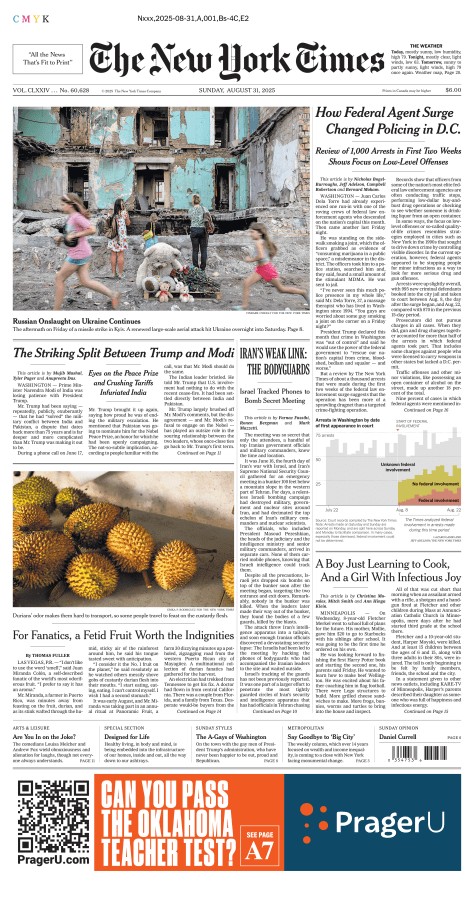
THE NEW YORK TIMES – SUNDAY, AUGUST 31, 2025

In Trump’s Federal Work Force Cuts, Black Women Are Among the Hardest Hit

President Trump has cut hundreds of thousands of jobs from the federal work force, disproportionately affecting Black employees.

Judge Temporarily Blocks U.S. Efforts to Deport Guatemalan Children

The ruling came hours after some shelters were directed to prepare children to be sent back to Guatemala. A hearing was scheduled for this afternoon.

Xi Uses Summit, Parade and History to Flaunt China’s Global Pull

With the leaders of Russia and India visiting, Xi Jinping will show how he can use statecraft, military might and history to push for global influence.

America Closed Malls, but China Kept Building Them. Now It Has Too Many.

The first closing of an Apple Store in mainland China hints at broader troubles facing the country’s shopping malls as developers open more of them.

Russian Strikes on Western Assets in Ukraine Send an Ominous Message

Hitting a U.S.-run factory and European offices, the Kremlin appeared to signal that it would resist Western peace efforts, analysts and officials said.

SHADOW GOVERNANCE, ACCELERATED

How an asynchronous presidency exploits the gap between platform time and constitutional time to bend institutions before the law can catch up.

By Michael Cummins, Editor, August 30, 2025

On a sweltering August afternoon in Washington, the line to the federal courthouse wraps around the block like a nervous necklace. Heat shimmers off the stone; gnats drift in lazy constellations above the security checkpoint. Inside, air-conditioning works harder than dignity, and the benches fill with reporters who’ve perfected the face that precedes calamity. A clerk calls the room to order. The judge adjusts her glasses. Counsel step to the lectern as if crossing a narrow bridge over fast water. Then the question—plain, improbable—arrives: can a president’s social-media post count as legal notice to fire a governor of the Federal Reserve?

What does it mean when the forum for that answer is a courtroom and the forum for the action was a feed? The gulf is not merely spatial. One realm runs on filings, exhibits, transcripts—the slow grammar of law. The other runs on velocity and spectacle, where a single post can crowd out a dozen briefings. The presidency has always tested its borders, but this one has learned a new technique: act first in public at speed; force the law to catch up in private at length. It is power practiced asynchronously—governance that unfolds on different clocks, with different rewards.

Call it latency as strategy. Declare a cause on a platform; label the declaration due process; make the firing a fact; usher the lawyers in after to domesticate what has already happened. The point is not to win doctrine immediately. The point is to harvest the days and weeks when a decision stands as reality while the courts begin their pilgrimage toward judgment. If constitutional time is meticulous, platform time is ruthless, and the space between them is policy.

In the hearing, the administration’s lawyer stands to argue that the Federal Reserve Act says “for cause” and leaves the rest to the president’s judgment. Why, he asks, should a court pour old meanings into new words? The statutory text is lean; executive discretion is broad. On the other side, counsel for Lisa Cook speaks a language almost quaint in the rapid glare of the moment: independence, notice, a chance to be heard—dignities that exist precisely to slow the hand that wields them. The judge nods, frowns, asks what independence means for an institution the law never designed to be dragged at the pace of a trending topic. Is the statute a rail to grip, or a ribbon to stretch?

When the hearing breaks, the stream outside is already three headlines ahead. Down the hill, near the White House, a combat veteran strikes a match to the hem of a flag. Fire crawls like handwriting. Two hours earlier, the president signed an executive order urging prosecutions for acts of flag “desecration” under “content-neutral” laws—no frontal attack on the First Amendment’s protection of symbolic speech, only an invitation to ticket for the flame, not the message. Is that a clever accommodation to precedent, or a dare?

The veteran knows the history; anyone who has watched the long argument over Texas v. Johnson does. The Supreme Court has repeatedly said that burning the flag as protest, however detestable to many, is speech. Yet symbolic speech lives in real space, and real space has ordinances: no open flames without a permit, no fires on federal property, no damage to parks. The order makes a temporal bet: ticket now; litigate later. The government may lose the grand constitutional fight, but it may win smaller battles quick enough to chill an afternoon’s protest. In the gap between the moment and the merits, who blinks first?

Back at the courthouse, a reporter asks a pragmatic question: even if the president can’t fire a Fed governor for mere allegations, will any of this matter for interest rates? Not in September, the expert shrugs. The committee is larger than one vote, dissent is rare. But calendars have leverage. February—when reappointments can shift the composition of the body that sets the price of money—looms larger than any single meeting. If the decision remains in place long enough, the victory is secured by time rather than law. Isn’t that the whole design?

Administration lawyers never say it so plainly. They don’t have to. The structure does the talking. Announce “cause” in a forum that rewards proclamation; treat the announcement as notice; act; then invite the courts to reverse under emergency standards designed to be cautious. Even a win for independence later may arrive late enough to be moot. In the arithmetic of acceleration, delay is not neutral; it is bounty.

If this sounds like a single episode, it is not. The same rhythm animates the executive order on flag burning. On paper, it bows to precedent; in practice, it asks police and prosecutors to find neutral hooks fast enough to produce a headline, a citation, an arrest photo. Months later, the legal machine may say, as it must, that the burning was protected and the charge pretextual. But how many will light a match the next day, knowing the ticket will be instant and the vindication slow?

And it animates something quiet but immense: the cancellation of thousands of research grants at the National Institutes of Health because proposals with words like “diversity,” “equity,” or “gender” no longer fit the administration’s politics. A district judge calls the cuts discriminatory. On the way to appeal, the litigation splits like a river around a rock: one channel to test the legality of the policy guidance, another to ask for money in a tribunal known mostly to contractors and procurement lawyers. The Supreme Court steps in on an emergency basis and says, for now, the money shouldn’t flow. Why should taxpayers pay today for projects that might be unlawful tomorrow?

Because science does not pause on command. Because a lab is not a spreadsheet but a choreography of schedules and salaries and protocols that cannot be put on ice for a season. Because a freeze that looks tidy in a docket entry becomes layoffs and abandoned lines of research in ordinary rooms with humming incubators. The Court’s concern is neat—what if the government cannot claw back dollars later?—but the neatness ignores what time does to fragile ecosystems. What is a remedy worth when the experiment that needed it has already died?

It is tempting to divide all this along ideological lines, to tally winners and losers as if the story were primarily about whose agenda prevails. But ideology is not the tool that fits. Time is. One clock measures orders, posts, firings, cancellations—the moves that define a day’s narrative. Another measures notice, hearing, record, reason—the moves by which a republic persuades itself that force has been tamed by law. When the first clock is always fast and the second is always slow, acceleration becomes a kind of authority in itself. Isn’t that the simplest way to understand what’s happening—that speed is taking up residence where statute once did?

Consider again the hearing. The administration’s brief is lean, the statute is shorter still, and the claim is stark: “for cause” is what the president says it is. To demand more—to import the old triad of “inefficiency, neglect of duty, or malfeasance in office,” to insist on a pre-removal process—is, in this telling, to romanticize independence and hobble accountability. Yet independence is not romance. It is architecture—an effort to keep central banking from becoming another branch of daily politics. If “for cause” becomes a slogan that can be made true after the fact by the simple act of saying it early and everywhere, what remains of the cordon the law tried to draw?

The judge knows this, and also knows the constraints of her role. Emergency relief is meant to preserve the status quo, not rewrite the world. But what is the status quo when the action has already been taken? How do you freeze a river that has been diverted upstream? The presidency practices motion, and then asks the judiciary for patience. Can a court restore a person to an office as easily as a timeline restored a post? Can an injunction rewind a vote composition that turned while the case wound its way forward?

Meanwhile, in the park across from the White House, the veteran’s fire has gone out. The citations are not for speech, officials insist, but for the flame and the scarring of public property. Somewhere between these statements and the executive order that prompted them sits the puzzle of pretext. If a president announces that he seeks to stop a type of speech and urges prosecutors to deploy neutral laws to do so, isn’t the neutrality already contaminated? The doctrine can handle the distinction. But the doctrine’s victory will arrive, at best, months later, and the message lands now: the state is watching, and the nearest hook will serve.

The research world hears its own version of that message. Grants are not gifts; they are contracts, explicit commitments that enable work across years. When a government cancels them mid-stream for political reasons and the courts respond by asking litigants to queue in separate lines—legality here, money there—the signal is not subtle. A promise from the state is provisional. A project can become a pawn. If the administration can accelerate the cut, and the law can only accelerate the analysis, who chooses a life’s work inside such volatility?

There are names for this pattern that sound technocratic—“latency arbitrage,” “platform time versus constitutional time”—and they are accurate without being sufficient. The deeper truth is simpler: a republic’s most reliable tools to restrain power are exactly the tools an accelerated executive least wants to use. Notice means warning; hearing means friction; record means reasons; reason means vulnerability. If you can do without them today and answer for their absence tomorrow, why wouldn’t you?

Well, because the institutions you bend today may be the ones you need intact when the wind shifts. A central bank nudged toward loyalty ceases to be ballast in a storm and becomes a sail. A public square patrolled by pretext breeds fewer peaceful protests and more brittle ones. A research ecosystem that learns that politics can zero out the future will deliver fewer cures and more exits. Isn’t it a curious form of victory that leaves you poorer in the very capacities that make governing possible?

Which brings the story back, inevitably, to process. Process is dull in the way bridges are dull—unnoticed until they fail. The seduction of speed lies in its drama: the crispness of the order, the sting of the arrest, the satisfying finality of a cancellation spreadsheet. Process is the opposite of drama. It is the insistence that power is obliged to explain itself before it acts, to create a record that can be tested, to bear, on the front end, the time it would rather push to the back. Why does that matter now? Because the tactic on display is not merely to defeat process, but to displace it—to make its protections arrive as afterthoughts, paper bandages for facts on the ground.

There are ways to close the gap. The law can require that insulated offices come with front-loaded protections: written notice of cause, an opportunity to respond, an on-the-record hearing before removal becomes effective, and automatic temporary relief if the dispute proceeds to court. The Department of Justice can be made to certify, in writing and in real time, that any arrest touching expressive conduct was green-lighted without regard to viewpoint, and courts can be given an expedited path to vacate citations when pretext is shown—not in a season, but in a week. Mid-cycle grant cancellations can trigger bridge funding and a short status-quo injunction as the default, with the government bearing the burden to prove genuine exigency. Even the Supreme Court can add small guardrails to its emergencies: reasoned, public minutes; sunset dates that force merits briefing on an actual clock rather than letting temporary orders congeal into policy by inertia. Would any of this slow governance? Yes. That is the point.

These are technical moves to answer a political technique, temporal fixes for a temporal hack. They do not hobble the presidency; they resynchronize it with the law. More than doctrine, they aim to withdraw the dividend that acceleration now pays: the days and weeks when action rules unchallenged simply because it happened first.

The images persist. A clerk emerges from chambers carrying two cardboard boxes heavy enough to bow in the middle: motions, exhibits, transcripts—the record, dense and unglamorous, the way reality usually is. The clerk descends the marble steps carefully because there is no other way to do it without spilling the case on the stairs. Across town, another draft order blinks on a screen in a bright room. One world moves on arms and gravity; the other moves on keystrokes and publish buttons. Which will shape the country more?

It is easy to say the law can win on the merits—often, it can. It is harder to say the law can win on time. If we let the presidency define the day with a cascade of acts and then consign the republic’s answer to months of briefs and polite argument, we will continue to confuse the absence of immediate correction with consent. The choice is not between nimbleness and stodginess; it is between a politics that cashes the check before anyone can read it and a politics that pauses long enough to ask what the money is for.

And so, one more question, the kind that lingers after the cameras have left: in a government becoming fluent in acceleration, can we persuade ourselves that synchronization is not obstruction but care? The future of independence, of speech, of public knowledge may turn less on who writes the next order than on whether we are willing to match speed with proportionate process—so that when power moves fast, law is not a distant echo but a present tense. Outside the courthouse, the air is still hot. The boxes are still heavy. The steps are still steep. There is a way to carry them, and there is a way to drop them, and the difference, just now, is the measure of our self-government.

THIS ESSAY WAS WRITTEN AND EDITED UTILIZING AI

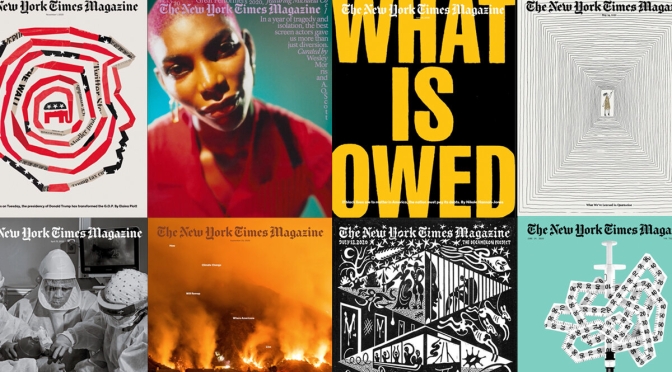
THE NEW YORK TIMES MAGAZINE – August 31, 2025

Current cover

THE NEW YORK TIMES MAGAZINE: The 8.31.25 Issue features Nathiel Rich on the Calabasas landfill following the Los Angeles fires; Scott Anderson on Georgia’s turn toward Russia; Marcela Valdes on in-home care for disabled Americans; and more.

What Does It Take to Get Men to See a Doctor?

Men in the United States live around five years less than women. One clinic is trying to persuade men that getting checked out could save their life. By Helen Ouyang

The Gold Digger Was an Archvillain. Now She’s an Aspiration.

What do men and women really want in our fraught new mating economy?

The New Dream Guy Is Beefy, Placid and … Politically Ambiguous

Amid pitched debates about masculinity, the “himbo” stands stoically above it all. By Casey Michael Henry

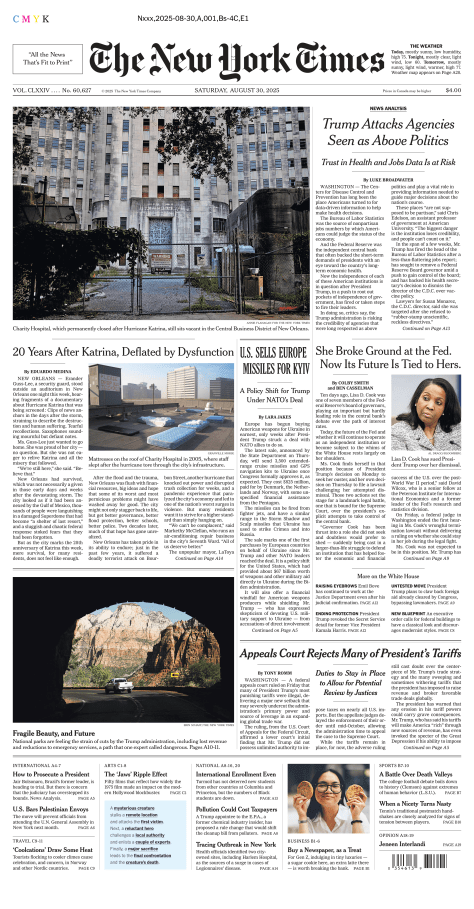
THE NEW YORK TIMES – SATURDAY, AUGUST 30, 2025

Targeting Iran’s Leaders, Israel Found a Weak Link: Their Bodyguards

Israel was able to track the movements of key Iranian figures and assassinate them this spring by following the cellphones carried by their security forces.

Trump’s Sweeping Tariffs Are Invalidated by Appeals Court

The judges delayed the implementation of their order until October, allowing President Trump to keep the duties in place for now and appeal the ruling.

Tracking the Tariffs on Every Country

He Plagiarized and Promoted Falsehoods. The White House Embraces Him.

Benny Johnson, a right-wing podcaster, has enjoyed rare access and promotion from the Trump administration.

The Nobel Prize and a Testy Phone Call: How the Trump-Modi Relationship Unraveled

President Trump’s repeated claims about having “solved” the India-Pakistan war infuriated Prime Minister Narendra Modi of India. And that was only the beginning.

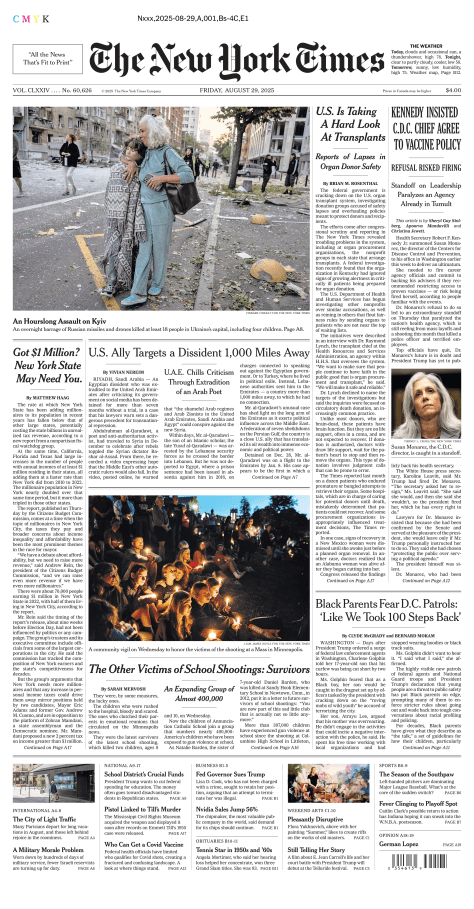
THE NEW YORK TIMES – FRIDAY, AUGUST 29, 2025

How the Future of the Fed Came to Rest on Lisa Cook

President Trump’s effort to oust the Federal Reserve governor has started a legal battle that will have major consequences for the institution’s independence.

2 Weeks, 1,000 Arrests: How a Surge of Federal Agents Changed D.C. Policing

Crime has fallen since agents began policing the streets of Washington in large numbers. Records show that the focus has often been on low-level offenses.

Trump Revokes Kamala Harris’s Secret Service Protection

President Trump terminated an extension to Kamala Harris’s Secret Service protection arranged by President Biden. She will lose her detail on Monday.

The Shattering of Wednesday Mass: Minnesota Parish Reels From Attack

Annunciation Catholic Church and School has been a neighborhood anchor in Minneapolis for more than a century.

THE ECONOMIST MAGAZINE – AUGUST 30, 2025 PREVIEW

THE ECONOMIST MAGAZINE: The latest issue features ‘What Brazil Can Teach America’

Brazil offers America a lesson in democratic maturity

It is a test case for how countries recover from a populist fever

Humiliation, vindication—and a giant test for India

Trump has triggered a trade and defence crisis: how should Modi respond?

How much danger is America’s central bank in?

Whether Lisa Cook stays or goes, important norms have been broken

France’s government is on the brink of collapse, again

Emmanuel Macron looks likely to lose another prime minister over an attempt to curb public debt

Don’t forget the downsides of China’s innovation push

China’s industrial policy attracts fans abroad, critics at home

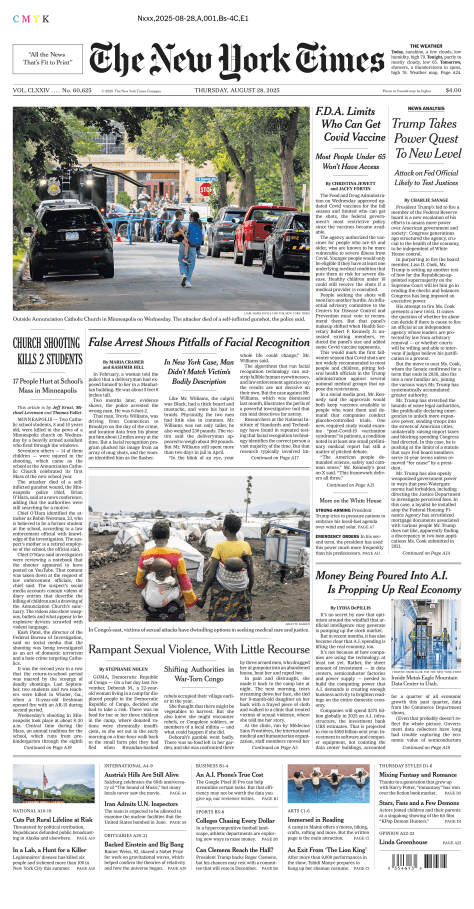
THE NEW YORK TIMES – THURSDAY, AUGUST 28, 2025

Fired C.D.C. Director’s Lawyers Say Kennedy Is Weaponizing Public Health

Susan Monarez was said to have refused to adopt Robert F. Kennedy Jr.’s stance on vaccinations. A lawyer for Dr. Monarez said the firing was “legally deficient.”

The Fate of the Fed May Turn on Two Words: ‘For Cause’

The Supreme Court has said the Federal Reserve Board’s independence warrants protection. President Trump’s effort to fire a member will test that commitment.

Russian Missile and Drone Attack Kills at Least 15 in Kyiv

The strikes on Ukraine’s capital, nearly two weeks after the U.S.-Russia summit in Alaska, injured at least 45 people, officials said.

Russian Drones Are Flying Over U.S. Weapons Routes in Germany, Officials Say

U.S. and European military officials are increasingly concerned about the flights, even as Russian acts of sabotage have declined.

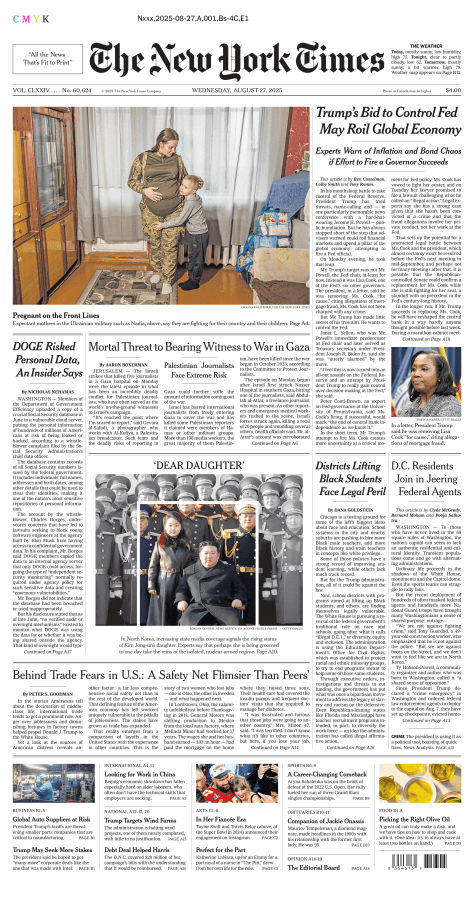
THE NEW YORK TIMES – WEDNESDAY, AUG. 27, 2025

The A.I. Spending Frenzy Is Propping Up the Real Economy, Too

The trillions of dollars that tech companies are pouring into new data centers are starting to show up in economic growth. For now, at least.

Full Weight of U.S. Tariffs Slams Into India

As punishment for buying Russian oil, President Trump doubled the tariff on goods from India to 50 percent, jeopardizing its relationship with the U.S.

Trump’s Appointees Could Rule the Federal Reserve for Decades

If President Trump succeeds in replacing Lisa Cook, his nominees will make up a majority of the central bank’s seven-person board.

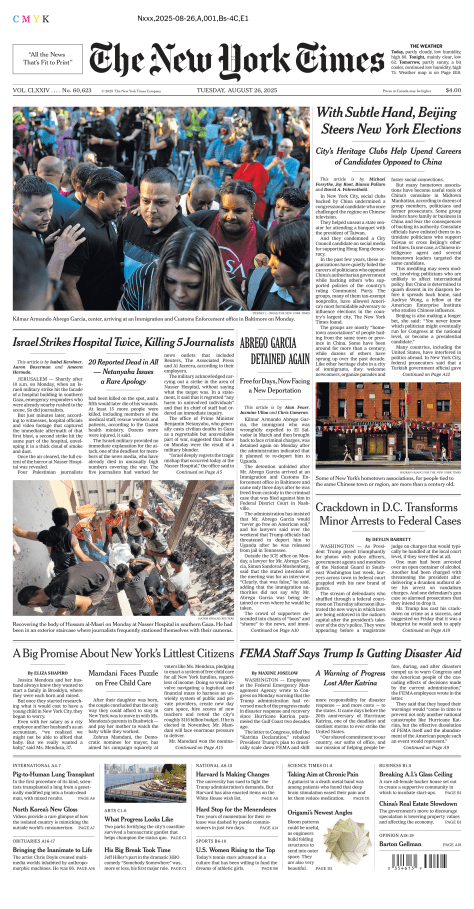
THE NEW YORK TIMES – TUESDAY, AUGUST 26, 2025

Seeking to Control Fed, Trump Risks Upending a Pillar of the Global Economy

President Trump’s attempt to fire Lisa Cook, a Fed governor, will set off a long legal battle and could lead to higher inflation and government borrowing costs.

Judge Dismisses Trump Administration Suit Against Federal Bench in Maryland

The judge took President Trump and some of his top aides to task for having repeatedly attacked other judges who have dared to rule against the White House.

Israel Faces Growing Pressure Over Hostages and Gaza Offensive

As rallies spread, the country’s security cabinet was to meet for the first time since Hamas agreed to a new cease-fire proposal, officials said.

Trump Wants Europe to Stop Regulating Big Tech. Will It Bend?

The White House suggested that countries with regulations restricting U.S. tech companies could face penalties.

The Envelope of Democracy

How a practice born on Civil War battlefields became the latest front in America’s fight over trust, law, and the vote.

By Michael Cummins, Editor, August 23, 2025

On a raw November morning in 1864, somewhere in a Union encampment in Virginia, soldiers bent over makeshift tables to mark their ballots. The war was not yet won; Grant’s men were still grinding through the trenches around Petersburg. Yet Abraham Lincoln insisted that these men, scattered across muddy fields and far from home, should not be denied the right to vote. Their ballots were gathered, sealed, and carried by courier and rail to their home states, where clerks would tally them beside those cast in person. For the first time in American history, large numbers of citizens voted from a distance—an innovation spread across 19 Union states by hasty wartime statutes and improvised procedures (National Park ServiceSmithsonian).

Lincoln understood the stakes. After the votes were counted, he marveled that “a people’s government can sustain a national election, in the midst of a great civil war” (Library of Congress). To deny soldiers their ballots was to deny the Union the very legitimacy for which it fought. Then, as now, critics fretted about fraud and undue influence: Democrats accused Republicans of manufacturing ballots in the field; rumors spread of generals pressuring soldiers to vote for Lincoln. Newspapers thundered warnings about the dilution of the franchise. But the republic held. Soldiers voted, the ballots were counted, and Lincoln was re-elected.

A century and a half later, the envelope has become a battlefield again. Donald Trump has promised to “end mail-in ballots” and scrap voting machines, declaring them corrupt, even while bipartisan experts explain that nearly all U.S. ballots are already paper, with machines used only for tabulation and auditing (APBipartisan Policy Center). The paradox is striking: modern tabulators are faster and more accurate than human tallies, while hand counts are prone to fatigue and error (Time).

But how did a practice with Civil War pedigree come to be portrayed as a threat to democracy itself? What, at root, do Americans fear when they fear the mailed ballot?

In a Phoenix suburb not long ago, a first-time voter—call her Teresa—dropped her ballot at a post office with pride. She liked the ritual: filling it out at her kitchen table, checking the boxes twice, signing carefully. Weeks later, she learned her ballot had been rejected for a signature mismatch with an old ID on file. She had, without knowing it, missed the deadline to “cure” her ballot. “It felt like I didn’t exist,” one young Arizonan told NPR, voicing the frustration of many. Across the country, younger and minority voters are disproportionately likely to have their mail ballots rejected for administrative reasons such as missing signatures or late arrival. If fraud by mail is vanishingly rare, disenfranchisement by process is not.

Meanwhile, on the factory floor of American vote-by-mail, the ordinary hum of democratic labor continues. Oregon has conducted its elections almost entirely by mail for a quarter century, with consistently high participation and confidence (Oregon Secretary of State). Colorado followed with its own all-mail model, paired with automatic registration, ballot tracking, and risk-limiting audits (Colorado Secretary of State). Washington and Utah have joined in similar fashion. Election officials talk about the efficiency of central counting centers, the ease of auditing paper ballots, the increased access for rural and working-class voters. One clerk described her office during election week as “a warehouse of democracy,” envelopes stacked in trays, staff bent over machines that scan and sort. In one corner, a team compares signatures with the care of art historians verifying provenance. The scene is not sinister but oddly moving: democracy reduced to thousands of small acts of faith, each envelope a declaration that one voice counts.

And yet suspicion lingers. Part of it is ritual. The image of democracy for generations has been the polling place: chalkboard schedules, folding booths, poll books fat with names. The mailed ballot decentralizes the ceremony. It moves civic action into kitchens and break rooms, onto couches and barracks bunks. For some, invisibility breeds mistrust; for others, it is the genius of the thing—citizenship woven into home life, not just performed in public.

Part of the anxiety is legal. The Constitution’s Elections Clause gives the states authority over the “Times, Places and Manner” of congressional elections but empowers Congress to “make or alter such Regulations” (Constitution Annotated). Presidents have no such power. The White House cannot ban absentee ballots by decree. Congress could attempt to standardize or limit the use of mail ballots in federal elections—though any sweeping restriction would run headlong into litigation from voters who cannot be present on Election Day, from soldiers on deployment to homebound citizens.

And we have seen how precarious counting can be when law and logistics collide. In 2000, Florida’s election—and the presidency—turned not on fraud but on ballots: “hanging chads,” the ambiguous punch-card remnants that confounded machines and humans alike. The Supreme Court’s decision in Bush v. Gore halted a chaotic recount and left many Americans convinced that the true count would forever be unknowable (Oyez). The lesson was not that ballots are fraudulent, mailed or otherwise, but that the process of counting and verifying them is fragile, and that the legitimacy of outcomes depends on rules agreed to before the tally begins.

It is tempting, in moments of panic, to look abroad for calibration. In the United Kingdom, postal ballots are an ordinary convenience governed by clear rules (UK Electoral Commission). Canadians deploy a “special ballot” system that lets voters cast by post from the Yukon to Kandahar (Elections Canada). The Swiss have made postal voting a workaday part of civic life (Swiss Confederation). Fraud exists everywhere—but serious cases are exceptional, detected, and punished.

Back home, the research is blunt. The Brennan Center for Justice finds that fraud in mail balloting is “virtually nonexistent.” A Stanford–MIT study found that universal vote-by-mail programs in California, Utah, and Washington had no partisan effect—undercutting claims that the method “rigs” outcomes rather than simply broadening access. And those claims that machines slow results? Election administrators, backed by Wisconsin Watch, explain that hand counts tend to be slower and less accurate, while scanners paired with paper ballots and audits deliver both speed and verifiability.

Still, mistrust metastasizes, not from facts but from fear. A rumor in Georgia about “suitcases of ballots,” long debunked, lingers as a meme. A Michigan voter insists he saw a neighbor mail five envelopes, unaware they were for a household of five registered voters. Conspiracy thrives in the gap between visibility and imagination.

Yet even as the mailed ballot feels embattled, the next frontier is already under debate. In recent years, pilot projects have tested whether citizens might someday cast votes on their phones or laptops, secured not by envelopes but by cryptographic ledgers. The mobile voting platform Voatz, used experimentally in West Virginia and a few municipal elections, drew headlines for its promise of accessibility but also for its flaws: researchers at MIT found vulnerabilities tied to third-party cloud storage and weak authentication, prompting urgent warnings (MIT Technology Review). GoatBytes’ 2023 review noted that blockchain frameworks like Hyperledger Sawtooth and Fabric might one day offer stronger, verifiable digital ballots, and even the U.S. Postal Service has patented a blockchain-based mobile voting system (USPTO Patent). Capitol Technology University traced this shift as the latest stage in the long evolution from paper to punch cards to optical scanners, with AI now assisting ballot tabulation (Capitol Tech University). For proponents, mobile systems are less about novelty than necessity: the disabled veteran, the soldier abroad, the homebound elder—all could vote with a tap.

But here, too, the fault lines are visible. The American Bar Association recently cautioned that while blockchain and smartphone voting might expand access, they raise thorny questions about privacy, coercion, and verification—how to ensure a vote cast on a personal device is both secret and authentic. TIME Magazine spotlighted the allure of digital voting for those long underserved by the system, even as groups like Verified Voting warned that premature adoption could expose elections to risks far graver than those posed by paper mail ballots (TIME). In this telling, technology is Janus-faced: a path to broaden democracy’s reach, and a Pandora’s box of new vulnerabilities. If the mailed envelope embodies trust carried by hand, the mobile ballot would ask citizens to entrust their franchise to lines of code. Whether Americans are ready to make that leap remains an open question.

If there is a flaw to worry about, it is not the specter of rampant fraud, but the small, fixable frictions that disenfranchise well-meaning voters: needlessly strict signature-match policies, short cure windows, postal delays for ballots requested late, confusing instructions, and uneven funding for local election offices. The remedy comes not from abolishing the envelope, but from investing in the infrastructure around it: clear statewide standards for verification and cure; robust voter education about deadlines; modernized voter registration databases; secure drop boxes; and the budget lines that let county clerks hire and train staff.

In the end, the mailed ballot is less a departure from American tradition than a continuation of it. The ritual has changed—less courthouse, more kitchen table—but the bargain is the same. When a soldier in 1864 dropped his folded ballot into a wooden box, he entrusted strangers to carry it home. When a modern voter seals an envelope in Denver or Tacoma, she entrusts a chain of clerks, scanners, and auditors. Trust, not spectacle, is the beating heart of the system.

And perhaps that is why the envelope matters so much now. To defend it is not merely to defend convenience; it is to defend a vision of democracy capacious enough to reach the absent, the disabled, the far-flung, the over-scheduled—our fellow citizens whose lives do not always bend to a Tuesday line at a nearby gym. To reject it is to narrow the franchise to those who can appear on command.

Imagine Lincoln again, weary at the White House in the fall of 1864, reading dispatches about alleged fraud in soldier ballots and still insisting the votes be counted. Imagine a first-time voter in Phoenix who lost her chance over a mismatched squiggle, and the next one who won’t because the state clarified its cure rules. Imagine the county clerk who will never trend on social media, but who builds public confidence day by day with plain procedures and paper trails.

At the end of the day, American democracy may still come down to envelopes—white, yellow, blue—carried in postal bins, stacked in counting rooms, marked by the smudges of human hands. They are fragile, yes, but they are resilient too. The Civil War ballots survived trains and rivers; today’s ballots survive disinformation and delay. The act is the same: a citizen marks a choice, seals it, and sends it forth with faith that it will be received. If democracy is government of, by, and for the people, then every envelope is its emissary.

What would we lose if we tore that emissary up? Not only the votes of those who cannot stand in line, but the habit of trust that keeps the republic breathing. Better, then, to do what we have done at our best moments—to keep counting, keep auditing, keep improving, keep faith. The mailed ballot is not a relic of pandemic panic; it is a tested tool of a sprawling republic that has always asked its citizens to speak from wherever they are.

THIS ESSAY WAS WRITTEN AND EDITED UTILIZING AI