Category Archives: Philosophy

THE REPUBLIC OF VOICES

At the height of its power in 1364, Venice was a republic where eloquence was currency and every piazza a stage.

By Michael Cummins, Editor, August 24, 2025

The bells began before sunrise. Their iron tongues tolled across the lagoon, vibrating against the damp November air, carrying from the Campanile of San Marco to the Arsenal’s yards and into the canals of Cannaregio. This was Venice in 1364—at the height of its power, its fleets unrivaled in the Mediterranean, its markets setting the prices of silk and spice across Europe. The city sat at the hinge of East and West, commanding trade routes between Byzantium, the Mamluk Sultanate, and Western Christendom. Venetian galleys, sleek and maneuverable, patrolled waters thick with pirates, their timbers assembled in the Arsenale di Venezia, a proto-industrial marvel capable of producing a galley in a single day. Venice was wood, stone, and gold, but above all, it was sound. “The city is never silent,” one German pilgrim marveled, “every tongue of Christendom and beyond seems to shout at once.”

Venice’s supremacy was not abstract. Its colonies in Crete and Cyprus served as staging posts; its consulates dotted the Dalmatian coast. In Constantinople and Alexandria, Venetians lived in fortified fondaci—walled compounds where merchants traded under their own laws. The wealth of Murano’s glassmakers, Rialto’s bankers, and San Polo’s textile dyers depended on this vast maritime lattice. Even the Doge—Venice’s elected head of state, chosen for life from among the patrician class, part monarch, part magistrate but hemmed in by councils—was more merchant than monarch. Venetian nobility was not feudal but commercial: a patrician might chair the Senate one year and finance a convoy to the Levant the next. Bills of exchange, maritime insurance, joint-stock ventures—all pioneered here—reduced risk and turned uncertainty into empire.

Yet the republic was also built on voices. Speech was its second currency, flowing through churches, palaces, markets, and courts. Treaties were sealed with words before they were inked; rumors shifted markets as much as cargoes; sermons inflamed consciences long before decrees reached the streets.

In San Marco, the Basilica of mosaics and incense, the preacher’s voice dominated. On feast days friars addressed audiences that blurred patrician and plebeian, women and sailors, artisans and merchants. A Franciscan, recalling the Black Death, likened Venetian greed to “a contagion that spreads from house to house.” Andrea Dandolo, the Doge who also wrote a chronicle of his age, noted the murmurs of unease that followed. A parable about false shepherds might by nightfall become tavern gossip, retooled as an attack on patrician governors.

In 1364, Venice granted Petrarch a palazzo on the Riva degli Schiavoni in exchange for his library, a collection that would become the foundation of the Biblioteca Marciana. Known as the father of Humanism and now often called the father of the Italian Renaissance, he was among Europe’s most influential figures—poet of the Canzoniere, rediscoverer of Cicero’s letters, and advocate for the revival of classical eloquence. From his Venetian residence, he praised the city as “a republic not only of ships and laws, but of eloquence itself, where voices, raised in harmony or dissent, bind the state together.” For him, Venice was not only a naval empire but also a theater of speech.

Across the piazza in the Doge’s Palace, words carried a different weight. The cavernous Sala del Maggior Consiglio could hold a thousand patricians, their decisions shaping treaties and wars. The Doge spoke little, his ritual response to petitions—“Si vedrà”, “It will be seen”—an eloquence of restraint. More dramatic were the relazioni, oral reports of ambassadors returning from Constantinople or Cairo. Though later transcribed, in the fourteenth century they were performances. An envoy describing the Byzantine emperor’s throne gestured so vividly that senators felt transported to the imperial court.

Yet it was in the Rialto that Venice’s speech was most raw, where chatter became commerce and gossip became power. By day, the wooden bridge creaked under merchants and beggars, its planks worn smooth by boots from every corner of Europe. Below, spices from Alexandria, silk from Cathay, and pepper from India changed hands, but so too did stories. “The Rialto is a world itself,” wrote the chronicler Marino Sanudo, “where the news of all Christendom and beyond is traded swifter than spices.” Rumors of Ottoman fleets could shift the price of cinnamon. Satirical verses, recited sotto voce, mocked the deafness of patricians: “A house of nodding heads, deaf to its people.”

And when night fell, the Rialto became something else entirely. Carnival transformed it into a stage where anonymity and satire thrived. Masked singers, some of them patrician youths disguised as artisans, improvised verses lampooning senators and guild leaders. One chronicler described young nobles in Greek disguise singing ballads about the Senate’s obsession with ceremony. The laughter echoed across the Grand Canal, tolerated because, as Venetians said, “the republic breathes satire as easily as air.”

The Grand Canal itself was Venice’s liquid stage. By day it was an artery of commerce, alive with the slap of oars, the curses of gondoliers, the hammering of crates. By dusk the atmosphere shifted. Lanterns swayed from boats, their reflections shimmering across the black water. Gondoliers sang what would one day evolve into the barcarolle. Noble families staged boat processions with lutes and trumpets, music drifting across the canal in competing layers of sound. Commerce by day, serenade by night—the same canal a bazaar and a ballroom.

And then there was the Piazza San Marco, the great stage of the republic. On feast days, choirs filled the basilica, their plainsong swelling into polyphony that ricocheted off Byzantine domes. Trumpeters announced the Doge, banners unfurled, and processions wound through the square until, as Dandolo wrote, “the piazza shone with gold and sounded with voices and trumpets.” During Carnival, the sacred gave way to the profane: jugglers, acrobats, and improvisatori recited comic verses in dialect. A fire-breather might draw crowds near the bronze horses while a masked singer mocked senators. It was noisy, unruly, profoundly Venetian—a place where art, politics, and voice collided.

Artisans, too, had their stages. The scuole, confraternities of tradesmen, were gatherings where chants gave way to orations. Statutes might be inscribed, but obligations were enforced aloud. A shoemakers’ statute from 1360 commanded that “each master shall stand and speak before his fellows, giving account not only of his work but of his conduct.” Eloquence was honor; to falter was to risk shame.

The courts offered a harsher stage. Justice, too, was spoken. The Statuta Veneta emphasized testimony over parchment: “testimony is judged not by parchment but by voice.” In 1362, a fisherman accused of theft protested, “Non rubai, ma trovai.”—“I did not steal, I found.” His trembling voice, the notary observed, betrayed him. Eloquence could acquit; faltering speech could condemn.

And words could also damn. After the plague, prophets thundered in piazzas, sailors cursed saints in taverns, women repeated visions too vividly. One inquisitorial record recalls a woman accused of declaring, “the plague is God’s punishment for the pride of merchants.” Whether prophecy or lament, her words were evidence of heresy.

To live in Venice was to live in a polyphony of languages. From Dalmatia to Crete, Cyprus to Trebizond, the city’s empire infused it with voices. The pilgrim Ludolf of Sudheim marveled that in one square he heard “Latin, Greek, Saracen, and Hebrew, all arguing.” Translators ferried not only goods but ideas—fragments of Averroes, Byzantine theology, Jewish philosophy. Did a spice-seller at the Rialto know he was transmitting the seeds of the Renaissance?

In patrician libraries and monastic scriptoria, another kind of voice was taking shape: Aristotle and Thomas Aquinas, arriving in Latin translation, read aloud in candlelit chambers. By 1364, copies of Aristotle’s Politics and Nicomachean Ethics were circulating among patricians. What did it mean to live a life of virtue? Could the common good outweigh private interest? Such debates mattered in a republic balancing mercantile ambition with civic restraint.

Thomas Aquinas, too, was debated in Dominican houses. His Summa Theologica offered a scaffolding that united reason and faith. Did divine law supersede human law, or did the latter participate in the former? A friar might thunder against usury on Sunday while echoing Aquinas’s careful distinctions on just exchange.

What is striking is that these scholastic voices did not remain confined to cloisters. They mingled with guild disputations, senatorial deliberations, carnival satire. And just beyond the horizon, Humanism was stirring. Petrarch, uneasy yet pivotal, urged Venetians to recover eloquence from Cicero and Livy. The republic was poised between worlds: the scholastic synthesis of Aquinas and the humanist insistence that civic life could be ennobled by rhetoric and classical virtue. Venice in 1364 was thus not only a theater of speech but also a laboratory of ideas.

At dusk, the bells tolled once more. Gondoliers sang across the black canal, masked youths mocked senators in the Rialto, choirs rehearsed in San Marco. Senators lingered in debate, artisans rehearsed speeches, children recited prayers before sleep. Venice in 1364 was not only a republic of ships, coins, and statutes. It was a republic of voices. Andrea Dandolo wrote that “our city is a harmony of voices, discordant yet united, a choir upon the waters.”

Perhaps that is the truest way to understand the city at its zenith. Its power lay not only in fleets or treaties, but in the ceaseless interplay of sound and sense: the preacher stirring unease, the envoy swaying senators, the gondolier echoing Aristotle, the satirist mocking the elite. The same city that hammered out galleys in the Arsenale was also hammering out philosophies in its libraries, rhythms in its shipyards, and laughter in its carnivals. To live in Venice in 1364 was to inhabit a world where speech, spectacle, and speculation were indivisible, where every bridge or piazza might become a stage. The republic endured not because it silenced discord but because it orchestrated it—turning sermon, satire, and song into the polyphony of civic life. Venice was, and remains, a choir upon the waters.

THIS ESSAY WAS WRITTEN AND EDITED UTILIZING AI

Cervantes in the Cave — The Art of Illusion

From Lepanto to Algiers to Seville, he recast Plato’s cave: instead of fleeing, he trimmed the wick—using comedy and narrative to make honest light out of shadow.

By Michael Cummins, Editor, August 22, 2025

In a cave in Argamasilla de Alba, Spain, a man sits hunched over a manuscript. The air is damp; the light keeps deciding what to keep. He writes not with the flourish of a court poet but with the urgency of someone who has known confinement—who has lived among shadows and learned to speak their language. The man is Miguel de Cervantes. The cave, according to local legend, is where he began Don Quixote. Whether the story is true hardly matters. The image endures: Cervantes, imprisoned, wounded, obscure, writing the book that would fracture the very idea of literary realism.

He breaks the silence first, as if talking to the walls. “Engendrado en una cárcel, donde toda incomodidad tiene su asiento,” he says—begotten in a prison, where every discomfort keeps its chair. He smiles at his own choice of verb. Begotten. It gives hardship hands.

A foot scuffs the threshold. Mateo steps into the half-light, a fellow freed captive from a life the two men still carry like a watermark. He takes the cave in at a glance—the whitewash, the barred slit of window, the stone bench that knows the shape of a tired back.

“You write in the dark, Miguel,” Mateo says. “Still chasing shadows?”

“Not chasing,” Cervantes replies, without looking up. “Refracting. These shadows are more honest than the sunlit lies of court and empire.”

Plato’s prisoners mistook flicker for fact. Cervantes has no such innocence; he knows exactly what light can do and what it cannot. In Algiers he learned the cost of sunlight and the uses of a candle. “We invented stories to survive,” he says. “We imagined rescue. We became authors of unreality. And in doing so, we learned how unreality works.”

He had boarded a homeward ship in 1575 and sailed straight into a profession he did not apply for. Corsairs took the vessel. Letters of recommendation—ironically the very proof of his merit—made him valuable. Algiers swallowed him for five years. Four escape attempts, each with its choreography of bribes, whispers, and night boats, failed in turn; punishments followed with bureaucratic punctuality. In the baños he organized fellow captives, staged plays that felt like oxygen rations, and discovered a kind of command that requires neither rank nor drumrolls. The lesson was not transcendence. It was texture. Captivity did not reveal some pure, sunlit truth; it revealed illusion’s machinery: how shadows are cast, how they persuade, how they can be turned from weapon into instrument.

“So you believe captivity reveals truth?” Mateo asks.

“No,” Cervantes says. “It reveals illusion. But if you know you’re in a cave, illusion can be honest about itself.”

He speaks like a man who has balanced too many ledgers and decided to keep one for the soul. In his prologue to the Exemplary Novels he would boast with a craftsman’s pride: mías propias, no imitadas ni hurtadas—my own pieces, not imitated or stolen. After a life in which other people held the keys, authorship felt like a kind of lawful possession. He is not naïve about it; theft will come in a thousand copies. Still, he plants his flag in sentences.

Mateo lowers himself onto the bench. The cave keeps its cool.

“Begin earlier,” Mateo says softly. “Begin with the wound.”

Cervantes nods, as if paging back. “Lepanto,” he says. “Two shots to the chest, one to the hand. El mayor bien que me vino. The greatest favor that came to me.”

Mateo laughs—a short, incredulous bark. “Favor?”

“A hand is a tool,” Cervantes says, flexing his right, letting the left sleeve fall into its gentle emptiness. “So is a story. One broke and taught the other its work. I learned that honor is not trumpets; it is the bruise that stays after the sound goes.”

“What did it smell like—the battle?” Mateo asks, because some questions insist.

“Oak and salt and a fire that wandered,” Cervantes says. “The sea keeps bad accounts—always debits, never balance. We threw our bodies at its ledger and called it glory. I got a bill I could live with.”

The cave changes its mind about brightness by a single shade. Light climbs a little higher on the wall, as if memory has a temperature.

“After Algiers,” Mateo says, “you came home to paper.”

“To paper and suspicion,” Cervantes answers. “Spain wanted receipts more than epics.” He became a purchasing agent, then a tax collector—the sort of work that presses humility into a man’s pockets and takes the lint besides. A banker fell in Seville and the ground gave way beneath him. Jail happened the way weather happens. Bureaucracy, he discovered, is a prison with nicer pens.

He thumps the palm of his right hand on the bench, a quiet imitation of a ledger closing. “Always the same sum,” he says. “Loyalty plus wounds equals suspicion.”

“That arithmetic,” Mateo says, “taught you comedy.”

“It taught me instruments,” Cervantes corrects gently. “Comedy is a surgeon’s knife you can carry in public.”

He had tried other rooms. La Galatea (1585), a pastoral romance, sighs under painted trees and speaks expertly in a fashionable voice—too expertly for a man who had learned to breathe in iron. “A ceiling too low for the lungs,” he says. Failure did not embarrass him; it emancipated him. “I loved what books promised. I wrote the promise’s correction.”

“And then you choose another cave,” Mateo says, looking around.

“This time I brought the candle.” Cervantes nods at the stub trembling in its dish. “The cave is not a prison if you know you’re inside it. Fiction is not delusion if you wield it knowingly.”

“Is that freedom?” Mateo asks. “To live in fiction?”

Cervantes answers with a line he will later put in a knight’s mouth because knights carry sentences farther than taxmen do. “La libertad, Sancho, es uno de los más preciosos dones…” Freedom, Sancho, is one of the most precious gifts. He lets the clause hang and then adds the counterweight: captivity is the greatest evil. “But there is a third thing,” he says. “The discipline of the wick. Not everyone reaches the sun. Many of us live by hearth-light. So make the hearth honest.”

He laughs, not kindly but not unkindly, at the memory of a barber’s basin mistaken for a helmet. “A basin can be a helmet,” he says, “if the story is honest about the trick.” The joke is not cruelty; it’s consent. Illusions that confess their wages are allowed to work.

“You sound like Plato’s least obedient pupil,” Mateo says. “He wants the prisoner out of the cave. You stay.”

“Plato had less practice with caves,” Cervantes says. “I stay and trim the wick.”

The man who stays in the cave can tell you about the cost of zeal. He knows what happens when mercy runs faster than attention: chaos dresses up as freedom. He has written a scene in which a knight frees a chain gang of galley slaves with a fine speech and a flash of temper, and the liberated—unbriefed on narrative responsibility—repay the favor with stones. “Pity without comprehension,” he says, “is a door swinging in a storm. Freedom without narrative becomes a mess that lets tyrants say, ‘You see? Chains keep order.’”

Mateo’s eyes drift toward a wooden head in the corner, painted eyes arrested mid-glance. “Master Pedro,” Cervantes says, amused at the prop the cave has supplied. He tells the story of a puppet theater, a knight who cannot bear strings, a sword that corrects an illusion into splinters. Even illusions keep accounts, he reminds Mateo. Someone pays for the pleasure. “In that scene,” he says, “I taxed zeal. I sent the bill to laughter.”

“So your book is a theater?” Mateo asks.

“A theater that shows its ropes,” Cervantes says. “A historian with a wink in his ink. A narrator who argues with me, and I with him. A false sequel enters the room, and I absorb him into the play. If illusion is a crime, let the evidence be visible. If it is a craft, let the strings show and the audience decide.”

He keeps his quotes short and to the point, letting them behave like tools rather than trophies. “Yo sé quién soy,” he says, not to boast but to set a boundary—I know who I am. “And I know what I am not. I am not the sun. I am a candle with a good memory.”

Memory is a troublesome servant. “¡Oh memoria, enemiga mortal de mi descanso!,” he mutters with theatrical exasperation—Oh memory, mortal enemy of my rest—knowing full well he cannot do without her. In the deepest fold of the book he is writing, he lowers his knight into the Cave of Montesinos and gives him a private vision no one can verify. Minutes pass in the world; days unfold in the cave. Readers will fight about that descent for centuries: lie or parable? He shrugs. The rope held. The telling is what matters.

“What about truth?” Mateo asks. “You dodge it like a matador.”

“Truth is errant,” Cervantes says. “Like my knight. It wanders, stumbles, reinvents itself. La verdad adelgaza y no quiebra—truth thins but does not break. It lives in the flicker between shadow and flame.” He aims for a truth you can sit with, not a blaze you must worship. Even now, when the cave dims or brightens by a breath, he adjusts nothing in his voice. He trusts the room to keep up.

The room has heard other versions of this life. Soldier, captive, clerk, failed author—the catalogue is accurate and useless until you give it breath. He has learned that a life of refusals and humiliations can be rearranged into a lamp. “El que lee mucho y anda mucho, ve mucho y sabe mucho,” he says with a grin—he who reads much and travels much sees much and knows much—and Mateos’s chuckle bounces off the whitewash and returns as agreement.

If the cave is a theater, it is also a workshop. He places three objects on the bench as if laying out tools: a frayed rope (failed escape; lesson kept), a ledger (bureaucracy’s Bible, now a prop for comedy), and the puppet head (illusion, demystified and retained). He sets the rope across the ledger like a sash and props the puppet against both like a child asleep between two patient adults.

“You’re staging your own life,” Mateo says.

“Everything I own appears in my books,” Cervantes answers. “Better to put them to work than let them gather dust.”

He will put even injury to work. He has already done it. “There is no book so bad that it does not have something good,” he says—No hay libro tan malo que no tenga algo bueno—and he means, among other things, his own early efforts. He tried the fashion and failed; he learned to write beyond it. The failure cleared the room.

“And the counterfeit?” Mateo asks. “The other Quixote?”

“I made room,” Cervantes says, not quite happily. He doesn’t bother to call the rival by name. “I let the counterfeit into Part II and gave him the dignity of being wrong on the page. It is the politest way to win.”

Outside, late afternoon arranges itself. Inside, the candle practices its small weather. The conversation acquires the unhurried gravity of men who have been forced to wait before and know that waiting can be made useful. They speak of the Información de Argel—the sworn testimonies that stitched a biography out of scars and courage; of the petition to the Council of the Indies that asked for four possible offices across the ocean and delivered no; of Seville’s auditoriums of suspicion where a man could do arithmetic all day and still owe.

“You turned all that into a style,” Mateo says.

“I turned it into a temperament,” Cervantes corrects. Style is the residue. The temperament is the choice: to stay in the cave and make the light adjustable; to refuse the panic of transcendence in favor of the patience of attention; to let laughter be a form of moral accounting. “I wanted a book in which the strings show,” he says. “So when someone pulls, we know who is moving what.”

He reaches for the candle with wetted fingers and trims the wick. The flame tightens, steadies, sharpens the edges of the room with a surgeon’s manners. The gesture is mundane and feels like a thesis.

“Why not flee?” Mateo asks one last time, because some questions return until answered in the body.

“Because someone must tend the flame,” Cervantes says. “Because most people live by hearth-light. Because the cave tells the truth about limits, and I prefer honest rooms to lying palaces.”

He stands, and the bench acknowledges the change with a creak that has learned both complaint and loyalty. He touches the stone with the backs of his fingers, as one does a sleeping child. The puppet keeps its round attention. The rope adopts its length. The ledger decides to be heavy again.

“Begin,” Mateo says, suddenly shy of making a ceremony of it.

“I did,” Cervantes answers, and returns to his page.

He writes the opening lines of Don Quixote as the candle throws a peninsula of light bordered by ink. A poor gentleman with a head full of books starts out into a world that will bruise him into philosophy. A squire with a sack of proverbs learns to spend them one by one, after listening. Windmills declare their innocence; a basin negotiates a new title. Dukes turn out to be children who have learned cruelty by playing. Priests explain themselves into farce. Puppets are freed to their ruin, then repaired by a writer who has learned to apologize with laughter.

Cervantes does not flee illusion; he illuminates it. He does not reject reality; he reframes it. He does not promise truth; he escorts it, errant and sturdy, through rooms with honest walls. He turns shadows into stories and stories into a way of seeing that does not blind. He has stayed where Plato urged ascension and found, by staying, a different kind of ascent: the climb of attention, the charity of proportion, the courage to let strings show and still believe in the show.

Unlike Plato’s prisoner, Cervantes remains in the cave. He writes. He refracts. He talks to the walls and to the future, and both answer. His broken hand, his captive mind, his errant knight—everything he survived and everything he invented—gathers in the small weather of a candle and becomes, against all instruction, a form of daylight.

THIS ESSAY WAS WRITTEN AND EDITED UTILIZING AI

THE COURAGE TO QUESTION: HOW AN EMPIRE WAS BUILT

By Michael Cummins, Editor, August 16, 2025

The memory of the Islamic Golden Age evokes powerful images: Baghdad’s legendary House of Wisdom, a beacon of scholarship for the world’s greatest minds; the astronomical observatories of Samarkand, mapping the heavens with unprecedented precision; the grand libraries of Córdoba, containing more books than all of Europe combined. For roughly five centuries, from the 8th to the 13th, the Islamic world was the undisputed global epicenter of science, philosophy, and culture. Its innovations gifted humanity algebra and algorithms, advanced surgical techniques, and the classical Greek philosophy that would later fuel the European Renaissance.

This flourishing was no accident. It was the direct result of a powerful, synergistic formula: the fusion of a voracious, institutionalized curiosity with strategic state patronage and a climate of relative tolerance. Yet, its eventual decline offers an equally crucial lesson—that such a vibrant ecosystem is fragile. Its vitality is contingent on maintaining an open spirit of inquiry, the closing of which precedes stagnation and decay. The story of the Islamic Golden Age, told through its twin centers of Baghdad and Córdoba, is therefore both an inspiring blueprint for civilizational greatness and a timeless cautionary tale of how easily it can be lost.

The Engine: A Genius for Synthesis

The foundation of the Golden Age was its genius for synthesis. It was an institutionalized curiosity that understood new knowledge is forged by actively seeking out, challenging, and combining the wisdom of others. As the scholar Dimitri Gutas argues in his seminal work, Greek Thought, Arabic Culture, this was not a random burst of energy but a deliberate, state-sponsored project driven by the “social and political imperatives of a new empire.” The Abbasid Caliphs, having established their capital in Baghdad in 762, sat at the crossroads of the Persian, Byzantine, and Indian worlds. Rather than view the intellectual traditions of these conquered or rival lands as a threat, they saw them as an invaluable resource for building a universalist imperial ideology.

This conviction gave rise to the Translation Movement, a massive, state-funded effort to translate the great works of science, medicine, and philosophy into Arabic. The nerve center of this project was Baghdad’s House of Wisdom (Bayt al-Hikmah). Far more than a library, it was a dynamic academy, a translation bureau, and a research institute where scholars from across the known world collaborated.

Their goal was never mere preservation. As the historian George Saliba demonstrates, they were active innovators who critically engaged with, corrected, and vastly expanded upon ancient texts. Ptolemy’s astronomical model in the Almagest was not just translated; it was rigorously tested in new observatories, its mathematical errors identified, and its cosmological assumptions challenged by thinkers like Ibn al-Haytham (Alhazen), whose work on optics overturned centuries of classical theory.

He did not simply import knowledge; he synthesized it into something new.

This process created a powerful intellectual alchemy. In mathematics, Muhammad ibn Musa al-Khwarizmi, a Persian scholar at the House of Wisdom, encountered the revolutionary numeral system from India, which included the concept of zero. He fused this with the geometric principles of the Greeks to create a new discipline he outlined in his landmark book, The Compendious Book on Calculation by Completion and Balancing. From the title’s key term, al-jabr (‘completion’ or ‘restoring’), the world received algebra—a tool for abstract problem-solving that would transform the world.

This same engine of synthesis, fueled by a competitive spirit, was humming thousands of miles away in Al-Andalus. In its capital, Córdoba, the physician Al-Zahrawi (Abulcasis), often called the father of modern surgery, compiled the Al-Tasrif, a thirty-volume medical encyclopedia. It was a monumental synthesis of classical medical knowledge with his own pioneering innovations, introducing the use of catgut for internal stitches and designing dozens of new surgical instruments that would define European medical practice for centuries. In philosophy, the Córdoban thinker Ibn Rushd (Averroes) produced radical commentaries on Aristotle that were so influential he became known simply as “The Commentator” in medieval Europe. He sought to demonstrate that reason and revelation were not in conflict but were two paths to the same truth, a bold intellectual project that would profoundly reshape Western scholasticism.

The Fuel: Strategic Investment in Knowledge

This intellectual engine was deliberately and lavishly fueled by rulers who saw investment in knowledge as a cornerstone of state power, prestige, and practical advantage. The immense wealth of the Abbasid Caliphate, derived from its control of global trade routes, made this grand-scale patronage possible. This power was materialized in Baghdad itself, Caliph al-Mansur’s perfectly circular “City of Peace,” an architectural marvel with the caliph’s palace and the grand mosque at its absolute center, symbolizing his position as the axis of the world. Later Abbasid palaces were sprawling complexes of exquisite gardens, cool marble halls, and courtyards filled with intricate fountains and exotic animals—dazzling stages for courtly life where poets, musicians, and scholars vied for the caliph’s favor.

It was within these opulent settings that legendary patrons like Harun al-Rashid and his son, al-Ma’mun, held court. Al-Ma’mun, a rationalist thinker himself, is said to have been inspired by a dream in which he conversed with Aristotle. He poured vast resources into the House of Wisdom, funding expeditions to Byzantium to acquire rare manuscripts and reportedly paying translators their weight in gold.

This model of state-sponsored knowledge was pursued with competitive fervor in Al-Andalus. In Córdoba, the Umayyad Caliph Abd al-Rahman III sought to build a capital that would eclipse all rivals. A few miles outside the city, he constructed a fabled palace-city, Madinat al-Zahra (“the shining city”). It was a breathtaking statement of power, built in terraces on a mountainside with thousands of imported marble columns. Its audience chambers were adorned with ivory and ebony, and at the center of the most magnificent hall lay a basin filled with shimmering quicksilver, which, when agitated, would flood the room with dazzling reflections of light.

This was a “war of culture” in which libraries were arsenals and palaces were declarations of supremacy. It was in this environment that Al-Hakam II, Abd al-Rahman’s son, amassed his legendary library of over 400,000 volumes, a beacon of knowledge designed to outshine Baghdad itself. This rivalry between distant capitals created a powerful ecosystem for genius, establishing a lasting infrastructure for discovery that attracted the best minds from every corner of the globe.

The Superpower: Pragmatic and Inclusive Tolerance

The era’s intellectual and financial investments were supercharged by a climate of relative tolerance. This was not a modern, egalitarian pluralism, but a practical and strategic inclusion that prevented intellectual monocultures and proved to be a civilizational superpower. As María Rosa Menocal writes in The Ornament of the World, this was a culture capable of a “first-rate pluralism,” where contradictions were not just tolerated but were often the source of creative energy.

The work of the Golden Age was a multi-faith and multi-ethnic endeavor. In Baghdad, the chief translator at the House of Wisdom and the most important medical scholar of his time, Hunayn ibn Ishaq, was a Nestorian Christian. A master of four languages—Syriac, Arabic, Greek, and Persian—he established a rigorous methodology, collecting multiple manuscript versions of a text to ensure the most accurate translation. For generations, Christian physicians from the Bakhtishu’ family served as personal doctors to the Abbasid caliphs.

This principle was just as potent in the West. In Córdoba, the court of Abd al-Rahman III thrived on the talents of figures like Hasdai ibn Shaprut, a Jewish physician and scholar who rose to become the caliph’s most trusted diplomat and vizier. He not only managed foreign policy but also used his position to patronize Hebrew poets and grammarians, fostering a golden age of Jewish culture that flourished in the heart of Islamic Spain. This was made possible by the dhimmi (protected peoples) system, which, while hierarchical, guaranteed non-Muslims the right to practice their faith and participate in intellectual life. In the realms of science and philosophy, merit and skill were often the ultimate currency. This diversity was the Golden Age’s secret weapon.

The Cautionary Tale: The Closing of the Mind

The Golden Age did not end simply with the hoofbeats of Mongol horses in 1258. Its decline was a prolonged grinding down of the audacious spirit of open inquiry. The Mongol sack of Baghdad was a devastating blow, but it struck a body already weakened by an internal intellectual malaise.

This cultural shift is often symbolized by the brilliant 11th-century theologian, Abu Hamid al-Ghazali. His influential critique of Hellenistic philosophy, The Incoherence of the Philosophers, was not an attack on reason itself—he was a master of it, who championed Aristotelian logic as a necessary tool for theology. Rather, it was a powerful argument against what he saw as the metaphysical overreach of philosophers on matters that he believed could only be known through divine revelation. His work, however, was a symptom of a decisive cultural turn. The intellectual energy of the elite, and the patronage that supported it, began to be re-channeled—away from speculative, open-ended philosophy (falsafa) and towards the preservation and systematization of established religious doctrine.

The central questions shifted from “What can we discover?” to “How do we defend what we know?”

This was compounded by political fragmentation. As the central authority of the Abbasid Caliphate waned, insecure local rulers, like the Seljuk Turks, increasingly sought legitimacy by patronizing conservative religious scholars. Funding flowed toward madrasas focused on theology and law rather than independent scientific academies. When a culture begins to fear certain questions, it loses its ability to generate new answers. The great North African historian Ibn Khaldun, writing in the 14th century from the ruins of this intellectual world, diagnosed the decline with stunning clarity in his Muqaddimah. He observed that when civilizations become too comfortable and focused on preserving past glories, they lose the “group solidarity” and intellectual dynamism that made them great. This growing intellectual rigidity created a civilizational brittleness, leaving it vulnerable to catastrophic external shocks.

Conclusion: A Timeless Blueprint

The legacy of the Islamic Golden Age is a double-edged one. Its rise in both the East and West provides a clear blueprint for greatness, built on relentless curiosity, wise patronage, and pragmatic inclusion. This formula demonstrates that progress is a product of openness and investment. Its decline, however, is a stark warning. The erosion of that most crucial pillar—the open, questioning mind—preceded the civilization’s fall.

The essential lesson of this epic is that culture precedes power. The wealth, military strength, and political influence of the caliphates were not the cause of the Golden Age; they were the result of a culture confident enough to be curious, strong enough to tolerate dissent, and wise enough to invest in knowledge. The engine of its greatness was not the treasury, but the House of Wisdom and the Library of Córdoba. Consequently, its decline was not merely a political or military failure, but the late-stage symptom of an intellectual culture that had begun to value orthodoxy over inquiry. When the questions stopped, the innovations stopped, and the foundations of power crumbled from within.

This narrative is not a historical artifact. It is a timeless blueprint, revealing that the most critical infrastructure any society can build is not made of stone or steel, but of the institutions and values that protect and promote the open pursuit of knowledge. In our modern world, the House of Wisdom finds its echo in publicly funded research universities, in international scientific collaborations, and in the legal frameworks that protect free speech and intellectual inquiry. The patronage of al-Ma’mun is mirrored in the grants that fund basic research—the kind of open-ended exploration that may not have an immediate commercial application but is the seedbed of future revolutions. The tolerance of Córdoba is the argument for diversity in our labs, our boardrooms, and our governments, recognizing that a multiplicity of perspectives is not a liability to be managed, but a strategic asset that fuels innovation.

The open secret of the Golden Age is therefore not a secret at all, but a choice. It is the choice to believe that greatness is born from the courage to question, to synthesize, and to explore. It is the choice to see knowledge not as a finite territory to be defended, but as an infinite ocean to be discovered. The moment a society decides it already has all the answers—the moment it values certainty over curiosity—is the moment its decline becomes inevitable.

THIS ESSAY WAS WRITTEN AND EDITED UTILIZING AI

The Humanist Genius Of Boccaccio’s “Dirty Tales”

By Michael Cummins, Editor, August 8, 2025

The enduring literary fame of the Italian writer and humanist Giovanni Boccaccio (1313-1375) is a monument to paradox. His name has been synonymous with the ribald, lascivious, and often obscene tales of the Decameron, a reputation that stands in stark opposition to the scholarly humanist who devoted his life to promoting Dante, meticulously copying ancient manuscripts, and writing a monumental work of literary theory. This seemingly irreconcilable contradiction, however, was not a sign of a conflicted personality but a masterfully deployed strategy.

Boccaccio’s genius lay in his ability to harness this paradox—juxtaposing the vulgar with the profound, the entertaining with the intellectual, the vernacular with the classical—to achieve his most ambitious goals. As Barbara Newman writes in her review “Dirty Books,” Boccaccio “used the irresistible allure of obscenity as a Trojan horse” to advance a revolutionary literary and intellectual agenda, ultimately establishing a new standard for vernacular literature and its relationship with the reader. He even feared this reputation, fretting that female readers, to whom he had dedicated the book, would consider him:

“a foul-mouthed pimp, a dirty old man.”

It was this very anxiety, however, that Boccaccio would so expertly exploit. His work, far from being a moral compromise, was a brilliant act of subversion. It offered a compelling blend of popular entertainment and intellectual rigor, creating a new literary space that transcended the rigid social and intellectual hierarchies of his time. The Decameron was not just a collection of tales but a comprehensive literary project, a direct challenge to the staid Latin humanism of his peers, and a deliberate attempt to shape the future of a nascent Italian literary tradition.

The “Light Fare” of Romance

Boccaccio’s first and most crucial strategic maneuver was the deliberate choice to write for an audience that had been largely ignored by the literary establishment: the common people, and especially women. In an era dominated by humanists who saw the Latin language as the only worthy vehicle for serious intellectual thought, Boccaccio’s decision to compose his masterpiece in the Italian vernacular was a revolutionary act. The review of his biography notes that few women could read Latin, and that his vernacular works were, in part, a response to their plight, offering them a mind-broadening occupation beyond their cloistered chambers. The “light fare” of romance and other stories was the key that unlocked this new readership, and Boccaccio brilliantly understood that the most effective way to captivate this audience was through sheer entertainment.

The scandalous and titillating stories, such as the tale of Alibech and Rustico, served as an irresistible hook. These seemingly frivolous tales were the attractive exterior of the Trojan horse, designed to slip past the defenses of literary elitism and cultural propriety, and gain access to an audience that was hungry for engaging material. In doing so, Boccaccio laid the groundwork for a literary future where the vernacular would reign supreme and where the lines between high art and popular entertainment would be forever blurred. He openly admitted to this strategy, telling his critics:

“the fact is that ladies have already been the reason for my composing thousands of verses, while the Muses were in no way the cause.”

This statement, with its characteristic blend of humility and boldness, was both a gracious dedication to his female audience and a powerful declaration of his revolutionary purpose: to create a new form of literature for a new kind of reader.

Once inside the gates, Boccaccio’s Trojan horse began its true work, embedding profound scholarly and social critiques within the entertaining narratives. The first of these, and one of the most powerful, was his use of satire to expose the hypocrisies of popular piety and clerical corruption. The tale of Ser Ciappelletto, the heinous villain who, on his deathbed, fakes a pious confession to an unwitting friar, is not merely a funny story. It is a brilliant, inverted hagiography that exposes the emptiness of a religious system based on appearances rather than genuine faith.

a scholarly and theological examination of popular piety, raising serious questions about the nature of sin, redemption, and the efficacy of the Church’s authority.

Boccaccio’s meticulous description of Ciappelletto’s fabricated saintliness and the friar’s unquestioning credulity is a scathing critique of a society that would venerate a man based on a convincing lie. This tale, disguised as a vulgar joke, functions as a scholarly and theological examination of popular piety, raising serious questions about the nature of sin, redemption, and the efficacy of the Church’s authority. This intellectual core is hidden beneath the surface of a simple, bawdy tale, a testament to Boccaccio’s strategic genius.

Entertaining Tales to Present Shockingly Progressive Philosophical Ideas

Boccaccio also used his entertaining tales to present shockingly progressive philosophical ideas. The story of Saladin and the Jewish moneylender Melchisedek is a prime example. The core of this story is the “Ring Parable,” in which a father with three equally beloved sons has three identical rings made, so that no one son can prove he holds the “true” inheritance. Melchisedek uses this parable to cleverly sidestep Saladin’s theological trap about which of the three Abrahamic religions is the true one. This tale, with its message of religious tolerance and the indeterminacy of religious truth, is an astonishingly modern concept for the 14th century.

Boccaccio’s decision to embed this complex philosophical lesson within a compelling narrative about a clever Jewish moneylender and a benevolent sultan was a stroke of genius. It made a difficult and dangerous idea palatable and memorable, allowing it to be discussed and absorbed by an audience that would likely never have read a dry theological treatise. It is no wonder that centuries later, Gotthold Lessing would make this same parable the centerpiece of his own play, Nathan the Wise, an impassioned plea for interreligious peace.

“a Jewish man who converts to Christianity despite witnessing the total debauchery of the pope and his clerics. He reasons that no institution so depraved could have survived without divine aid.”

The most politically charged of Boccaccio’s embedded critiques is the tale of the Jewish man Abraham, who, after a visit to Rome, converts to Christianity despite witnessing the total debauchery of the pope and his clerics. He reasons that no institution so depraved could have survived without divine aid. While the tale is a humorous inversion of the traditional conversion story, its message is deeply subversive and profoundly serious.

It serves as a devastating critique of clerical corruption, an attack so potent that it resonated for centuries, even finding an admirer in the less-than-tolerant Martin Luther. The review notes that Luther preferred this story for its “vigorous anti-Catholic message,” a clear indication that Boccaccio’s seemingly simple tale had a scholarly and political weight far beyond mere entertainment. This tale, along with the others, reveals that the Decameron was not just a collection of stories but a well-orchestrated assault on the religious and social institutions of his day, all delivered under the guise of an amusing “dirty book.”

Shifting Moral Blame

Boccaccio’s most explicit defense of his method can be found in his own writings, where he articulated a revolutionary literary theory that placed the moral responsibility for a work squarely on the reader. In the introduction to Book 4 and his conclusion to the Decameron, Boccaccio confronts his prudish critics head-on. He disarmingly accepts their accusations that he wrote to please women, arguing that the Muses themselves are ladies. But his most significant contribution is his groundbreaking theory of “reader responsibility.” Drawing on St. Paul, he argues that “to the pure all things are pure,” and that a corrupt mind sees nothing but corruption everywhere. This was not a flimsy excuse for his bawdy tales but a serious philosophical statement about the nature of interpretation and the autonomy of fiction. He drove this point home with a pointed command to his detractors:

“the lady who is forever saying her prayers or baking… cakes for her confessor should leave my tales alone,”

Boccaccio was, in effect, defending the right to write for amusement while simultaneously ensuring that those who sought a deeper meaning would be rewarded with profound truths.

The “Feminine” Chain

This revolutionary theory was not an isolated thought but was, as the review so eloquently puts it, “braided together and gendered feminine.” This final act cemented his position as a far-sighted innovator, one who saw the future of literature not in the elitist cloisters of humanism but in the hands of the wider public. Boccaccio’s defense of vernacularity, writing for entertainment, and reader responsibility all coalesced into a single, cohesive argument about the nature of literature. In his Latin masterpiece, the Genealogy of the Pagan Gods, Boccaccio defined poetry as a:

“fervent and exquisite invention” proceeding from the bosom of God.

By dedicating his works to women, by championing the vernacular language they could read, and by giving them the power to interpret the stories for themselves, Boccaccio was creating a new and enduring literary canon. He was not only writing for a new audience; he was creating it, and he was giving it the tools to appreciate literature on its own terms, free from the conservative constraints of his era.

Conclusion

Boccaccio’s reputation as a purveyor of “dirty” tales is not a stain on his scholarly legacy, but the very tool he used to forge it. His strategic use of popular, entertaining stories was a brilliant, multilayered gambit to achieve his most ambitious goals: to create a new literary audience, to disseminate challenging intellectual and philosophical ideas, and to articulate a groundbreaking theory of literature itself. By packaging his sharp wit, profound social critiques, and revolutionary ideas within the guise of a “commedia profana,”

His genius, as a biographer would later note, lay in his “psychological fragility” that led to a restlessness and a willingness to “experiment in genre and style.”

Boccaccio bypassed the conservative gatekeepers of his time and proved that literature could be both enjoyable and intellectually rigorous. His genius, as a biographer would later note, lay in his “psychological fragility” that led to a restlessness and a willingness to “experiment in genre and style.” This willingness, combined with his strategic mind, secured his place as a foundational figure of the Renaissance and as a truly modern writer—one who understood that the most effective way to change minds was to first capture hearts and imaginations, even with the “dirtiest” of stories.

Boccaccio’s influence stretches far beyond his immediate contemporaries. His work became a cornerstone for a new literary tradition that valued realism and human psychology. Writers like Chaucer, despite his reluctance to name him, were clearly influenced by Boccaccio’s narrative structures and characterizations. Later, in the English Renaissance, Shakespeare drew inspiration from Boccaccio’s plots for plays like All’s Well That Ends Well and Cymbeline. The development of the modern novel, with its emphasis on detailed character portraits and the use of dialogue to drive the plot, owes a significant debt to Boccaccio’s innovations. He was among the first to give voice to the full spectrum of humanity, from the most pious to the most profane, laying the groundwork for the rich, multifaceted characters we see in literature today. His legacy is not merely that of a storyteller, but of a literary architect who built the foundations of a new, more expansive, and more humanistic form of writing.

Works Cited: Newman, Barbara. “Dirty Books.” Review of Boccaccio: A Biography, by Marco Santagata, and Boccaccio Defends Literature, by Brenda Deen Schildgen. London Review of Books, 14 August 2025.

THIS ESSAY WAS WRITTEN AND EDITED UTILIZING AI

PHILOSOPHY NOW MAGAZINE – AUGUST/SEPTEMBER 2025

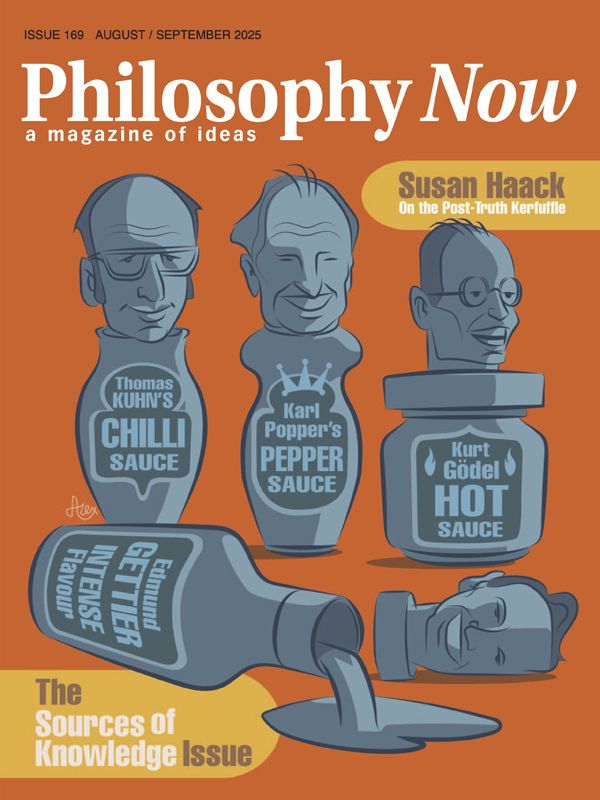
PHILOSOPHY NOW MAGAZINE (August 5, 2025): The latest issue features ‘The Sources of Knowledge Issue’

Xuanzang & the Gettier Problem

Maya Koka journeys through the desert to seek knowledge about knowledge.

The Philosophical Method of Exception

Peter Keeble spotlights and critiques a common philosophical technique.

Popper, Science & Democracy

Brian King follows Popper’s idea of the evolution of knowledge, life and society.

Challenging the Objectivity of Science

Sina Mirzaye Shirkoohi observes science to get the facts straight about it.

Gödel, Wittgenstein, & the Limits of Knowledge

Michael D. McGranahan takes us to the edge of language, mathematics and science.

Moby-Dick, Perpetual Inquiry, and the Sublime

By Intellicurean, July 25, 2025

“Call me Ishmael.”

This iconic first line anchors one of the most enduring openings in American literature. Yet before it is spoken, before Ishmael’s voice emerges on the page, we encounter something more unusual: a kind of literary invocation. The opening pages of Moby-Dick—those dense, eclectic “Extracts” quoting scripture, classical literature, scientific treatises, and forgotten travelogues—do not serve as a traditional preface. Instead, they operate like a ritual threshold. They ask us to enter the novel not as a narrative, but as a vast textual cosmos.

Melville’s fictional “sub-sub-librarian” gathers fragments from Job to Shakespeare to obscure whaling reports, assembling a chorus of voices that have, across centuries, spoken of the whale. This pre-narrative collage is more than ornamentation. It proposes a foundational idea: that the whale lives not only in the ocean, but in language. Not only in myth, but in memory. Not only in flesh, but in thought.

Before the Pequod ever sets sail, Melville has already charted his central course—into the ocean of human imagination, where the whale swims through texts, dreams, and questions that refuse easy resolution.


Proof of Two Lives

“There’s something I find strangely moving about the ‘Extracts’ section,” remarks literary critic Wyatt Mason on The World in Time, a podcast hosted by Lewis Lapham. “It’s proof of two kinds of life. The life of the creature itself, and the life of the mind—the attention we pay over time to this creature.”

Mason’s comment offers a keel for the voyage ahead. In Moby-Dick, the whale is not simply an animal or antagonist. It becomes a metaphysical magnet, a mirror for human understanding, a challenge to the limits of knowing. The “Extracts” and “Etymologies,” often dismissed as digressions, are in fact sacred rites—texts that beg to be read with reverence.

In teaching the novel to incarcerated students through the Bard Prison Initiative, Mason and fellow writer Donovan Hohn describe how these obscure, labyrinthine sections are received not as trivia but as scripture. The students descend into the archive as divers into a shipwreck—recovering fragments of forgotten wisdom, learning to breathe in the pressure of incomprehensibility. “The whale,” Mason repeats, “resides or lives in texts.” And what a library it is.


The Whale as Philosophy

“All my means are sane, my motive and my object mad.”

Harold Bloom, the late sage of literary criticism, would have nodded at Mason’s insight. For Bloom, Moby-Dick was not merely a novel, but “a giant Shakespearean prose poem.” Melville, he believed, was a tragedian of the American soul. Captain Ahab, mad with self-reliance, became for Bloom a Promethean figure—bound not by divine punishment, but by his own obsessive will.

In Bloom’s classroom at Yale in 2011, there were no lecture notes. He taught Moby-Dick like a jazz solo—improvised, living, drawn from a lifetime of memory and myth. “It’s very unfair,” he said, reflecting on the whale hunts—great mammals hunted with harpoons and lances. Yet the Pequod’s most moral man, Starbuck, is also its most proficient killer. A Quaker devoted to peace, he is also the ship’s deadliest lance. This contradiction—gentleness and violence braided together—is the essence of Melville’s philosophy.

The whale, in Bloom’s reading, is sublime not because it symbolizes any one thing—God, evil, justice, nature—but because it cannot be pinned down. It is an open question. An unending inquiry. A canvas for paradox. “Heaven help them all,” Bloom said of the Pequod’s doomed crew. “And us.”


Melville the Environmentalist

“There she blows! There she blows! A hump like a snow-hill! It is Moby Dick!”

Where Bloom heard Melville’s music in metaphor and myth, Richard J. King hears it in science. In Ahab’s Rolling Sea: A Natural History of Moby-Dick (2019), King charts a different map—overlaying Melville’s imagined ocean onto real tides, real whales, real voyages. He sails replica whalers, interviews marine biologists, pores over Melville’s notebooks.

His inquiry begins with a straightforward question: could a sperm whale really destroy a ship? Historical records suggest yes. But King doesn’t stop at anatomy. His portrait of Melville reveals a proto-environmentalist, someone who revered the sea not just as symbol but as system. Melville’s whale, King argues, is a creature of wonder and terror, not just prey but presence.

In an age of ecological crisis, King reframes Moby-Dick as a book not just of metaphor but of environmental ethics. Ishmael’s meandering digressions become meditations on the ocean as moral agent—an entity capable of sustaining and destroying. The sea is no backdrop; it is a character, a god, an intelligence. Melville’s ocean, King suggests, humbles the hubris of Ahab and calls readers to ecological humility.


Rediscovery in Dark Times

“Strike through the mask! How can the prisoner reach outside except by thrusting through the wall?”

Aaron Sachs, in Up From the Depths: Herman Melville, Lewis Mumford, and Rediscovery in Dark Times (2022), picks up the whale’s trail in the 20th century. In 1929, as the world plunged into the Great Depression, the writer and historian Lewis Mumford resurrected Melville from literary oblivion. His biography of the long-forgotten author recast Melville not as a failure, but as a visionary.

For Mumford, Melville was a kindred spirit—a man who, long before the term “modernity” took hold, had already seen its psychic cost. As Mumford watched the rise of industry, mass production, and spiritual exhaustion, he found in Melville a dark prophet. Ahab’s fury was not personal—it was civilizational.

Critics have praised Sachs’s biography as timely and thoughtful. Its thesis is clear: in times of disorientation, literature does more than reflect the world—it refracts it. It preserves vital truths, repurposing them when our present crises demand older insights.

In Sachs’s telling, Moby-Dick is not just a classic; it’s a living text. A lighthouse in the storm. A warning bell. A whale-shaped mirror reflecting our fears, failures, and persistent hope.


The Whale in the Classroom

“Ignorance is the parent of fear.”

The classroom, as Sachs and Mason both suggest, becomes a site of literary resurrection. In prison education programs, students discover themselves in the “Extracts”—not despite their difficulty, but because of it. The very act of grappling with Melville’s arcane references, strange structures, and encyclopedic digressions becomes an act of reclamation.

To teach Moby-Dick in a prison is to raise a sunken ship. Its sentences, like salvaged artifacts, reveal new meaning. Forgotten knowledge becomes fuel for rediscovery. Students, many of whom have been dismissed by society, see in Melville’s endless inquiry a validation of their own intelligence and complexity.

Harold Bloom taught Moby-Dick the same way. Every reading was new. No fixed script, only the swell of thought. He modeled Melville’s method: trust the reader, trust the text, trust the mystery.

The whale resists capture—literal and interpretive. It is not a symbol with a key, but a question without an answer. That resistance is what makes Moby-Dick enduring. It insists on being re-read. Re-thought. Re-discovered.


The Archive That Breathes

“It is not down in any map; true places never are.”

Taken together, the voices of Wyatt Mason, Harold Bloom, Richard J. King, and Aaron Sachs reveal Moby-Dick as something more than literature. It is a breathing archive—a repository of imagination, inquiry, and paradox.

Within its pages dwell theologies and taxonomies, drama and digression, sermons and sea shanties. It houses the ethical weight of ecology, the fury of Ahab, the wonder of Ishmael, and the ghosts of Melville’s century. It defies genre, resists reduction, and insists on complexity.

Melville did not write to close arguments but to open them. He did not believe in neat endings. His whale is the quintessential “true place”: uncapturable, immeasurable, endlessly sublime.

And yet we return. We keep hunting—not with harpoons, but with attention. With interpretation. With awe.


A Final Breach

What, then, do we do with Moby-Dick in the twenty-first century? How do we reconcile Ahab’s consuming fury with Ishmael’s contemplative awe? How do we carry Bloom’s Prometheus, King’s Leviathan, Sachs’s resurrected Melville, and Mason’s classroom in a single imagination?

We read. We reread. We become “sub-sub-librarians”—archivists of ambiguity, curators of complexity. We do not read Moby-Dick for closure. We read it to learn how to remain open—to contradiction, to paradox, to mystery.

But what if we, like Captain Ahab, set off to find Moby Dick and never found the whale?

What if all our intellectual harpoons missed their mark? What if the whale was never there to begin with—not as symbol, not as certainty, not as prize?

Would we call that failure?

Or might we discover, like Ishmael adrift on the coffin-raft, that survival is not about conquest, but endurance? That truth lives not in the kill, but in the quest?

Perhaps Melville’s greatest lesson is that the whale must never be caught. Its sublimity lies in its elusiveness—in its capacity to remain just beyond the reach of definition, control, and meaning. It breaches in metaphor. It disappears in digression. It waits—not to be captured, but to be considered.

We will never catch it. But we must keep following.

For in the following, we become something more than readers.
We become seekers.

THIS ESSAY WAS WRITTEN BY INTELLICUREAN UTILIZING AI

The Curated Persona vs. The Cultivated Spirit

“There is pleasure in the pathless woods,
There is rapture on the lonely shore,
There is society where none intrudes,
By the deep sea, and music in its roar.”
— Lord Byron, Childe Harold’s Pilgrimage

Intellicurean (July 20, 2025):

We are living in a time when almost nothing reaches us untouched. Our playlists, our emotions, our faces, our thoughts—all curated, filtered, reassembled. Life itself has been stylized and presented as a gallery: a mosaic of moments arranged not by meaning, but by preference. We scroll instead of wander. We select instead of receive. Even grief and solitude are now captioned.

Curation is no longer a method. It is a worldview. It tells us what to see, how to feel, and increasingly, who to be. What once began as a reverent gesture—a monk illuminating a manuscript, a poet capturing awe in verse—has become an omnipresent architecture of control. Curation promises freedom, clarity, and taste. But what if it now functions as a closed system—resisting mystery, filtering out surprise, and sterilizing transformation?

This essay explores the spiritual consequences of that system: how the curated life may be closing us off from the wildness within, the creative rupture, and the deeper architecture of meaning—the kind once accessed by walking, wandering, and waiting.

Taste and the Machinery of Belonging

Taste used to be cultivated: a long apprenticeship shaped by contradiction and immersion. One learned to appreciate Bach or Baldwin not through immediate alignment, but through dedicated effort and often, difficulty. This wasn’t effortless consumption; it was opening oneself to a demanding process of intellectual and emotional growth, engaging with works that pushed against comfort and forced a recalibration of understanding.

Now, taste has transformed. It’s no longer a deep internal process but a signal—displayed, performed, weaponized. Curation, once an act of careful selection, has devolved into a badge of self-justification, less about genuine appreciation and more about broadcasting allegiance.

What we like becomes who we are, flattened into an easily digestible profile. What we reject becomes our political tribe, a litmus test for inclusion. What we curate becomes our moral signature, a selective display designed to prove our sensibility—and to explicitly exclude others who don’t share it. This aesthetic alignment replaces genuine shared values.

This system is inherently brittle. It leaves little room for the tension, rupture, or revision essential for genuine growth. We curate for coherence, not depth—for likability, not truth. We present a seamless, unblemished self, a brand identity without flaw. The more consistent the aesthetic, the more brittle the soul becomes, unable to withstand the complexities of real life.

Friedrich Nietzsche, aware of human fragility, urged us in The Gay Science to “Become who you are.” But authentic becoming requires wandering, failing, and recalibrating. The curated life demands you remain fixed—an unchanging exhibit, perpetually “on brand.” There’s no space for the messy, contradictory process of self-discovery; each deviation is a brand inconsistency.

We have replaced moral formation with aesthetic positioning. Do you quote Simone Weil or wear linen neutrals? Your tastes become your ethics, a shortcut to moral authority. But what happens when we are judged not by our love or actions, but by our mood boards? Identity then becomes a container, rigidly defined by external markers, rather than an expansive horizon of limitless potential.

James Baldwin reminds us that identity, much like love, must be earned anew each day. It’s arduous labor. Curation offers no such labor—only the performative declaration of arrival. In the curated world, to contradict oneself is a failure of brand, not a deepening of the human story.

Interruption as Spiritual Gesture

Transformation—real transformation—arrives uninvited. It’s never strategic or trendy. It arrives as a breach, a profound disruption to our constructed realities. It might be a dream that disturbs, a silence that clarifies, or a stranger who speaks what you needed to hear. These are ruptures that stubbornly refuse to be styled or neatly categorized.

These are not curated moments. They are interruptions, raw and unmediated. And they demand surrender. They ask that we be fundamentally changed, not merely improved. Improvement often implies incremental adjustments; change implies a complete paradigm shift, a dismantling and rebuilding of perception.

Simone Weil wrote, “Attention is the rarest and purest form of generosity.” To give genuine attention—not to social media feeds, but to the world’s unformatted texture—is a profoundly spiritual act. It makes the soul porous, receptive to insights that transcend the superficial. It demands we quiet internal noise and truly behold.

Interruption, when received rightly, becomes revelation. It breaks the insidious feedback loop of curated content. It reclaims our precious time from the relentless scroll. It reminds us that meaning is not a product, but an inherent presence. It calls us out of the familiar, comfortable loop of our curated lives and into the fertile, often uncomfortable, unknown.

Attention is not surveillance. Surveillance consumes and controls. Attention, by contrast, consecrates; it honors sacredness. It is not monitoring. It is beholding, allowing oneself to be transformed by what is perceived. In an age saturated with infinite feeds, sacred attention becomes a truly countercultural act of resistance.

Wilderness as Revelation

Before curation became the metaphor for selfhood, wilderness was. For millennia, human consciousness was shaped by raw, untamed nature. Prophets were formed not in temples, but in the harsh crucible of the wild.

Moses wandered for forty years in the desert before wisdom arrived. Henry David Thoreau withdrew to Walden Pond not to escape, but to immerse himself in fundamental realities. Friedrich Nietzsche walked—often alone and ill—through the Alps, where he conceived eternal recurrence, famously declaring: “All truly great thoughts are conceived by walking.”

The Romantic poets powerfully echoed this truth. William Wordsworth, in Tintern Abbey, describes a profound connection to nature, sensing:

“A sense sublime / Of something far more deeply interfused, / Whose dwelling is the light of setting suns…”

John Keats saw nature as a portal to the eternal.

Yet now, even wilderness is relentlessly curated. Instagrammable hikes. Hashtagged retreats. Silence, commodified. We pose at the edge of cliffs, captioning our solitude for public consumption, turning introspection into performance.

But true wilderness resists framing. It is not aesthetic. It is initiatory. It demands discomfort, challenges complacency, and strips away pretense. It dismantles the ego rather than decorating it, forcing us to confront vulnerabilities. It gives us back our edges—the raw, unpolished contours of our authentic selves—by rubbing away the smooth veneers of curated identity.

In Taoism, the sage follows the path of the uncarved block. In Sufi tradition, the Beloved is glimpsed in the desert wind. Both understand: the wild is not a brand. It is a baptism, a transformative immersion that purifies and reveals.

Wandering as Spiritual Practice

The Romantics knew intuitively that walking is soulwork. John Keats often wandered through fields for the sheer presence of the moment. Lord Byron fled confining salons for pathless woods, declaring: “I love not Man the less, but Nature more.” His escape was a deliberate choice for raw experience.

William Wordsworth’s daffodils become companions, flashing upon “that inward eye / Which is the bliss of solitude.” Walking allows a convergence of external observation and internal reflection.

Walking, in its purest form, breaks pattern. It refuses the algorithm. It is an act of defiance against pre-determined routes. It offers revelation in exchange for rhythm, the unexpected insight found in the meandering journey. Each footstep draws us deeper into the uncurated now.

Bashō, the haiku master, offered a profound directive:

“Do not seek to follow in the footsteps of the wise. Seek what they sought.”

The pilgrim walks not primarily to arrive at a fixed destination, but to be undone, to allow the journey itself to dismantle old assumptions. The act of walking is the destination.

Wandering is not a detour. It is, in its deepest sense, a vocation, a calling to explore the contours of one’s own being and the world without the pressure of predetermined outcomes. It is where the soul regains its shape, shedding rigid molds imposed by external expectations.

Creation as Resistance

To create—freely, imperfectly, urgently—is the ultimate spiritual defiance against the tyranny of curation. The blank page is not optimized; it is sacred ground. The first sketch is not for immediate approval. It is for the artist’s own discovery.

Samuel Taylor Coleridge defined poetry as “the best words in the best order.” Rainer Maria Rilke declared, “You must change your life.” Friedrich Nietzsche articulated art’s existential necessity: “We have art so that we do not perish from the truth.” These are not calls to produce content for an audience; they are invitations to profound engagement with truth and self.

Even creation is now heavily curated by metrics. Poems are optimized for engagement. Music is tailored to specific moods. But art, in its essence, is not engagement; it is invocation. It seeks to summon deeper truths, to ask questions the algorithm can’t answer, to connect us to something beyond the measurable.

To make art is to stand barefoot in mystery—and to respond with courage. To write is to risk being misunderstood. To draw is to embrace the unpolished. This is not inefficiency. This is incarnation—the messy, beautiful process of bringing spirit into form.

Memory and the Refusal to Forget

The curated life often edits memory for coherence. It aestheticizes ancestry, reducing complex family histories to appealing narratives. It arranges sentiment, smoothing over rough edges. But real memory is a covenant with contradiction. It embraces the paradoxical coexistence of joy and sorrow.

John Keats, in his Ode to a Nightingale, confronts the painful reality of transience and loss: “Where youth grows pale, and spectre-thin, and dies…” Memory, in its authentic form, invites this depth, this uncomfortable reckoning with mortality. It is not a mood board. It is a profound reckoning, where pain and glory are allowed to dwell together.

In Jewish tradition, memory is deeply embodied. To remember is not merely to recall a fact; it is to retell, to reenact, to immerse oneself in the experience of the past, remaining in covenant with it. Memory is the very architecture of belonging. It does not simplify complex histories. Instead, it deepens understanding, allowing generations to draw wisdom and resilience from their heritage.

Curation flattens, reducing multifaceted experiences to digestible snippets. Memory expands, connecting us to the vast tapestry of time. And in the sacred act of memory, we remember how grace once broke into our lives, how hope emerged from despair. We remember so we can genuinely hope again, with a resilient awareness of past struggles and unexpected mercies.

The Wilderness Within

The final frontier of uncuration is profoundly internal: the wilderness within. This is the unmapped territory of our own consciousness, the unruly depths that resist control.

Søren Kierkegaard called it dread—not fear, but the trembling before the abyss of possibility. Nietzsche called it becoming—not progression, but metamorphosis. This inner wilderness resists styling, yearns for presence instead of performance, and asks for silence instead of applause.

Even our inner lives are at risk of being paved over. Advertisements and algorithmic suggestions speak to us in our own voice, subtly shaping desires. Choices feel like intuition—but are often mere inference. The landscape of our interiority, once a refuge for untamed thought, is being meticulously mapped and paved over for commercial exploitation, leaving little room for genuine self-discovery.

Simone Weil observed: “We do not obtain the most precious gifts by going in search of them, but by waiting for them.” The uncurated life begins in this waiting—in the ache of not knowing, in the quiet margins where true signals can penetrate. It’s in the embrace of uncertainty that authentic selfhood can emerge.

Let the Soul Wander

“Imagination may be compared to Adam’s dream—he awoke and found it truth.” — Keats

To live beyond curation is to choose vulnerability. It is to walk toward complexity, to embrace nuances. It is to let the soul wander freely and to cultivate patience for genuine waiting. It is to choose mystery over mastery, acknowledging truths revealed in surrender, not control.

Lord Byron found joy in pathless woods. Percy Bysshe Shelley sang alone, discovering his creative spirit. William Wordsworth found holiness in leaves. John Keats touched eternity through birdsong. Friedrich Nietzsche walked, disrupted, and lived with intensity.

None of these lives were curated. They were entered—fully, messily, without a predefined script. They were lives lived in engagement with the raw, untamed forces of self and world.

Perhaps / The truth depends on a walk around a lake, / A composing as the body tires, a stop. // To see hepatica, a stop to watch. / A definition growing certain…” Wallace Stevens

So let us make pilgrimage, not cultivate a profile. Let us write without audience, prioritizing authentic expression. Let us wander into ambiguity, embracing the unknown. And let us courageously welcome rupture, contradiction, and depth, for these are the crucibles of genuine transformation.

And there—at the edge of control, in the sacred wilderness within, where algorithms cannot reach—
Let us find what no curated feed can ever give.
And be profoundly changed by it.

THIS ESSAY WAS WRITTEN AND EDITED BY INTELLICUREAN USING

PHILOSOPHY NOW MAGAZINE – JUNE/JULY 2025 PREVIEW

Image

PHILOSOPHY NOW MAGAZINE (June 6, 2025): The latest issue features ‘Digital Philosophy’…

Ethics for the Age of AI

Mahmoud Khatami asks, can machines make good moral decisions?

Rescuing Mind from the Machines

Vincent J. Carchidi agrees with Descartes and friends that our ability to use language creatively distinguishes our minds from computers.

Studying Smarter with AI?

Max Gottschlich on sense and nonsense when using AI in academia.

Affirmative Action for Androids

Jimmy Alfonso Licon asks, when should we prioritise android rights?

Is VR Meaningful Escapism?

Amir Haj-Bolouri enquires into possible meaning through technology.

AI Think Therefore AI Am

by Rick Lewis

Humanities Magazine – Spring 2025 Preview

Cover Image -- Noyes

HUMANITIES MAGAZINE (April 10, 2025): The latest issue features Eliot Noyes, pictured here on the television show Omnibus, brought a sculptural grace to his work. 

Corpus Linguistics Is Changing How Courts Interpret the Law

David Skinner

Monet Saving the World

Public art and politics

Why Spinoza Was Excommunicated

Steven Nadler

The Extreme Geometries of Bodys Isek Kingelez 

Christopher Byrd

The New Criterion ——- April 2025 Preview

THE NEW CRITERION (March 15, 2025): The April issue features

The hard Frost by Brenda Wineapple

Vicar’s vision by Micah Mattix

Ambassador of dreams by Gary Saul Morson

The lush fields of allusion by Rachel Hadas

Ezra Pound & the mystery of the calling cards by William Logan