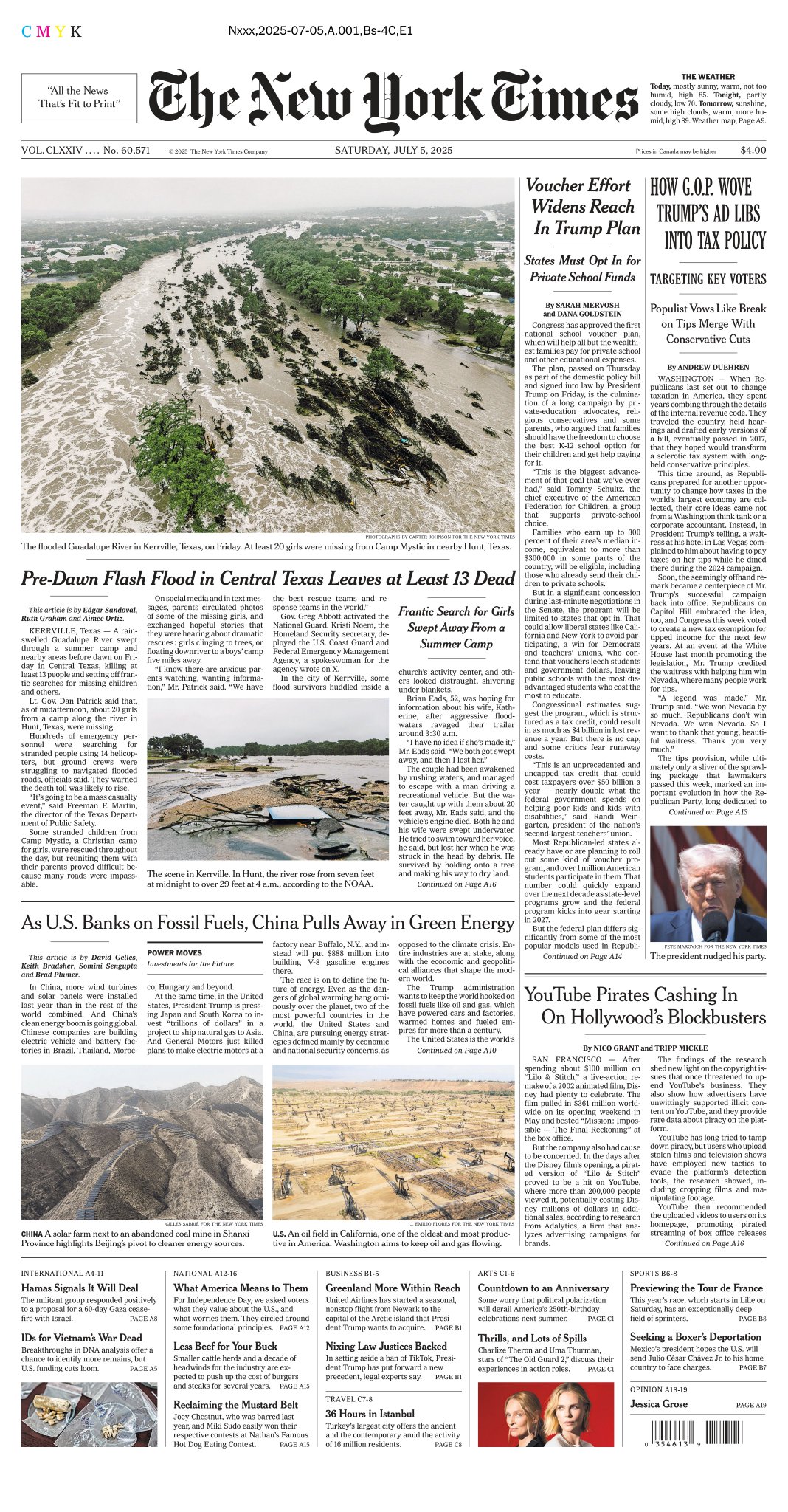
Officials said the search for remains would continue until all victims were accounted for. In the hardest-hit county, no survivors have been found since Friday.
A court-ordered pause in May had covered nearly two dozen federal agencies at different stages of executing President Trump’s directive for mass layoffs.
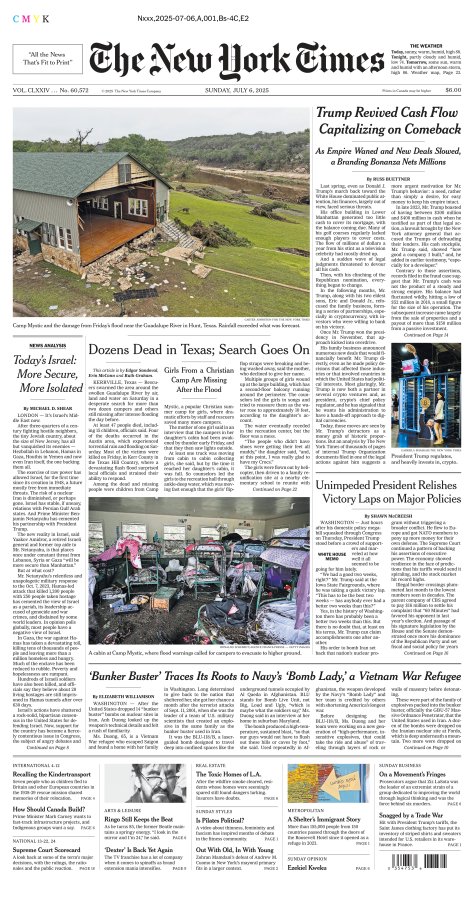
President Trump and Prime Minister Benjamin Netanyahu of Israel confronted an array of high-stakes Middle East issues. But first they took a victory lap.
President Trump is considering whether to pursue a new nuclear agreement with Tehran. He is also urging a new cease-fire deal to end the fighting in Gaza.
THE NEW YORK TIMES MAGAZINE: The 7.06.25 Issue features Nick Confessore on how the trans rights movement bet on the Supreme Court in U.S. v Skrmetti and lost; Charles Homans on Trump’s fight with Los Angeles on immigration; Oliver Whang on Luke Littler, an 18-year-old darts prodigy; and more.
Democrats Denied This City Had a Gang Problem. The Truth Is Complicated.
Trump’s claim that Venezuelan criminals took over Aurora, Colorado, became a rationale for his immigration crackdown. What really happened there?
THE FOLLOWING IS AN “AI REVIEW” OF THE JULY 3 EPISODE OF “BLOOMBERG LAW WITH JUNE GRASSO” PODCAST TRANSCRIPT:
In the dimly lit chambers of American justice, two parallel stories unfolded this term—one involving the cultural phenomenon of Sean “Diddy” Combs, the other the ideological recalibration of the United States Supreme Court. Each, in its own way, exposed the tensions inherent in a legal system grappling with the competing imperatives of moral condemnation, procedural fairness, and the inexorable gravitational pull of politics.
In federal court, Combs emerged, if not unscathed, then improbably triumphant. After six weeks of graphic testimony and the steady drip of lurid detail, jurors acquitted him of the most sensational accusations: racketeering conspiracy and sex trafficking, crimes that, had they stuck, would almost certainly have resulted in a life sentence. Instead, he was convicted only on two counts of transporting sex workers across state lines to participate in what prosecutors termed “freak-off parties.” In the pantheon of celebrity trials, this outcome was remarkable not merely for the verdict itself but for the rhetorical overreach that defined the government’s case.
Robert Mintz, a former federal prosecutor turned defense attorney, spoke to the case’s cautionary lesson about prosecutorial ambition. RICO—the Racketeer Influenced and Corrupt Organizations Act—was never an intuitive fit for Combs, a music mogul whose business dealings, however flamboyant, bore little resemblance to the mafia syndicates the statute was designed to dismantle. In the final analysis, jurors appeared unconvinced that the machinery of Combs’s empire—record labels, promotional companies, an entourage that blurred the line between personal and professional—was itself the instrument of a criminal conspiracy. They were similarly unconvinced that the two women at the heart of the government’s sex trafficking charges had been coerced rather than entangled in a toxic, if mutually complicit, set of relationships.
Perhaps more striking still was the defense’s strategy: they called no witnesses. Rather than counter the government’s narrative with competing testimony, Combs’s lawyers focused their energy on cross-examination, unspooling the contradictions and ambivalences embedded in the prosecution’s evidence. Here, too, lay a broader truth about modern criminal justice. The power to define the contours of the case—the charges themselves—can be as determinative as the evidence marshaled to prove them. When the government chooses to depict a defendant as the capo di tutti capi of an illicit empire, it must persuade a jury not only of wrongdoing but of a sweeping criminality that often strains credulity. When that narrative collapses, as it did here, the defense is left with the simpler task of pointing out the seams.
But Combs’s legal jeopardy is not yet at an end. Though acquitted of the most serious charges, he faces up to twenty years in prison on the counts that remain, even if the federal sentencing guidelines suggest a considerably lower range. The presiding judge, troubled by videotaped evidence of Combs assaulting one of the alleged victims, declined to release him pending sentencing—a reminder that in federal court, the most powerful voice is not the jury’s but the judge’s. It is not inconceivable that the final chapter of this saga will be harsher than the defense’s celebration suggested.
If Combs’s courtroom drama offered a microcosm of prosecutorial overreach, the Supreme Court’s term showcased a more profound shift: a conservative supermajority willing to reconfigure the balance of power between the judiciary and the executive—and, by extension, between individuals and the state. In conversation with constitutional law scholar Michael Dorf, host June Grasso illuminated the breadth of these changes. Over the past year, the Court issued a series of rulings that, taken together, represent a quiet revolution in the way the federal courts interact with presidential authority.
At the heart of this transformation was the Court’s decision to curtail nationwide injunctions—sweeping orders issued by district judges to block federal policies across the entire country. For decades, these injunctions served as a vital mechanism by which civil rights plaintiffs, immigrant communities, and other marginalized groups could halt executive overreach before it inflicted irreparable harm. Their disappearance is no mere procedural adjustment; it recasts the balance between the judiciary’s protective function and the executive’s prerogative to govern unencumbered.
This doctrinal shift accrued almost exclusively to the benefit of President Trump, whose administration had faced a phalanx of legal challenges. Whether the issue was the forced deportation of migrants, the exclusion of transgender Americans from military service, or the elimination of birthright citizenship, the Supreme Court’s majority showed an evident willingness to side with the executive branch on an emergency basis—often with scant explanation. Dorf described this posture as striking not merely for its partisanship but for its inconsistency: lower courts that blocked Trump policies were overruled with alacrity, even as those same justices castigated nationwide injunctions as judicial overreach.
At the same time, the term’s most divisive rulings revealed a Court emboldened to advance a culturally conservative agenda. In a 6-3 decision, the justices upheld Tennessee’s ban on gender-affirming care for minors, dismissing the equal protection claims of transgender plaintiffs and casting doubt on whether such discrimination should trigger heightened constitutional scrutiny. In another ruling, religious parents were granted the right to withdraw their children from public school curricula that included LGBTQ-themed storybooks—a decision that critics warn will invite broader challenges to any teaching that conflicts with sectarian belief. In the aggregate, these rulings did more than roll back hard-won protections for LGBTQ Americans. They signaled a willingness to prioritize religious objections over the rights of vulnerable communities, an alignment that recurred throughout the term.
For Dorf, the most unsettling dimension was not the conservative tilt per se but the Court’s apparent comfort with what he called a “soft authoritarian” style of governance. The Roberts Court had already repealed the constitutional right to abortion and limited the federal government’s capacity to regulate firearms. What distinguished this term was its readiness to facilitate the Trump administration’s disregard for judicial orders—an erosion not of precedent but of the rule of law itself.
Whether these developments portend a lasting reorientation of American jurisprudence remains to be seen. What is clear, however, is that the ideological polarization of the Supreme Court is reshaping the lives of countless citizens in ways that transcend conventional partisanship. In this respect, the travails of Sean Combs and the ambitions of the Roberts Court are, improbably, two facets of the same American story: one in which the legal system’s power to punish and to protect is increasingly mediated by political will—and by the narratives that prevail when the evidence, the law, and the culture clash in the crucible of the courtroom.
Segment 1: The Verdict in Sean “Diddy” Combs’ Case
Guests:
Robert Mintz, former federal prosecutor, partner at McCarter & English
Topics:
Combs’ acquittal on the most serious charges (racketeering, conspiracy, sex trafficking)
Conviction on two lesser felonies (transportation to engage in prostitution)
Defense’s strategy to challenge overcharging
Impact of the 2016 video showing domestic violence
Potential sentencing: between ~2–5 years under guidelines, but judge has broad discretion
Judge’s refusal to release Combs pending sentencing due to danger concerns
Broader implications of prosecutorial overreach and the difficulties of proving coercion in complex, long-term relationships
Segment 2: The Supreme Court Term Review
Guest:
Michael Dorf, constitutional law professor, Cornell Law School
Topics:
The Supreme Court siding repeatedly with the Trump administration
Disbanding nationwide injunctions (limiting checks on executive power)
Facilitating major policy shifts (transgender military ban, deportations, birthright citizenship challenges)
LGBTQ rights decisions:
Upholding Tennessee’s ban on gender-affirming care for minors
Requiring schools to exempt religious families from LGBTQ-inclusive curricula
Concerns about the erosion of protections under equal protection doctrine
Forthcoming cases on transgender sports participation and conversion therapy bans
Second Amendment developments:
Court upholding ghost gun regulations
Declining to broadly immunize gun manufacturers
Signaling possible caution but not reversal of the pro-gun rights direction
Emergency docket criticism:
Pattern of granting Trump administration emergency relief with limited justification
Disregard for procedural norms
Overarching movement:
From traditional conservatism into enabling a more authoritarian style of governance
Summary
This episode of Bloomberg Law, hosted by June Grasso, offered an in-depth analysis of two major legal stories:
1. The Sean “Diddy” Combs Case After a six-week federal trial with emotionally charged testimony, Combs was acquitted of racketeering and sex trafficking but convicted of transporting sex workers across state lines—a felony under the Mann Act. Prosecutors’ strategy to use RICO laws typically reserved for mob cases ultimately backfired, allowing the defense to argue overreach. While the jury found Combs’ conduct disturbing, they did not believe it rose to organized criminal enterprise. Despite securing partial convictions, the prosecution faces criticism for overcharging, which opened avenues for defense cross-examination and ultimately undermined their case. Combs remains in custody as he awaits sentencing, which could be significantly harsher than defense estimates due to the judge’s concerns about continued danger.
2. The Supreme Court’s Term Professor Michael Dorf described a term marked by sweeping decisions that advanced a conservative agenda, often benefiting the Trump administration. The Court stripped lower courts of their ability to issue nationwide injunctions, effectively removing a key check on executive overreach. In LGBTQ cases, the Court upheld bans on gender-affirming care for minors, sided with religious parents seeking exemptions from inclusive curricula, and signaled openness to further limits on trans rights in upcoming cases. While the Court maintained some gun regulations, its overall jurisprudence continues a rightward trajectory, blending traditional conservative principles with deference to Trump’s more aggressive policies. Emergency docket decisions frequently favored the administration without full briefing, raising concerns about procedural fairness and erosion of judicial norms. Ultimately, the Court’s direction was characterized as not just conservative, but increasingly aligned with authoritarian tendencies.
THIS POSTING WAS WRITTEN BY AI AND EDITED BY INTELLICUREAN
The nation is more secure from threats than ever. But the war in Gaza, and attacks on Iran and Lebanon, have undercut its standing among the world’s democracies.
It was not immediately clear whether the group was demanding any significant changes to the plan for a 60-day truce and talks on a permanent end to the war.
The following is an in-depth analysis of President Trump’s “One Big Beautiful Bill Act” written by ChatGPT from important, bi-partisan fiscal, economic and political sources, all listed below:
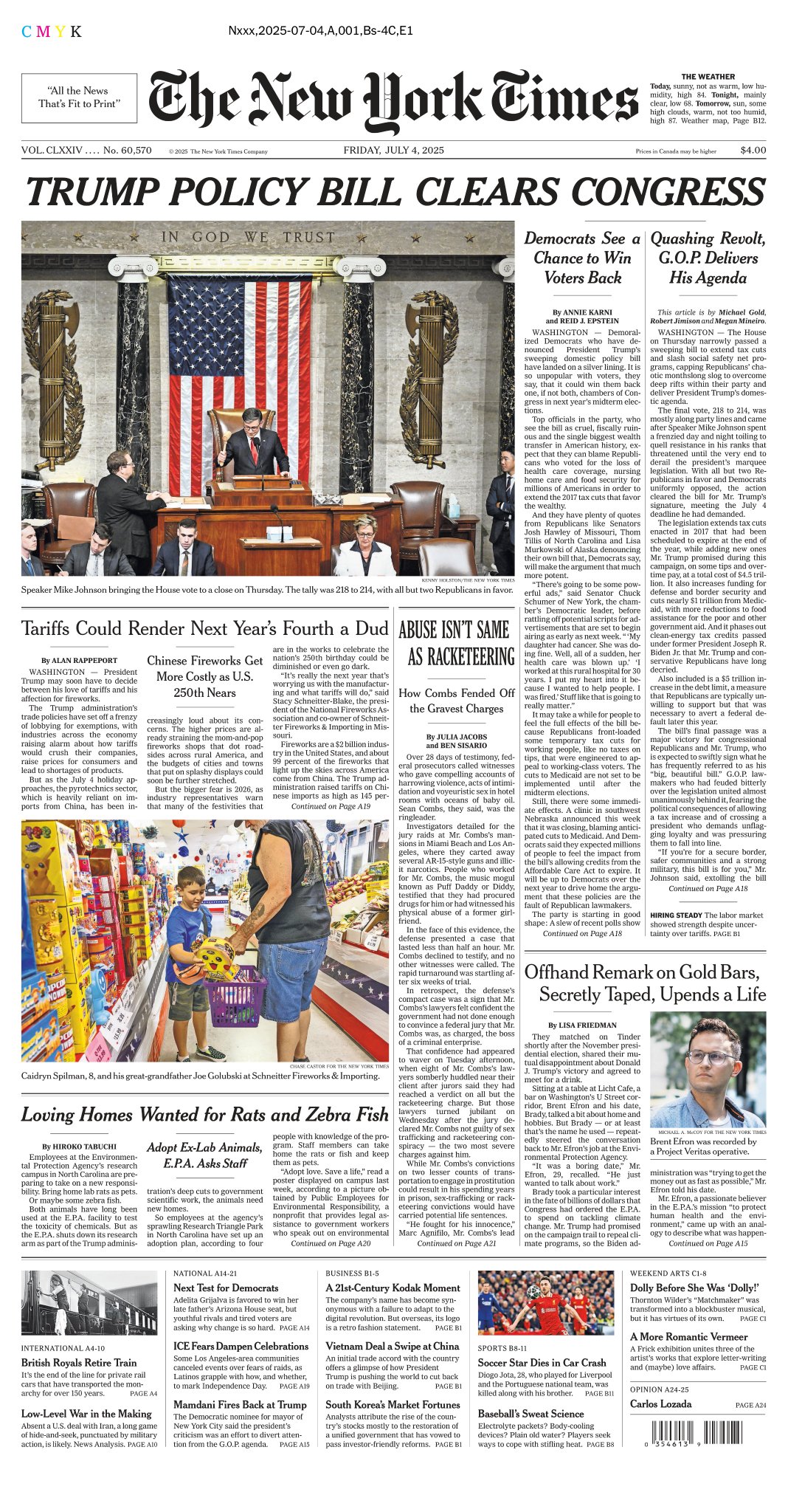
If there is one unassailable truth in American political life, it is that no grand legislative gesture arrives without the promise of prosperity—and the prospect of unintended consequences. Donald Trump’s “One Big Beautiful Bill,” signed into law on July 4th, stands as a monument to this dynamic: a sprawling package of permanent tax cuts, entitlement retrenchments, and fresh spending, all wrapped in a populist bow and accompanied by the familiar refrain that the deficits will somehow pay for themselves.
To understand the bill’s import—and its likely fallout—it helps to consider three vantage points. The first is that of Milton Friedman, who would see in these provisions a laboratory for the free market, tempered by fiscal illusions. The second is Paul Krugman’s, for whom this is a brazen experiment in upward redistribution. The third is David Stockman’s, whose uniquely jaundiced eye discerns an unholy alliance of crony capitalism and debt-fueled political theatre.
Friedman, the Nobel laureate and evangelist of free enterprise, might first commend the bill’s unapologetic tax relief. A permanent extension of the 2017 tax cuts is precisely the sort of measure he once called “a way to restore incentives, reduce distortions, and reward enterprise.” For Friedman, a tax system ought to be predictable, broad-based, and minimally intrusive. In this sense, the bill’s elimination of taxes on tips and overtime income, coupled with higher thresholds for the estate tax, will likely increase the incentive to work, save, and invest.
Yet Friedman would be quick to warn that no tax cut exists in a vacuum. The real test of fiscal virtue, he always argued, is not in slashing tax rates but in restraining spending. This bill, by combining aggressive tax cuts with continued defense expansions and only partial reductions to social spending, falls short of the discipline he prescribed. The result, Friedman would say, is a structural deficit that will eventually require either inflation or future tax hikes. “There is no such thing as a free lunch,” he liked to remind audiences. This is a lunch billed to generations unborn.
Krugman, viewing the same legislation, would perceive not a triumph of market freedom but an egregious abdication of public responsibility. He has long argued that the most misleading idea in modern politics is the notion that tax cuts inevitably pay for themselves. As the Congressional Budget Office’s scoring shows, the bill is likely to add over $3 trillion to the national debt in the next decade, even after accounting for higher GDP. Krugman would note that the permanent nature of the cuts deprives lawmakers of future leverage and crowds out investments in education, infrastructure, and health.
More pointedly, Krugman would argue that the bill’s distributional impact is regressive by design. Expanded deductions for capital gains and estates, the restoration of a higher SALT cap, and corporate incentives all tilt the benefits toward the affluent, while Medicaid cuts and SNAP work requirements fall hardest on those with the least. In Krugman’s view, this is not simply poor economics but a moral failing: a return to what he calls “the era of Dickensian inequality, dressed up in the rhetoric of growth.”
Yet the critique most likely to sting is the one that David Stockman would deliver. Unlike Krugman, Stockman began as a champion of supply-side tax reform. But he has since become its most unflinching critic. To him, the “Big Beautiful Bill” represents the final stage of a fiscal derangement decades in the making: a bipartisan addiction to borrowing and a refusal to reckon with arithmetic. “This is not capitalism,” Stockman might write, “it’s a simulacrum of capitalism—an endless auction of political favors financed by the Fed’s printing press.”
Stockman would remind readers that when he served as Reagan’s budget director, the expectation was that tax cuts would be offset by deep spending restraint. Instead, deficits ballooned and discipline eroded. The new bill, with its eye-watering cost and lack of credible offsets, is an even more flamboyant departure from any pretense of balance. Stockman would likely deride the Republican celebration as a form of magical thinking, no more credible than the illusions peddled by Democrats. In his telling, the bill is both symptom and accelerant of a broader collapse of fiscal sanity.
All three perspectives converge on a single point: the bill’s enormous impact on the debt trajectory. According to estimates from the Committee for a Responsible Federal Budget, the legislation could push the U.S. debt-to-GDP ratio past 145% by 2050—an unprecedented level for a peacetime economy. While proponents insist that higher growth will mitigate the burden, the Tax Foundation’s dynamic scoring suggests the additional output will cover only a fraction of the revenue loss.
Friedman would insist that economic growth requires both lower taxes and leaner government. Krugman would counter that social stability and productivity demand sustained public investment. Stockman would argue that the entire paradigm—borrowing trillions to finance giveaways—has become a bipartisan racket. Despite their ideological divergences, all three would agree that the arithmetic is merciless. Eventually, debts must be serviced, entitlements must be funded, and the dollar’s credibility must be defended.
What remains is the question of public memory. In the years ahead, as interest payments rise and fiscal constraints tighten, politicians will doubtless blame one another for the bill’s consequences. The narrative will fracture along familiar lines: Republicans will claim the tax cuts were sabotaged by spending; Democrats will argue the spending was hobbled by tax cuts. Independents will declare that neither side ever intended to balance the books. But the numbers, as Friedman and Krugman and Stockman all understood in their own ways, are immune to spin.
There is an old line, attributed variously to Keynes and to an anonymous Treasury mandarin, that the markets can remain irrational longer than you can remain solvent. Perhaps, in this case, Washington can remain irrational longer than the public can remain attentive. But eventually, the bill will come due—not only the legislation signed on Independence Day, but the larger bill for decades of self-deception.
A big, beautiful bill indeed. And perhaps, in the fullness of time, an even bigger, less beautiful reckoning.
Key Elements of the Bill
Permanent tax cuts (≈ $4.5 trillion): Extends nearly all parts of Trump’s 2017 Tax Cuts and Jobs Act, including individual rate brackets, expanded standard deduction, plus new deductions—no taxes on tips/overtime (through 2028), boosted SALT deduction ($40k cap for five years), larger child/senior credits, plus expansions like auto loan interest write-offs and “Trump Accounts” for parents apnews.com+15ft.com+15crfb.org+15.
Major spending cuts: $1–1.2 trillion in savings via Medicaid cuts (work requirements, provider taxes), SNAP/state cost-shifts, rollback of clean energy incentives .
Increased enforcement and defense: $150 B added to defense, another $150 B+ for border/ICE enhancements; ICE funding grows tenfold – now largest federal law enforcement budget .
Earlier CBO distributional analysis estimated 10.9 million fewer insured and initially $2.4 trillion added – revised upward to $2.8 trillion theguardian.com+4en.wikipedia.org+4apnews.com+4.
🏦 CRFB & Budget Advocates
Committee for a Responsible Federal Budget (CRFB) puts the Senate’s reconciliation version at $4.1 trillion added debt through 2034—and warns a permanent version could add $5.3–5.5 trillionen.wikipedia.org.
CRFB also flags that Social Security and Medicare’s projected insolvency deadlines are now accelerated by roughly one year .
🧮 Tax Foundation
Estimates that permanent tax measures could yield a +1.2% GDP boost over the long run, but also slash federal revenue by $4 trillion (dynamically)—meaning growth would only cover ~19% of the revenue loss en.wikipedia.org+15en.wikipedia.org+15reuters.com+15.
Shorter-term growth boost around +0.6% by 2027, but turns mildly negative (–0.1%) by 2034 once fiscal constraints bite taxfoundation.org.
Reuters warns of a “debt spiral,” with rising interest costs jeopardizing Fed independence .
FT, Washington Post, The Guardian, The Economist describe it as the largest GOP tax/deficit expansion since Reagan, dubbing it a “reverse Robin Hood”—favoring corporations and wealthy over vulnerable groups .
Economists at Yale, Penn warn severe health-care cuts could increase preventable mortality and financial distress en.wikipedia.org+1ft.com+1.
🔍 Bottom Line Summary
Metric
Estimate
Deficit Increase (2025–34)
$3.3–4.1 T (CBO: ≈ $3.4T; CRFB Senate: ≈ $4.1T)
Debt-to-GDP Trajectory
Rising, potentially 145–200% by 2050
GDP Growth Impact
+0.6% by 2027, fading to –0.1% by 2034
Revenue Loss
~$4–5 T over a decade (dynamic)
Insured Loss & Social Costs
~11 M fewer insured; Medicaid/SNAP and health impacts significant
Neutral consensus: Deficit historians, nonpartisan agencies agree debt will balloon sharply in absence of offsetting revenues or spending reversals.
Growth trade-off: While tax relief offers modest short-term growth, it does not offset long-run fiscal burdens.
Debt consequences: Higher mandatory interest costs, credit rating erosion, pressure on policy flexibility, and future tax hikes or spending cuts loom.
🧠 Final Take
Trump’s “One Big Beautiful Bill” delivers sweeping tax cuts, spending reductions in social safety nets, and major border/defense expansions—all rolled into one 940-page, $4–5 trillion fiscal package. Bipartisan institutions like the CBO, CRFB, Tax Foundation, and independent watchdogs align on its massive impact:
Adds trillions to the deficit, sharply escalating national debt.
Offers modest, short-term output gains, but risks longer-term economic drag.
Amplifies fiscal risk, stokes interest burden, and could strain future budgets.
Contains explicit regressive elements—favoring higher-income households and corporations over lower-income families and health-care access.
Here are the three writers whose vantage points are considered:
1️⃣ Conservative / Republican
Milton Friedman
Why he stands out:
Nobel Prize–winning economist and prolific writer whose work shaped modern conservative and libertarian economic thought.
Champion of free markets, limited government, and monetarism (the idea that controlling the money supply is key to managing the economy).
His books and columns influenced Ronald Reagan and Margaret Thatcher and remain foundational in debates about taxes, deficits, and regulation. Major Works:
Capitalism and Freedom (1962) – argued that economic freedom underpins political freedom.
Free to Choose (1980, with Rose Friedman) – a best-selling defense of deregulation, school vouchers, and lower taxes.
Columns for Newsweek and extensive public outreach (including the PBS series Free to Choose).
2️⃣ Liberal / Progressive
Paul Krugman
Why he stands out:
Nobel Prize–winning economist and prominent columnist who shaped liberal economic commentary from the 1990s onward.
A sharp critic of supply-side tax cuts, deregulation, and austerity.
Influential in Democratic policy debates on stimulus spending, inequality, and health care. Major Works:
The Conscience of a Liberal (2007) – traced the rise of inequality and made a moral case for progressive taxation and social insurance.
End This Depression Now! (2012) – argued forcefully for Keynesian stimulus after the Great Recession.
Columns in The New York Times, where he has been one of the most-read voices on economic policy.
3️⃣ Independent / Centrist
David Stockman
Why he stands out:
Former Reagan budget director who later became an iconoclastic critic of both parties’ fiscal excesses.
He helped design the Reagan tax cuts, but later turned against supply-side orthodoxy and big deficits.
His writings blend libertarian skepticism of big government with scathing critiques of Wall Street bailouts and crony capitalism. Major Works:
The Triumph of Politics: Why the Reagan Revolution Failed (1986) – a landmark insider account of budget battles and exploding deficits.
The Great Deformation: The Corruption of Capitalism in America (2013) – an encyclopedic denunciation of central banking, stimulus, and fiscal irresponsibility.
Regular commentary and op-eds across financial and political publications (The New York Times, Zero Hedge, The Atlantic).
President Trump spent days cajoling Republicans to support his bill. Now he will have to convince a skeptical public as Democrats focus on how it helps the wealthy.










 Boomers Daily