

 A selection of three essential articles read aloud from the latest issue of The Economist. This week, the power of protest and the legacy of George Floyd; (11:07) life in great cities after the pandemic; (17:55) and the lessons from one hundred Bartleby columns on work and management.
Category Archives: News

Political News: “Shields & Brooks” On Widespread Protests (PBS Video)
Syndicated columnist Mark Shields and New York Times columnist David Brooks join Judy Woodruff to discuss the latest news, including the impact of widespread protests on American society and politics, what makes members of Generation-Z different from their predecessors and how the movement for racial equity is affecting President Trump’s reelection campaign strategy.

New Science Podcasts: Coronavirus Contact Tracing Apps, Sea Otters
 Staff Writer Kelly Servick joins host Sarah Crespi to talk about the ins and outs of coronavirus contact tracing apps—what they do, how they work, and how to calculate whether they are crushing the curve.
Edward Gregr, a postdoctoral fellow at the Institute for Resources, Environment, and Sustainability at the University of British Columbia, Vancouver, talks with Sarah about the controversial reintroduction of sea otters to the Northern Pacific Ocean—their home for centuries, before the fur trade nearly wiped out the apex predator in the late 1800s. Gregr brings a unique cost-benefit perspective to his analysis, and finds many trade-offs with economic implications for fisheries For example, sea otters eat shellfish like urchins and crabs, depressing the shellfishing industry; but their diet encourages the growth of kelp forests, which in turn provide a habitat for economically important finfish, like salmon and rockfish.

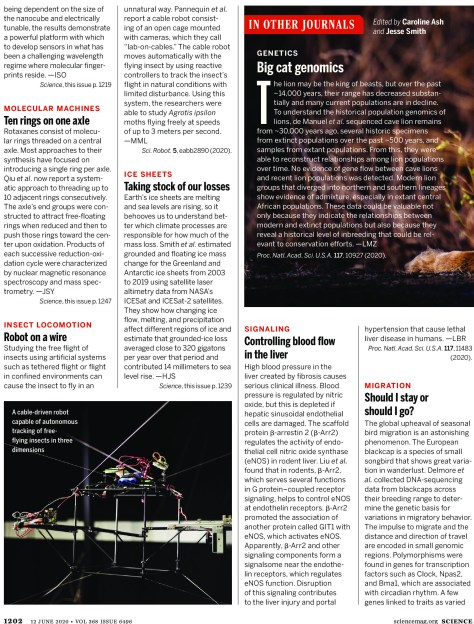
TOP JOURNALS: RESEARCH HIGHLIGHTS FROM SCIENCE MAGAZINE (JUNE 12, 2020)

Top New Science Podcasts: Quantum States In Space Lab, Barcode Bacteria
 This week, the spaceborne lab that allows investigation of quantum states, and the debate surrounding how mountain height is maintained.
In this episode:
01:18 Space lab
Scientists have built a lab on the international space station, allowing them to remotely investigate quantum phenomena in microgravity. Research Article: Aveline et al.; News and Views: Quantum matter orbits Earth
08:37 Research Highlights
Trackable ‘barcode’ bacteria, and physicists simulate near light speed cycling. Research Highlight: ‘Barcode’ microbes could help to trace goods — from lettuce to loafers; Research Highlight: What Einstein’s theory means for a cyclist moving at almost light speed
10:48 Maintaining mountain height
For a long time many researchers have thought that mainly erosion controls the height of mountains, but new research suggests that tectonic forces play a bigger role. Research Article: Dielforder et al.; News and Views: Mountain height might be controlled by tectonic force, rather than erosion
16:12 Pick of the Briefing
We pick our highlights from the Nature Briefing, including how sleep deprivation kills, and a monumental Maya structure hidden in plain sight. Quanta Magazine: Why Sleep Deprivation Kills; National…

“Politics Monday”: Tamara Keith And Amy Walter On Police Reform (PBS Video)
NPR’s Tamara Keith and Amy Walter of the Cook Political Report join Judy Woodruff to discuss the latest political news, including the pressure that mass public protests are putting on lawmakers to enact police reform, President Trump’s “law and order” strategy and whether it will energize his base and where former Vice President Joe Biden stands on changes to American law enforcement.

Global: Police Violence In America, China Trade & Pushkin’s Lockdown
A selection of three essential articles read aloud from the latest issue of The Economist. This week: Police violence, race and protest in America, How will China’s Belt and Road Initiative survive? (10:30) And, Alexander Pushkin’s productive lockdown (23:10).

Political News: “Shields & Brooks” Discuss Current Nationwide Protests (PBS)
Syndicated columnist Mark Shields and New York Times columnist David Brooks join Judy Woodruff to discuss the latest news, including public opinion of the nationwide protests over police treatment of black Americans, President Trump’s response and use of force to dispel protesters and the reaction of prominent military leaders to his handling of the situation.
Top New Science Podcasts: Higher Covid-19 Severity In Men, Bacteria Tracking
First up this week, Staff Writer Meredith Wadman talks with host Sarah Crespi about how male sex hormones may play a role in higher levels of severe coronavirus infections in men. New support for this idea comes from a study showing high levels of male pattern baldness in hospitalized COVID-19 patients.
Next, Jason Qian, a Ph.D. student in the systems biology department at Harvard Medical School, joins Sarah to talk about an object-tracking system that uses bacterial spores engineered with unique DNA barcodes. The inactivated spores can be sprayed on anything from lettuce, to wood, to sand and later be scraped off and read out using a CRISPR-based detection system. Spraying these DNA-based identifiers on such things as vegetables could help trace foodborne illnesses back to their source. Read a related commentary piece.

 Boomers Daily