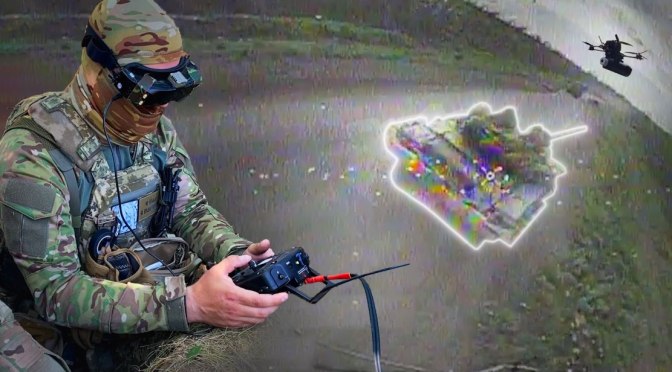
Wall Street Journal (July 27, 2023) – Since the Ukrainian counteroffensive against Russian forces began, there’s been a dramatic increase in Ukraine’s use of FPV, or first person view drones to execute kamikaze-style attacks on Russian tanks, troop positions and other large-scale weapons.
Video timeline:0:00 Increase in use of FPV drones 1:01 The kamikaze drone process 2:15 Destroying targets
The aim is to operate cheaply and to make the military less dependent on Western weapons. WSJ gathered dozens of videos from Ukrainian units on the frontlines, to break down how their drone teams execute these attacks on Russia’s military.
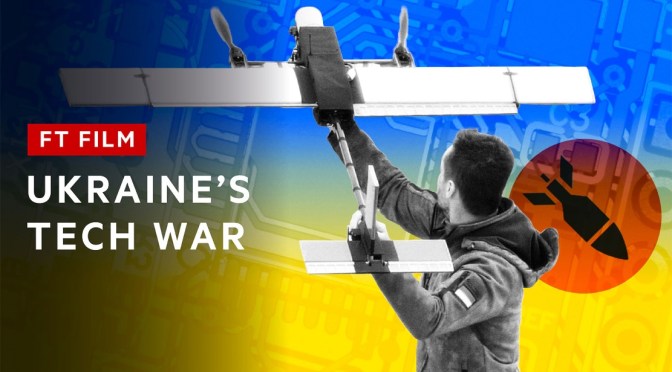
Financial Times (July 25, 2023) -From the production of cheap battlefield drones to AI-powered missile detection, Ukrainian tech start-ups, IT workers and volunteers have been developing military tech and putting themselves on the front line of the war effort
Video timeline:00:00 Ukraine’s tech war 00:39 The growing tech sector 01:28 The tech start-up: Respeecher and AI voice cloning 03:35 The miltech start-up: Zvook and AI missile detection 05:32 A digitally-focused country 08:00 A fully-fledged drone war 09:06 The drone start-up 11:17 Drones: the growth of the market 12:41 Why drones? 14:13 Drones and the women’s veteran movement 16:00 Ukrainian resilience 16:30 Air Alert! Ajax Systems 19:30 It’s not just about drones 20:12 The anti-drone gun: DroneUA 21:04 Who’s winning the tech war? 22:45 The army of robots 23:36 A new Israel? 24:46 The war has changed us
Wall Street Journal (June 3, 2023) – Ukrainian President Volodymyr Zelensky spoke with Wall Street Journal editor in chief Emma Tucker in Odesa ahead of his meeting with European leaders to press for membership in NATO and as the world waits for Ukraine’s counteroffensive against Russia.
Video timeline:0:00 Ukraine’s counteroffensive 0:50 Ukraine’s long-term security and Western allies 2:23 U.S. election’s effect on Ukraine 4:03 Ukrainian weapons 5:44 NATO and Ukraine 7:05 Zelensky’s thoughts on China 7:38 How Zelensky is personally dealing with the war
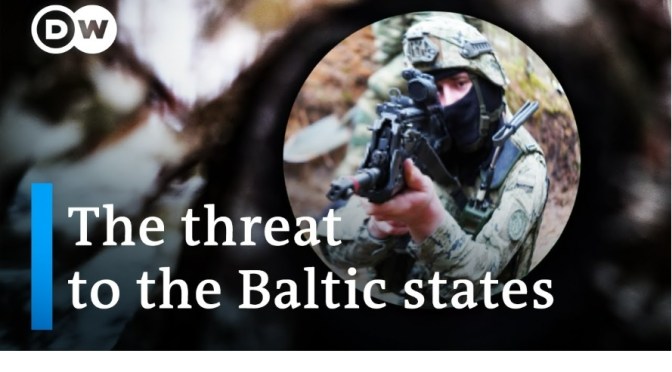
DW Documentary (May 28, 2023) – NATO members are viewing Russia’s war of aggression against Ukraine with grave concern, especially those on the alliance’s eastern flank. They’re joining forces with German troops right on the Russian border.
Germany is the leading or “framework nation” in what is called the NATO Battle Group Lithuania. With its alliance partners, German forces are serving “on the front line” – right on the Russian border. They’re guarding NATO’s northeast flank against any possible incursion and ensuring the Baltic states are supported during times of crisis and, if necessary, conflict.
In the spring of 2023, Germany’s military is in Rukla and Pabrade, among other places, for maneuvers. There it is practicing with NATO partners from Croatia, the Czechia and the Netherlands to handle a Russian attack on the Baltic states. In full agreement with the NATO motto “train as you fight,” practice and training are closely-oriented to a genuine threat.
The leader of the German contingent, Colonel Wolfgang Schmidt, points out the special historic significance and perceived peril in the Baltic. He says, “From historical experience, of course the perception of possible aggression – be it Russian or Belarusian – is far more intense here than in the Federal Republic of Germany.” He adds that not everyone has grasped the defense of “all that we stand for – modernity, freedom of opinion and speech and everything we describe as Western values begins here.” For a year, Schmidt says, the Ukraine has been fighting far more than their Russian attackers – they’re defending “our freedom,” too. This report follows a major exercise called “Griffin Lightning.” A platoon commander with the Dutch Armed Forces emphasizes the importance of maneuvers and cooperation among the multinational forces.
First Lieutenant Bent S. says, “We’re taking part in different exercises. Last week we were with the Norwegians. In a few weeks, the whole Battle Group will come together and we’ll train again with the Norwegians, Germans, Czechs and Croats. Nobody wants war, but if it really comes to it, we’ll be ready.” This documentary provides an exclusive look at NATO maneuvers in Lithuania, which are unfolding closer than ever before to a genuine military threat.
Wall Street Journal (May 23, 2023) – Ukraine is on the brink of launching its counteroffensive against Russia. Russia now occupies 17% of Ukrainian territory, a stretch of landmass roughly equivalent to the size of Iceland with 900 miles of frontline.
Video timeline:0:00 The stakes for the counteroffensive 0:53 The current Russia-Ukraine War situation 4:09 Ukraine’s counteroffensive scenarios 6:42 Potential results from the counteroffensive
Ukrainian troops’ current offensives have been limited to the Donbas region. WSJ spoke to retired Brigadier General Mark Kimmitt, who breaks down four likely scenarios that the Ukrainian forces might attempt to kick off their counteroffensive.
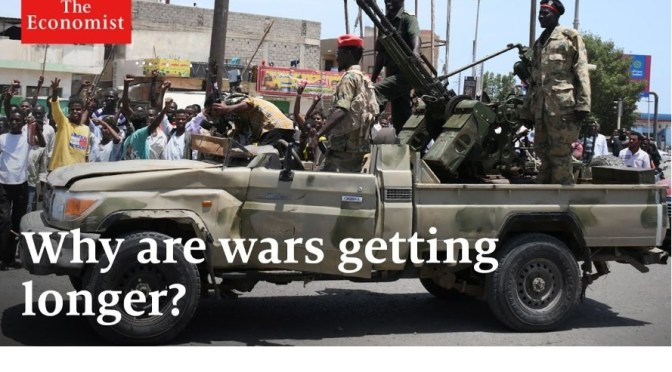
The Economist (April 18, 2023) – The outbreak of violence in Sudan isn’t an anomaly; the world’s civil wars are growing longer and deadlier. Robert Guest, The Economist’s deputy editor, explains why.
Video timeline:00:00 – Civil wars are getting longer 00:58 – Complexity 02:14 – Criminality 03:12 – Climate change 04:52 – The road to peace?
The Telegraph (March 29, 2023) – Following Russia’s invasion of Ukraine, Poland has been investing billions in new tanks, weaponry, cyber operations and manpower. By 2035 Poland hopes to double the size of its armed forces to 300,000 troops.
There is even talk of the country becoming a major military power in Europe. Watch The Telegraph’s Steven Edginton interview key members of the Polish military and politicians to understand why they are rearming. He also asked young Poles whether they are prepared to die for their country.
For Poland, investing in the military is no longer a luxury but a necessity. With conflict at their border (don’t forget that two Poles have already been casualties of this war, killed by a stray Ukrainian missile) Poland can no longer rely only on the United States and its Nato allies for protection.
Warsaw plans to increase military spending to 5% of its GDP, outspending its fellow European capitals relatively by a wide margin. Poland’s military expansion must be thought of within the context of the nation’s history. You don’t have to be a pensioner to remember a time when Poland was suffering under Communist rule.
Monuments to the Soviet oppressors litter cities like Warsaw, where one can wonder at Stalin’s “gift” to the Poles, the grand Palace of Culture, and despite the government’s best efforts to tear them down many statues still stand commemorating the Red Army as “liberators”.
“This is going to change the world as we know it.”
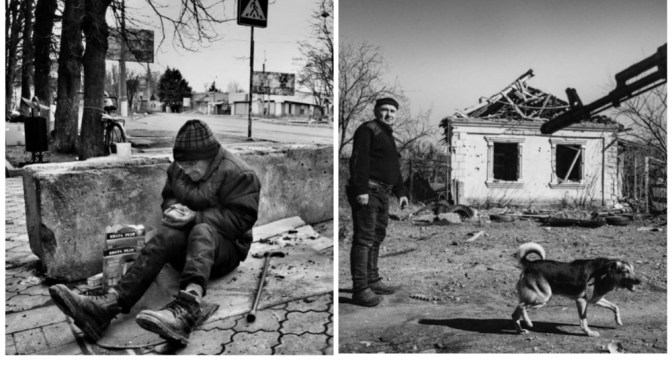
“The pictures are a documentation of the brutality within the conflict itself. It’s about civilians and civilian casualties because they are the ones hit the hardest. “
“The Russians are terrorizing the civilian population. They are hitting civilian infrastructure, may it be water, electricity, or heating. That brutality is extremely important to show. For me, it is about getting as close to these people as possible.”
Grarup is convinced that the ongoing war in Ukraine will mark the beginning of a new area that will isolate Russia from the Western World for generations to come: “I have been covering wars and conflicts for the last 35 years – just about every conflict you can imagine. In many ways, the brutality of the genocide in Rwanda in 1994 is second to none. But the war in Ukraine comes really, really close. It’s basically a country which is desiring democracy and freedom and independence – and because of that, its people are killed.”
Grarups also reflects upon his feelings covering the war, such as his general discomfort with silence as “you can be sure that something is about to happen.” On the other hand, he sees the necessity to document the war for future generations and the possible prosecution of war crimes. “What I like about black-and-white photography is its timelessness. We think in our part of the world that the world has changed, developed, and moved far away from what we have seen historically.
But the fact is: It hasn’t. It’s still the same atrocities. It’s still the same victims.” Jan Grarup was born in Denmark in 1968 and is today regarded as one of the leading and most experienced war photographers globally. Already in 1991, the year of his graduation, he won the prestigious Danish Press Photographer of the Year Award, a prize he would receive on several further occasions. In 1993, he moved to Berlin for a year, working as a freelance photographer for Danish newspapers and magazines. Afterwards, Grarup covered many wars and conflicts worldwide, including the Gulf War, the Rwandan genocide, the siege of Sarajevo and the Palestinian uprising against Israel in 2000.
His coverage of the conflict between Palestine and Israel led to two series: The Boys of Ramallah, which earned him the Pictures of the Year International World Understanding Award in 2002, followed by The Boys from Hebron. His book, Shadowland (2006), presents his work during the 12 years he spent in Kashmir, Sierra Leone, Chechnya, Rwanda, Kosovo, Slovakia, Ramallah, Hebron, Iraq, Iran, and Darfur. In the words of Foto8’s review, it is “intensely personal, deeply felt, and immaculately composed.”
His second book, Darfur: A Silent Genocide, was published in 2009. In 2017 he released the prizewinning bestseller And Then There Was Silence. He is currently working on a follow-up called While We Bleed with Danish author Adam Holm about the war in Ukraine. Jan Grarup has won numerous prizes for his dedicated work, for example eight World Press Awards, the Pictures of the Year International World Understanding Award, the UNICEF Children Photo of the Year Award, Visa d’Or, Leica Oskar Barnack Award, to mention a few of the more prestigious ones. Jan Grarup was interviewed by Marc-Christoph Wagner in Copenhagen, Denmark.
The interview took place at the Danish War Museum in March 2023 on the occasion of Grarup’s exhibition One Year With War. Camera: Jakob Solbakken Edited by: Helle Pagter Produced by: Marc-Christoph Wagner
The Economist (February 23, 2023): The invasion of Ukraine left Russians with a stark choice: carry on as normal or make a stand against the war. But speaking out in Russia carries huge risks. How is the opposition managing to resist the regime – and at what personal cost?
Video timeline:00:00 – One year on 01:37 – The first wave of protests 05:43 – Crackdown on dissent 10:04 – Individual acts of rebellion 13:51 – Partial mobilisation 16:20 – Russia’s mass exodus 23:06 – The future of Russian rebellion
News, Views and Reviews For The Intellectually Curious


 Financial Times


 The Economist (April 18, 2023) – The outbreak of violence in Sudan isn’t an anomaly; the world’s civil wars are growing longer and deadlier. Robert Guest, The Economist’s deputy editor, explains why.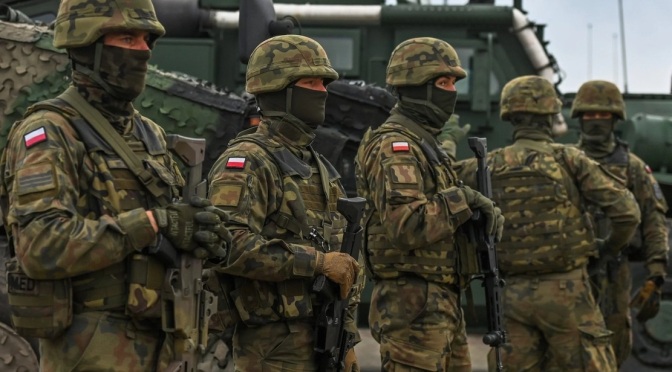




 Boomers Daily