Category Archives: Literature

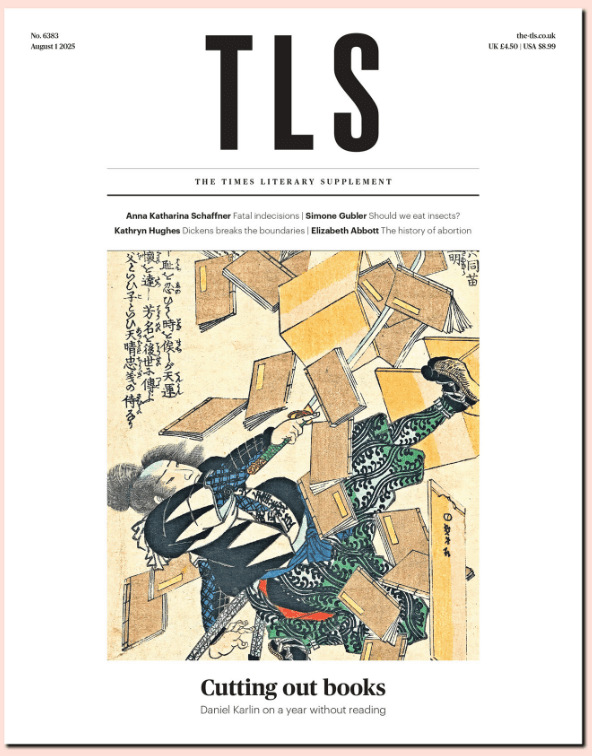
TIMES LITERARY SUPPLEMENT – AUGUST 1, 2025 PREVIEW

TIMES LITERARY SUPPLEMENT: The latest issue features Daniel Karlin about his twelve-month abstinence from the printed word. As one of his friends remarked, he must have been the first person to make a New Year’s resolution to read less.

Life beyond literature

A year without reading By Daniel Karlin

What lies ahead for fiction?

AI, literary theory and traditional storytelling By Benjamin Markovits

Maggots as meat

The ethics of industrial insect farming By Simone Gubler

A right to choose

Efforts to prohibit abortion down the ages By Elizabeth Abbott

Moby-Dick, Perpetual Inquiry, and the Sublime

By Intellicurean, July 25, 2025

“Call me Ishmael.”

This iconic first line anchors one of the most enduring openings in American literature. Yet before it is spoken, before Ishmael’s voice emerges on the page, we encounter something more unusual: a kind of literary invocation. The opening pages of Moby-Dick—those dense, eclectic “Extracts” quoting scripture, classical literature, scientific treatises, and forgotten travelogues—do not serve as a traditional preface. Instead, they operate like a ritual threshold. They ask us to enter the novel not as a narrative, but as a vast textual cosmos.

Melville’s fictional “sub-sub-librarian” gathers fragments from Job to Shakespeare to obscure whaling reports, assembling a chorus of voices that have, across centuries, spoken of the whale. This pre-narrative collage is more than ornamentation. It proposes a foundational idea: that the whale lives not only in the ocean, but in language. Not only in myth, but in memory. Not only in flesh, but in thought.

Before the Pequod ever sets sail, Melville has already charted his central course—into the ocean of human imagination, where the whale swims through texts, dreams, and questions that refuse easy resolution.


Proof of Two Lives

“There’s something I find strangely moving about the ‘Extracts’ section,” remarks literary critic Wyatt Mason on The World in Time, a podcast hosted by Lewis Lapham. “It’s proof of two kinds of life. The life of the creature itself, and the life of the mind—the attention we pay over time to this creature.”

Mason’s comment offers a keel for the voyage ahead. In Moby-Dick, the whale is not simply an animal or antagonist. It becomes a metaphysical magnet, a mirror for human understanding, a challenge to the limits of knowing. The “Extracts” and “Etymologies,” often dismissed as digressions, are in fact sacred rites—texts that beg to be read with reverence.

In teaching the novel to incarcerated students through the Bard Prison Initiative, Mason and fellow writer Donovan Hohn describe how these obscure, labyrinthine sections are received not as trivia but as scripture. The students descend into the archive as divers into a shipwreck—recovering fragments of forgotten wisdom, learning to breathe in the pressure of incomprehensibility. “The whale,” Mason repeats, “resides or lives in texts.” And what a library it is.


The Whale as Philosophy

“All my means are sane, my motive and my object mad.”

Harold Bloom, the late sage of literary criticism, would have nodded at Mason’s insight. For Bloom, Moby-Dick was not merely a novel, but “a giant Shakespearean prose poem.” Melville, he believed, was a tragedian of the American soul. Captain Ahab, mad with self-reliance, became for Bloom a Promethean figure—bound not by divine punishment, but by his own obsessive will.

In Bloom’s classroom at Yale in 2011, there were no lecture notes. He taught Moby-Dick like a jazz solo—improvised, living, drawn from a lifetime of memory and myth. “It’s very unfair,” he said, reflecting on the whale hunts—great mammals hunted with harpoons and lances. Yet the Pequod’s most moral man, Starbuck, is also its most proficient killer. A Quaker devoted to peace, he is also the ship’s deadliest lance. This contradiction—gentleness and violence braided together—is the essence of Melville’s philosophy.

The whale, in Bloom’s reading, is sublime not because it symbolizes any one thing—God, evil, justice, nature—but because it cannot be pinned down. It is an open question. An unending inquiry. A canvas for paradox. “Heaven help them all,” Bloom said of the Pequod’s doomed crew. “And us.”


Melville the Environmentalist

“There she blows! There she blows! A hump like a snow-hill! It is Moby Dick!”

Where Bloom heard Melville’s music in metaphor and myth, Richard J. King hears it in science. In Ahab’s Rolling Sea: A Natural History of Moby-Dick (2019), King charts a different map—overlaying Melville’s imagined ocean onto real tides, real whales, real voyages. He sails replica whalers, interviews marine biologists, pores over Melville’s notebooks.

His inquiry begins with a straightforward question: could a sperm whale really destroy a ship? Historical records suggest yes. But King doesn’t stop at anatomy. His portrait of Melville reveals a proto-environmentalist, someone who revered the sea not just as symbol but as system. Melville’s whale, King argues, is a creature of wonder and terror, not just prey but presence.

In an age of ecological crisis, King reframes Moby-Dick as a book not just of metaphor but of environmental ethics. Ishmael’s meandering digressions become meditations on the ocean as moral agent—an entity capable of sustaining and destroying. The sea is no backdrop; it is a character, a god, an intelligence. Melville’s ocean, King suggests, humbles the hubris of Ahab and calls readers to ecological humility.


Rediscovery in Dark Times

“Strike through the mask! How can the prisoner reach outside except by thrusting through the wall?”

Aaron Sachs, in Up From the Depths: Herman Melville, Lewis Mumford, and Rediscovery in Dark Times (2022), picks up the whale’s trail in the 20th century. In 1929, as the world plunged into the Great Depression, the writer and historian Lewis Mumford resurrected Melville from literary oblivion. His biography of the long-forgotten author recast Melville not as a failure, but as a visionary.

For Mumford, Melville was a kindred spirit—a man who, long before the term “modernity” took hold, had already seen its psychic cost. As Mumford watched the rise of industry, mass production, and spiritual exhaustion, he found in Melville a dark prophet. Ahab’s fury was not personal—it was civilizational.

Critics have praised Sachs’s biography as timely and thoughtful. Its thesis is clear: in times of disorientation, literature does more than reflect the world—it refracts it. It preserves vital truths, repurposing them when our present crises demand older insights.

In Sachs’s telling, Moby-Dick is not just a classic; it’s a living text. A lighthouse in the storm. A warning bell. A whale-shaped mirror reflecting our fears, failures, and persistent hope.


The Whale in the Classroom

“Ignorance is the parent of fear.”

The classroom, as Sachs and Mason both suggest, becomes a site of literary resurrection. In prison education programs, students discover themselves in the “Extracts”—not despite their difficulty, but because of it. The very act of grappling with Melville’s arcane references, strange structures, and encyclopedic digressions becomes an act of reclamation.

To teach Moby-Dick in a prison is to raise a sunken ship. Its sentences, like salvaged artifacts, reveal new meaning. Forgotten knowledge becomes fuel for rediscovery. Students, many of whom have been dismissed by society, see in Melville’s endless inquiry a validation of their own intelligence and complexity.

Harold Bloom taught Moby-Dick the same way. Every reading was new. No fixed script, only the swell of thought. He modeled Melville’s method: trust the reader, trust the text, trust the mystery.

The whale resists capture—literal and interpretive. It is not a symbol with a key, but a question without an answer. That resistance is what makes Moby-Dick enduring. It insists on being re-read. Re-thought. Re-discovered.


The Archive That Breathes

“It is not down in any map; true places never are.”

Taken together, the voices of Wyatt Mason, Harold Bloom, Richard J. King, and Aaron Sachs reveal Moby-Dick as something more than literature. It is a breathing archive—a repository of imagination, inquiry, and paradox.

Within its pages dwell theologies and taxonomies, drama and digression, sermons and sea shanties. It houses the ethical weight of ecology, the fury of Ahab, the wonder of Ishmael, and the ghosts of Melville’s century. It defies genre, resists reduction, and insists on complexity.

Melville did not write to close arguments but to open them. He did not believe in neat endings. His whale is the quintessential “true place”: uncapturable, immeasurable, endlessly sublime.

And yet we return. We keep hunting—not with harpoons, but with attention. With interpretation. With awe.


A Final Breach

What, then, do we do with Moby-Dick in the twenty-first century? How do we reconcile Ahab’s consuming fury with Ishmael’s contemplative awe? How do we carry Bloom’s Prometheus, King’s Leviathan, Sachs’s resurrected Melville, and Mason’s classroom in a single imagination?

We read. We reread. We become “sub-sub-librarians”—archivists of ambiguity, curators of complexity. We do not read Moby-Dick for closure. We read it to learn how to remain open—to contradiction, to paradox, to mystery.

But what if we, like Captain Ahab, set off to find Moby Dick and never found the whale?

What if all our intellectual harpoons missed their mark? What if the whale was never there to begin with—not as symbol, not as certainty, not as prize?

Would we call that failure?

Or might we discover, like Ishmael adrift on the coffin-raft, that survival is not about conquest, but endurance? That truth lives not in the kill, but in the quest?

Perhaps Melville’s greatest lesson is that the whale must never be caught. Its sublimity lies in its elusiveness—in its capacity to remain just beyond the reach of definition, control, and meaning. It breaches in metaphor. It disappears in digression. It waits—not to be captured, but to be considered.

We will never catch it. But we must keep following.

For in the following, we become something more than readers.
We become seekers.

THIS ESSAY WAS WRITTEN BY INTELLICUREAN UTILIZING AI

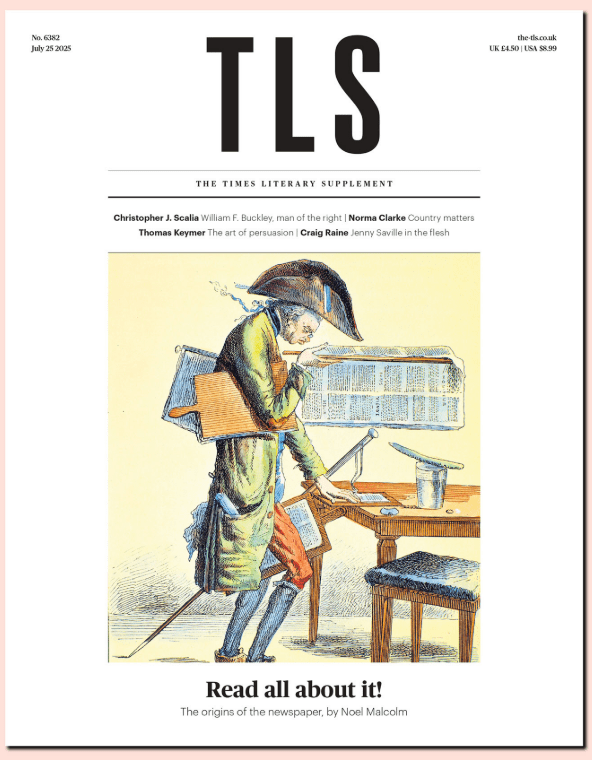
TIMES LITERARY SUPPLEMENT – JULY 25, 2025 PREVIEW

TIMES LITERARY SUPPLEMENT: The latest issue features All change is for the worse? Pessimists will find evidence in Joad Raymond Wren’s The Great Exchange: Making the news in early modern Europe, reviewed for the TLS by Noel Malcolm.

The news that was fit to print

Where newspapers came from By Noel Malcolm

Light of the right

A cultural conservative who paved the way for Ronald Reagan By Christopher J. Scalia

Through bushes and briars

Ancient rural skills in a modern world By Norma Clarke

Away from it all

Restfully contemplative holiday reading By Irina Dumitrescu

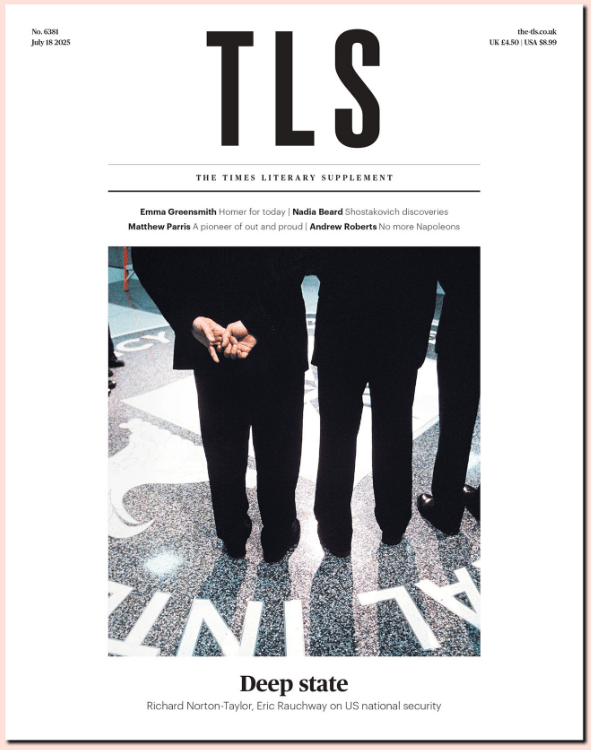
TIMES LITERARY SUPPLEMENT – JULY 18, 2025 PREVIEW

TIMES LITERARY SUPPLEMENT: The latest issue features Definitions of national security are elastic. After the Battle of Waterloo, the Duke of Wellington judged that the defence of the British homeland rested on two pillars – a strong Royal Navy and a European order “that kept Belgium beyond French control”.

Deep State vs Donald Trump

How accountable are US intelligence agencies to the president and Congress? By Richard Norton-Taylor

A stranger in his own land

Henry James’s return to the United States By Alicia Rix

The Invisible Shell

New light on ‘Captain’ Warner’s weapon of mass destruction By Trevor Pateman

Magical mutability

A poet for yesterday and today By Emma Greensmith

Literary Essay: “Infinite Interiors – On the Twenty Best Novels of All Time”

The following essay was written by ChatGPT and edited by Intellicurean from an article titled “The 20 best novels of all time” written by Claire Allfree and published in The Telegraph book section on July 6, 2025.

When a culture attempts to consecrate a definitive list of its greatest novels, it risks both an admirable arrogance and a kind of elegiac futility. The recent selection of The 20 Best Novels of All Time, published by The Telegraph, seems at once a celebration of the novel’s inexhaustible possibility and an implicit acknowledgment of our own waning capacity for reading with genuine urgency. It is as though we assemble these canons less to instruct our descendants than to reassure ourselves that we have not entirely forgotten how literature once moved the soul.

One cannot help but admire the breadth and seriousness of this catalogue. It stretches from the dreamlike elegance of The Tale of Genji—a work whose thousand-year distance intensifies its immediacy—to the compulsive self-dissection of Knausgaard’s My Struggle, a testament to our age’s faith that self-disclosure can substitute for narrative shape. What holds these disparate texts together is not merely their historical significance but their shared aspiration to render life in all its unmastered perplexity.

If Harold Bloom were to begin here, he might call attention to The Tale of Genji as an early demonstration of what he once termed the “internalization of romance.” It is a book that transcends its courtly gossip to become an inexhaustible study in desire’s transformations, a mirror to the reader’s own fluctuations of attachment and estrangement. We encounter Genji’s erotic restlessness as both scandalous and poignantly familiar, for the novel’s true subject is the incommensurability between longing and fulfillment—an incommensurability that modern fiction has inherited as its principal obsession.

James Wood, by contrast, might focus on Middlemarch as the novelistic apogee of moral realism. Eliot’s genius lay in her refusal to reduce her characters to mere emblems of ideology or historical process. Instead, she endowed them with what Wood has called “free indirect style’s psychic oscillation,” a prose capable of inhabiting and exposing consciousness in the same instant. It is a book that dares to be both panoramic and exquisitely local, to weigh the ambitions of a nation against the disappointments of a single marriage bed. If there is a single argument to be made for the continued relevance of the realist novel, it is that Middlemarch remains more acute about our interiority than any contemporary memoir.

And yet one cannot ignore how this list gestures toward the novel’s capacity for formal subversion. Ulysses, with its irreverent transformations of the Homeric epic into the trivial routines of Dublin, still feels scandalous in its abundance. Joyce’s genius is not only in his linguistic pyrotechnics but in his suspicion that consciousness itself can never be adequately represented. His prose, that shifting mosaic of styles and registers, offers no comfort to the reader who seeks transparency. Instead, it confronts us with the knowledge that the novel’s greatest power may reside in its refusal to cohere.

This refusal—to simplify, to console, to moralize—animates many of the twenty selections. Invisible Man is less a conventional narrative than a hallucinatory initiation into the American underworld of racial invisibility. Ellison’s rhetorical bravado, his blending of surrealism and jeremiad, still outpaces the efforts of more contemporary chroniclers of identity. To read Invisible Man today is to recognize how easily literary radicalism becomes cultural commonplace, but also to remember how singular its achievement remains.

Nor does the list shy from novels that embrace the uncanny. Bulgakov’s The Master and Margarita may be the most exuberant refutation of realist pieties ever composed. Its supernatural comedy is both a rebuke to Stalinist orthodoxy and a reminder that the imagination is an inherently seditious faculty. If much of the 20th-century novel sought to dismantle the illusions of bourgeois life, Bulgakov’s masterpiece demonstrates that irony and enchantment can be revolutionary forces.

Yet if Bloom were to caution us, he would do so against the temptation to read these novels exclusively as instruments of social critique. Literature endures precisely because it exceeds its momentary political applications. War and Peace is indeed an anatomy of the Napoleonic Wars, but it is more crucially a demonstration of how historical consciousness itself can become an object of artistic inquiry. Tolstoy’s genius was to discover that the novelist’s truest fidelity is not to facts but to the felt perplexity of lived experience.

It is striking how Robinson Crusoe stands at the inception of the English novel, bearing within it the seeds of many later contradictions. Defoe’s narrative is, on the surface, a hymn to industry and resourcefulness. But the same story—of a man claiming dominion over an island—also encodes the imperial impulse, the confidence that the world exists to be measured, catalogued, and possessed. What once seemed the purest adventure has become, to modern readers, an uneasy parable of conquest.

One also encounters here the severe naturalism of Thérèse Raquin, a work whose lurid determinism feels almost an affront to Victorian piety. Zola’s lovers are not tragic in any redemptive sense; they are specimens trapped in an experiment of their own appetites. And yet there is a perverse grandeur in the novel’s refusal to pretend that desire leads anywhere but into the pit.

New Grub Street too is a novel about entrapment—this time not by passion but by commerce. Gissing’s weary chronicling of literary London feels uncannily prophetic, as if he anticipated the rise of every ghostwritten bestseller and every writer forced to commodify a persona. What is most unsettling is that he offers no counterexample: no heroic idealist who transcends the marketplace, no unspoiled domain of “pure” art. In this sense, the book remains an indispensable autopsy of cultural production.

If Zola and Gissing reveal the suffocating material conditions of life, Moby-Dick reveals the existential abyss. No novel is more saturated with the terror of cosmic indifference. Melville’s prose—sometimes biblical, sometimes madcap—collapses the distance between metaphysics and anatomy, making the whale not merely an animal but an emblem of the universe’s mute resistance to comprehension. In Bloom’s phrase, it is the American epic that devours all interpretations, a text that renders the critic humble before its incommensurate ambition.

One finds a different kind of ambition in Party Going, where Henry Green distills modernist unease into something almost glacial. Its stranded revellers, imprisoned in their own frivolity while fog swallows the city below, seem to embody an entire civilization’s failure to apprehend its own decline. The novel is both slight in incident and inexhaustible in implication—a reminder that the modernist fascination with stasis can be as provocative as any narrative pyrotechnics.

Proust’s In Search of Lost Time remains the most exhaustive testimony to literature’s faith in consciousness as a world unto itself. No novel before or since has so patiently mapped the minute inflections of memory, the subtle humiliations and triumphs of social life. It is a book that tests the limits of our attention but also rewards it with an intimacy that becomes, paradoxically, universal.

The Great Gatsby, meanwhile, retains its status as a parable of aspiration’s inevitable corrosion. Fitzgerald’s sentences are so lapidary that their loveliness can almost distract from the novel’s acrid judgment. Gatsby’s dream—at once romantic and predatory—has become the template for American self-mythology. That the dream collapses under the weight of its illusions is precisely what grants it the force of prophecy.

It is striking, too, how many of these novels seek to articulate the experience of cultures in collision. Things Fall Apart is the most lucid demonstration of Achebe’s conviction that narrative authority must be reclaimed by those whom empire has consigned to silence. Okonkwo’s tragedy is not only that he fails to adapt but that his story has been written over by the conqueror’s language. Achebe’s triumph is to create a form that both inhabits and transforms that language.

Closer to our own era, The Country Girls quietly ignited a literary insurrection. O’Brien’s candid portrayal of female desire and disillusionment, so scandalous in 1960s Ireland, now seems almost decorous in its gentleness. Yet its influence remains incalculable. It taught a generation of writers that the domestic could be radical, that the most private confessions might unsettle entire cultures.

No less ambitious, though in a different register, is The Golden Notebook. Lessing’s formal fragmentation enacts the very psychic disintegration it describes. Anna Wulf’s notebooks—political, personal, artistic—refuse to reconcile into any coherent identity. In this refusal, Lessing anticipates the confessional experiments of Knausgaard and the autofiction that now dominates so much literary discourse.

The Rings of Saturn, by W.G. Sebald, is a late testament to literature’s capacity to hover between genres—memoir, travelogue, essay—and to become, in that ambiguity, something more resonant than any of them alone. Sebald’s melancholy is not performative but almost geological: the sorrow of civilizations grinding into dust, of memory dissolving into rumor.

If Sebald writes out of mourning, Knausgaard writes out of a hunger so relentless it often seems pathological. My Struggle is both monument and provocation: an assertion that the granular details of ordinary life deserve the same attention Proust once gave to aristocratic salons. Whether this is a triumph of honesty or a capitulation to narcissism is a question the reader must answer alone.

And then there is Conversations with Friends, whose subdued prose and emotional diffidence reflect an era uneasy with grandeur. Rooney’s novel is not so much plotted as observed: a record of glancing attachments, tentative betrayals, and the provisional negotiations of millennial intimacy. Some will dismiss it as slight, but its cool detachment has a disquieting relevance. It suggests that the novel no longer needs epic ambition to be significant; it need only be exact.


A Closing Reflection

Surveying these twenty novels, we see not a single tradition but a plurality of experiments—each one extending the novel’s reach. To read them is to join a conversation that has never ended, in which each new book answers its predecessors with admiration, dissent, or surpassing ambition. Perhaps that is the most heartening lesson: that literature, in all its contradictions, remains the most durable form we possess for contemplating the inexhaustible strangeness of being alive.

A LIST OF THE BOOKS FROM THE ESSAY AND REVIEW IS BELOW:

  1. The Tale of Genji (1021) – Murasaki Shikibu
    Often called the first novel ever written, this thousand-year-old Japanese masterpiece recounts the romantic adventures of Prince Genji and the inner lives of the women he pursues, offering an exquisite portrayal of courtly love and social intrigue.
  2. The Pilgrim’s Progress (1678) – John Bunyan
    A religious allegory composed in prison, telling the story of Christian’s perilous journey to the Celestial City. Simultaneously quest narrative, moral parable, and spiritual confession, it became one of English literature’s most influential texts.
  3. Robinson Crusoe (1719) – Daniel Defoe
    A castaway narrative presented as a true account, blending adventure and colonial ideology. Crusoe’s survival on an island and mastery over his domain has sparked both admiration and fierce debates over its imperialist assumptions.
  4. Moby-Dick (1851) – Herman Melville
    Captain Ahab’s vengeful pursuit of the white whale becomes an existential epic exploring obsession, fate, and humanity’s place in the cosmos. Famous for its lyrical prose and encyclopedic digressions on whales and whaling.
  5. Thérèse Raquin (1867) – Émile Zola
    A grim study of adultery and guilt, depicting the murderous passion between Thérèse and her lover, Laurent. Their crime leads to psychological disintegration and ghostly hauntings in this early work of French naturalism.
  6. War and Peace (1867) – Leo Tolstoy
    Tolstoy’s sprawling saga of Russian aristocrats during the Napoleonic Wars interweaves personal transformation with sweeping history, offering a masterful portrait of love, fate, and the forces that shape nations.
  7. Middlemarch (1871) – George Eliot
    Set in a provincial English town, this realist masterpiece follows the intellectual and emotional struggles of Dorothea Brooke and other characters as they confront marriage, ambition, and disappointment.
  8. New Grub Street (1891) – George Gissing
    An unflinching look at the late-Victorian literary marketplace, chronicling the rivalry between idealistic writers and pragmatic hacks, and exploring the compromises required to survive as a professional author.
  9. Ulysses (1922) – James Joyce
    A modernist reimagining of Homer’s Odyssey, set over a single day in Dublin. Famous for its stream-of-consciousness style, linguistic experimentation, and celebration of ordinary life’s hidden richness.
  10. In Search of Lost Time (1913–1927) – Marcel Proust
    A monumental seven-volume exploration of memory, time, and desire, chronicling the narrator’s life and the decline of French aristocracy with lush psychological and social detail.
  11. The Great Gatsby (1925) – F. Scott Fitzgerald
    A glittering tragedy of the Jazz Age, centering on the mysterious Jay Gatsby’s doomed pursuit of wealth and love, and exposing the hollowness of the American Dream.
  12. Party Going (1939) – Henry Green
    A surreal, modernist novel about a group of privileged young people stranded in a railway hotel, whose trivial gossip masks a pervasive sense of dread as Europe hovers on the brink of war.
  13. Invisible Man (1952) – Ralph Ellison
    An unnamed Black narrator journeys through racism and disillusionment in America, blending surreal episodes, biting satire, and profound reflections on identity and invisibility.
  14. Things Fall Apart (1958) – Chinua Achebe
    Set in a 19th-century Igbo village, this landmark postcolonial novel traces the cultural collision between indigenous African traditions and British missionaries, through the tragic story of Okonkwo.
  15. The Country Girls (1960) – Edna O’Brien
    The coming-of-age story of two Irish girls escaping their repressive Catholic upbringing, whose quest for independence transformed Irish literature and scandalized conservative audiences.
  16. The Golden Notebook (1962) – Doris Lessing
    An ambitious, formally fragmented narrative about a woman writer dividing her life into separate notebooks—political, personal, creative—and attempting to reconcile them during a breakdown.
  17. The Master and Margarita (1966) – Mikhail Bulgakov
    A satirical fantasy in which the Devil arrives in Stalinist Moscow with a retinue that includes a giant talking cat, exposing the absurdity and cruelty of totalitarian society.
  18. The Rings of Saturn (1995) – W.G. Sebald
    A genre-defying meditation combining travelogue, memoir, history, and philosophy, as a narrator’s walk along the English coast sparks digressions on decay, memory, and loss.
  19. My Struggle (2009–2011) – Karl Ove Knausgaard
    A six-volume autofiction epic chronicling the author’s life in exhaustive detail, from childhood to fatherhood, redefining confessional writing and stirring controversy over privacy and truth.
  20. Conversations with Friends (2017) – Sally Rooney
    A millennial love story about a young Dublin student entangled in an affair with an older married man, written in Rooney’s lucid, understated style that captures the textures of contemporary intimacy.

THE BRUSSELS REVIEW – SUMMER 2025 PREVIEW

THE BRUSSELS REVIEW (June 15, 2025): The Summer 2025 issue of The Brussels Review offers a captivating blend of fiction, nonfiction, and poetry, showcasing diverse voices and narratives. On its evocative cover, Ximena Maldonado Sánchez’s vibrant artwork, Terracotta, beautifully sets the tone for a collection defined by profound emotional depth and artistic exploration. You can also read a review of her work or listen to her journey in our new podcast: Call To The Editor on Spotify.

The issue opens with Sonnet Mondal’s poetic reflections, drawing readers into nuanced meditations on memory, loss, and heritage. His pieces, including “Fragments of Life,” “The Biscuit Factory,” “The Bridge at Midnight,” and “Grandpa’s Veranda,” evoke a poignant sense of nostalgia and the passage of time.

In nonfiction, Gaye Brown’s introspective essay “Some Gifts” elegantly probes the complex nature of generosity, intertwining personal anecdotes with thoughtful philosophical insights. Similarly, Sue Tong’s “Father in the Photograph” and Gina Elia’s “Show and Tell” offer deeply personal explorations that resonate universally, inviting readers to reflect on their own histories and relationships.

The fiction selection is particularly compelling, headlined by Patrick ten Brink’s imaginative and thought-provoking “The Word Thief.” Brink masterfully blends elements of mystery and fantasy to craft a tale that explores the profound power of language and memory. Beatriz Seelaender’s “Motion Picture Sickness” adds a clever and satirical dimension, examining fame, identity, and morality through the lens of contemporary pop culture with sharp humor and keen observations.

Louis Kummerer’s intriguingly titled “A Founding Father’s Guide to Contingency Planning” provides both historical nuance and sharp social commentary, while Charles Wilkinson’s “Hayden in March” and Danila Botha’s “Like Freedom or Fear” explore psychological landscapes with acute sensitivity and emotional authenticity.

The New York Review Of Books – April 24, 2025

THE NEW YORK REVIEW OF BOOKS (April 3, 2025): The latest issue features ‘Spring Books’….

Charting an Unheroic Past

With her densely textured, ambitious, and deeply collaborative scholarship, the historian Catherine Hall has transformed public discourse about slavery.

Lucky Valley: Edward Long and the History of Racial Capitalism by Catherine Hall

The 176-Year Argument

At the University of Chicago all they wanted to know was, What’s the theory? At Yale all they wanted to know was, What’s the technique? At City College of New York all they wanted to know was, How does this relate to real life?

Lunar Myths and Mysteries

Two new books explore our growing scientific understanding of the moon as well as its powerful appeal to the imagination.

Lunar: A History of the Moon in Myths, Maps, and Matter edited by Matthew Shindell, with a foreword by Dava Sobel

Our Moon: How Earth’s Celestial Companion Transformed the Planet, Guided Evolution, and Made Us Who We Are by Rebecca Boyle

The London Magazine – April/May 2025 Preview

THE LONDON MAGAZINE (April 2, 2025): The latest issue takes the city as its muse:

Joshua Mehigan finds poetic inspiration at a petrol station stop, on the way back from Atlantic City

Kasra Lang and Sara Ahmad explore London and its residents who are marginalised or ignored

Paul Stephenson goes to Paris and attempts to ‘exhaust a place’ à la Georges Perec

Gráinne O’Hare’s fiction takes us to Belfast, a city scarred by the effects of generational trauma

Times Literary Supplement – April 4, 2025 Preview

TIMES LITERARY SUPPLEMENT (April 2, 2025): The latest issue features ‘Art and Lifestyle’ – On visual culture in the era of AI…

A bad business

Recalculating the economic gains of slavery By Padraic X. Scanlan

Raging bull

Rejecting the narrative of Picasso the monster to women By Lisa Hilton

Rebirth of the modern

The future of art and artists in the era of artificial intelligence By Aaron Peck

Writer, lawyer, banker, cleaner

Chimamanda Ngozi Adichie’s tale of four women – and many social ills By Houman Barekat

Literature: The Paris Review – Spring 2025

THE PARIS REVIEW (MARCH 18, 2025): The Spring 2025 issue features

Ludmilla Petrushevskaya on the Art of Fiction: “Don’t you know my life story by now? I don’t experience fear.”

Margo Jefferson on the Art of Criticism: “I’m a lousy reporter. If I’m not interested in the person—and sometimes you’re not if you’re just on assignment for a magazine—I’ll think, Well, why aren’t you interviewing me?”

Prose by Amie Barrodale, A. M. Homes, Marie NDiaye, Domenico Starnone, Miriam Toews, and Zheng Zhi.

Poetry by Abigail Dembo, Nora Fulton, Susan Howe, D. A. Powell, Nasser Rabah, Edward Salem, and Nanna Storr-Hansen.

Art by Em Kettner, Agosto Machado, and Lady Shalamar Montague; cover by Anna Weyant.