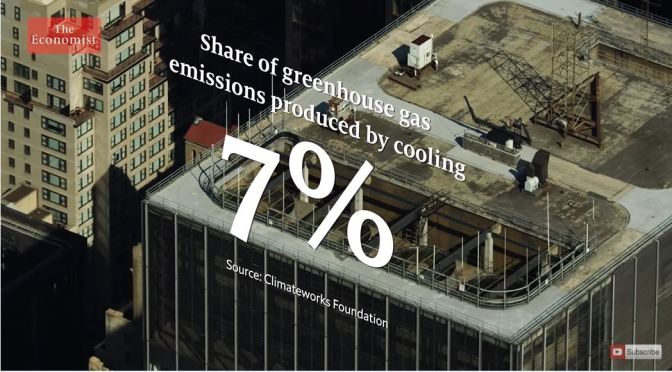
The warmer it gets, the more people use air conditioning—but the more people use air conditioning, the warmer it gets. Is there any way out of this trap?
Video timeline: 00:00: What’s the cooling conundrum? 01:05: The pros and cons of AC 03:28: How to reinvent air conditioning 05:02: Can buildings be redesigned to keep cool? 07:30: Scalable, affordable cooling solutions 10:24: Policy interventions for cooling
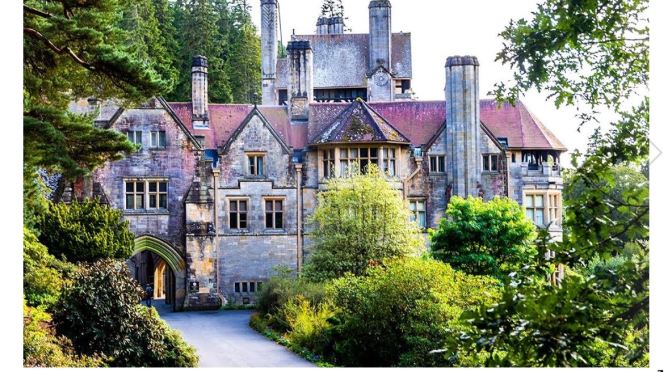
The first house in the world to be lit by hydroelectricity and full of Victorian gadgets and innovations, Cragside in Northumberland has always been at the forefront of modern living.
But now, climate change has started to catch up with this pioneering place. More frequent and intense rainfall is overwhelming the house’s drainage system and beginning to find its way inside of the Arts and Crafts mansion. Most affected is the drawing room with its immense, two-story high, ornately carved marble fireplace.
Rainwater is pushing salts that are in the stonework of the house through to the decorative marble and plasterwork of fireplace inside, causing its surface to deteriorate, meaning urgent work is needed to save this irreplaceable piece of architecture from crumbling away.
A two-stage project is currently underway to stabilise and future-proof the fireplace against climate-change, conserving it for future generations. As conservation work continues, Cragside is once again looking to the future – this time by looking to its past. Originally built by architect Lord Armstrong and his wife Lady Margaret, this pair of innovators created Britain’s original smart home when Cragside became the first house in the world to be illuminated by hydroelectricity, generated by its man-made lakes.
A project in 2014 gave the estate the ability to yield enough energy from water to light the whole house by installing an Archimedes Screw, which works at an angle and allows water to pass between the Tumbleton Lake and the burn below. This converts the power of the water flowing through it into electricity, a never-ending source that now illuminates the whole house and sends excess power back to the National Grid. Watch this video to discover more.
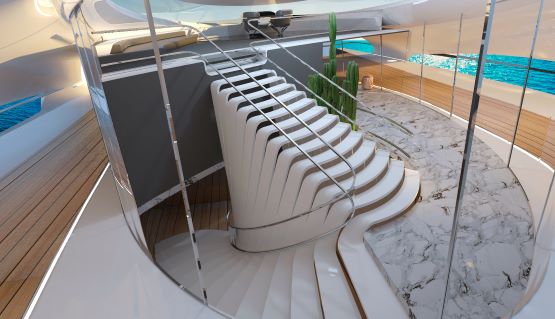
Migma is the greek word for mixture, an evocation to the life of the sea through structural bionic elements where the rationality of the technique is mixed with the fluidity of nature, represented by this noiseless Hydrogen-powered 180 feet electric Catamaran as a living entity that furrows the seas with zero emissions.
Migma catamaran is based on a minimalist and high-end aesthetic, creating a new way to understand spaces within a catamaran, where the core structure is located in the middle and all elements grow from it.
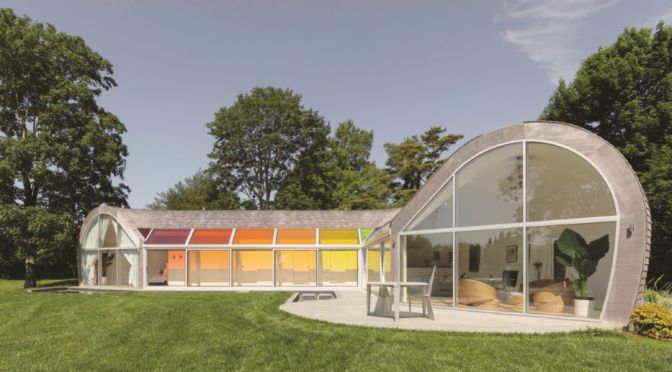
After earning her doctorate at the Oslo School of Architecture and Design and working in Norway’s capital as a teacher and research fellow, architect Nina Edwards Anker came home to the U.S. with a refreshed perspective on environmental sensitivity. When the opportunity arose to build an eco-cottage on family land in Southampton, Long Island, Edwards Anker’s thought experiments resulted in a 1,738-square-foot vacation home completed in 2017, made striking for the combination of curved, shingle-clad walls that meet planes of glass, with some cast in bright, unexpected color.
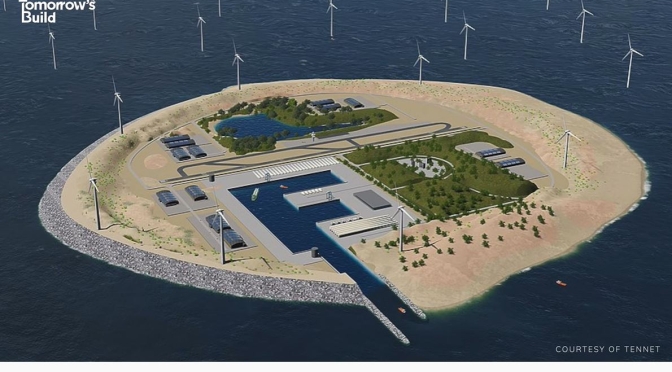
The energy islands and the wind farms with a combined capacity of 5 GW are expected to be commissioned by 2030.
The North Sea energy island will have an initial capacity of 3 GW which could potentially be further scaled up to 10 GW offshore wind. This will be an artificial island.
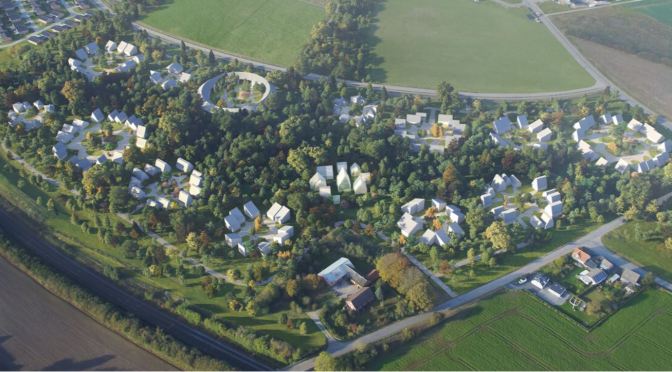
Copenhagen-based studio EFFEKT has presented plans for a residential development that forms part of its contribution to the upcoming venice architecture biennale. titled ‘naturbyen’, a name that translates as ‘nature village’, the project will see a field in denmark transformed into a completely new forest-neighborhood district comprising more than 200 homes. the development seeks to demonstrate how sustainable housing development can be combined with ambitious afforestation, increased biodiversity, and circular resource thinking. ‘as humanity is facing its greatest challenge ever with the imminent threat of climate change, habitat loss and depletion of natural resources — not to mention the ongoing pandemic — we need to rethink the way we live together on this planet. not only as humans, but across all species and ecosystems,’ EFFEKT tells designboom, discussing how the project responds to the biennale’s theme — ‘how will we live together?’. Responding to denmark’s goal of covering 20% of its landmass with forest by 2100, EFFEKT developed the project in collaboration with the town of middelfart. the site, currently an agricultural field, will be densely planted with a mix of native tree seedlings — an approach based on interviews and insight from industry experts, anders busse nielsen and björn wiström. ‘with a project like ‘naturbyen’ we try to address the growing need for more housing while also restoring natural habitats in close proximity to our cities, increasing biodiversity and through afforestation sequester carbon over time,’ EFFEKT explains.
Basalt Architects has used marine-grade concrete to build Guðlaug Baths, a geothermal pool on Langisandur Beach in Iceland. The baths consist of a three-tiered structure, with a viewing deck on the top, a warm geothermal pool in the middle, and a cold-water pool at the bottom.
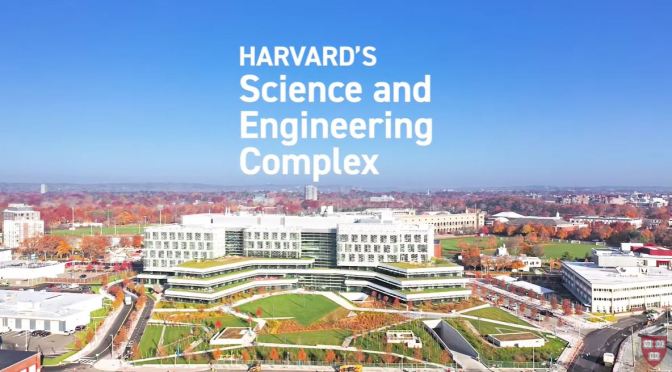
Harvard’s much-anticipated Science and Engineering Complex (SEC) in Allston is complete. The SEC is home to a portion of Harvard’s John A. Paulson School of Engineering and Applied Sciences (SEAS). Labs are setting up (some are already operational), furniture has been moved in, and offices are being transitioned. Assuming continued progress in controlling the virus, it will be open to students in the Fall of 2021. Join us for a look inside the new SEC – one of the most innovative, healthiest and energy-efficient buildings in the world!
Norrbotten in Sweden is blessed with natural resources but more recently has been turning heads because of its growing roster of innovative start-ups. We bear witness to the region’s effort to change heavy industries into clean businesses.
Norrbotten County is the northernmost county or län of Sweden. It is also the largest county by land area, almost a quarter of Sweden’s total area.
News, Views and Reviews For The Intellectually Curious









 Boomers Daily