
Category Archives: Climate Change

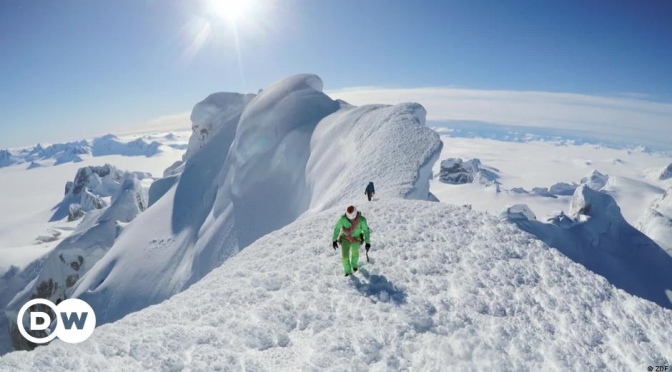
Climate Research: The ‘Ice Fields’ Of Patagonia, Chile

DW Documentary (March 4, 2024): Patagonia’s icefields are very difficult to access. As a result, they remain largely unexplored by climate researchers. Now, a scientist and two extreme mountaineers are venturing into this hard-to-reach area, in search of new data for climate research.

Even after 15 years of research in Chile, scientist Tobias Sauter says that for him, many questions remain unanswered. To clarify them, he decides to venture into areas that are difficult to access. The mountaineers Robert Jasper and Jörn Heller agree to help – and put themselves in great danger in the process. The two icefields in the Patagonian Andes, which stretch across the borders of Chile and Argentina, represent the largest ice mass outside the polar ice caps.

However, as a result of climate change, the ice here is losing mass. In some areas, the icefields are losing up to 20 meters in height per year. Little is known about these dramatic developments and their specific causes. The ice field to the north in particular has so far mainly been studied using satellite-based data. The area’s extreme weather conditions and great remoteness make field research on site a challenge. Tobias Sauter from Humboldt University in Berlin is one of the few researchers to take on this challenge.

#documentary #dwdocumentary

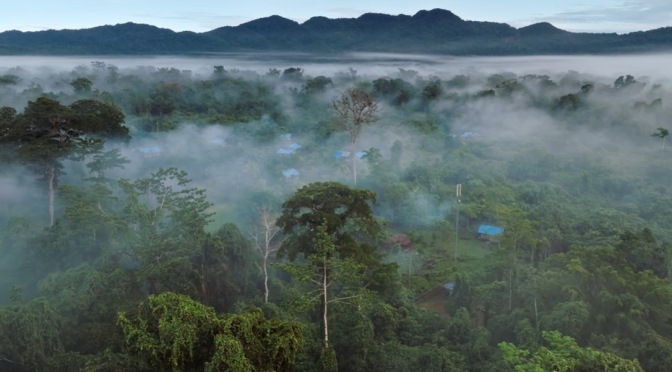
Sustainability: Forests On Papua Island In Indonesia

Cornell Lab of Ornithology (December 3, 2023) – Papua, Indonesia’s easternmost province, encompasses the western half of New Guinea and several other islands. An area of cultural and biological diversity, its rainforests and mountains are inhabited by indigenous Melanesian tribes and diverse wildlife including tree kangaroos and birds of paradise. Whale sharks swim amid the hard coral gardens of Cenderawasih Bay National Park, a dive site off the north coast. 

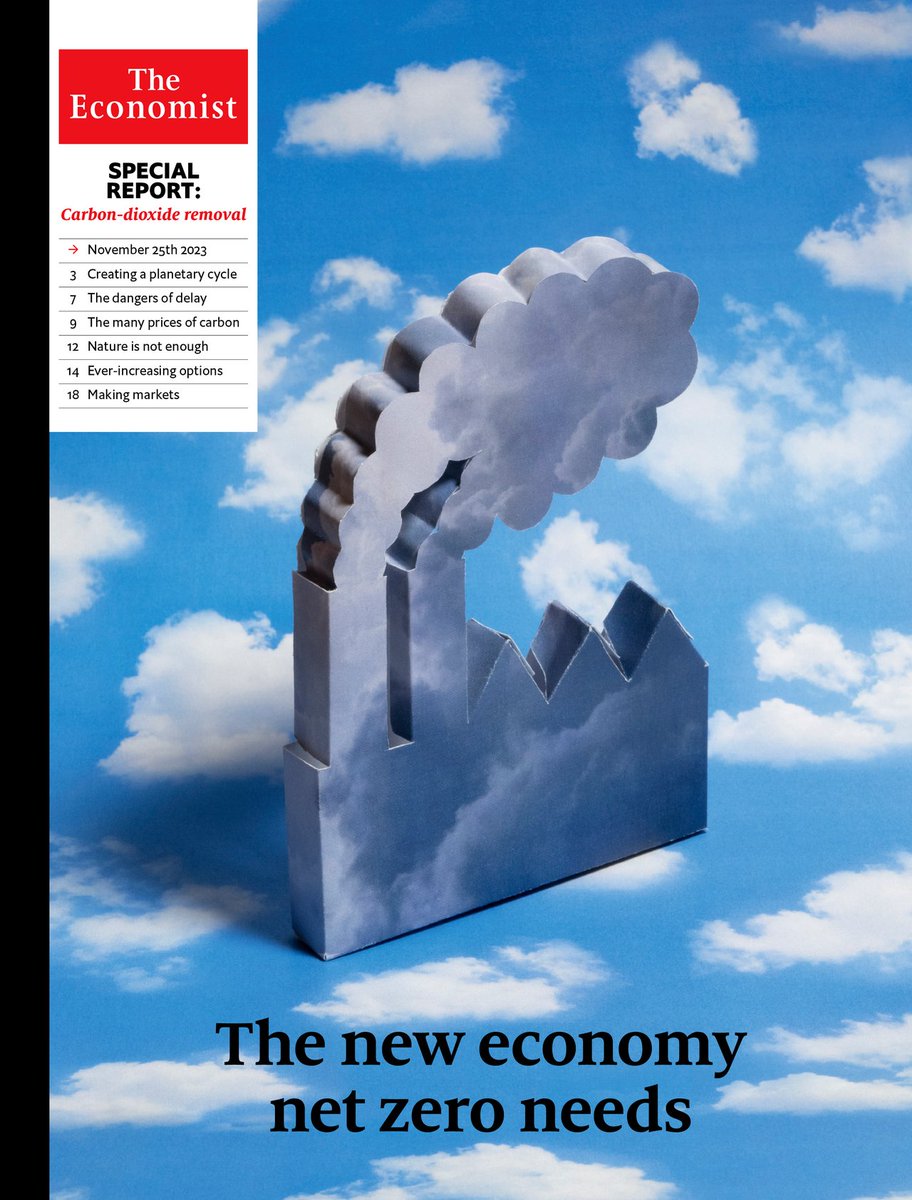
Special Report: ‘Carbon Dioxide Removal’ (NOV ’23)

Image

The Economist SPECIAL REPORTS – CARBON DIOXIDE REMOVAL (NOVEMBER 25, 2023): The new economy net zero needs – It is vital to climate stabilization, remarkably challenging and systematically ignored.

Carbon-dioxide removal needs more attention

It is vital to climate stabilisation, remarkably challenging and systematically ignored

St Augustine’s climate policy

The temptations of deferred removals

Carbon dioxide removals must start at scale sooner than people think

On the other hand…

The many prices of carbon dioxide

Not all tonnes are created equal

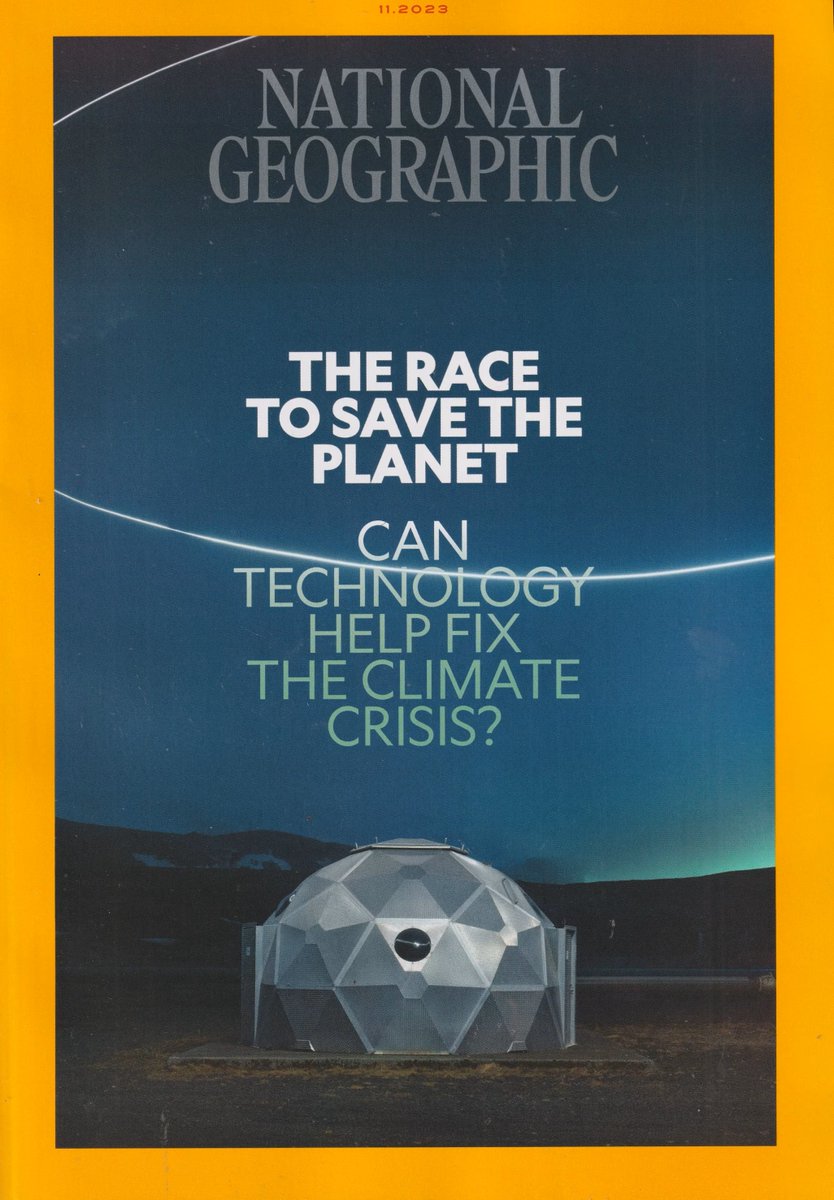
NATIONAL GEOGRAPHIC MAGAZINE – NOVEMBER 2023

Image

National Geographic (NOVEMBER 2023) – The latest issue features The race to capture carbon – Any climate solutions strategy requires the removal of carbon from the atmosphere. Here are 12 of the most promising strategies; What flashy feathers reveal about the secret lives of birds, and more…


Another weapon to fight climate change? Put carbon back where we found it

Diver in wetsuit next to free-floating experimental enclosures.

Getting to zero carbon emissions won’t save the world. We’ll have to also remove carbon from the air—a massive undertaking unlike anything we’ve ever done.

BY SAM HOWE VERHOVEK

Over the past few centuries, we have dug, chopped, burned, drilled, pumped, stripped, forged, flared, lit, launched, driven, and flown our way to adding 2.4 trillion metric tons of carbon dioxide to Earth’s atmosphere.

That’s as much CO2 as would be emitted annually by 522 billion cars, or 65 cars per person living today.

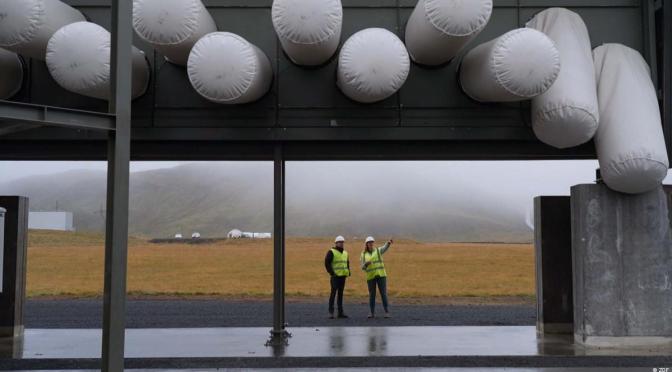
On a lonely, lunar-like valley 20 miles outside of Reykjavík, Iceland, Edda Aradóttir is on a mission to put it back where it came from.

What these flashy feathers reveal about the secret lives of birds

Shimmery. Spiky. Shaggy. Soft. Feathers are what make birds so alluring—but these photographs remind us that they also tell a story about the science of evolution.

BY ANNIE ROTH

PHOTOGRAPHS BY HEIDI AND HANS-JÜRGEN KOCH

In 1860 Charles Darwin wrote, “The sight of a feather in a peacock’s tail, whenever I gaze at it, makes me sick!” The plumes were so extravagant, he surmised, they could be a hindrance to survival. Darwin’s frustration with their seemingly inexplicable elegance eventually led him to the idea of sexual selection. Although this form of natural selection—driven by the preference of one sex for certain characteristics in individuals of the other sex—is well understood today, a peacock’s feather can still hold mystery for its viewers, says Heidi Koch. She and her husband, Hans-Jürgen, have spent the past few years photographing feathers in all their glorious detail.

Although both sexes of the gray peacock pheasant have back and tail feathers adorned with brilliant eyespots, the males make the best use of them. During elaborate wooing rituals, they raise and fluff up their feathers—which can reach nearly 16 inches in length—putting..

Climate Change: Can Cities Be Sustainable Solutions?

DW Documentary (September 9, 2023) – The race against climate change is in full swing. Can cities be a solution? The UN says that by the year 2050, some 70 per cent of all people will be urban dwellers. But how can cities sustainably accommodate as many people as possible and still offer a good quality of life?

“Urban living must save the planet!” says Xuemei Bai, an Australian professor for sustainability research. But is it really possible to live more sustainably in the city than in the countryside? What about the suburbs? “The suburbs are a climate killer,” says climate economist Gernot Wagner. In the classic suburb – large plots of land with detached or semi-detached properties – CO2 emissions are two to three times as high as in city centers or rural areas. So, why are cities so crucial for the climate?

The answer is simple: Because they are growing exponentially. The UN says that by the year 2050, more than two thirds of the world’s population will be living in cities. Density is one reason cities have so much potential. In a city, measures such as home redevelopments or electric bus routes impact far more people than they would in rural areas.

So, should we all live in megacities to save the Earth? In Europe, many people are turning their backs on urban life in favor of a home in the suburbs or the countryside. So what should the cities of the future look like, if they are to sustainably accommodate as many people as possible while still offering a good quality of life? After all, skyscrapers aren’t necessarily a good choice. Urban planner Dita Leyh compares a city of high-rise buildings with an asparagus field: “They’re like asparagus tips everywhere.

The spaces in between aren’t really useable. That’s not an interesting public space,” she says. So, what should a city look like then? There’s no single blueprint, because every city has its own challenges, as well as different climactic and social conditions. Can cities really save us? #documentary #dwdocumentary

Climate Change: A Review Of High-Tech Solutions

DW Documentary (June 13, 2023) – Can high-tech solutions help protect the climate? What would be the side effects of further human intervention in nature?

Attempts are being made to reduce the CO2 in the atmosphere with technical solutions. For example, new carbon capture technology that can extract CO2 from air and water, even if the amount currently captured is minimal and not enough to prevent the climate crisis and its consequences. Still, there is no shortage of ideas. Adding basalt rock dust to agricultural fields not only binds carbon dioxide but keeps the soil fertile.

Biochar, made from organic waste, has a similar effect. Some ideas are bolder: A protective screen of particles in the upper layers of the atmosphere could filter sunlight, as seen with the eruption of the Pinatubo volcano in the Philippines in 1991. The millions of tons of sulfur dioxide spewed into the stratosphere cooled the earth significantly.

Theoretically, aircraft could be used to deliver the particles. But experts warn that the consequences for humans and the weather would be felt worldwide and could never be fully controlled.

#documentary #dwdocumentary #climatechange

Environment: The Grand Canyon Is Losing Its River

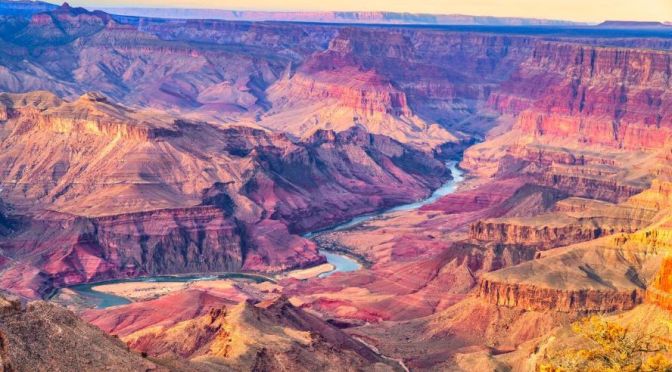
Long shadows are in the foreground of a view of the reddish canyon walls, which loom on either side and ahead. The sky is blue with ribbed white clouds.

The New York Times (June 6, 2023) – Down beneath the tourist lodges and shops selling keychains and incense, past windswept arroyos and brown valleys speckled with agave, juniper and sagebrush, the rocks of the Grand Canyon seem untethered from time. The oldest ones date back 1.8 billion years, not just eons before humans laid eyes on them, but eons before evolution endowed any organism on this planet with eyes.

The Grand Canyon, a Cathedral to Time, Is Losing Its River

Written and photographed by Raymond Zhong, who joined scientists on a 90-mile raft expedition through the canyon.

About half a dozen people with orange life jackets ride a blue raft on a murky, brownish and somewhat choppy Colorado River. Rust-colored canyon walls loom on either side and ahead of them. Three other rafts are in the distance.

Since 1963, the Glen Canyon Dam has been backing up the Colorado for nearly 200 miles, in the form of America’s second-largest reservoir, Lake Powell. Engineers constantly evaluate water and electricity needs to decide how much of the river to let through the dam’s works and out the other end, first into the Grand Canyon, then into Lake Mead and, eventually, into fields and homes in Arizona, California, Nevada and Mexico.


Spend long enough in the canyon, and you might start feeling a little unmoored from time yourself.

A spring that looks like a narrow waterfall cascades out of a hole in a canyon wall down into a calm part of the Colorado River. The canyon walls are rust-red.
North Canyon, and a spring at Vasey’s Paradise.

The immense walls form a kind of cocoon, sealing you off from the modern world, with its cell signal and light pollution and disappointments. They draw your eyes relentlessly upward, as in a cathedral.

You might think you are seeing all the way to the top. But up and above are more walls, and above them even more, out of sight except for the occasional glimpse. For the canyon is not just deep. It is broad, too — 18 miles, rim to rim, at its widest. This is no mere cathedral of stone. It is a kingdom: sprawling, self-contained, an alternate reality existing magnificently outside of our own.

And yet, the Grand Canyon remains yoked to the present in one key respect. The Colorado River, whose wild energy incised the canyon over millions of years, is in crisis.

Read more

Climate Change Films 2023: Switzerland- ‘The Last Ice’

Alessandro Rovere Films (May 3, 2023) – The Last Ice showcases two cultures, laying on the same longitude on opposite sides of our planet, who have for generations relied on their deep connection with nature to sustain their way of life.

DIRECTOR / PRODUCER / EDITOR / DRONE: ALESSANDRO ROVERE
CLIENT: KLIMAHAUS BREMERHAVEN

However, the devastating effects of climate change have begun to threaten the future of a Swiss mountain village and the Yupik people, on a small island in the Bering Sea, Alaska.

The film was created in collaboration with, and exhibited at, the German Climate Museum, Klimahaus Bremerhaven, as a reminder of the common ground and concerns shared by communities worldwide in the face of climate change and humanity’s heavy dependence on nature.

Culture: Dal Lake Floating Market, Srinagar, Kashmir

Insider Business (April 21, 2023) – For generations, farmers in Indian-administered Jammu and Kashmir have been selling their crops on the Dal Lake in a floating market. The lake is an economic hub for people living there – with many working in agriculture, fishing, and tourism. But decades of pollution have threatened their livelihoods.

The floating vegetable market on Dal Lake is in Srinagar, Kashmir, where locals trade out of their canoes. The produce sold here is grown in floating gardens.. The rich ecosystem of this wetland produces plenty of tomatoes, cucumbers, water chestnuts and the famous nadru (lotus roots, a delicacy in the Kashmir Valley).

They gather in the centre of the lake at dawn, and disappear just as sunlight hits the waters.

Climate Change: 10 Foods That Keep Getting Pricier

Insider Business (April 4, 2023) – Purple flowers in Kashmir produce the world’s most expensive spice — saffron. While it can sell for $10,000 per kilogram, climate change is making it even more expensive. Because of lower-than-usual rainfall over the last few years, production has dropped significantly.

And fields that once yielded this delicate spice have become sites for new housing construction. Climate change is threatening the production of all kinds of foods from cloves in India to eels in Japan and Spain. Here are 10 expensive, and vulnerable, foods and why climate change is making them so much more expensive.