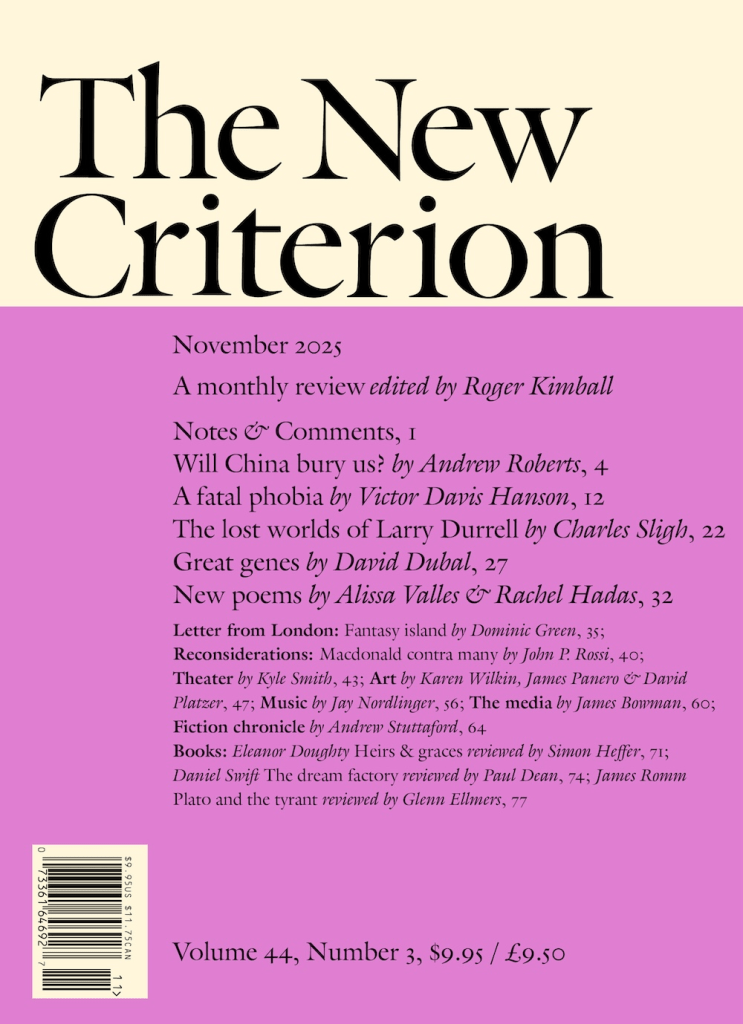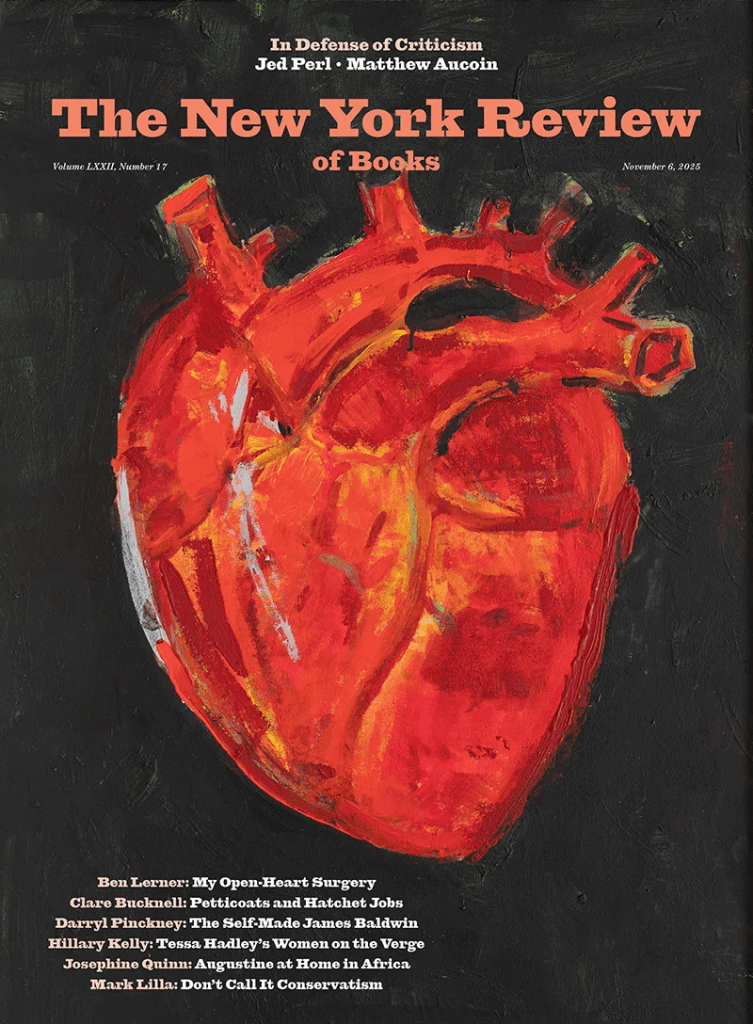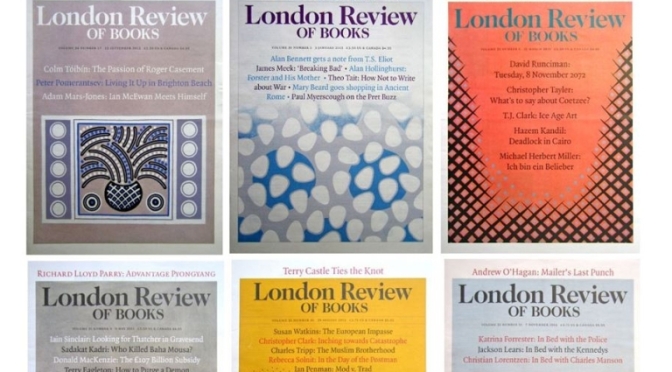
LONDON REVIEW OF BOOKS: The latest issue features Tariffs Before Trump; Boccaccio’s Dirty Book and Constance Marten’s Defiance

LONDON REVIEW OF BOOKS: The latest issue features Tariffs Before Trump; Boccaccio’s Dirty Book and Constance Marten’s Defiance

TIMES LITERARY SUPPLEMENT: The latest issue features ‘Tech Bro Utopia’ – Why Bacon’s New Atlantis is Peter Thiel’s favorite book; The monarch who built Britain; Charles and the carbuncles; The miseries of Victor Hugo’s daughter…

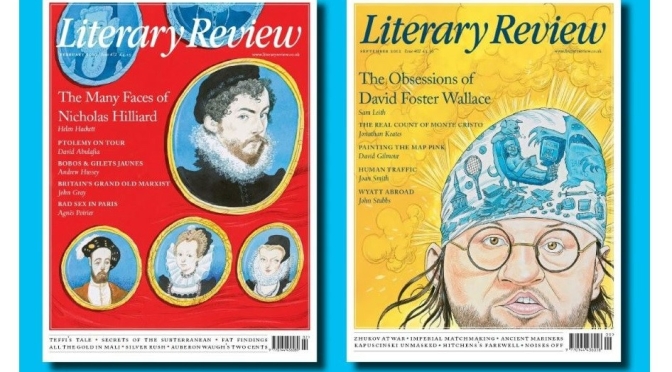
LITERARY REVIEW (August 2, 2025): The latest issue features ‘Mark Twain’s American Odyssey’…

TIMES LITERARY SUPPLEMENT: The latest issue features Daniel Karlin about his twelve-month abstinence from the printed word. As one of his friends remarked, he must have been the first person to make a New Year’s resolution to read less.
A year without reading By Daniel Karlin
AI, literary theory and traditional storytelling By Benjamin Markovits
The ethics of industrial insect farming By Simone Gubler
Efforts to prohibit abortion down the ages By Elizabeth Abbott

TIMES LITERARY SUPPLEMENT: The latest issue features All change is for the worse? Pessimists will find evidence in Joad Raymond Wren’s The Great Exchange: Making the news in early modern Europe, reviewed for the TLS by Noel Malcolm.
Where newspapers came from By Noel Malcolm
A cultural conservative who paved the way for Ronald Reagan By Christopher J. Scalia
Ancient rural skills in a modern world By Norma Clarke
Restfully contemplative holiday reading By Irina Dumitrescu

How accountable are US intelligence agencies to the president and Congress? By Richard Norton-Taylor
Henry James’s return to the United States By Alicia Rix
New light on ‘Captain’ Warner’s weapon of mass destruction By Trevor Pateman
A poet for yesterday and today By Emma Greensmith

The following essay was written by AI and edited by Intellicurean:
One often hears that art is a refuge from the storm, a quaint hermitage for the sensitive soul. But when the storm is a veritable tempest of tyranny, what then? Must beauty shrink to a whispered metaphor, or can it, with a flourish, confront the grotesque, form itself a weapon, and memory its shield?

Peter Weiss, the German-Swedish playwright and novelist, perhaps best known for his provocative Marat/Sade, offers an unflinching answer in his masterwork, The Aesthetics of Resistance. This three-volume novel—published between 1975 and 1981, and only recently fully translated into English by Joel Scott for Verso Books—presents not merely a chronicle of Europe’s descent into fascism, but an audacious theory of survival, contemplation, and rebellion through the very act of art.
In a perceptive recent essay for Liberties Journal, Jared Marcel Pollen explores the novel’s radical scope, elegantly correcting a common misattribution of a pivotal political aphorism. Not Lenin, but Maxim Gorky, Pollen reveals, claimed that “aesthetics was [his] ethics—the ethics of the future.” More than a mere historical footnote, this elegantly salvaged reversal encapsulates the novel’s very governing spirit: that beauty, far from being a retreat from political crisis, is its very precondition for meaning, that art does not merely ornament truth, but, with a surgical precision, it excavates it.
The Aesthetics of Resistance unfolds in the shadow of Europe’s unraveling, commencing in 1937, as Hitler consolidates power and Stalin’s purges silence dissent. The narrative spans the years up to 1942—a period that Hannah Arendt once called “midnight in the century.” But unlike conventional historical fiction, Weiss offers no linear tale of protagonists moving toward neat resolution. Instead, he crafts a philosophical Hades-wanderung—a relentless descent through betrayal, failed revolutions, ideological fracture, and the wreckage of cultural inheritance.
The text itself resists easy consumption. Its dense, paragraphless pages—walls of syntax without clear beginning or end—mirror the labyrinthine realities its characters inhabit. In an interview with The New York Times, translator Joel Scott remarked that reading Weiss is like “being submerged in consciousness,” and likened the novel’s structure to a frieze: a continuous mural of intellect, grief, and memory. This relentless, frieze-like form compels the reader to engage with history not as a series of discrete events, but as an overwhelming, cumulative force, a continuous present of trauma and resistance. The novel is as much a meditation on how we perceive history as it is on history itself.
At its core, The Aesthetics of Resistance is a Bildungsroman—a novel of education and formation. But it defiantly eschews the genre’s traditional bourgeois framework. This is no Goethe’s Wilhelm Meister or Joyce’s Stephen Dedalus spiraling through self-inquiry in cloistered academic halls. Weiss’s narrator—working-class, gentile, unnamed—does not wander through elite libraries or university quads. Instead, he and his comrades read Dante, study Greek sculpture, and debate Marxist theory in factory basements and kitchens, under constant threat of arrest or worse.
This autodidacticism—the practice of self-teaching—is not a mere supplement to formal education but a radical replacement. The narrator declares early on: “Our most important goal was to conquer an education… by using any means, cunning and strength of mind.” Their knowledge is not earned; it is stolen—like Promethean fire—from the guarded sanctums of official culture. This echoes Friedrich Schiller’s view in On the Aesthetic Education of Man (1795) that beauty cultivates moral freedom, acting as a safeguard against the dehumanizing mechanisms of state power. Indeed, in a totalitarian state that mutilates truth and simplifies human experience, the very act of preserving intellectual complexity – a core tenet of Weiss’s autodidacts – becomes, as Susan Sontag argued in “On Style,” an ethical stance in itself, an insistence on the primacy of certain values. In Weiss’s hands, this ethic becomes urgently, tragically manifest.
The profound question that animates Weiss’s project is not simply how to survive violence, but how to perceive it. What happens to art, to the very faculty of perception, when the world collapses into brutality? One compelling answer emerges in the novel’s early scene at the Pergamon Altar, a Hellenistic frieze of the Gigantomachy—a mythic war between gods and giants—housed in Berlin’s museum. As Nazi banners flutter outside, the young resisters look upon this magnificent fragment of antiquity and see not quaint myth, but relentless struggle. They interpret the contorted figures as symbols of class war, reclaiming the altar from its imminent fascist cooptation.
This interpretive act—the deliberate reading “against the grain”—is both aesthetic and political, a defiant reconstitution of meaning. It echoes Walter Benjamin’s chilling thesis that “there is no document of civilization that is not at the same time a document of barbarism.” Indeed, as Pollen writes with chilling precision, the Nazis, in their grotesque appropriation of classical forms, hollowed them into “plaster emptiness.” Weiss’s characters do the opposite: they revive these ancient forms by placing them in urgent dialogue with their own suffering, thus universalizing the struggle against domination, making the “mass of stone” a value “belonging to anyone who steps in front of it.”
The novel closes with a powerful meditation on Picasso’s Guernica, his monumental canvas depicting the bombing of the Basque town in 1937. The painting, the narrator insists, does not merely show war—it registers “an assault on the ability to express things.” Guernica marks a new kind of aesthetic task: not only must art represent horror, it must endure it. The painting outlasts its own referent, becoming what philosopher Elaine Scarry once called “a durable object,” an artifact that shelters memory and meaning long after political systems fall and the bombs cease to drop. In Alfonso Cuarón’s bleakly prescient dystopian film Children of Men (2006), Guernica appears, almost unnoticed, in the sterile interior of a government building—a poignant token of lost humanity. This, precisely, is Weiss’s abiding fear: that without the active labor of interpretation, without the human will to engage, even the greatest artistic achievements become mere decor, robbed of their subversive potential.
Some may, of course, recoil, finding The Aesthetics of Resistance too cerebral, too demanding, perhaps even too… Germanic, to resonate beyond the intellectual class. It’s a fair, if somewhat lazy, concern. And yet, as Timothy Snyder so chillingly reminds us in On Tyranny, fascism thrives precisely when the imagination is starved—when complexity gives way to cliché, when memory is replaced by manufactured myth.
Weiss’s project is a counteroffensive. His characters repeatedly ask, with desperate sincerity: “What does the Divina Commedia have to do with our lives?” In posing the question, they model the very activity the novel enacts—bridging distant beauty with present suffering. As Pollen notes, Weiss is not proposing simplistic analogies between then and now, but calling us to maintain the capacity for analogy—the capacity to perceive echoes and derive moral relevance from history, an imaginative act in itself.
Art, then, is not escapism. It is a form of mnemonic defense, a profound act of spiritual preservation. Horst Heilmann, a real historical figure and one of the novel’s central martyrs, declares: “All art… all literature are present inside ourselves, under the aegis of the only deity we can believe in—Mnemosyne”—Memory, mother of the Muses. Here Weiss evokes a stunning theological shift: divinity no longer lies in revelation, but in remembrance. Not in salvation, but in reckoning. Weiss shares this ethos with writers like W.G. Sebald and Toni Morrison, both of whom insisted that literature’s task is not to uplift, but to testify. In her Nobel lecture, Morrison described language as “the measure of our lives,” and warned that its decay is the first sign of cultural amnesia. Weiss anticipates this danger, and his novel becomes a fortress of form against forgetting.
Perhaps the greatest gauntlet Weiss throws down, the element that still most sharply divides critics, is his distinctive style. The novel’s paragraphs can stretch for pages. There is no chapter division, no conventional dialogue, and barely a linear plot. But this excess is deliberate. As George Steiner observed in The New Yorker, Weiss “wanted his novel to resist readability as a form of moral laziness.” This is not to suggest the novel is obscure for its own sake, a mere affectation of difficulty. Rather, its very form embodies its thesis: the reader’s discomfort, the laborious trek through its unbroken syntax, becomes an echo of the characters’ own relentless, desperate struggle for meaning amidst chaos. Like Thomas Bernhard, whose relentless monologic fury shapes Correction and Extinction, Weiss denies literary comfort. Instead, he offers friction, density, and dissonance—qualities perfectly befitting a narrative of clandestine, underground resistance, where truth arrives not through effortless clarity but through sheer, unyielding persistence. In his study The Work of Literature, philosopher Peter Szondi described literature as a form that must “carry contradiction inside itself.” Weiss takes this principle further: contradiction is not a flaw but a crucial feature of truly resistant art. The reader’s discomfort, then, is the novel’s ethical demand.
Weiss died in 1982, a year after completing his trilogy. In a rare interview that year with Der Spiegel, he confessed that his greatest fear was not censorship but irrelevance—that art would become mute in the face of spectacle. That fear feels chillingly prescient. As Western democracies flirt again with the seductive sirens of authoritarianism, and as history is re-scripted by those who profit from collective forgetting, The Aesthetics of Resistance emerges not merely as literature but as an instruction manual for endurance.
Its lessons are not limited to Germany or the 1930s. They resonate in Chile’s brutal reckoning with Pinochet, in the defiant murals of Belfast, in the urgent poetry of Mahmoud Darwish, and in the resolute chants of Tehran’s women today. Where brutality seeks silence, art insists on form—on surviving and shaping what was meant to be annihilated.
Weiss leaves us with a final, searing proposition: Imagination lives as long as resistance lives. And when resistance ends—when truth is reduced to slogan, when memory collapses into myth—then imagination, too, begins to die. But while a single reader still labors through his walls of text, still stands before the Pergamon frieze and refuses to see mere stone, Weiss’s profound vision endures. This is the essence of The Aesthetics of Resistance: not to comfort, but to compel. Not to promise victory, but to remind us that moral clarity comes not from slogans, but from study. And that to understand the past is not merely to remember—it is, in the most profound sense, to resist the future that forgets it.


The following essay review was written by AI and edited by Intellicurean from a New Yorker article titled “4.6 Billion Years On, The Sun Is Having A Moment”, by Bill McKibben from his forthcoming book “Here Comes The Sun”.
Much like a seasoned playgoer at a modern drama, we find ourselves watching the improbable and the inevitable perform a dizzying pas de deux. For decades, renewable energy existed on the fringe—a topic for earnest environmentalists, academic dreamers, and early adopters armed with more zeal than capital. One recalls the almost quaint marvel of the first all-solar house at the University of Delaware in 1973, drawing curious crowds like pilgrims to a modern oracle. It was a novelty, an “alternative” to the fossil-fueled behemoth that powered Western economies for two centuries. And “alternative” was the key word—suggesting not a contender, but a polite afterthought.
Yet as we move through the mid-2020s, a stunning twist has unfolded, largely unnoticed amid louder headlines. With little fanfare, renewable energy has shifted from a peripheral ideal to a mainstream economic reality. In a world often held hostage to political drama and climate paralysis, this shift—documented in a recent New Yorker piece drawn from Bill McKibben’s forthcoming book, Here Comes the Sun: A Last Chance for the Climate and a Fresh Chance for Civilization (August 2025)—feels both miraculous and overdue. What was once “too good to be true” is now simply true. Solar, wind, and battery storage have become the most cost-efficient, fastest-growing power sources on Earth. The implications are nothing short of a new Industrial Revolution—only this time, it’s clean, decentralized, and increasingly democratic.
The statistics McKibben explores in the excerpted material are not dry metrics—they’re signals of an epochal shift. It took nearly seventy years from the invention of the photovoltaic cell in 1954 to reach the first terawatt of installed solar power by 2022. The second terawatt arrived by 2024. The third? Expected by 2026. Solar is now being added at a rate of one gigawatt—equivalent to a coal plant—every fifteen hours. Wind power, a cousin to solar in its dependence on planetary physics, isn’t far behind.
Globally, renewables met 96% of new electricity demand in the past year. In the U.S., the figure was 93%. Fossil fuels, once the uncontested monarchs of modernity, are losing their crown. In March, for the first time, fossil fuels generated less than half of all U.S. electricity.
California provides a dramatic case study. In May, the state—now the fourth-largest economy in the world—hit a record: renewable sources produced 158% of its power demand. Over the entire day, they delivered 82% of electricity consumed. This wasn’t theoretical progress—it was operational proof.
Equally revolutionary is the rise of energy storage. Battery deployment has surged 76% this year alone. These systems often act as California’s overnight power source, stabilizing the grid when sunlight fades or wind slows. One official from the North American Electric Reliability Corporation noted, “batteries can smooth out some of that variability from those times when the wind isn’t blowing or the sun isn’t shining.” The result? California now uses 40% less natural gas than it did just last year—a number McKibben hails as “the single most hopeful statistic I’ve seen in four decades of writing about the climate crisis.”
Even Texas, synonymous with oil and gas, is rapidly rebranding its energy identity. In March, it set records for solar, wind, and battery output. During a brutal May heatwave, over a quarter of its power came from renewables. By adding 10,000 megawatts of clean capacity, Texas slashed emergency blackout risk from 16% last year to less than 1% now. This isn’t green idealism—it’s grid-level, boots-on-the-ground practicality.
But the scale of change in the U.S. pales in comparison to what’s happening in China. More than half the world’s renewables and batteries are now installed within Chinese borders. In May alone, China added 93 gigawatts of solar—equivalent to one gigawatt every eight hours. The environmental payoff is immediate: carbon emissions dropped in the first quarter of 2025, with electricity-linked emissions falling nearly 6% as solar and wind displaced coal. Nearly half of all vehicles sold in China this year were electric or hybrid.
This trend isn’t isolated—it’s contagious. South America, once planning 15 new coal plants, now plans none. India’s solar output surged so rapidly in early 2025 that coal consumption plateaued while natural gas use fell by a quarter. Even Poland, long a coal bastion, saw solar outstrip coal in May. These aren’t anomalies—they’re geopolitical rewrites.
And why? Because solar is now the cheapest, fastest path to power. China’s relentless innovation has driven battery costs down by 95% in 15 years. In just the first half of 2024, the U.S. alone added 4 gigawatts of storage. A Chinese utility’s latest bidding round cut prices by another 30%. Grid-scale batteries now power entire cities for hours. Nations that ignore this transformation aren’t just polluting—they’re rendering themselves globally uncompetitive.
Even petro-states have noticed. Saudi Arabia, Qatar, and the UAE are all building massive solar fields. Their goal? 50% of electricity from solar by 2050. When oil empires go solar, the narrative has changed.
As with all revolutions, hindsight exposes how blind the experts were. In 2009, the International Energy Agency predicted 244 gigawatts of solar by 2030. That benchmark was reached by 2015. Their forecasts over the last decade missed by an average of 235%. The only group that got it close? Greenpeace.
Jenny Chase of Bloomberg, quoted in the book, admitted: “If you’d told me nearly 20 years ago what would be the case now… I would have laughed in your face.” The contrast between establishment analysts and environmentalists makes for a satisfying, if sobering, moment of vindication.
Perhaps the most radical reordering is happening in places least expected. In Pakistan, widespread solar adoption is quietly displacing national grid demand—not from recession, but from progress. Diesel sales are down 30%. Corn farmers now gift solar inverters as wedding dowries. Panels are laid flat on the earth without costly mounts. DIY TikTok tutorials fill the role of training programs. This is grassroots ingenuity—climate transition as community-driven liberation.
A similar story is emerging across Africa. In Namibia and Eswatini, rooftop solar accounts for 11–15% of peak electricity. In South Africa, small-scale solar now contributes nearly 20% of national grid capacity. Many of these systems go unreported, installed informally by citizens weary of blackouts. As energy analyst Joel Nana puts it: “This is happening anyway, whether you like it or not.”
What of minerals? What of land? These limits, once feared fatal, now seem manageable.
Lithium, long considered a bottleneck, has seen prices drop even as demand rises. New sources have been discovered. More importantly, recycling systems are maturing. A 2023 Energy Transitions Commission report found that all materials needed to reach net zero by 2050 amount to less than the coal burned in a single year. Battery tech is also becoming more efficient—using less lithium, less silver, and recovering more materials post-use. One roof of solar panels can now power ten replacements over 25 years. That’s not just sustainability—it’s a virtuous cycle.
Land, too, is more abundant than assumed. Rooftops and parking lots help, but a more powerful solution lies in reclaiming farmland used for ethanol. A single acre of solar produces as much energy as 100 acres of corn-based ethanol. Cornell researchers found that converting under half of U.S. ethanol fields could decarbonize the entire grid by 2050. That’s not fantasy. That’s arithmetic.
The obstacles now aren’t technical—they’re political. Thousands of renewable projects are stuck in “interconnection queues,” awaiting utility approval. The Biden Administration has taken steps to clear these logjams. But the Trump Administration is actively trying to reverse course, propping up coal and gas, and demonizing renewables. One appointee—formerly a fracking executive—labeled solar “a parasite on the grid.” That’s not science. That’s theater.
Ironically, such obstruction may accelerate the global transition. Nations are increasingly wary of U.S. energy instability and looking elsewhere. Wall Street sees the trend clearly: renewables are not just climate solutions, but hedges against geopolitical volatility. A 2023 global poll found that 68% of people support solar energy—five times more than fossil fuels. Even among likely Trump voters, 87% support clean energy tax credits. The political class may dither, but the public is marching forward.
The most profound feature of this transition may be its structure. Fossil fuels are scarce, located in select pockets, and easy to monopolize. But solar and wind are everywhere. You can’t own the sun. You can’t weaponize the wind. What this means geopolitically is staggering. Wars have been fought over oil. No one’s going to invade for sunshine.
And that’s the quiet promise of this revolution. Decentralized power doesn’t just decarbonize economies—it redistributes agency. It empowers individuals, communities, and nations to unshackle themselves from legacy dependencies.
Paradigm shifts of this magnitude—the Industrial Revolution, the rise of computing—rarely announce themselves with fireworks. But when they arrive, they redefine everything.
The insights drawn from McKibben’s forthcoming book deliver that quiet shock. What emerges is not speculation, but evidence. A meticulously documented, unapologetically optimistic vision of a world poised on the edge of salvation—not by hope alone, but by hard math, falling prices, and widespread will.
The sun, it seems, is not merely rising. It is conquering.

TIMES LITERARY SUPPLEMENT: The latest issue features ‘American Dreamer’ – On the enduring greatness of Gatsby; Tear down the museums?; Big tech is watching you; A new Locke manuscript; The ultimate declutter and An epic bromance for our times…
What makes a novel of ideas? By Benjamin Markovits
The centre left has joined the populist right in despairing of good government By Sam Freedman
The following essay is AI -generated, edited by Intellicurean, as part of our “The Cynic & The Dandy” series, of an interview article published on July 6, 2025 on the Toynbee Prize Foundation website titled Hayek’s Bastards and the Global Origins of the Far Right: An Interview with Quinn Slobodian.

One finds oneself, much like a seasoned playgoer observing a particularly convoluted modern drama, grappling with the profound complexities of our age. The curtain, it seems, has risen on “Trump 2.0,” a performance so bewildering in its contradictions that even the most astute critics of human folly might pause for breath. This curious administration simultaneously seeks to disentangle itself from global commitments while igniting fresh international disputes; it endeavours to depreciate the dollar to boost exports whilst clinging to its status as the world’s reserve currency; and it champions a reduction in global economic reliance while striving to unilaterally dictate global economic terms. The American colossus, one might observe, appears caught in a most perplexing dance with its own identity, and the global audience watches, utterly transfixed.
It is into this very contemporary conundrum that Quinn Slobodian, a historian of capitalism whose intellectual acuity is as sharp as a well-honed epigram, strides with his latest volume: Hayek’s Bastards: Race, Gold, IQ, and the Capitalism of the Far Right (Princeton University Press, 2025). This title, one must concede, possesses a certain Wildean flourish, hinting at the delightful audacity within its pages. Slobodian, with the keen eye of a diagnostician, posits that the apparent contradiction of the Far Right simultaneously embracing pro-market liberalism and social hierarchies – facilitating the free movement of capital but not of people – is, in fact, no contradiction at all. He argues that neoliberalism has always possessed the intellectual elasticity to accommodate such a narrative.
Slobodian’s current work builds upon his earlier seminal analyses in Globalists: The End of Empire and the Birth of Neoliberalism (Harvard University Press, 2018) and Crack-up Capitalism: Market Radicals and the Dream of a World Without Democracy (Metropolitan, 2023). However, Hayek’s Bastards shifts its chronological focus decisively to the 1990s, illuminating this pivotal decade through the lens of figures not previously central to his explorations. If Globalists dissected the intellectual elite of the Mont Pèlerin Society, and Crack-Up Capitalism examined market radicals within the broader globalisation context, this new work turns its penetrating gaze to paleo-libertarianism. This intriguing ideological fusion, combining libertarian disdain for global governance with paleo-conservative traditionalism and isolationism (a distinct contrast to the more recent neoconservative branch of the Republican Party), forms the crux of Slobodian’s argument.
At the heart of Slobodian’s contention lies a startling conclusion: the rise of the Far Right is an acceleration, not a rejection of capitalism; a frontlash, not a backlash. He meticulously demonstrates how right-wing libertarians of the 1990s, through their convergence with paleoconservatives and their burgeoning interest in biology, IQ, and gold, inadvertently laid the intellectual foundations for our present reality.
In a recent conversation with Asensio Robles of Comillas Pontifical University, Slobodian elucidated the two primary concepts underpinning his book. The notion of “bastards,” he explains, serves as a vivid metaphor for the generations of intellectual influence, where adherents, though inspired by mentors, may diverge significantly from the original spirit and content of their masters’ work. In the case of Friedrich Hayek, Slobodian points to those who, in their pursuit of his scientific and complexity-focused ideas, veered into domains such as scientific racism or the belief in human nature as an absolute organizing principle. These, Slobodian asserts, represent the “illegitimate” heirs who strayed far enough to betray Hayek’s fundamental principles.
Friedrich Hayek, a Nobel laureate in Economics (1974) and a leading figure of the Austrian School of economics, is perhaps best known for his fervent defense of free-market capitalism and his critiques of central planning, notably articulated in his seminal 1944 work, The Road to Serfdom. Hayek argued that economic coordination arises not from central design, but from a “spontaneous order” – the result of millions of individuals making decisions based on dispersed, localized knowledge communicated primarily through the price system. He believed that any attempt by the state to centrally plan the economy would inevitably lead to a loss of individual liberty and, ultimately, totalitarianism, because such planners could never possess the vast, tacit knowledge embedded within a decentralized market.
The second crucial concept is “Volk capital.” Slobodian critiques the common, overly generalized understanding of neoliberalism as simply advocating for the commodification of all things and the reduction of all humans to an interchangeable substance. By adopting a narrower, more historically precise definition, focusing on a discrete group of thinkers (including those within the Mont Pèlerin Society, which Hayek co-founded in 1947), he reveals a significant inflection point in the 1960s and 1970s. This period saw a shift in neoliberal thought towards an emphasis on human difference, rather than equality.
Slobodian argues that the universalizing concept of human capital became “re-grounded” in specific genetic populations or cultural groups. He observes the re-emergence of 19th-century notions of the “Volk”—the idea of an essential character of a kinship group—fused with economic categories. This, he contends, transforms “human capital” into “Volk capital,” demonstrating how an ideology often associated with abstract market principles could regress to antiquated distinctions. For instance, by the 1980s, Hayek himself, often considered a progenitor of neoliberalism, suggested a unique quality of the Western world in producing an “optimal economic actor.”
Slobodian further clarifies the genesis of these two books, revealing they were initially conceived as a single grand volume. The political shocks of 2016-2017 – the election of Donald Trump, the Brexit “Leave” vote, and the rise of parties like Alternative for Germany – prompted his inquiry. He expresses dissatisfaction with mainstream interpretations that viewed these developments as a revolt against neoliberal capitalism by those “left behind” by globalisation. This narrative, he argues, incorrectly positioned figures like Trump and Boris Johnson as unexpected challengers to the neoliberal consensus.
To counter this, Slobodian first introduced the concept of the “zone” in Crack-up Capitalism. This refers to more fluid spaces for investor capital within nations, such as freeports in the United Kingdom or the proliferation of Special Economic Zones in countries like China and India. He notes that in 2017-2018, much of the apparent economic nationalism was, in fact, about creating these spaces for capital mobility. For example, as of 2023, there were over 7,000 Special Economic Zones globally, employing tens of millions of people and contributing significantly to trade and investment, illustrating this practical application of “zones.”
He then sought to integrate the observation that many within the alt-right in 2016 originated from the paleo-libertarian camp. These individuals, skeptical of both global and national governments, sought a fracturing of the state system. The “grand narrative” of bundling these ideas proved “quixotic,” leading to the separate publication of Crack-up Capitalism and Hayek’s Bastards, the latter focusing on the paleo-alliance between dissident right-wing figures and the neoliberal movement.
The chronological alignment between the two books is evident. In Hayek’s Bastards, the post-Cold War period is presented as a moment of reckoning for neoliberals, who questioned whether they had truly “won” or if “state spending and socialism” persisted in new guises, such as environmentalism or feminism. Similarly, in Crack-up Capitalism, the 1990s marked a breakthrough for zones, representing a form of globalisation that fostered “diversities across territory” rather than uniform regulatory spaces. The fundamental thread uniting both narratives, Slobodian suggests, is the “use of difference, politically or economically.” This challenges the widely held assumption that the 1990s and 2000s were periods of increasing uniformity, arguing instead that they were also times when “irreconcilable differences” were intensified and leveraged for new political agendas.
Slobodian also tackles the pervasive assumption that neoliberalism is solely a celebration of individualism. He argues that while individualism is indeed a focus, neoliberals are intensely concerned with the conditions under which it can be realized. When the traditional “republican tradition” – based on an impartial state providing space for individual expression – is discarded, a new framework for community must be forged. This is particularly true for the “subgenre of neoliberal thought” that advocates for the dissolution of the state.
In this context, the necessity arises to constitute communities that can function and allow for individual expression without uniform regulations from a representative state. This leads to an interest in factors like the role of ethnic homogeneity in decreasing transaction costs and fostering trust, thereby allowing communities to self-perpetuate. It also involves examining the importance of the “social contract” as a literal set of terms for participation in smaller communities, and questions of social reproduction – specifically, the necessary gender orders to ensure sufficient population in a “closed-border model of political organization.” This, he notes, is where anarcho-capitalists and conservatives find common ground, the former seeking abstract individual freedom but recognizing the need for parameters, and the latter striving to preserve existing moral and cultural orders.
A striking observation from Slobodian’s research is the neoliberal fear that the Cold War might have been “lost” despite the Soviet Union’s collapse, due to persistent high state spending. The end of the Cold War, Slobodian reveals, raised the possibility of completely dismantling the social state, which in turn brought forth new questions about how a post-redistributive order could be anchored. This, he asserts, directly relates to the current moment in the United States, where campaigns to significantly cut the federal budget, such as proposals to reduce it by one-third (as seen in certain fiscal proposals from conservative groups, often citing a need to return to pre-expansion levels of spending), would necessitate the dismantling of the existing social state. This scenario, he suggests, brings to mind the ominous question posed by Charles Murray regarding the aftermath of the welfare state’s disappearance – whether it would lead to anarchy, organic self-organization, or a segment of the population perishing. The “vexed triumphalism” following the Cold War, Slobodian concludes, thus set the stage for the “apocalyptic forms of politics” now all too familiar.
Slobodian highlights the remarkable absence of significant sectarian splits within neoliberalism between the 1940s and 1980s. The clear ideological battle lines drawn between the “free, liberal, capitalist” world and the “planned command economies” of the communist bloc maintained a cohesive front. However, with the abrupt erasure of this divide in the 1990s, two paths emerged: either assume inevitable global convergence and the end of meaningful political divisions, or contend that divisions persisted, merely migrating to previously overlooked domains. The global Right, he observes, opted for the latter.
The 1990s became a period of “restless search for a new enemy” for the Right. This sometimes involved resurrecting older tropes, such as the anti-Semitic portrayal of George Soros as a conspiratorial figure, a narrative prominently used by figures like Viktor Orbán. Neoliberals, too, participated in this search, ultimately identifying their new adversary in the Left’s “march through the institutions” – specifically, movements advocating for gender and racial equality and a “politically correct” discourse. Slobodian emphasizes that this framing of issues like affirmative action and state-led efforts to redress inequality began remarkably early – some 35 years ago. He argues that the Left, too focused on internal critiques of a more mainstream neoliberalism (like that associated with Bill Clinton or Barack Obama), was often “caught off guard” by the “disruptive politics of the last decade,” failing to recognize the emerging “villain” that would ultimately manifest in today’s culture wars.
Slobodian’s methodological approach, as noted by Robles, is characterized by his commitment to “reading against the grain.” He consistently challenges conventional wisdom: if neoliberalism is thought to strive for state dissolution, Globalists shows its reliance on state intervention; if it promotes a borderless society, Crack-up Capitalism highlights its attention to “human separation”; and if the alt-right is seen as a backlash, Hayek’s Bastards frames it as a “frontlash,” an acceleration of the ideology. This “counterintuitive position” is, for Slobodian, a means to explore the profound revelations found within such contradictions. His advice to students – to begin a paper with “We think it’s like this, but it’s actually like that, and I’m going to show you why” – underscores his dedication to empirical evidence and intellectual revision.
He also draws a strong correlation between the 1990s and the 1960s, suggesting that understanding paleo-libertarian interests in hard borders, IQ, and gold necessitates examining earlier debates surrounding the 1965 Immigration Act, 1960s evolutionary psychology, or monetary reform post-Bretton Woods. These two decades, both periods of relative prosperity, represented moments where attempts were made to reconfigure societal settlements. Slobodian contends that the Left’s focus on criticizing a “progressive neoliberalism” (e.g., of the Clinton or Obama era) that paid “lip service” to 1960s social movements while blunting their critical edge meant they were “caught off guard” in 2016. He suggests that identifying what neoliberals “worried about” in a given decade, such as environmental demands disrupting growth models in the 1970s and 1990s, could reveal “vulnerability in the economic system” and “soft spots” for counter-movements to exploit.
Regarding future inquiries, Robles points to the absence of cryptocurrencies and AI in Hayek’s Bastards. Slobodian confirms these will be explored in his forthcoming book, Muskism, co-authored with Ben Tarnoff, which will delve into AI, effective altruism, and superintelligence. This work is slated for release next year.
However, Slobodian maintains a critical stance on cryptocurrencies, viewing them as “parasitical on a functioning traditional monetary system” and primarily “a hedge-speculative asset” or “plaything for a small number of libertarians and more recently large investors.” He believes his skepticism has been “a wise bet,” as the number of “true believers” in blockchain as a political template remains small, with most investors using crypto like any other growth sector.
Intriguingly, Slobodian’s other new research direction looks not to the digital future, but to a historical “backward” step: the changes in the human sciences in the postwar decades, specifically “How humans became animals at Harvard.” This project will explore the world of figures like Richard Herrnstein (a student of B. F. Skinner) and E. O. Wilson in the 1960s and 1970s, examining how humans were increasingly “analogized to animals.”
In Hayek’s Bastards, Quinn Slobodian has, with surgical precision, woven a compelling and unsettling thread through the tapestry of intellectual history. He compels us to confront the uncomfortable truths about the origins of our present predicament, reminding us that the seemingly spontaneous outbursts of populism are, in fact, the meticulously cultivated fruits of a long and complex intellectual lineage. One leaves his analysis with a renewed sense of vigilance, a heightened awareness of the subtle, often insidious, ways in which ideas, like the most potent of poisons, can mutate and proliferate, shaping our world in ways we are only now beginning to comprehend. Indeed, the stage is set for future acts in this ongoing drama, and one eagerly awaits Slobodian’s next intellectual curtain call.
“The Cynic & The Dandy” is an AI-generated essay series based on a hypothetical collaboration between Oscar Wilde and George Bernard Shaw.