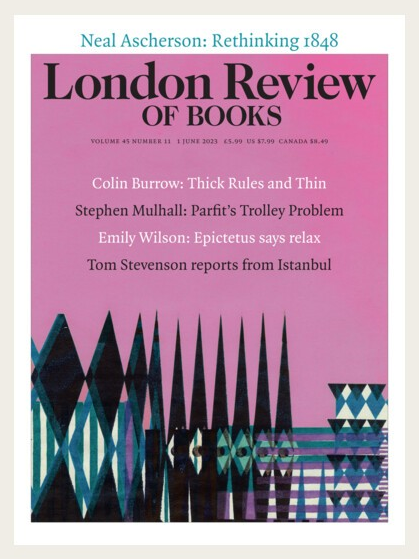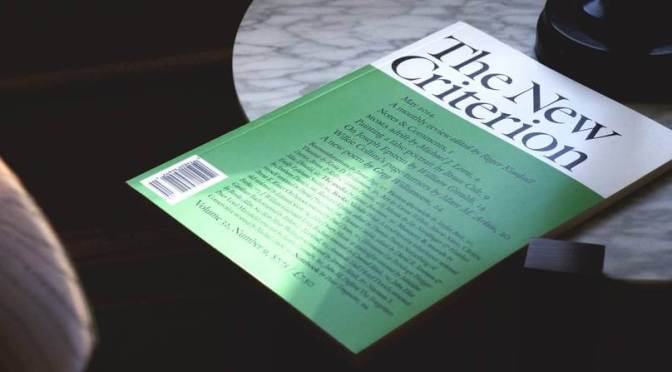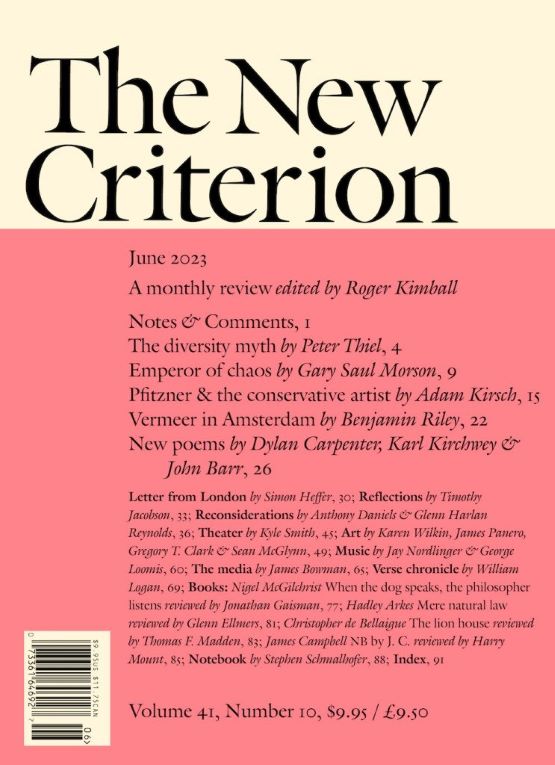
London Review of Books (LRB) – May 18, 2023 issue: The War in Khartoum, Vermeer’s Waywardness, Palestinians in Paraguay and Claire Hall on Anaximander.
In London, I had taken A Young Woman Standing at a Virginal for a dependable rest point on strolls around the National Gallery. In Amsterdam, relocated to join 27 other Vermeers in the Rijksmuseum exhibition, its strangeness re-emerged. This canvas, executed towards the end of Vermeer’s relatively brief career (some four years, perhaps, before he died aged 43 in 1675), commits to a tactic he had earlier only toyed with: to set an internal picture as a wholly self-contained block within his own composition, uninterrupted by foreground forms.
Claire Dederer’s deft and searching book surfaces a “fan’s dilemma” over such figures as Vladimir Nabokov, Woody Allen, Willa Cather and Roman Polanski.
Expanding on a popular essay published in The Paris Review a month after the exposure of Harvey Weinstein’s sexual predation, “Monsters” sustains an essayistic, sometimes aphoristic tone throughout 250-odd pages.
Welcome to three novels set in locales where life is exceedingly difficult.
By Alida Becker
AT THE HOUR BETWEEN DOG AND WOLF by Tara Ison
The title comesfrom a French expression for twilight. Sure enough, her novel sends us to the dusk that borders the familiar and the wild, the known and the unknown. It’s where our beliefs and suspicions can cast dark shadows over our lives. And, of course, the lives of others.
Alarmed by the country’s political divisions, Jeff Sharlet embarked on an anguished quest to understand the rise of antidemocratic extremism. In “The Undertow,” he documents his findings.
By Joseph O’Neill
THE UNDERTOW: Scenes From a Slow Civil War, by Jeff Sharlet
The premise of “The Undertow,” Jeff Sharlet’s anguished new book of reportage, is that the United States is “coming apart.” The disintegration is political. It involves the rise of the autocratically inclined Donald Trump; the attempt by members of the Republican Party to overthrow the election of Joe Biden in January 2021; and, during the Biden presidency, the overturning by the Supreme Court of Roe v Wade.
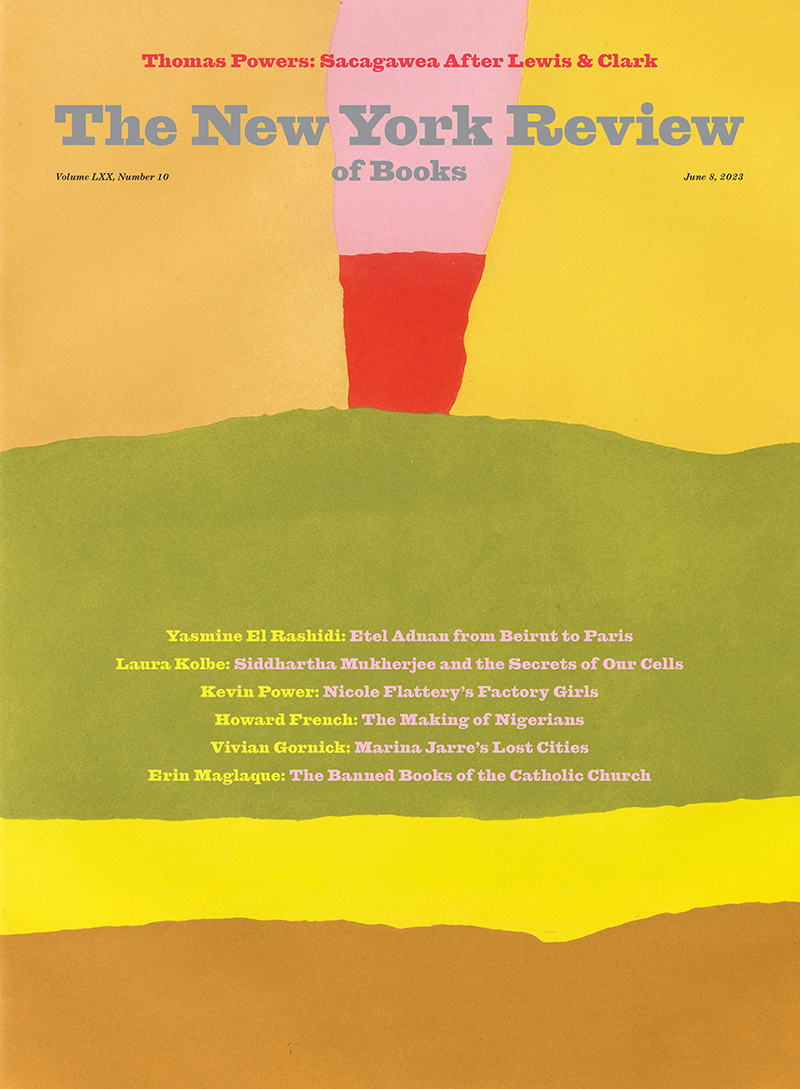
The New York Review of Books – May 25, 2023 issue: Michael Hofmann on Goethe’s last years, Jerome Groopman on the business of biotech, Joan Acocella on Balanchine, Jed S. Rakoff on William O. Douglas’s environmentalism, Adam Hochschild on 1619 and 1776, Willa Glickman on grassroots labor unions, Brenda Wineapple on Susanna Moore, Ian Johnson on art looters, Jenny Uglow on Samuel Pepys and the wreck of the HMS Gloucester, Nicholas Guyatt on financing the Civil War, Elaine Blair on how we talk about sexual assault, poems by Eugene Ostashevsky, D. Nurske, and Ama Codjoe, and much more.
In Johann Eckermann, Goethe found an amanuensis made in heaven.
Conversations with Goethe: In the Last Years of His Life by Johann Peter Eckermann, translated from the German by Allan Blunden, with an introduction and notes by Ritchie Robertson
A strange time to publish—strange time to publish anything—a translation of Eckermann’s Conversations with Goethe (or should that be Goethe’s Conversations with Eckermann?), in six hundred static, major-key pages that can easily feel like twice as many. The big man, himself by now somewhat fallen on hard times, recorded by the little acolyte.
A new book reveals the split personality of the biotech industry: an altruistic enterprise that creates breakthrough treatments for patients in need, and a bare-knuckle business that seeks to generate astronomic profits and stop competitors from developing better treatments.
A research scientist for Pharmacyclics, Sunnyvale, California, 2013. In For Blood and Money, Nathan Vardi writes that when Pharmacyclics—which developed ibrutinib, a treatment for chronic lymphocytic leukemia—was bought by the pharmaceutical giant AbbVie in 2015 for $21 billion, ‘the deal…set the new high-water mark for success in the biotechnology industry.’
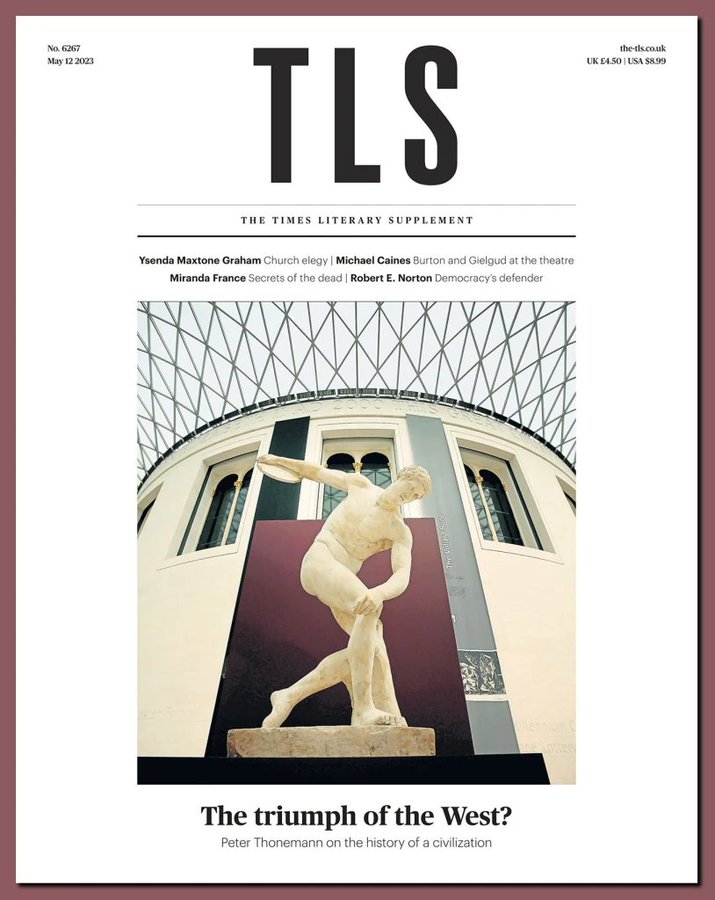
Times Literary Supplement @TheTLS (May 5, 2023) – This week’s @TheTLS features Bruno Schulz – a writer from another Europe; Patrick O’Brian’s bleak vision; Vermeer – a great but flawed exhibition; extreme fandom and Derek Parfit, eccentric genius.
How Bruno Schulz found freedom on the periphery of life By Boris Dralyuk
It’s more than a little discomfiting to read the great Polish novelist Witold Gombrowicz’s description, in his diary from the early 1960s, of his not-quite-friend Bruno Schulz: “A tiny gnome with enormous head, appearing too scared to dare exist, he was rejected by life and slouched along its peripheries”. Written for publication two decades after Schulz was gunned down by a Nazi just outside the ghetto of his occupied native town of Drohobych in November 1942, these words cannot help but seem impious.
When in 1960 I first came across Osip Mandelstam’s poetry, nobody in the USSR had enjoyed access to his work since the early 1930s and few even knew of his existence, let alone of his death, as he had predicted, in Stalin’s Gulag. His books had been removed from libraries and bookshops.
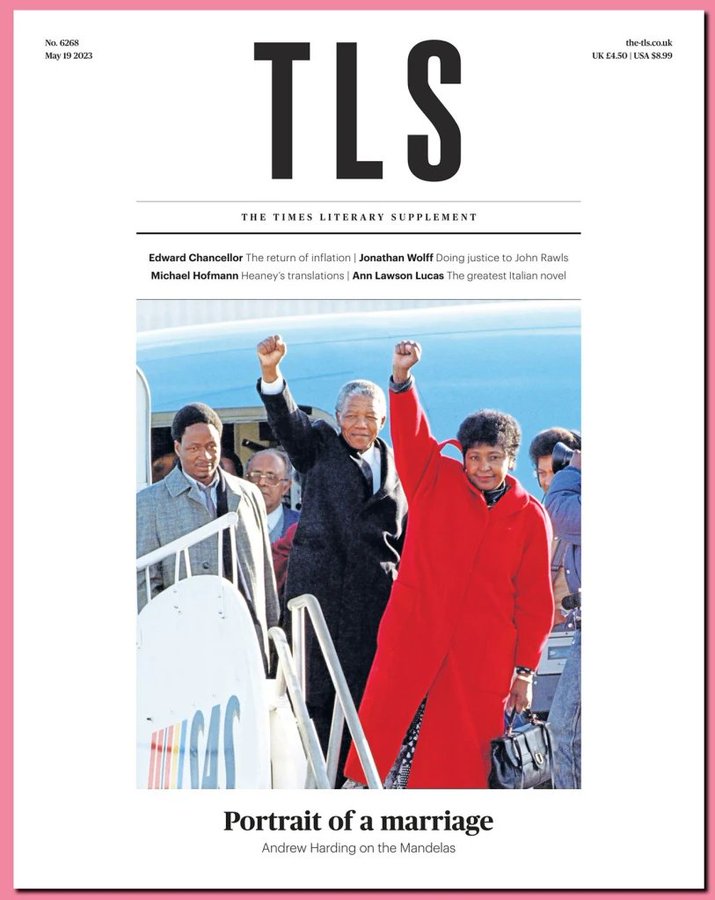
‘Winnie and Nelson: Portrait of a Marriage’ By Jonny Steinberg
Under apartheid, aspiring South African writers frequently marketed themselves to the world as committed and heroic anti-apartheid activists. The enormous success of Alan Paton’s Cry, the Beloved Country (fifteen million copies sold and counting) showed the way, though Paton was the real McCoy, a committed liberal who suffered for his beliefs.
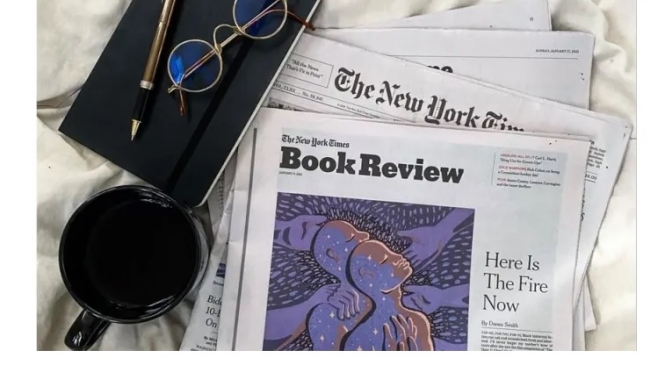
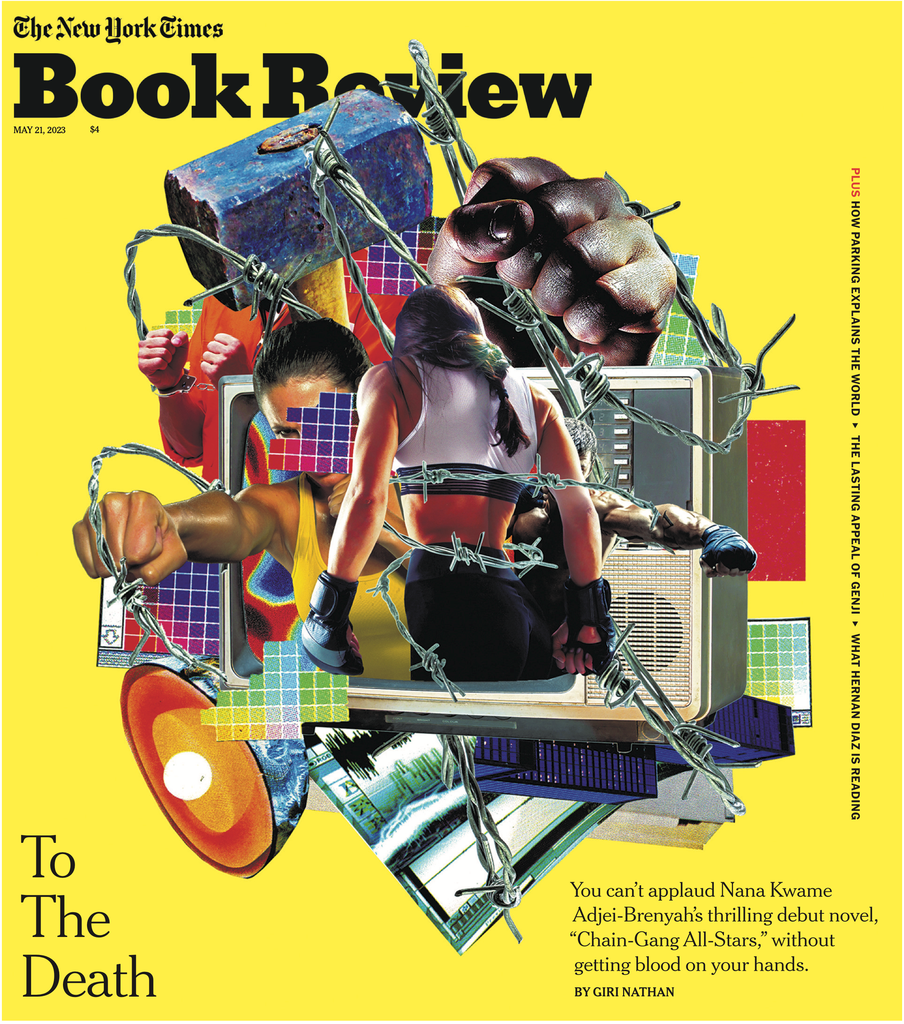
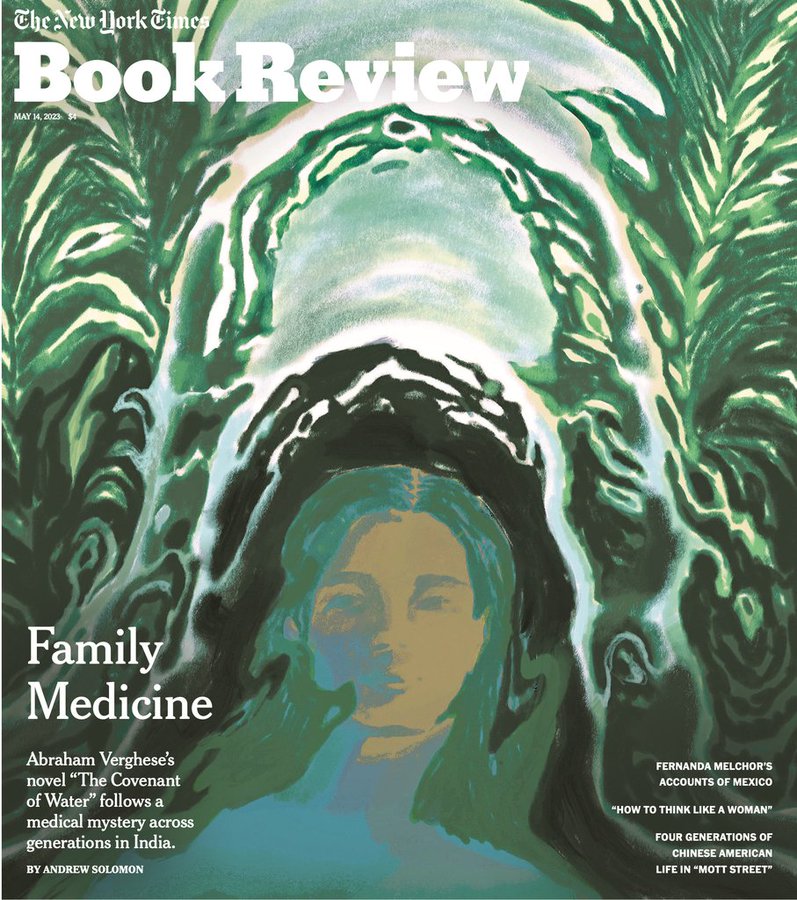
The New York Times Book Review(April 30, 2023): On the cover this week – Ned Blackhawk’s “The Rediscovery of America,” a sweeping, important, revisionist work of American history that places Native Americans front and center. Illustrating it is “Les Castors du Roi,” a 2011 painting by Kent Monkman, a Cree artist in Canada’s Dish With One Spoon Territory.
Paul Theroux, the quintessential travel writer, has also enshrined his Massachusetts roots in his writing. Here are his recommendations for those who come to visit.
My father, like many passionate readers, was a literary pilgrim in his native Massachusetts, a state rich in destinations, hallowed by many of the greatest writers in the language. “Look, Paulie, this is the House of the Seven Gables — go on, count them!”
A woman consults a book at the New York Public Library on Fifth Avenue and 42nd Street in Manhattan.Credit…Ángel Franco/The New York Times
In “All the Knowledge in the World,” Simon Garfield recounts the history of the encyclopedia — a tale of ambitious effort, numerous errors and lots of paper.
The scholar Christina Sharpe’s new book comprises memories, observations, artifacts and artworks — fragments attesting to the persistence of prejudice while allowing glimpses of something like hope.
The Best Minds: A Story of Friendship, Madness, and the Tragedy of Good Intentions
By Jonathan Rosen | Penguin Press
A young man’s ife of brilliant promise was overtaken when his struggle with mental illness took a turn into delusion and nightmare. Review by Richard J. McNally.
A Brutal Reckoning: Andrew Jackson, the Creek Indians, and the Epic War for the American South
By Peter Cozzens | Knopf
The most consequential Indian war in U.S. history didn’t take place on the prairie but among the forsts and marshes of the Deep South. Atrocities were committed by both sides. Review by Fergus M. Bordewich.
The names and dates of battles that changed history are well-remembered. But what about storms or volcanic eruptions? For eons, human civilizations have shaped—and been shaped by—the natural world. Review by Tunku Varadarajan.