Category Archives: Arts & Literature

THE MAN WHO INVENTED THE MODERN THRILLER

Before Hitchcock or Highsmith, there was Pietro Aretino—Renaissance Venice’s scandalous satirist who turned gossip into cliffhangers and obscenity into art. The man who terrified popes may also have invented the modern thriller.

By Michael Cummins, Editor, August 29, 2025

Venice, 1537

The candle gutters in its brass dish, casting a crooked halo on the damp walls of a salon off the Grand Canal. Pietro Aretino leans back in his chair, one boot propped on a velvet footstool, his voice curling through the smoke like a blade. He does not write—he dictates. A scribe, young and ink-stained, hunches over parchment, trying to keep pace. The letter—addressed, perhaps, to a cardinal, perhaps to a painter—will contain more than pleasantries. It will contain a threat, veiled as an observation, wrapped in a joke.

“Princes fear me more than the plague,” Aretino murmurs, eyes half-lidded. “For I do not kill bodies—I murder reputations.”

The scribe pauses, startled. Aretino waves him on. “Write it. Let them tremble.”

Tomorrow, this page will cross the lagoon, board a courier’s horse, and ignite tremors in Rome or Paris. It may be copied, whispered, condemned. It may be burned. But it will be read.

It was Aretino’s genius to recognize that scandal was not merely gossip—it was architecture. A scaffolding of insinuation and revelation designed to leave its victim dangling. In his six volumes of Lettere (1537–1557), he sharpened that architecture to a fine point. Written to popes, kings, artists, and courtesans, the letters are part autobiography, part political commentary, and wholly performance. “I speak to the powerful as I would to a neighbor,” he crowed, “for truth makes no bow.” What terrified his recipients was not what he said but what he withheld. His words worked like cliffhangers: each letter a suspense novel in miniature.

Aretino liked to imagine himself not born in Arezzo, as the records claimed, but in his own tongue. The myth suited him: a man conjured out of ink and scandal rather than flesh and baptismal water. By the 1520s, he was notorious as the flagello dei principi—the scourge of princes. The title was not a label pinned on him by enemies; it was one he cultivated, polished, and wore like armor. “I carry more lives in my inkpot than the hangman in his noose,” he declared, and few doubted it.

His life was a play in which he cast himself as both author and protagonist. When Pope Clement VII hesitated to pay him, Aretino wrote slyly, “Your Holiness, whose charity is beyond compare, surely requires no reminder of the poverty that afflicts your devoted servant.” In another letter, he praised the Pope’s mercy while threatening to reveal “those excesses which Rome whispers but dares not record.” He lived by double edge: each compliment a prelude, each benediction a warning.

The tactic was not confined to popes. To Michelangelo he sent fulsome admiration: “Your brush moves like lightning, striking down the pride of the ancients.” To Titian he became impresario, writing to Francis I of France that no royal gallery could be complete without Titian’s brush. But the same pen could turn against friend or patron in an instant. A single phrase from Aretino could undo a reputation; a withheld rumor could ruin a night’s sleep.

His enemies often answered with violence. In Rome, in 1525, mercenaries burst into his lodgings after he lampooned the papal indulgence sellers in his Frottole. They dragged him into the street and beat him nearly to death. Neighbors recalled him crawling, bloodied, back to his rooms. Later, when asked why he returned to writing almost immediately, he grinned through broken teeth: “Even death cannot silence a tongue as sharp as mine.” The scars became his punctuation. “My scars,” he wrote in the Lettere, “are the punctuation marks of my story.”

Aretino’s letters functioned like serialized thrillers. Each installment built tension, each cliffhanger left its audience half-terrified, half-delighted. He understood that suggestion could be more devastating than revelation, that anticipation was more dangerous than disclosure. He used ambiguity as a weapon, seeding his pages with conditional phrases: “It is said,” “One hears,” “Were I less discreet…” They were not evasions. They were traps.

One courtier compared the experience to “sitting at supper and finding the meat still bleeding.” The reader was implicated, made complicit in the scandal’s unfolding. Aretino’s genius lay in turning the audience into co-conspirators.

And Venice—city of masks, labyrinths, and whispered betrayals—was practically designed as the birthplace of the thriller. Long before the genre had a name, its ingredients were already steeping in the canals: duplicity, desire, surveillance, and the ever-present threat of exposure. Aretino didn’t write thrillers in form, but he mastered their emotional architecture. His letters were suspenseful, his dialogues scandalous, his persona a walking cliffhanger. Venice gave him the perfect mise-en-scène: a place where truth wore a disguise and reputation was currency. The city itself functioned like a thriller plot—beautiful on the surface, treacherous underneath.

And consider the mechanics: the masked ball becomes the thriller’s false identity. The gondola ride at midnight becomes the covert rendezvous. The whispered rumor in a candlelit salon becomes the inciting incident. The Contarini garden becomes the secret meeting place where alliances shift and truths unravel. It is no accident that Henry James, Daphne du Maurier, Patricia Highsmith, and Donna Leon all returned to Venice when they wanted to explore psychological tension and moral ambiguity. The city doesn’t just host thrillers—it is one.

Imagine a summer evening in 1537. The garden is fragrant with jasmine and fig. Aretino reclines beneath a pergola, flanked by Titian and a Greek scholar from Crete. A courtesan named Nanna pours wine into silver cups.

“You paint gods,” Aretino says to Titian, “but I paint men. And men are far more dangerous.”

Titian chuckles. “Gods do not pay commissions.”

The scholar leans in. “And men do not forgive.”

Nanna smirks, leaning on the marble balustrade. “And yet men pay both of you—in gold for their portraits, in secrets for his letters.”

Aretino raises his cup. “Which is why I never ask forgiveness. Only attention.”

Venice itself became a character: beautiful, deceptive, morally ambiguous. Its canals mirrored the duplicity of its citizens. Its masks—literal and figurative—echoed Aretino’s own performative identity.

But letters were only one weapon. In 1527, Aretino detonated another: the Sonetti lussuriosi, written to accompany Giulio Romano’s engravings known as I Modi. The sonnets made no attempt at discretion. In one, a woman gasps mid-embrace, “Oh God, if this be sin, then let me sin forever!” In another, a lover interrupts her partner’s poetic boasting with the sharp command: “Speak less and thrust more.” The verses shocked even worldly Rome. Pope Clement VII banned the work, copies were burned, and Aretino’s name became synonymous with obscenity. Yet suppression only heightened its allure. “My verses are daggers,” he later said, “that caress before they strike.”

He followed with the Ragionamenti (1534–1536), dialogues between prostitutes and matrons that turned confession into carnival. In the Dialogo della Nanna e della Antonia, one woman scoffs, “The cardinals pray with their lips while their hands wander beneath the skirts.” In the Dialogo nel quale la Nanna insegna a la Pippa, the older courtesan instructs a young girl in survival: “A woman must learn to wield her body as men wield their swords.” These were not just bawdy jokes but philosophical inversions. They exposed hypocrisy with laughter and turned vice into discourse.

His comedies struck with equal force. In La Cortigiana (1534), a satire of Roman society, a friar assures his audience: “Do as I say, not as I do—for my sins are a privilege of office.” In Il Marescalco, a groom forced into marriage laments, “Better to wed a sword than a wife, for steel at least does not betray.” In La Talanta, he boasted with characteristic swagger: “My tongue is the scourge of princes and the trumpet of truth.” These plays were not staged fantasies but mirrors held to the world. Rome and Venice recognized themselves, and recoiled.

Even his occasional pieces carried teeth. During the sack of Rome, he penned the Frottole (1527), short verses filled with bitter humor: “The Germans loot the altars, the Spaniards strip the nuns, and Christ hides his face behind the clouds.” Earlier still, in Il Testamento dell’Elefante Hanno (1516), he composed a mock will for Pope Leo X’s pet elephant. The beast bequeathed its tusks to the cardinals and its dung to the faithful: “For the people, my eternal gift, what Rome already feeds them daily.” Juvenile, grotesque, and brilliant, it set the tone for a lifetime of satiric violence.

Was Aretino a moralist or a manipulator? The question haunts his legacy. Like Machiavelli, he understood power. Like Montaigne, he understood performance. His satire was not disinterested—it was strategic. He exposed corruption, yes, but he also profited from it. His critics accused him of blackmail, of cruelty, of vulgarity. But Aretino saw himself as a mirror. “I do not invent,” he wrote, “I reflect.” The discomfort lay not in his words, but in their accuracy.

The dilemma still feels modern. When does exposure serve truth, and when does it become spectacle? Is scandal a form of justice—or just another form of entertainment? To read Aretino is to feel that question sharpen into relevance. He knew the intoxicating pleasure of watching a hypocrite stripped bare, but he also knew the profit of keeping the knife just shy of the skin.

For centuries, Aretino was dismissed as a pornographer and blackmailer, an obscene footnote beside Petrarch and Ariosto. But scandal has a way of surviving. Nineteenth-century Romantics rediscovered him as a prophet of modernity. Today, critics trace his fingerprints across satire, reportage, and fiction. Balzac’s Parisian intrigues, Wilde’s aesthetic scandals, Patricia Highsmith’s Venetian thrillers—all echo Aretino’s mix of desire and dread.

And then there are the heirs who claimed him outright. The Marquis de Sade, that relentless anatomist of transgression, drew directly from Aretino’s playbook. Sade’s philosophical obscenities echo the structures of the Ragionamenti and the Sonetti lussuriosi: dialogues in which sexuality becomes both performance and interrogation, the bed a courtroom, the embrace a cross-examination. Like Aretino, Sade deployed eroticism not only to shock but to dismantle. Both men wielded obscenity as an intellectual weapon, stripping religion and politics of their sanctity by exposing their hypocrisies in the stark light of desire. When Sade has his libertines sneer at clerics who preach chastity while gorging on pleasure, he repeats Aretino’s barbed observation from a century earlier: “The cardinals pray with their lips while their hands wander beneath the skirts.”

Sade shared Aretino’s radical anti-clericalism, his love of dialogue as a tool of exposure, and his cultivation of notoriety as a literary strategy. The “Divine Marquis” may have been locked in the Bastille, but he carried in his cell Aretino’s scandalous legacy: the belief that obscenity could be philosophy, that provocation itself could be a mode of truth-telling.

Three centuries later, Guillaume Apollinaire would rediscover Aretino with a different eye. In the early twentieth century, Apollinaire praised him as a master who combined “the obscene with the sublime.” In works like Les Onze Mille Verges (The Eleven Thousand Rods), Apollinaire blurred the line between pornography and poetry, scandal and art, just as Aretino had done in his Venetian salons. He admired Aretino’s ability to turn audacity into literature, to make provocation itself a kind of aesthetic. “There is,” Apollinaire wrote of Aretino, “a grandeur in obscenity when it reveals the soul of an age.”

Apollinaire saw in Aretino a precedent for his own experiments: erotic audacity, satirical edge, literary innovation, and a fascination with scandal as aesthetic principle. Where Aretino staged dialogues between courtesans and matrons, Apollinaire crafted delirious erotic parables; where Aretino mocked clerics in his comedies, Apollinaire mocked bourgeois morality with surreal extravagance. Both men made literature dangerous again—texts that could be banned, burned, whispered, yet still survive.

In this long genealogy, Aretino is less a Renaissance curiosity than the origin point of a scandalous tradition that threads through Sade’s prisons, Apollinaire’s Paris, and our own scandal-hungry media. Each recognized that literature need not be safe, that scandal could be structure, that provocation could outlast sermons.

Most uncanny is how current Aretino feels. “What is whispered,” he mused in the Ragionamenti, “weighs more than what is spoken.” That line could be Twitter’s motto, or the tagline of an exposé-driven news cycle. Aretino would have thrived online: the cryptic tweet, the artful insinuation, the screenshot without context. He would have understood the logic of cancel culture, the way scandal circulates as performance, the way innuendo becomes currency.

Imagine him at the end, older now, dictating one last letter. The room is quieter, the scars deeper, the city outside still murmuring with intrigue. He knows his enemies wait for him to fall silent, but he also knows the page will outlive him. The candlelight no longer dances—it trembles. His scribe, older now too, no longer rushes. They have learned the rhythm of Aretino’s menace: slow, deliberate, inevitable.

He pauses mid-sentence, gazing out toward the lagoon. The bells of San Zanipolo toll the hour. A gondola glides past, its oars whispering against the water. Somewhere in the Palazzo Contarini dal Zaffo garden, jasmine blooms in the dark.

“Write this,” he says finally. “To be feared is to be remembered. To be remembered is to be read.”

The scribe hesitates. “And to be read?”

Aretino smiles. “Is to survive.”

He signs his name with a flourish—Pietro Aretino—and sets the quill down. The letter will travel, as they always have, faster than truth and deeper than rumor. It will be copied, misquoted, condemned, and preserved. It will be read by those who hate him and those who become him.

Centuries later, in a world of digital whispers and algorithmic outrage, his voice still echoes. In every scandal that unfolds like a story, in every tweet that wounds like a dagger, in every exposé that trembles with withheld revelation—Aretino is there. Not as ghost, but as architect. He understood what we are still learning: that scandal is not the opposite of art. It is one of its oldest forms. And in the hands of a master, it becomes not just spectacle, but structure. Not just provocation, but prophecy.

The trumpet still sounds. The question is not whether we hear it. The question is whether we recognize the tune.

THIS ESSAY WAS WRITTEN AND EDITED UTILIZING AI

THE REPUBLIC OF VOICES

At the height of its power in 1364, Venice was a republic where eloquence was currency and every piazza a stage.

By Michael Cummins, Editor, August 24, 2025

The bells began before sunrise. Their iron tongues tolled across the lagoon, vibrating against the damp November air, carrying from the Campanile of San Marco to the Arsenal’s yards and into the canals of Cannaregio. This was Venice in 1364—at the height of its power, its fleets unrivaled in the Mediterranean, its markets setting the prices of silk and spice across Europe. The city sat at the hinge of East and West, commanding trade routes between Byzantium, the Mamluk Sultanate, and Western Christendom. Venetian galleys, sleek and maneuverable, patrolled waters thick with pirates, their timbers assembled in the Arsenale di Venezia, a proto-industrial marvel capable of producing a galley in a single day. Venice was wood, stone, and gold, but above all, it was sound. “The city is never silent,” one German pilgrim marveled, “every tongue of Christendom and beyond seems to shout at once.”

Venice’s supremacy was not abstract. Its colonies in Crete and Cyprus served as staging posts; its consulates dotted the Dalmatian coast. In Constantinople and Alexandria, Venetians lived in fortified fondaci—walled compounds where merchants traded under their own laws. The wealth of Murano’s glassmakers, Rialto’s bankers, and San Polo’s textile dyers depended on this vast maritime lattice. Even the Doge—Venice’s elected head of state, chosen for life from among the patrician class, part monarch, part magistrate but hemmed in by councils—was more merchant than monarch. Venetian nobility was not feudal but commercial: a patrician might chair the Senate one year and finance a convoy to the Levant the next. Bills of exchange, maritime insurance, joint-stock ventures—all pioneered here—reduced risk and turned uncertainty into empire.

Yet the republic was also built on voices. Speech was its second currency, flowing through churches, palaces, markets, and courts. Treaties were sealed with words before they were inked; rumors shifted markets as much as cargoes; sermons inflamed consciences long before decrees reached the streets.

In San Marco, the Basilica of mosaics and incense, the preacher’s voice dominated. On feast days friars addressed audiences that blurred patrician and plebeian, women and sailors, artisans and merchants. A Franciscan, recalling the Black Death, likened Venetian greed to “a contagion that spreads from house to house.” Andrea Dandolo, the Doge who also wrote a chronicle of his age, noted the murmurs of unease that followed. A parable about false shepherds might by nightfall become tavern gossip, retooled as an attack on patrician governors.

In 1364, Venice granted Petrarch a palazzo on the Riva degli Schiavoni in exchange for his library, a collection that would become the foundation of the Biblioteca Marciana. Known as the father of Humanism and now often called the father of the Italian Renaissance, he was among Europe’s most influential figures—poet of the Canzoniere, rediscoverer of Cicero’s letters, and advocate for the revival of classical eloquence. From his Venetian residence, he praised the city as “a republic not only of ships and laws, but of eloquence itself, where voices, raised in harmony or dissent, bind the state together.” For him, Venice was not only a naval empire but also a theater of speech.

Across the piazza in the Doge’s Palace, words carried a different weight. The cavernous Sala del Maggior Consiglio could hold a thousand patricians, their decisions shaping treaties and wars. The Doge spoke little, his ritual response to petitions—“Si vedrà”, “It will be seen”—an eloquence of restraint. More dramatic were the relazioni, oral reports of ambassadors returning from Constantinople or Cairo. Though later transcribed, in the fourteenth century they were performances. An envoy describing the Byzantine emperor’s throne gestured so vividly that senators felt transported to the imperial court.

Yet it was in the Rialto that Venice’s speech was most raw, where chatter became commerce and gossip became power. By day, the wooden bridge creaked under merchants and beggars, its planks worn smooth by boots from every corner of Europe. Below, spices from Alexandria, silk from Cathay, and pepper from India changed hands, but so too did stories. “The Rialto is a world itself,” wrote the chronicler Marino Sanudo, “where the news of all Christendom and beyond is traded swifter than spices.” Rumors of Ottoman fleets could shift the price of cinnamon. Satirical verses, recited sotto voce, mocked the deafness of patricians: “A house of nodding heads, deaf to its people.”

And when night fell, the Rialto became something else entirely. Carnival transformed it into a stage where anonymity and satire thrived. Masked singers, some of them patrician youths disguised as artisans, improvised verses lampooning senators and guild leaders. One chronicler described young nobles in Greek disguise singing ballads about the Senate’s obsession with ceremony. The laughter echoed across the Grand Canal, tolerated because, as Venetians said, “the republic breathes satire as easily as air.”

The Grand Canal itself was Venice’s liquid stage. By day it was an artery of commerce, alive with the slap of oars, the curses of gondoliers, the hammering of crates. By dusk the atmosphere shifted. Lanterns swayed from boats, their reflections shimmering across the black water. Gondoliers sang what would one day evolve into the barcarolle. Noble families staged boat processions with lutes and trumpets, music drifting across the canal in competing layers of sound. Commerce by day, serenade by night—the same canal a bazaar and a ballroom.

And then there was the Piazza San Marco, the great stage of the republic. On feast days, choirs filled the basilica, their plainsong swelling into polyphony that ricocheted off Byzantine domes. Trumpeters announced the Doge, banners unfurled, and processions wound through the square until, as Dandolo wrote, “the piazza shone with gold and sounded with voices and trumpets.” During Carnival, the sacred gave way to the profane: jugglers, acrobats, and improvisatori recited comic verses in dialect. A fire-breather might draw crowds near the bronze horses while a masked singer mocked senators. It was noisy, unruly, profoundly Venetian—a place where art, politics, and voice collided.

Artisans, too, had their stages. The scuole, confraternities of tradesmen, were gatherings where chants gave way to orations. Statutes might be inscribed, but obligations were enforced aloud. A shoemakers’ statute from 1360 commanded that “each master shall stand and speak before his fellows, giving account not only of his work but of his conduct.” Eloquence was honor; to falter was to risk shame.

The courts offered a harsher stage. Justice, too, was spoken. The Statuta Veneta emphasized testimony over parchment: “testimony is judged not by parchment but by voice.” In 1362, a fisherman accused of theft protested, “Non rubai, ma trovai.”—“I did not steal, I found.” His trembling voice, the notary observed, betrayed him. Eloquence could acquit; faltering speech could condemn.

And words could also damn. After the plague, prophets thundered in piazzas, sailors cursed saints in taverns, women repeated visions too vividly. One inquisitorial record recalls a woman accused of declaring, “the plague is God’s punishment for the pride of merchants.” Whether prophecy or lament, her words were evidence of heresy.

To live in Venice was to live in a polyphony of languages. From Dalmatia to Crete, Cyprus to Trebizond, the city’s empire infused it with voices. The pilgrim Ludolf of Sudheim marveled that in one square he heard “Latin, Greek, Saracen, and Hebrew, all arguing.” Translators ferried not only goods but ideas—fragments of Averroes, Byzantine theology, Jewish philosophy. Did a spice-seller at the Rialto know he was transmitting the seeds of the Renaissance?

In patrician libraries and monastic scriptoria, another kind of voice was taking shape: Aristotle and Thomas Aquinas, arriving in Latin translation, read aloud in candlelit chambers. By 1364, copies of Aristotle’s Politics and Nicomachean Ethics were circulating among patricians. What did it mean to live a life of virtue? Could the common good outweigh private interest? Such debates mattered in a republic balancing mercantile ambition with civic restraint.

Thomas Aquinas, too, was debated in Dominican houses. His Summa Theologica offered a scaffolding that united reason and faith. Did divine law supersede human law, or did the latter participate in the former? A friar might thunder against usury on Sunday while echoing Aquinas’s careful distinctions on just exchange.

What is striking is that these scholastic voices did not remain confined to cloisters. They mingled with guild disputations, senatorial deliberations, carnival satire. And just beyond the horizon, Humanism was stirring. Petrarch, uneasy yet pivotal, urged Venetians to recover eloquence from Cicero and Livy. The republic was poised between worlds: the scholastic synthesis of Aquinas and the humanist insistence that civic life could be ennobled by rhetoric and classical virtue. Venice in 1364 was thus not only a theater of speech but also a laboratory of ideas.

At dusk, the bells tolled once more. Gondoliers sang across the black canal, masked youths mocked senators in the Rialto, choirs rehearsed in San Marco. Senators lingered in debate, artisans rehearsed speeches, children recited prayers before sleep. Venice in 1364 was not only a republic of ships, coins, and statutes. It was a republic of voices. Andrea Dandolo wrote that “our city is a harmony of voices, discordant yet united, a choir upon the waters.”

Perhaps that is the truest way to understand the city at its zenith. Its power lay not only in fleets or treaties, but in the ceaseless interplay of sound and sense: the preacher stirring unease, the envoy swaying senators, the gondolier echoing Aristotle, the satirist mocking the elite. The same city that hammered out galleys in the Arsenale was also hammering out philosophies in its libraries, rhythms in its shipyards, and laughter in its carnivals. To live in Venice in 1364 was to inhabit a world where speech, spectacle, and speculation were indivisible, where every bridge or piazza might become a stage. The republic endured not because it silenced discord but because it orchestrated it—turning sermon, satire, and song into the polyphony of civic life. Venice was, and remains, a choir upon the waters.

THIS ESSAY WAS WRITTEN AND EDITED UTILIZING AI
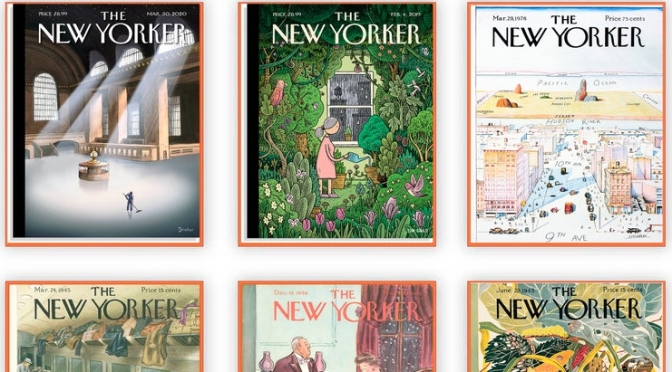
THE NEW YORKER MAGAZINE – SEPT. 1 & 8, 2025 PREVIEW

A GIF switching the profiles of the dandy Eustace Tilley and the artist Condy Sherman.

THE NEW YORKER MAGAZINE: The latest cover features ‘Cindy Sherman’s and Rea Irvin’s Eustace Tilley – A special nod to celebrate a centenary of cultural coverage.

The Trump Administration’s Efforts to Reshape America’s Past

Ahead of next year’s two-hundred-and-fiftieth anniversary of the Declaration of Independence, the White House has issued a directive to the Smithsonian. By Jill Lepore

A.I. Is Coming for Culture

We’re used to algorithms guiding our choices. When machines can effortlessly generate the content we consume, though, what’s left for the human imagination? By Joshua Rothman

How a Billionaire Owner Brought Turmoil and Trouble to Sotheby’s

Patrick Drahi made a fortune through debt-fuelled telecommunications companies. Now he’s bringing his methods to the art market. By Sam Knight

Cervantes in the Cave — The Art of Illusion

From Lepanto to Algiers to Seville, he recast Plato’s cave: instead of fleeing, he trimmed the wick—using comedy and narrative to make honest light out of shadow.

By Michael Cummins, Editor, August 22, 2025

In a cave in Argamasilla de Alba, Spain, a man sits hunched over a manuscript. The air is damp; the light keeps deciding what to keep. He writes not with the flourish of a court poet but with the urgency of someone who has known confinement—who has lived among shadows and learned to speak their language. The man is Miguel de Cervantes. The cave, according to local legend, is where he began Don Quixote. Whether the story is true hardly matters. The image endures: Cervantes, imprisoned, wounded, obscure, writing the book that would fracture the very idea of literary realism.

He breaks the silence first, as if talking to the walls. “Engendrado en una cárcel, donde toda incomodidad tiene su asiento,” he says—begotten in a prison, where every discomfort keeps its chair. He smiles at his own choice of verb. Begotten. It gives hardship hands.

A foot scuffs the threshold. Mateo steps into the half-light, a fellow freed captive from a life the two men still carry like a watermark. He takes the cave in at a glance—the whitewash, the barred slit of window, the stone bench that knows the shape of a tired back.

“You write in the dark, Miguel,” Mateo says. “Still chasing shadows?”

“Not chasing,” Cervantes replies, without looking up. “Refracting. These shadows are more honest than the sunlit lies of court and empire.”

Plato’s prisoners mistook flicker for fact. Cervantes has no such innocence; he knows exactly what light can do and what it cannot. In Algiers he learned the cost of sunlight and the uses of a candle. “We invented stories to survive,” he says. “We imagined rescue. We became authors of unreality. And in doing so, we learned how unreality works.”

He had boarded a homeward ship in 1575 and sailed straight into a profession he did not apply for. Corsairs took the vessel. Letters of recommendation—ironically the very proof of his merit—made him valuable. Algiers swallowed him for five years. Four escape attempts, each with its choreography of bribes, whispers, and night boats, failed in turn; punishments followed with bureaucratic punctuality. In the baños he organized fellow captives, staged plays that felt like oxygen rations, and discovered a kind of command that requires neither rank nor drumrolls. The lesson was not transcendence. It was texture. Captivity did not reveal some pure, sunlit truth; it revealed illusion’s machinery: how shadows are cast, how they persuade, how they can be turned from weapon into instrument.

“So you believe captivity reveals truth?” Mateo asks.

“No,” Cervantes says. “It reveals illusion. But if you know you’re in a cave, illusion can be honest about itself.”

He speaks like a man who has balanced too many ledgers and decided to keep one for the soul. In his prologue to the Exemplary Novels he would boast with a craftsman’s pride: mías propias, no imitadas ni hurtadas—my own pieces, not imitated or stolen. After a life in which other people held the keys, authorship felt like a kind of lawful possession. He is not naïve about it; theft will come in a thousand copies. Still, he plants his flag in sentences.

Mateo lowers himself onto the bench. The cave keeps its cool.

“Begin earlier,” Mateo says softly. “Begin with the wound.”

Cervantes nods, as if paging back. “Lepanto,” he says. “Two shots to the chest, one to the hand. El mayor bien que me vino. The greatest favor that came to me.”

Mateo laughs—a short, incredulous bark. “Favor?”

“A hand is a tool,” Cervantes says, flexing his right, letting the left sleeve fall into its gentle emptiness. “So is a story. One broke and taught the other its work. I learned that honor is not trumpets; it is the bruise that stays after the sound goes.”

“What did it smell like—the battle?” Mateo asks, because some questions insist.

“Oak and salt and a fire that wandered,” Cervantes says. “The sea keeps bad accounts—always debits, never balance. We threw our bodies at its ledger and called it glory. I got a bill I could live with.”

The cave changes its mind about brightness by a single shade. Light climbs a little higher on the wall, as if memory has a temperature.

“After Algiers,” Mateo says, “you came home to paper.”

“To paper and suspicion,” Cervantes answers. “Spain wanted receipts more than epics.” He became a purchasing agent, then a tax collector—the sort of work that presses humility into a man’s pockets and takes the lint besides. A banker fell in Seville and the ground gave way beneath him. Jail happened the way weather happens. Bureaucracy, he discovered, is a prison with nicer pens.

He thumps the palm of his right hand on the bench, a quiet imitation of a ledger closing. “Always the same sum,” he says. “Loyalty plus wounds equals suspicion.”

“That arithmetic,” Mateo says, “taught you comedy.”

“It taught me instruments,” Cervantes corrects gently. “Comedy is a surgeon’s knife you can carry in public.”

He had tried other rooms. La Galatea (1585), a pastoral romance, sighs under painted trees and speaks expertly in a fashionable voice—too expertly for a man who had learned to breathe in iron. “A ceiling too low for the lungs,” he says. Failure did not embarrass him; it emancipated him. “I loved what books promised. I wrote the promise’s correction.”

“And then you choose another cave,” Mateo says, looking around.

“This time I brought the candle.” Cervantes nods at the stub trembling in its dish. “The cave is not a prison if you know you’re inside it. Fiction is not delusion if you wield it knowingly.”

“Is that freedom?” Mateo asks. “To live in fiction?”

Cervantes answers with a line he will later put in a knight’s mouth because knights carry sentences farther than taxmen do. “La libertad, Sancho, es uno de los más preciosos dones…” Freedom, Sancho, is one of the most precious gifts. He lets the clause hang and then adds the counterweight: captivity is the greatest evil. “But there is a third thing,” he says. “The discipline of the wick. Not everyone reaches the sun. Many of us live by hearth-light. So make the hearth honest.”

He laughs, not kindly but not unkindly, at the memory of a barber’s basin mistaken for a helmet. “A basin can be a helmet,” he says, “if the story is honest about the trick.” The joke is not cruelty; it’s consent. Illusions that confess their wages are allowed to work.

“You sound like Plato’s least obedient pupil,” Mateo says. “He wants the prisoner out of the cave. You stay.”

“Plato had less practice with caves,” Cervantes says. “I stay and trim the wick.”

The man who stays in the cave can tell you about the cost of zeal. He knows what happens when mercy runs faster than attention: chaos dresses up as freedom. He has written a scene in which a knight frees a chain gang of galley slaves with a fine speech and a flash of temper, and the liberated—unbriefed on narrative responsibility—repay the favor with stones. “Pity without comprehension,” he says, “is a door swinging in a storm. Freedom without narrative becomes a mess that lets tyrants say, ‘You see? Chains keep order.’”

Mateo’s eyes drift toward a wooden head in the corner, painted eyes arrested mid-glance. “Master Pedro,” Cervantes says, amused at the prop the cave has supplied. He tells the story of a puppet theater, a knight who cannot bear strings, a sword that corrects an illusion into splinters. Even illusions keep accounts, he reminds Mateo. Someone pays for the pleasure. “In that scene,” he says, “I taxed zeal. I sent the bill to laughter.”

“So your book is a theater?” Mateo asks.

“A theater that shows its ropes,” Cervantes says. “A historian with a wink in his ink. A narrator who argues with me, and I with him. A false sequel enters the room, and I absorb him into the play. If illusion is a crime, let the evidence be visible. If it is a craft, let the strings show and the audience decide.”

He keeps his quotes short and to the point, letting them behave like tools rather than trophies. “Yo sé quién soy,” he says, not to boast but to set a boundary—I know who I am. “And I know what I am not. I am not the sun. I am a candle with a good memory.”

Memory is a troublesome servant. “¡Oh memoria, enemiga mortal de mi descanso!,” he mutters with theatrical exasperation—Oh memory, mortal enemy of my rest—knowing full well he cannot do without her. In the deepest fold of the book he is writing, he lowers his knight into the Cave of Montesinos and gives him a private vision no one can verify. Minutes pass in the world; days unfold in the cave. Readers will fight about that descent for centuries: lie or parable? He shrugs. The rope held. The telling is what matters.

“What about truth?” Mateo asks. “You dodge it like a matador.”

“Truth is errant,” Cervantes says. “Like my knight. It wanders, stumbles, reinvents itself. La verdad adelgaza y no quiebra—truth thins but does not break. It lives in the flicker between shadow and flame.” He aims for a truth you can sit with, not a blaze you must worship. Even now, when the cave dims or brightens by a breath, he adjusts nothing in his voice. He trusts the room to keep up.

The room has heard other versions of this life. Soldier, captive, clerk, failed author—the catalogue is accurate and useless until you give it breath. He has learned that a life of refusals and humiliations can be rearranged into a lamp. “El que lee mucho y anda mucho, ve mucho y sabe mucho,” he says with a grin—he who reads much and travels much sees much and knows much—and Mateos’s chuckle bounces off the whitewash and returns as agreement.

If the cave is a theater, it is also a workshop. He places three objects on the bench as if laying out tools: a frayed rope (failed escape; lesson kept), a ledger (bureaucracy’s Bible, now a prop for comedy), and the puppet head (illusion, demystified and retained). He sets the rope across the ledger like a sash and props the puppet against both like a child asleep between two patient adults.

“You’re staging your own life,” Mateo says.

“Everything I own appears in my books,” Cervantes answers. “Better to put them to work than let them gather dust.”

He will put even injury to work. He has already done it. “There is no book so bad that it does not have something good,” he says—No hay libro tan malo que no tenga algo bueno—and he means, among other things, his own early efforts. He tried the fashion and failed; he learned to write beyond it. The failure cleared the room.

“And the counterfeit?” Mateo asks. “The other Quixote?”

“I made room,” Cervantes says, not quite happily. He doesn’t bother to call the rival by name. “I let the counterfeit into Part II and gave him the dignity of being wrong on the page. It is the politest way to win.”

Outside, late afternoon arranges itself. Inside, the candle practices its small weather. The conversation acquires the unhurried gravity of men who have been forced to wait before and know that waiting can be made useful. They speak of the Información de Argel—the sworn testimonies that stitched a biography out of scars and courage; of the petition to the Council of the Indies that asked for four possible offices across the ocean and delivered no; of Seville’s auditoriums of suspicion where a man could do arithmetic all day and still owe.

“You turned all that into a style,” Mateo says.

“I turned it into a temperament,” Cervantes corrects. Style is the residue. The temperament is the choice: to stay in the cave and make the light adjustable; to refuse the panic of transcendence in favor of the patience of attention; to let laughter be a form of moral accounting. “I wanted a book in which the strings show,” he says. “So when someone pulls, we know who is moving what.”

He reaches for the candle with wetted fingers and trims the wick. The flame tightens, steadies, sharpens the edges of the room with a surgeon’s manners. The gesture is mundane and feels like a thesis.

“Why not flee?” Mateo asks one last time, because some questions return until answered in the body.

“Because someone must tend the flame,” Cervantes says. “Because most people live by hearth-light. Because the cave tells the truth about limits, and I prefer honest rooms to lying palaces.”

He stands, and the bench acknowledges the change with a creak that has learned both complaint and loyalty. He touches the stone with the backs of his fingers, as one does a sleeping child. The puppet keeps its round attention. The rope adopts its length. The ledger decides to be heavy again.

“Begin,” Mateo says, suddenly shy of making a ceremony of it.

“I did,” Cervantes answers, and returns to his page.

He writes the opening lines of Don Quixote as the candle throws a peninsula of light bordered by ink. A poor gentleman with a head full of books starts out into a world that will bruise him into philosophy. A squire with a sack of proverbs learns to spend them one by one, after listening. Windmills declare their innocence; a basin negotiates a new title. Dukes turn out to be children who have learned cruelty by playing. Priests explain themselves into farce. Puppets are freed to their ruin, then repaired by a writer who has learned to apologize with laughter.

Cervantes does not flee illusion; he illuminates it. He does not reject reality; he reframes it. He does not promise truth; he escorts it, errant and sturdy, through rooms with honest walls. He turns shadows into stories and stories into a way of seeing that does not blind. He has stayed where Plato urged ascension and found, by staying, a different kind of ascent: the climb of attention, the charity of proportion, the courage to let strings show and still believe in the show.

Unlike Plato’s prisoner, Cervantes remains in the cave. He writes. He refracts. He talks to the walls and to the future, and both answer. His broken hand, his captive mind, his errant knight—everything he survived and everything he invented—gathers in the small weather of a candle and becomes, against all instruction, a form of daylight.

THIS ESSAY WAS WRITTEN AND EDITED UTILIZING AI

TIMES LITERARY SUPPLEMENT – AUGUST 22, 2025 PREVIEW

TIMES LITERARY SUPPLEMENT: The latest issue features Lawrence Durrell, “so many towns” that could “become Alexandria” – “founded”, as indeed so many were, “At the doors of Africa”, “Upon a parting”. Yet what other town could boast of anything to compare with that “last pale / Lighthouse”, the Pharos of Alexandria, “like a Samson blinded”?

Family of fabulists

Literary myth-making, from Alexandria to Corfu By Jonathan Keates

‘Celestial walnuts’

The pleasures and challenges of making – and describing – great wines By George Berridge

The path to Rome

Investigating the deathbed conversion of Oscar Wilde By Richard A. Kaye

More, now, again

To what extent are addicts responsible for their actions? By Crispin Sartwell

THE NEW YORKER MAGAZINE – AUGUST 25, 2025 PREVIEW

A child draws on a man's tattooed arm.

THE NEW YORKER MAGAZINE: The latest cover features ‘Sergio García Sánchez and Lola Moral’s “Artist in Training”

Pam Bondi’s Power Play

Donald Trump now has the Attorney General he always wanted—an ally willing to harness the law to enable his agenda. By Ruth Marcus

Trump Sends in the National Guard

Is the President’s takeover of D.C. a dry run for other cities? By Margaret Talbot

Bill Belichick Goes Back to School

Can the legendary former Patriots coach transform U.N.C. football? By Paige Williams

The Family Fallout of DNA Surprises

Through genetic testing, millions of Americans are estimated to have discovered that their parents aren’t who they thought. The news has upended relationships and created a community looking for answers. By Jennifer Wilson

THE COURAGE TO QUESTION: HOW AN EMPIRE WAS BUILT

By Michael Cummins, Editor, August 16, 2025

The memory of the Islamic Golden Age evokes powerful images: Baghdad’s legendary House of Wisdom, a beacon of scholarship for the world’s greatest minds; the astronomical observatories of Samarkand, mapping the heavens with unprecedented precision; the grand libraries of Córdoba, containing more books than all of Europe combined. For roughly five centuries, from the 8th to the 13th, the Islamic world was the undisputed global epicenter of science, philosophy, and culture. Its innovations gifted humanity algebra and algorithms, advanced surgical techniques, and the classical Greek philosophy that would later fuel the European Renaissance.

This flourishing was no accident. It was the direct result of a powerful, synergistic formula: the fusion of a voracious, institutionalized curiosity with strategic state patronage and a climate of relative tolerance. Yet, its eventual decline offers an equally crucial lesson—that such a vibrant ecosystem is fragile. Its vitality is contingent on maintaining an open spirit of inquiry, the closing of which precedes stagnation and decay. The story of the Islamic Golden Age, told through its twin centers of Baghdad and Córdoba, is therefore both an inspiring blueprint for civilizational greatness and a timeless cautionary tale of how easily it can be lost.

The Engine: A Genius for Synthesis

The foundation of the Golden Age was its genius for synthesis. It was an institutionalized curiosity that understood new knowledge is forged by actively seeking out, challenging, and combining the wisdom of others. As the scholar Dimitri Gutas argues in his seminal work, Greek Thought, Arabic Culture, this was not a random burst of energy but a deliberate, state-sponsored project driven by the “social and political imperatives of a new empire.” The Abbasid Caliphs, having established their capital in Baghdad in 762, sat at the crossroads of the Persian, Byzantine, and Indian worlds. Rather than view the intellectual traditions of these conquered or rival lands as a threat, they saw them as an invaluable resource for building a universalist imperial ideology.

This conviction gave rise to the Translation Movement, a massive, state-funded effort to translate the great works of science, medicine, and philosophy into Arabic. The nerve center of this project was Baghdad’s House of Wisdom (Bayt al-Hikmah). Far more than a library, it was a dynamic academy, a translation bureau, and a research institute where scholars from across the known world collaborated.

Their goal was never mere preservation. As the historian George Saliba demonstrates, they were active innovators who critically engaged with, corrected, and vastly expanded upon ancient texts. Ptolemy’s astronomical model in the Almagest was not just translated; it was rigorously tested in new observatories, its mathematical errors identified, and its cosmological assumptions challenged by thinkers like Ibn al-Haytham (Alhazen), whose work on optics overturned centuries of classical theory.

He did not simply import knowledge; he synthesized it into something new.

This process created a powerful intellectual alchemy. In mathematics, Muhammad ibn Musa al-Khwarizmi, a Persian scholar at the House of Wisdom, encountered the revolutionary numeral system from India, which included the concept of zero. He fused this with the geometric principles of the Greeks to create a new discipline he outlined in his landmark book, The Compendious Book on Calculation by Completion and Balancing. From the title’s key term, al-jabr (‘completion’ or ‘restoring’), the world received algebra—a tool for abstract problem-solving that would transform the world.

This same engine of synthesis, fueled by a competitive spirit, was humming thousands of miles away in Al-Andalus. In its capital, Córdoba, the physician Al-Zahrawi (Abulcasis), often called the father of modern surgery, compiled the Al-Tasrif, a thirty-volume medical encyclopedia. It was a monumental synthesis of classical medical knowledge with his own pioneering innovations, introducing the use of catgut for internal stitches and designing dozens of new surgical instruments that would define European medical practice for centuries. In philosophy, the Córdoban thinker Ibn Rushd (Averroes) produced radical commentaries on Aristotle that were so influential he became known simply as “The Commentator” in medieval Europe. He sought to demonstrate that reason and revelation were not in conflict but were two paths to the same truth, a bold intellectual project that would profoundly reshape Western scholasticism.

The Fuel: Strategic Investment in Knowledge

This intellectual engine was deliberately and lavishly fueled by rulers who saw investment in knowledge as a cornerstone of state power, prestige, and practical advantage. The immense wealth of the Abbasid Caliphate, derived from its control of global trade routes, made this grand-scale patronage possible. This power was materialized in Baghdad itself, Caliph al-Mansur’s perfectly circular “City of Peace,” an architectural marvel with the caliph’s palace and the grand mosque at its absolute center, symbolizing his position as the axis of the world. Later Abbasid palaces were sprawling complexes of exquisite gardens, cool marble halls, and courtyards filled with intricate fountains and exotic animals—dazzling stages for courtly life where poets, musicians, and scholars vied for the caliph’s favor.

It was within these opulent settings that legendary patrons like Harun al-Rashid and his son, al-Ma’mun, held court. Al-Ma’mun, a rationalist thinker himself, is said to have been inspired by a dream in which he conversed with Aristotle. He poured vast resources into the House of Wisdom, funding expeditions to Byzantium to acquire rare manuscripts and reportedly paying translators their weight in gold.

This model of state-sponsored knowledge was pursued with competitive fervor in Al-Andalus. In Córdoba, the Umayyad Caliph Abd al-Rahman III sought to build a capital that would eclipse all rivals. A few miles outside the city, he constructed a fabled palace-city, Madinat al-Zahra (“the shining city”). It was a breathtaking statement of power, built in terraces on a mountainside with thousands of imported marble columns. Its audience chambers were adorned with ivory and ebony, and at the center of the most magnificent hall lay a basin filled with shimmering quicksilver, which, when agitated, would flood the room with dazzling reflections of light.

This was a “war of culture” in which libraries were arsenals and palaces were declarations of supremacy. It was in this environment that Al-Hakam II, Abd al-Rahman’s son, amassed his legendary library of over 400,000 volumes, a beacon of knowledge designed to outshine Baghdad itself. This rivalry between distant capitals created a powerful ecosystem for genius, establishing a lasting infrastructure for discovery that attracted the best minds from every corner of the globe.

The Superpower: Pragmatic and Inclusive Tolerance

The era’s intellectual and financial investments were supercharged by a climate of relative tolerance. This was not a modern, egalitarian pluralism, but a practical and strategic inclusion that prevented intellectual monocultures and proved to be a civilizational superpower. As María Rosa Menocal writes in The Ornament of the World, this was a culture capable of a “first-rate pluralism,” where contradictions were not just tolerated but were often the source of creative energy.

The work of the Golden Age was a multi-faith and multi-ethnic endeavor. In Baghdad, the chief translator at the House of Wisdom and the most important medical scholar of his time, Hunayn ibn Ishaq, was a Nestorian Christian. A master of four languages—Syriac, Arabic, Greek, and Persian—he established a rigorous methodology, collecting multiple manuscript versions of a text to ensure the most accurate translation. For generations, Christian physicians from the Bakhtishu’ family served as personal doctors to the Abbasid caliphs.

This principle was just as potent in the West. In Córdoba, the court of Abd al-Rahman III thrived on the talents of figures like Hasdai ibn Shaprut, a Jewish physician and scholar who rose to become the caliph’s most trusted diplomat and vizier. He not only managed foreign policy but also used his position to patronize Hebrew poets and grammarians, fostering a golden age of Jewish culture that flourished in the heart of Islamic Spain. This was made possible by the dhimmi (protected peoples) system, which, while hierarchical, guaranteed non-Muslims the right to practice their faith and participate in intellectual life. In the realms of science and philosophy, merit and skill were often the ultimate currency. This diversity was the Golden Age’s secret weapon.

The Cautionary Tale: The Closing of the Mind

The Golden Age did not end simply with the hoofbeats of Mongol horses in 1258. Its decline was a prolonged grinding down of the audacious spirit of open inquiry. The Mongol sack of Baghdad was a devastating blow, but it struck a body already weakened by an internal intellectual malaise.

This cultural shift is often symbolized by the brilliant 11th-century theologian, Abu Hamid al-Ghazali. His influential critique of Hellenistic philosophy, The Incoherence of the Philosophers, was not an attack on reason itself—he was a master of it, who championed Aristotelian logic as a necessary tool for theology. Rather, it was a powerful argument against what he saw as the metaphysical overreach of philosophers on matters that he believed could only be known through divine revelation. His work, however, was a symptom of a decisive cultural turn. The intellectual energy of the elite, and the patronage that supported it, began to be re-channeled—away from speculative, open-ended philosophy (falsafa) and towards the preservation and systematization of established religious doctrine.

The central questions shifted from “What can we discover?” to “How do we defend what we know?”

This was compounded by political fragmentation. As the central authority of the Abbasid Caliphate waned, insecure local rulers, like the Seljuk Turks, increasingly sought legitimacy by patronizing conservative religious scholars. Funding flowed toward madrasas focused on theology and law rather than independent scientific academies. When a culture begins to fear certain questions, it loses its ability to generate new answers. The great North African historian Ibn Khaldun, writing in the 14th century from the ruins of this intellectual world, diagnosed the decline with stunning clarity in his Muqaddimah. He observed that when civilizations become too comfortable and focused on preserving past glories, they lose the “group solidarity” and intellectual dynamism that made them great. This growing intellectual rigidity created a civilizational brittleness, leaving it vulnerable to catastrophic external shocks.

Conclusion: A Timeless Blueprint

The legacy of the Islamic Golden Age is a double-edged one. Its rise in both the East and West provides a clear blueprint for greatness, built on relentless curiosity, wise patronage, and pragmatic inclusion. This formula demonstrates that progress is a product of openness and investment. Its decline, however, is a stark warning. The erosion of that most crucial pillar—the open, questioning mind—preceded the civilization’s fall.

The essential lesson of this epic is that culture precedes power. The wealth, military strength, and political influence of the caliphates were not the cause of the Golden Age; they were the result of a culture confident enough to be curious, strong enough to tolerate dissent, and wise enough to invest in knowledge. The engine of its greatness was not the treasury, but the House of Wisdom and the Library of Córdoba. Consequently, its decline was not merely a political or military failure, but the late-stage symptom of an intellectual culture that had begun to value orthodoxy over inquiry. When the questions stopped, the innovations stopped, and the foundations of power crumbled from within.

This narrative is not a historical artifact. It is a timeless blueprint, revealing that the most critical infrastructure any society can build is not made of stone or steel, but of the institutions and values that protect and promote the open pursuit of knowledge. In our modern world, the House of Wisdom finds its echo in publicly funded research universities, in international scientific collaborations, and in the legal frameworks that protect free speech and intellectual inquiry. The patronage of al-Ma’mun is mirrored in the grants that fund basic research—the kind of open-ended exploration that may not have an immediate commercial application but is the seedbed of future revolutions. The tolerance of Córdoba is the argument for diversity in our labs, our boardrooms, and our governments, recognizing that a multiplicity of perspectives is not a liability to be managed, but a strategic asset that fuels innovation.

The open secret of the Golden Age is therefore not a secret at all, but a choice. It is the choice to believe that greatness is born from the courage to question, to synthesize, and to explore. It is the choice to see knowledge not as a finite territory to be defended, but as an infinite ocean to be discovered. The moment a society decides it already has all the answers—the moment it values certainty over curiosity—is the moment its decline becomes inevitable.

THIS ESSAY WAS WRITTEN AND EDITED UTILIZING AI

SHAKESPEARE’S STAGE: WHEN THE MIND OVERHEARS ITSELF

By Michael Cummins, Editor, August 15, 2025

There is a moment in the history of the theater, and indeed in the history of consciousness itself, when the stage ceased to be merely a platform for action and became a vessel for thought. Before this moment, a character might speak their mind to an audience, but the thoughts were settled, the intentions declared. After, the character began to speak to themselves, and in doing so, they changed. They were no longer merely revealing a plan; they were discovering it, recoiling from it, marveling at it, and becoming someone new in the process.

This revolution was the singular invention of William Shakespeare. The literary critic Harold Bloom, who argued it was the pivotal event in Western consciousness, gave it a name: “self-overhearing.” It is the act of a character’s mind becoming its own audience. For Shakespeare, this was not a theory of composition but the very mechanism of being. He placed a theater inside his characters’ minds, and on that internal stage, they overheard the whispers of their own souls.

This interior drama, this process of a consciousness listening to itself, is the molten core of Shakespearean tragedy. It grants his characters a psychological autonomy that feels startlingly, sometimes terrifyingly, modern. While this technique permeates his work, it finds its most potent expression in three of his greatest tragic figures. Through them, Shakespeare presents a triptych of the mind in conflict. In Hamlet, we witness the intellectual paralyzed by the sheer polyphony of his own consciousness. In Iago, we find the chilling opposite: a malevolent artist who overhears his own capacity for evil and gleefully improvises a script of pure destruction. And in Macbeth, we watch a noble soldier become an audience to his own corruption, mesmerized and horrified by the murderous voice his ambition has awakened. Together, these three characters map the frontiers of human consciousness, demonstrating that the most profound tragedies unfold not in castles and on battlefields, but in the silent, echoing theater of the mind.

Hamlet: The Consciousness in Crisis

Hamlet is not merely a character; he is a consciousness. More than any figure in literature, he exists as a mind in perpetual, agonizing conversation with itself. His tragedy is not that he must avenge his father, but that he must first navigate the labyrinth of his own thoughts to do so. His soliloquies are not statements of intent but sprawling, recursive processes of self-interrogation. He is the ultimate self-overhearer, and the voice he listens to is so articulate, philosophically nuanced, and relentlessly self-critical that it becomes a prison.

From his first soliloquy, we see a mind recoiling from a world it cannot stomach. He laments the “unweeded garden” of the world, wishing:

O, that this too too solid flesh would melt,
Thaw and resolve itself into a dew!

 Hamlet, 1.2.129-130

After his encounter with the Ghost, the theater of his mind becomes a chamber of horrors. He overhears not just a command for revenge, but a shattering revelation about the nature of reality itself, concluding that “one may smile, and smile, and be a villain” (Hamlet, 1.5.108). This overheard truth—that appearance is a stage and humanity is a performance—becomes a cornerstone of his own psyche, prompting his decision to put on an “antic disposition.”

Charged with a task demanding bloody action, Hamlet’s consciousness instead turns inward, staging a debate that consumes the play. In his most famous soliloquy, he puts existence itself on trial: “To be, or not to be: that is the question.” This is not a man deciding whether to live or die; it is a mind listening to its own arguments for and against being. He weighs the “slings and arrows of outrageous fortune” against the terrifying uncertainty of “the undiscover’d country from whose bourn / No traveller returns.” The voice of his intellect, he concludes, is what “puzzles the will,” making it so that “conscience does make cowards of us all” (Hamlet, 3.1.56-83). He overhears his own fear and elevates it into a universal principle.

This intellectual paralysis is born of his relentless self-analysis. After watching an actor weep for the fictional Hecuba, Hamlet turns on himself in a fury of self-loathing, beginning with, “O, what a rogue and peasant slave am I!” He overhears his own inaction and is disgusted by it, mocking his tendency to talk instead of act:

Why, what an ass am I! …
That I, the son of a dear father murder’d,
Prompted to my revenge by heaven and hell,
Must, like a whore, unpack my heart with words.

— Hamlet, 2.2.583-586

He is both the speaker and the critic, the actor and the audience, caught in a feedback loop of thought, accusation, and further thought. Hamlet’s mind is a stage where the drama of consciousness perpetually upstages the call to action; the performance is so compelling he cannot bring himself to leave the theater.

Iago: The Playwright of Evil

If Hamlet’s self-overhearing leads to a tragic paralysis, Iago’s is the engine of a terrifying and creative evil. Where Hamlet’s mind is a debating chamber, Iago’s is a workshop. He is Shakespeare’s most chilling villain precisely because his villainy is an act of artistic improvisation. In his soliloquies, we do not witness a man wrestling with his conscience; we witness a playwright brainstorming his plot, listening with detached delight to the diabolical suggestions of his own intellect. He overhears the whispers of a motiveless malignity and, finding them intriguing, decides to write them into being.

Iago’s supposed motives for destroying Othello are flimsy and interchangeable. He first claims to hate the Moor for promoting Cassio. Then, he adds a rumor: “it is thought abroad, that ‘twixt my sheets / He has done my office” (Othello, 1.3.387-388). He presents this not as fact, but as a passing thought he chooses to entertain, a justification he can try on, resolving to act “as if for surety.” Where Hamlet desperately seeks a single, unimpeachable motive to act, Iago casually auditions motives, searching only for one that is dramatically effective. He is listening for a good enough reason, and when he finds one, he seizes it not with conviction but with artistic approval.

His soliloquies are masterclasses in this dark creativity. At the end of Act I, he pauses to admire his burgeoning plot. “How, how? Let’s see,” he muses, like an artist sketching a scene. “After some time, to abuse Othello’s ear / That he is too familiar with his wife.” The plan flows from him, culminating in the famous declaration:

Hell and night
Must bring this monstrous birth to the world’s light.

 Othello, 1.3.409-410

Later, he marvels at the tangible effect of his artistry, watching his poison corrupt Othello’s mind and noting with clinical detachment, “The Moor already changes with my poison: / Dangerous conceits are, in their natures, poisons” (Othello, 3.3.325-326). He is not just the playwright, but the rapt critic of his own unfolding drama. He steps outside of himself to admire his own performance as “honest Iago,” listening with applause to his own deceptive logic. This is the chilling sound of a consciousness with no moral compass, only an aesthetic one. It overhears its own capacity for deception and finds it beautiful. Iago is the playwright within the play, and the voice he hears is that of the void, whose suggestions he finds irresistible.

Macbeth: The Audience to Corruption

In Macbeth, we witness the most visceral and terrifying form of self-overhearing. He is a man who hears two voices within himself—that of the loyal thane and that of a murderous usurper—and the play charts his horrifying decision to listen to the latter. Unlike Hamlet, he is not paralyzed, and unlike Iago, he takes no pleasure in his dark machinations. Macbeth is an unwilling audience to his own ambition. He overhears the prophecy of his own moral decay and, though it terrifies him, cannot bring himself to walk out. His tragedy is that of a man who watches himself become a monster.

Our first glimpse into this internal battle comes after he meets the witches. Their prophecy is a “supernatural soliciting” that he reveals in an aside, a moment of public self-overhearing: “This supernatural soliciting / Cannot be ill, cannot be good” (Macbeth, 1.3.130-131). He listens as his mind debates the proposition. If it’s good, why does he yield to a suggestion:

Whose horrid image doth unfix my hair
And make my seated heart knock at my ribs,
Against the use of nature?

 Macbeth, 1.3.135-137

He is already a spectator to his own treasonous thoughts. The voice of ambition conjures the murder of Duncan, and his body reacts with visceral terror. The most profound moment of this internal drama is the “dagger of the mind” soliloquy. Here, Macbeth is a captive audience to his own murderous intent. “Is this a dagger which I see before me, / The handle toward my hand?” he asks, knowing it is a “dagger of the mind, a false creation, / Proceeding from the heat-oppressed brain” (Macbeth, 2.1.33-39). He is watching his own mind project its bloody purpose into the world; he overhears his own resolve and sees it take physical form.

After the murder, the voice he overheard as temptation becomes an inescapable torment. His consciousness broadcasts its own verdict—“Sleep no more! / Macbeth does murder sleep” (Macbeth, 2.2.35-36)—and he has no choice but to listen. This torment is soon joined by a chilling, logical self-appraisal. He overhears his own entrapment, recognizing that the only path forward is through more violence:

I am in blood
Stepp’d in so far that, should I wade no more,
Returning were as tedious as go o’er.

 Macbeth, 3.4.136-138

His tragedy culminates in his final soliloquy, where, upon hearing of his wife’s death, he overhears the voice of utter despair: “Tomorrow, and tomorrow, and tomorrow, / Creeps in this petty pace from day to day…” (Macbeth, 5.5.19-20). It is his own soul pronouncing its damnation, the final, devastating judgment on a life spent listening to the wrong voice.

Conclusion

The soliloquy, in Shakespeare’s hands, became more than a dramatic convention; it became a window into the birth of the modern self. Through the radical art of self-overhearing, he transformed characters from archetypes who declared their nature into fluid beings who discovered it, moment by moment, in the echo chamber of their own minds.

Hamlet, Iago, and Macbeth stand as the titanic pillars of this innovation. Hamlet’s mind is a storm of intellectual static, a signal so complex it jams the frequency of action. Iago tunes his ear to a darker station, one that transmits pure malignity, and becomes a gleeful conductor of its chaotic symphony. Macbeth, most tragically, is trapped between stations, hearing both the noble music of his better nature and the siren song of ambition, and makes the fatal choice to listen to the latter until it is the only sound left.

In giving his characters the capacity to listen to themselves, Shakespeare gave them life. He understood that identity is not a fixed point but a constant, fraught negotiation—a dialogue between the self we know and the other voices that whisper of what we might become. By staging this internal drama, he invented a new kind of tragedy, one where the fatal flaw is not a trait, but the very process of thought itself. We return to these plays again and again, not merely as an audience, but to witness the terrifying and beautiful spectacle of a soul becoming an audience to itself.

THIS ESSAY WAS WRITTEN AND EDITED UTILIZING AI

The Multi-Faith Prosperity Of 10th-Century Córdoba

By Michael Cummins, Editor, August 13, 2025

While much of Christian Europe was mired in the intellectual and economic stagnation of the so-called “Dark Ages,” 10th-century Córdoba, the capital of the Umayyad Caliphate of al-Andalus, blazed as a singular exception in the medieval world. It was not merely its population of over 250,000, its paved streets, or its public baths that made it a marvel. The true marvel of Córdoba lay in its unprecedented model of intellectual and economic collaboration, a model that harnessed the talents of its diverse Muslim, Jewish, and Christian populations. While modern historians like [suspicious link removed] have rightly challenged the romanticized notion of a perfect convivencia—or coexistence—there is no denying that the collective contributions of its Jewish and Christian communities were not peripheral. They were, in fact, integral to the caliphate’s rise as a preeminent power, forging a society so unique that it stands apart in human history.

This era’s success was a testament to a pragmatic, collaborative environment. As scholar María Rosa Menocal eloquently argued in her book, The Ornament of the World, the period was defined by a culture where “tolerance was an inherent aspect of Andalusian society,” allowing for an extraordinary degree of exchange and innovation. In this multi-faith environment, Jewish and Christian communities were not simply tolerated subjects; they were indispensable collaborators. Their contributions were so intertwined with the caliphate’s achievements that its success would have been impossible without them. This collaborative ethos also extended to the roles of women, who, despite the era’s patriarchal legal framework, rose to prominence as scholars, poets, scribes, and even political figures, further enriching the city’s intellectual and cultural life.


The Engine of Scholarship: A Shared Knowledge Base

The intellectual life of 10th-century Córdoba was a testament to the power of a shared, multilingual knowledge base, a system that was virtually without parallel in the medieval world. The Umayyad rulers, particularly Caliph al-Hakam II, created the institutional framework for learning. A dedicated bibliophile, al-Hakam II amassed a caliphal library that some sources claim numbered as many as 400,000 volumes, commissioning scribes and bookbinders to produce new copies.

While monastic libraries in Christian Europe contained only a few hundred manuscripts, often focused on religious dogma, the caliphal library was a dynamic workshop where scholars of all faiths worked side by side to translate ancient Greek and Latin texts, a process that preserved and expanded upon classical knowledge largely lost to the rest of Europe. The caliph’s agents were dispatched across the Islamic world and beyond to acquire rare manuscripts on every conceivable subject, from medicine and astronomy to poetry and philosophy.

The caliph’s patronage extended to a diverse group of intellectuals who curated the collection, and the role of women in this intellectual flowering was particularly striking. Among them was Lubna of Córdoba, a remarkable intellectual, poet, and mathematician who rose from slavery to become one of al-Hakam II’s most trusted secretaries, instrumental in the administration of the library itself. Her story is a powerful example of the city’s unique meritocratic ethos, where talent and intellect could transcend social barriers.

The contributions of women in scholarship were not limited to Lubna; records show that hundreds of women worked as professional scribes and copyists, transcribing books and manuscripts for the royal library. Beyond the library, the era produced celebrated female poets and scholars whose work was highly regarded, such as ‘A’isha bint Ahmad al-Qurtubiyya, a renowned poet and calligrapher, and the poet Wallada bint al-Mustakfi, famous for her sharp wit and love poems.

The Great Mosque of Córdoba served as the city’s de facto university, a hub of religious and secular learning where scholars and students from diverse backgrounds gathered for instruction. The caliphs funded chairs for distinguished professors, and the mosque’s courtyards provided a space for open intellectual exchange, fostering a culture of critical inquiry and debate. As Dr. Nowar Nizar Al-Ani and his colleagues noted, this institutional framework was designed to “foster a kind of intellectual pluralism that was revolutionary for its time.”

It was in this environment that Jewish and Christian scholars were not just conduits for old ideas but active contributors to new ones. The Jewish community, in particular, experienced a golden age under this system. Hasdai ibn Shaprut, a Jewish court physician and scholar, was at the forefront of medical research and botanical studies. He was also a major patron of Jewish intellectual life, sponsoring scholars and poets who would compose masterpieces of Hebrew literature and helping to establish Córdoba as a new center for Jewish scholarship, eclipsing the traditional academies in Baghdad.

This era also produced pioneering scientific advancements, such as those of the physician Abulcasis (Al-Zahrawi), a key figure of the late 10th century. He wrote a comprehensive 30-volume medical encyclopedia, Al-Tasrif, which was revolutionary for its detailed descriptions of surgical procedures and instruments, many of which he invented. His work would become a standard medical text in Europe for centuries, directly influencing the development of surgery.

The fusion of knowledge and faith led to a unique intellectual environment where, as Jerrilynn D. Dodds‘s edited volume, Al-Andalus: The Art of Islamic Spain, suggests, “the arts of the mind were as celebrated as the arts of the hand.” This collaborative spirit permeated scholarly life: a Christian monk might have been translating a Greek medical treatise in one corner of a library while a Jewish botanist analyzed a new plant in another. It was this cross-pollination of ideas, made possible by the linguistic and cultural fluency of the Christian and Jewish communities, that truly powered Córdoba’s intellectual engine.


The Foundation of Prosperity: Economic and Diplomatic Contributions

The wealth and political stability of the Umayyad Caliphate did not emerge in a vacuum; they were built on the contributions of its non-Muslim subjects, who served as a vital economic and diplomatic backbone. In a period when European feudal society was strictly hierarchical and exclusive, Córdoba’s pragmatic approach was historically unique.

The Jewish community was essential to Córdoba’s sophisticated diplomatic network, with its members highly valued for their linguistic skills and relative neutrality in disputes between Muslim and Christian rulers. The elevation of Hasdai ibn Shaprut to a position of such immense influence—a Jewish diplomat and physician serving as a key advisor to the caliph—was a political innovation without parallel in the medieval West. Fluent in Arabic, Hebrew, and Latin, Hasdai was an indispensable intermediary in diplomatic missions to Christian kingdoms like León and the Holy Roman Empire, skillfully navigating political tensions and securing alliances. He also served as the head of the Jewish community, centralizing cultural life in Córdoba and fostering its independence from the Jewish academies in Baghdad.

The economic engine of Córdoba was also powered by its minorities. The Jewish community was instrumental in the city’s robust international trade, acting as merchants and financiers. Their extensive networks across Europe and the Mediterranean were crucial to Córdoba’s commercial success, helping to establish trade routes that brought precious silks, spices, and other luxury goods into al-Andalus. This immense wealth funded the caliphate’s ambitious building projects. As L. P. Harvey notes in his work, Islamic Spain, 1250 to 1500, the caliphate’s political authority rested on a “pragmatic reliance on a professional class of civil servants, many of whom came from the dhimmi communities, whose loyalty and expertise were a cornerstone of the administrative apparatus.”

Christians, known as Mozarabs, also played critical, though often different, roles. While the highest offices were reserved for Muslims, some Christians rose to positions of influence. For example, a Christian cleric named Recemund served as a civil servant for ‘Abd al-Rahman III and even undertook a diplomatic mission to the Holy Roman Emperor, Otto I. However, the majority of the Christian population was essential to the agricultural economy in the surrounding rural areas. Their contributions as farmers and artisans, who continued many of the traditions and techniques from the Visigothic period, were fundamental to the food supply and wealth of the caliphate.


The Unique Fabric: Cultural and Artistic Synthesis

The artistic and cultural identity of 10th-century Córdoba was a magnificent tapestry woven from the threads of all three religions. The caliphs’ patronage of the arts led to a unique blending of styles that is most famously showcased in the Great Mosque. Its most significant and elaborate expansion, led by Caliph al-Hakam II, featured intricate polylobed arches, ribbed domes, and the lavish use of mosaics—a technique learned directly from Byzantine Christian craftsmen. According to the article “Historical restorations of the Maqṣūrah glass mosaics from the Great Mosque of Córdoba” by J. V. Tarín et al., the caliph specifically sought out Byzantine craftsmen, a profound act of cultural confidence that integrated Christian artistic tradition into the very heart of Islamic worship. In a world often defined by sectarian art, this was a revolutionary aesthetic vision.

Beyond the grand monuments, this cultural synthesis permeated everyday life. The “Mozarabic” style of art and architecture—a blend of Christian and Islamic design—flourished. Christian artisans were not only employed on royal projects but also developed their own unique style that incorporated elements of Islamic geometric patterns and calligraphy. This fusion was also evident in language and literature. Many Christians and Jews adopted Arabic as their language for daily life and scholarship, leading to a unique body of work where Jewish poets composed in a sophisticated Hebrew deeply influenced by Arabic meter and rhyme schemes. As the volume Al-Andalus: The Art of Islamic Spain captures, the art of the period was a “visual dialogue between cultures.” The result was a truly syncretic culture, a unique and irreplaceable expression of the people who created it.

The caliphate’s immense wealth also fueled a boom in refined artistic crafts. Cordoban artisans were celebrated for their skills in calligraphy, which adorned not only architecture but also the lavish ivory caskets and boxes that were prized possessions of the caliph’s court. These caskets, often carved with intricate scenes and calligraphic inscriptions, are a perfect example of how different artistic traditions were fused. Similarly, the city was famous for its fine metalwork, glazed tiles, and high-quality textiles, which were not only major economic drivers but also expressions of a sophisticated and cosmopolitan taste. The creation of the palatine city of Madinat al-Zahra, a new capital built by ‘Abd al-Rahman III, further exemplified this artistic ambition. Its lavish palaces and gardens, described in scholarly works as “a testament to the state’s power and artistic ambition,” were a massive undertaking that drew on the combined skills of Muslim, Jewish, and Christian artisans, cementing the visual legacy of the golden age.


Conclusion

Córdoba in the 10th century was more than just a powerful city; it was a testament to the potential for a pluralistic society to flourish. Its success was a collaborative endeavor, with Jewish, Christian, and female communities providing the crucial intellectual, economic, and cultural components that enabled the Umayyad Caliphate to achieve its zenith. Through their roles as translators, scholars, diplomats, merchants, and artisans, these groups were not simply tolerated subjects but indispensable collaborators in the creation of a sophisticated civilization.

The modern scholarship of historians like Kenneth Baxter Wolf has rightly challenged the romanticized “myth of coexistence,” pointing to the complex realities of power dynamics. But even with this more critical lens, the story that emerges is not one of a failed paradise, but a more compelling and historically significant narrative: a society where, for a sustained period, deep cultural and intellectual collaboration was possible. The lessons of Córdoba continue to resonate today, reminding us that cultural exchange is often the true catalyst for progress.

This legacy is perhaps best captured by a post on the Jewish Andalusian Heritage Route, which describes how the Jewish sages of Andalusia “loved the Torah but understood existence and Judaism as a whole that encompassed religion, spirituality, science, poetry and literature, music, medicine and philosophy.” This powerful insight tells a more complete and hopeful story of how diverse people, bound together by a shared quest for knowledge and prosperity, can build an enduring legacy.

THIS ESSAY WAS WRITTEN AND EDITED UTILIZING AI