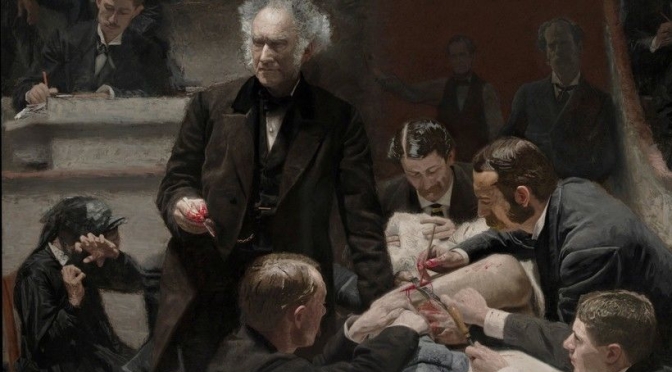
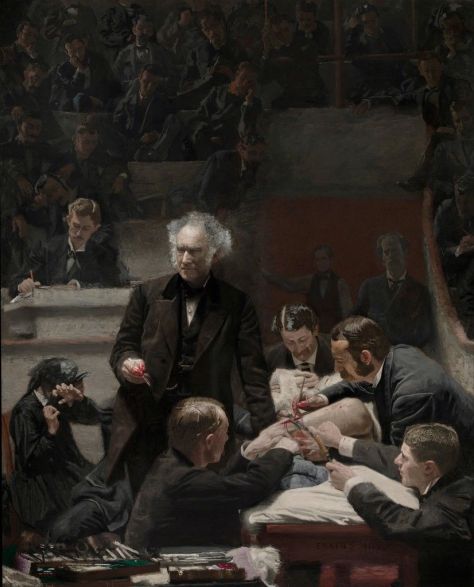
Eakins’s ambitious painting brought Renaissance-era virtuosity to the mid–19th century United States, as American art was still struggling to find its place on the world stage. The Gross Clinic, which still hangs in Philadelphia today, is a triumph of composition, light, and shadow.
In 1875, Thomas Eakins decided to paint a picture that would glorify his hometown of Philadelphia. The first ever World’s Fair to be held in the United States, the Centennial International Exhibition, would open in the city the following year. Through his painting, Eakins hoped to honor the scientific breakthroughs that were coming out of the local Jefferson Medical College. The artist observed live procedures by the celebrated surgeon Dr. Samuel Gross, then translated them onto a large-scale canvas that he titled Dr. Gross (1875) (now known as The Gross Clinic). The work has become perhaps the most important painting in the history of American art.
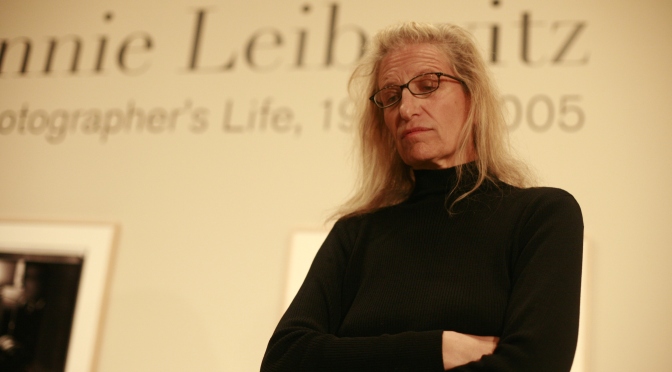
I chose to call myself a portrait photographer because labels were always being thrown on me. When I was at Rolling Stone I was a ‘rock-and-roll photographer’, at Vanity Fair I was a ‘celebrity photographer’. You know, I’m just a photographer. I realised I wasn’t really a journalist. I have a point of view and, while these photographs that I call portraits can be conceptual or illustrative, that keeps me on the straight and narrow. So I settled on this brand called ‘portraits’ because it had a lot of leeway. But I don’t think of myself that way now: I think of myself as a conceptual artist using photography.
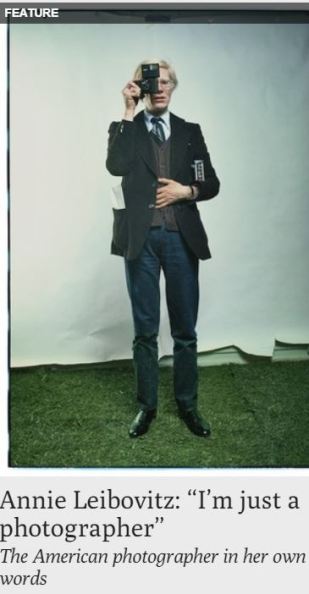
I remember going to the Factory in 1976 and watching Andy Warhol work. I’d been there before, earlier in the 70s, photographing Joe Dallesandro and Holly Woodlawn, and then Paul Morrissey. Warhol was a fixture of New York. It was just shocking when he died, because he was everywhere. I don’t know how he did it, but he was out at everything. You felt that if he was at a place you were at, then you were at the right place.
Warhol had things everywhere in the Factory – silkscreens all over the place, and tables of artwork – and things were always going on. I think Fran Lebowitz was there for Interview magazine, and [Warhol] was photographing the sisters from Grey Gardens [1975]. I was just a fly on the wall: there were people milling around doing all kinds of things, it was a pretty active place.
One of the most successful artists of the Italian Renaissance, Titian was the master of the sixteenth-century Venetian school and admired by his royal patrons and fellow artists alike. Several of his contemporaries, including the authors and art theorists Giorgio Vasari, Francesco Priscianese, Pietro Aretino, and Ludovico Dolce, wrote accounts of Titian’s life and work.
In this episode, Getty assistant curator of paintings Laura Llewellyn discusses what these “lives” teach us about Titian and the artistic debates and rivalries of his time. All of these biographies are gathered together in Lives of Titian, recently published by the Getty as part of our Lives of the Artists series.
Gauguin’s stay at the Yellow House is mired in controversy. What really happened? Bernadette Murphy, author of ‘Van Gogh’s Ear: The True Story’, considers those fateful days from Gauguin’s point of view.
The Credit Suisse Exhibition: Gauguin Portraits 7 October 2019 – 26 January 2020 Book tickets online and save, Members go free: https://bit.ly/2IspPWH
The first-ever exhibition devoted to the portraits of Paul Gauguin. Spanning his early years as an artist through to his later years spent in French Polynesia, the exhibition shows how the French artist revolutionised the portrait.
Exhibition organised by the National Gallery and the National Gallery of Canada, Ottawa.
How is a drapery put in place? For what reasons does this motive persist until today? How to explain its power of fascination? These are the questions that this exhibition intends to pose, in order to enter the “factory” of the drapery and to get closer to the artistic gesture. By showing the stages of making a drapery, the visitor will discover the singular practices of artists from the Renaissance to the second half of the 20th century.
November 30, 2019 – March 8, 2020, Museum of Fine Arts of Lyon
Albrecht Dürer, Drapery Study, 1508, Brush and Indian Ink, heightened white on dark green paper
The Musée des Beaux-Arts in Lyon retains an exceptional drawing by Albrecht Dürer studying a piece of drapery. This meticulous study reveals how the flexibility of a fabric lends itself to an infinity of folds, underlined by shadows and lights.
“Everywhere is the wait and the gathering,” concludes “Resort.” A kind of soporific haze has seeped into de Chirico’s imagination, asserted through evocations of sleeping and dreaming. Even the violence and ambiguous sexual imagery of “The Mysterious Night” yield to a final note of definitive somnolence: “Everything sleeps; even the owls and the bats who also in the dream dream of sleeping.”
“My room,” he writes, “is a beautiful vessel,” and from there he propels his imagination outward across space and time, geography and history. Indeed, “faraway” (lontani, lontano) is one of his favorite adjectives. He daydreams of Mexico or Alaska and invokes a future-oriented “avant-city” and a distant day where he is immortalized, albeit in an old-fashioned mode as a “man of marble.”
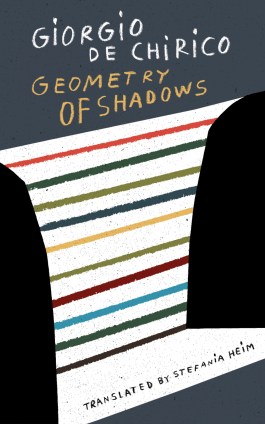
The paintings of Giorgio de Chirico invariably call to mind a cluster of adjectives: haunting, enigmatic, evocative, poetic. But unlike many artists whose poetry remains wordless and confined to the canvas, de Chirico was also a writer whose texts have been praised and even translated by such art-world luminaries as Louise Bourgeois and John Ashbery. A new collection provides us with more of de Chirico’s writings. Translated into English by Stefania Heim, Geometry of Shadows presents the relatively compact totality of the artist’s extant poems and poetic fragments written in Italian, complementing his memoirs and the novel Hebdomeros (in French), which have been available in English for some time.
Rodin first exhibited a bronze and a plaster version of The Age of Bronze at the Cercle Artistique in Brussels in January 1877. A few months later, he exhibited the plaster at the Paris Salon, where it caused a scandal. ‘The vitality and naturalism of the sculpture was so extreme, the sense of modelling so observed, that he was accused of having cast the sculpture from the model himself,’ says the specialist.
Tudor Davies, Head of Impressionist & Modern Art in Paris, reveals why Rodin’s Salon ‘scandal’ marked a pivotal turning point in the artist’s career.
The Age of Bronze was originally conceived in 1877, and is widely considered Rodin’s first great work, ranking alongside his later masterpieces, including LaPorte de l’Enfer, Le Penseur and Le Baiser. Its conception marked a decisive turning point in the sculptor’s career.
Retrofuturism is the curious eye of the past upon us. This era’s rosy predictions about the future seem laughable from the perspective of the present; however, it seems that they got some things exceptionally right. Their ideas ranged from child-like and pridefully ambitious and inspired a movement upon the artists, designers, musicians, and filmmakers who channeled the technological fantasies of a lost age.
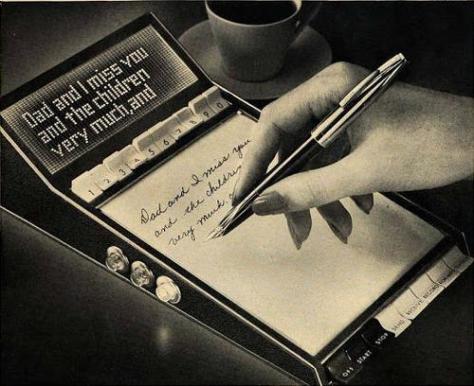
Instant Messaging (1964 Prediction)
This technology has actually become a reality. Many smartphones have this feature, or at least something similar to it. It doesn’t look like this of course, but the main idea is still there: you write it with your smartpen and the device makes your illegible handwriting into a text that is actually readable! However, it is not widely used; nobody could predict that typing would be superior to actual handwriting.
Personal Transportation (1950s Vision)
It is unclear why people in the 1950s thought this was a practical way to travel; not only it looks like it is impossible to breathe in there, who would want to stand upright while driving? It would definitely ease the traffic; however, probably no one would want to use it.
The Smart-Cities of Future
Towering transmitters in the city and private-jet traffic in the sky… This is a prediction that was made probably too early and it is definitely not so far from reality. Today, we paint a similar future for smart-cities and sci-fi movies depict the future cities in the same manner. It seems that older generations and we have a similar vision of the future look of the world.
The mahout (elephant keeper), the turbaned Ottoman warriors, and the crowning crescent all allude to the Eastern origins of the elephant. Within the Kunstkammer the elephant represented rulership. This automaton clock, which strikes at both the quarter hour and the hour, is driven by a movement connected to a wheel mounted on the walkway of the howdah (saddle). On the hour, the four Muslim warriors revolve around the brickwork tower. The mahout thumps his arm up and down, as though he were leading the animal, and his counterweighted eyes move back and forth as the machine travels.
Presented to Empress Maria Theresa in Vienna in 1760, this automaton was made at the height of the “century of writing.” Written communication connected scientists, dignitaries, scholars, and artists across long distances, and the act of writing was celebrated in every form. This piece is the last in a series of increasingly complicated ones that Friedrich von Knaus produced during his tenure as Austrian court machinist; he presented other examples to dignitaries such as the French king Louis XV and Duke Charles Alexander of Lorraine.
The machine writes through the hand of the small statuette seated at its top, one of the first mechanical writing figures in human form. This video shows the mechanisms inside the sphere that produce its precise movements. Up to 107 words can be preprogrammed by the arrangement of pegs on a barrel. The figure can also be set via a hand-worked control to appear to write from dictation; this technology that presaged the first typewriter.
Duke Charles Alexander of Lorraine, who bought this automaton clock in 1777, collected luxury objects made in his realm that demonstrated local technical advances. The self-moving components of this timepiece represent the height of Flemish invention in a fashionable Neoclassical style. Mechanically complex and visually impressive, this sparkling clock was a worthy addition to the duke’s collection of timepieces and scientific instruments.
This video shows the movement of the dials for hours, minutes, and seconds; days of the month; and phases of the moon, as well as that of the seven dynamic design elements. The cross-of-Lorraine pendulum swings steadily over the main dial, underneath a dancing letter M. Above the calendar dial turns a Catherine wheel, while the four dragons supporting the obelisk flap their wings and spit pearls. Another Catherine wheel spins above the moon-phase dial, and the entire obelisk is topped by a rotating planetarium. The fourth dial shows the maker’s signature.
From a Wall Street Journal Magazine online interview:
“The script is about questioning the nature of existence. I think about that every day of life. What is the purpose of life? As I get older, I look back on my own life as if it’s a novel written by someone else. To me it’s all a mystery. I started out over 60 years ago. My first job was, my God, 62 years ago and here I am. I don’t understand any of it. They gave me work, and I continued to work. It’s only just recently looking back, I thought, ‘My goodness, who designed this life? I certainly didn’t.’ I don’t know what’s life or destiny or kismet or God. I don’t want to get too philosophical about it. I’m fascinated about the mystery of life, about how we get through it, how we survive. I have no answers and I can’t take credit for any of it.”
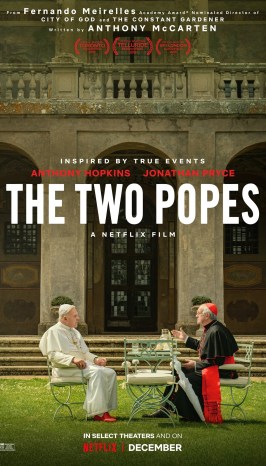
Anthony Hopkins, who plays Pope Benedict XVI in this month’s Netflix movie The Two Popes, has a personal philosophy of not taking anything too seriously. “When I was younger, I was much more intense,” he says. “I got to a certain age, maybe 10 years ago, and thought, ‘Come on, just relax. Have some fun with it. Let’s have a ball!’” Hopkins’s surprising approach to playing the pope was to be as laid back as the actor, 81, appears on his lively Instagram account: He captures himself singing, dancing in his Thor costume and playing the piano with his cat perched on his lap.

 I chose to call myself a portrait photographer because labels were always being thrown on me. When I was at Rolling Stone I was a ‘rock-and-roll photographer’, at Vanity Fair I was a ‘celebrity photographer’. You know, I’m just a photographer. I realised I wasn’t really a journalist. I have a point of view and, while these photographs that I call portraits can be conceptual or illustrative, that keeps me on the straight and narrow. So I settled on this brand called ‘portraits’ because it had a lot of leeway. But I don’t think of myself that way now: I think of myself as a conceptual artist using photography.
 I remember going to the Factory in 1976 and watching Andy Warhol work. I’d been there before, earlier in the 70s, photographing Joe Dallesandro and Holly Woodlawn, and then Paul Morrissey. Warhol was a fixture of New York. It was just shocking when he died, because he was everywhere. I don’t know how he did it, but he was out at everything. You felt that if he was at a place you were at, then you were at the right place.
 One of the most successful artists of the Italian Renaissance, Titian was the master of the sixteenth-century Venetian school and admired by his royal patrons and fellow artists alike. Several of his contemporaries, including the authors and art theorists Giorgio Vasari, Francesco Priscianese, Pietro Aretino, and Ludovico Dolce, wrote accounts of Titian’s life and work.
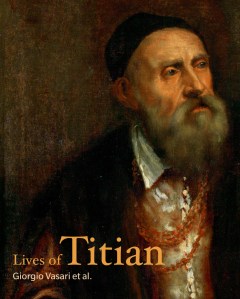 In this episode, Getty assistant curator of paintings Laura Llewellyn discusses what these “lives” teach us about Titian and the artistic debates and rivalries of his time. All of these biographies are gathered together in Lives of Titian, recently published by the Getty as part of our Lives of the Artists series.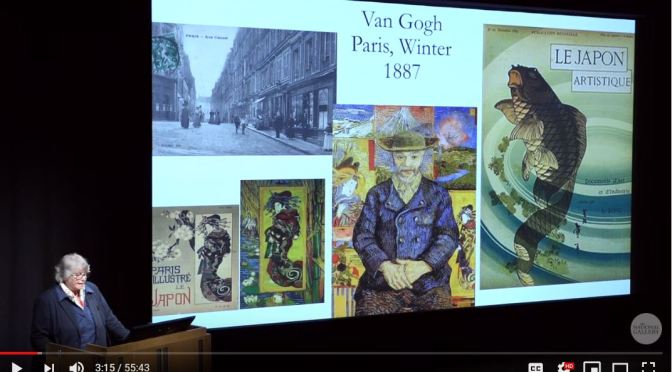
 The Credit Suisse Exhibition: Gauguin Portraits 7 October 2019 – 26 January 2020 Book tickets online and save, Members go free:
 How is a drapery put in place? For what reasons does this motive persist until today? How to explain its power of fascination? These are the questions that this exhibition intends to pose, in order to enter the “factory” of the drapery and to get closer to the artistic gesture. By showing the stages of making a drapery, the visitor will discover the singular practices of artists from the Renaissance to the second half of the 20th century.
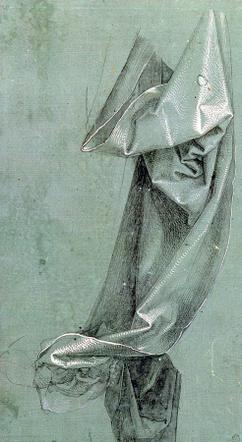 Albrecht Dürer, Drapery Study, 1508, Brush and Indian Ink, heightened white on dark green paper
 “Everywhere is the wait and the gathering,” concludes “Resort.” A kind of soporific haze has seeped into de Chirico’s imagination, asserted through evocations of sleeping and dreaming. Even the violence and ambiguous sexual imagery of “The Mysterious Night” yield to a final note of definitive somnolence: “Everything sleeps; even the owls and the bats who also in the dream dream of sleeping.”
 He daydreams of Mexico or Alaska and invokes a future-oriented “avant-city” and a distant day where he is immortalized, albeit in an old-fashioned mode as a “man of marble.”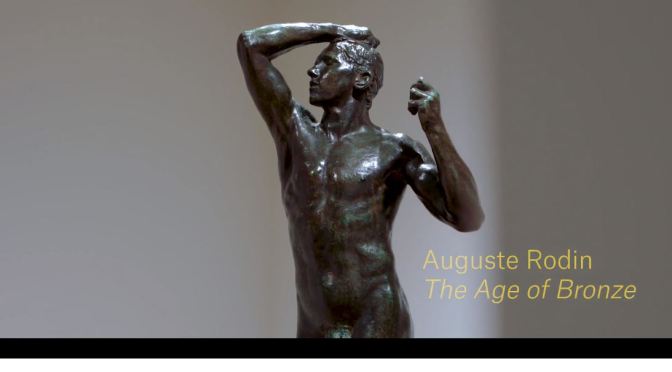
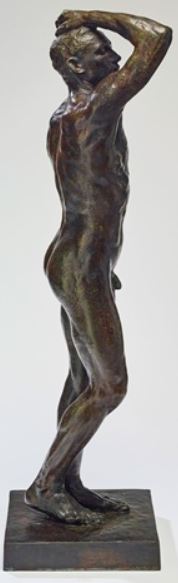 Rodin first exhibited a bronze and a plaster version of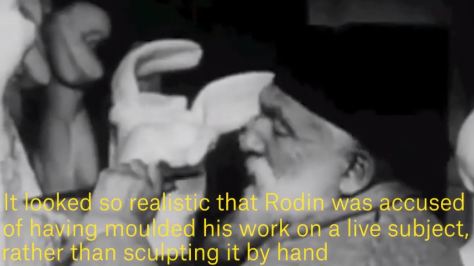

 It is unclear why people in the 1950s thought this was a practical way to travel; not only it looks like it is impossible to breathe in there, who would want to stand upright while driving? It would definitely ease the traffic; however, probably no one would want to use it.
 Towering transmitters in the city and private-jet traffic in the sky… This is a prediction that was made probably too early and it is definitely not so far from reality. Today, we paint a similar future for smart-cities and sci-fi movies depict the future cities in the same manner. It seems that older generations and we have a similar vision of the future look of the world.

 “The script is about questioning the nature of existence. I think about that every day of life. What is the purpose of life? As I get older, I look back on my own life as if it’s a novel written by someone else. To me it’s all a mystery. I started out over 60 years ago. My first job was, my God, 62 years ago and here I am. I don’t understand any of it. They gave me work, and I continued to work. It’s only just recently looking back, I thought, ‘My goodness, who designed this life? I certainly didn’t.’ I don’t know what’s life or destiny or kismet or God. I don’t want to get too philosophical about it. I’m fascinated about the mystery of life, about how we get through it, how we survive. I have no answers and I can’t take credit for any of it.”
 Boomers Daily