Category Archives: Analysis

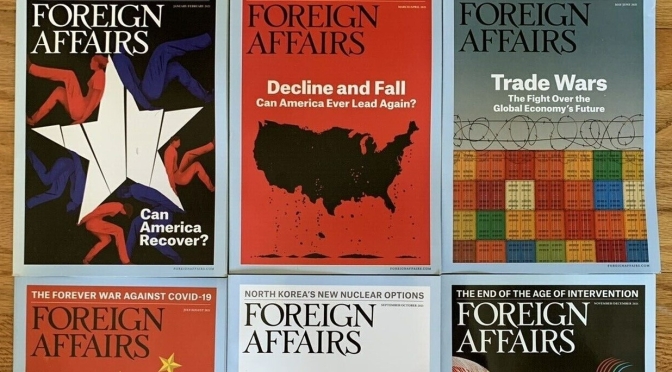
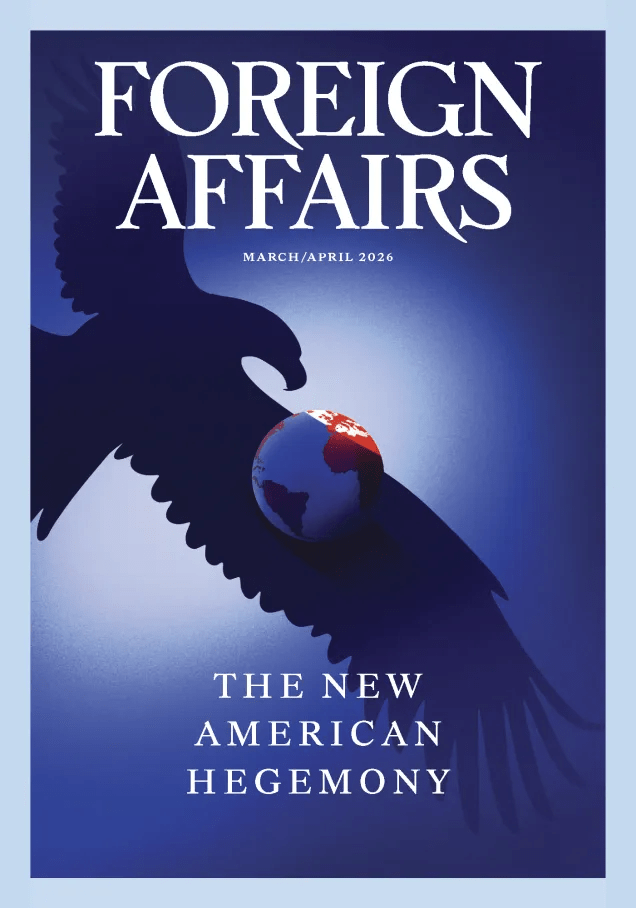
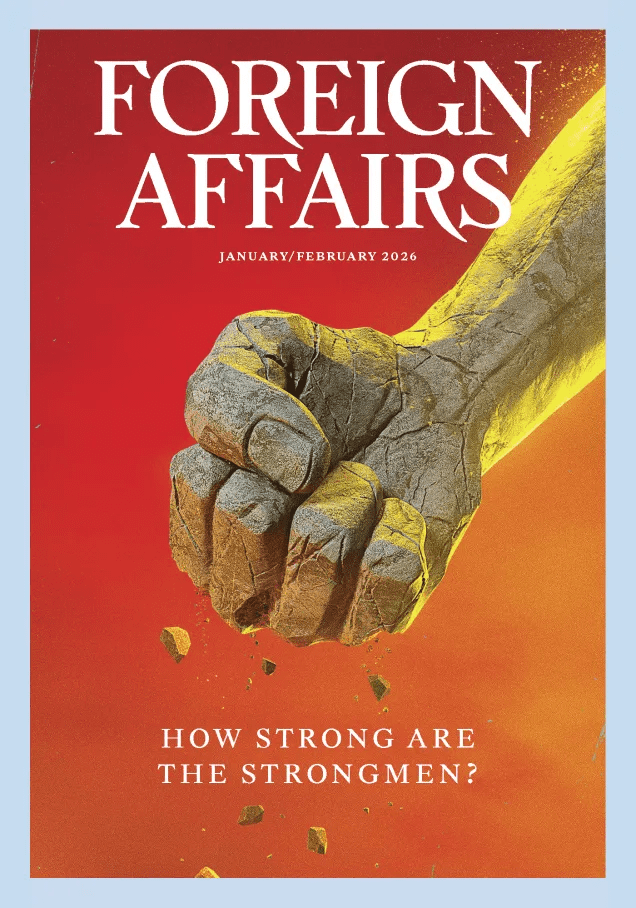
FOREIGN AFFAIRS MAGAZINE JANUARY/FEBRUARY 2026

FOREIGN AFFAIRS MAGAZINE: The latest issue features ‘How Strong Are The Strongmen?’

The Weakness of the Strongmen

What Really Threatens Authoritarians? Stephen Kotkin

The Price of American Authoritarianism

What Can Reverse Democratic Decline? By Steven LevitskyLucan A. Way, and Daniel Ziblatt

The Illiberal International

Authoritarian Cooperation Is Reshaping the Global Order by Nic CheesemanMatías Bianchi, and Jennifer Cyr

How China Wins the Future

Beijing’s Strategy to Seize the New Frontiers of Power by Elizabeth Economy

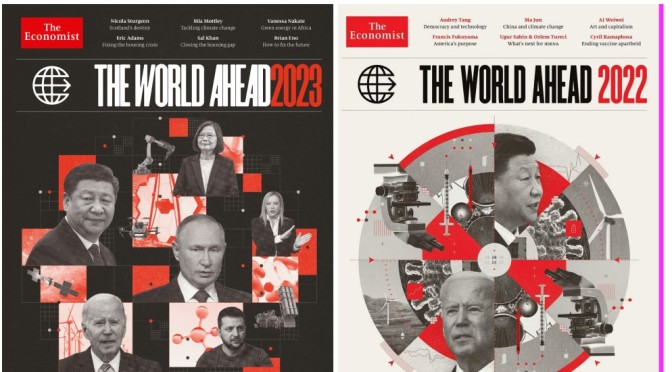
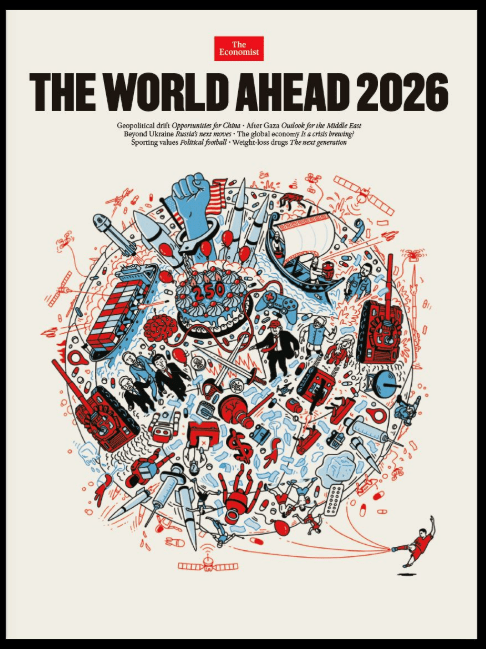
Analysis: The World Ahead In 2026 – The Economist

The Economist The World Ahead 2026 (November 13, 2025):

This is Donald Trump’s world—we’re all just living in it. The disruptor-in-chief was the biggest factor shaping global affairs in 2025, and that will be the case for as long as he remains in the White House. His norm-shattering approach has caused turmoil in some areas (as in trade) but has also delivered diplomatic results (as in Gaza) and forced necessary change (as with European defence spending). As the Trumpnado spins on in 2026, here are ten trends and themes to watch in the coming year.

1. America’s 250th.

Expect to hear wildly diverging accounts of America’s past, present and future, as Republicans and Democrats describe the same country in irreconcilably different terms to mark the 250th anniversary of its founding. Voters will then give their verdict on America’s future in the midterm elections in November. But even if the Democrats take the House, Mr Trump’s rule by bullying, tariffs and executive orders will go on.

2. Geopolitical drift.

Foreign-policy analysts are divided: is the world in a new cold war, between blocs led by America and China, or will a Trumpian deal divide the planet into American, Russian and Chinese “spheres of influence”, in which each can do as they please? Don’t count on either. Mr Trump prefers a transactional approach based on instinct, not grand geopolitical paradigms. The old global rules-based order will drift and decay further. But “coalitions of the willing” will strike new deals in areas such as defence, trade and climate.

3. War or peace? Yes.

With luck, the fragile peace in Gaza will hold. But conflicts will grind on in Ukraine, Sudan and Myanmar. Russia and China will test America’s commitment to its allies with “grey-zone” provocations in northern Europe and the South China Sea. As the line between war and peace becomes ever more blurred, tensions will rise in the Arctic, in orbit, on the sea floor and in cyberspace.

4. Problems for Europe.

All this poses a particular test for Europe. It must increase defence spending, keep America on side, boost economic growth and deal with huge deficits, even though austerity risks stoking support for hard-right parties. It also wants to remain a leading advocate for free trade and greenery. It cannot do all of these at once. A splurge on defence spending may lift growth, but only slightly.

5. China’s opportunity.

China has its own problems, with deflation, slowing growth and an industrial glut, but Mr Trump’s “America First” policy opens up new opportunities for China to boost its global influence. It will present itself as a more reliable partner, particularly in the global south, where it is striking a string of trade agreements. It is happy to do tactical deals with Mr Trump on soyabeans or chips. The trick will be to keep relations with America transactional, not confrontational.With rich countries living beyond their means, the risk of a bond-market crisis is growing

6. Economic worries.

So far America’s economy is proving more resilient than many expected to Mr Trump’s tariffs, but they will dampen global growth. And with rich countries living beyond their means, the risk of a bond-market crisis is growing. Much will depend on the replacement of Jerome Powell as chair of the Federal Reserve in May; politicising the Fed could trigger a market showdown.

7. Concerns over AI.

Rampant spending on infrastructure for artificial intelligence may also be concealing economic weakness in America. Will the bubble burst? As with railways, electricity and the internet, a crash would not mean that the technology does not have real value. But it could have wide economic impact. Either way, concern about AI’s impact on jobs, particularly those of graduates, will deepen.

8. A mixed climate picture.

Limiting warming to 1.5°C is off the table, and Mr Trump hates renewables. But global emissions have probably peaked, clean tech is booming across the global south and firms will meet or exceed their climate targets—but will keep quiet about it to avoid Mr Trump’s ire. Geothermal energy is worth watching.

9. Sporting values.

Sport can always be relied upon to provide a break from politics, right? Well, maybe not in 2026. The football World Cup is being jointly hosted by America, Canada and Mexico, whose relations are strained. Fans may stay away. But the Enhanced Games, in Las Vegas, may be even more controversial: athletes can use performance-enhancing drugs. Is it cheating—or just different?

10. Ozempic, but better.

Better, cheaper GLP-1 weight-loss drugs are coming, and in pill form, too. That will expand access. But is taking them cheating? GLP-1s extend the debate about the ethics of performance-enhancing drugs to a far wider group than athletes or bodybuilders. Few people compete in the Olympics. But anyone can take part in the Ozempic games.

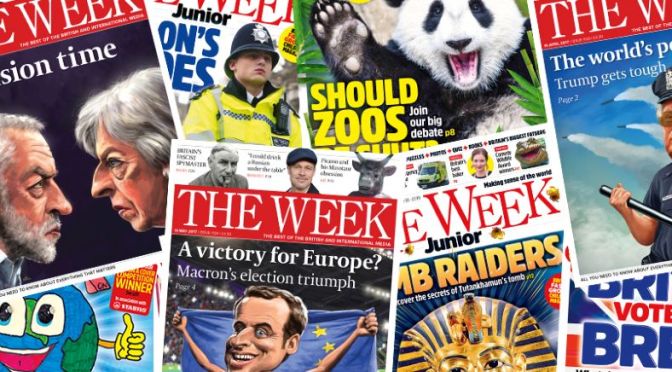
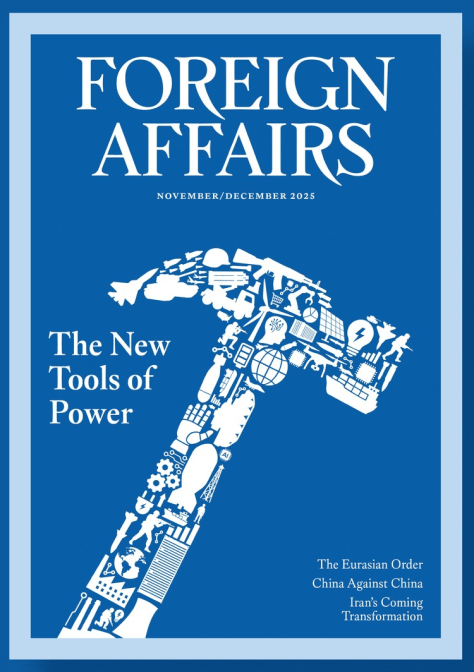
FOREIGN AFFAIRS MAGAZINE NOVEMBER/DECEMBER 2025

FOREIGN AFFAIRS MAGAZINE: The latest issue features ‘The New Tools of Power’

The Stagnant Order

And the End of Rising Powers by Michael Beckley

A Grand Strategy of Reciprocity

How to Build an Economic and Security Order That Works for America by Oren Cass

The New Supply Chain Insecurity

Fortress America Is Not a Safer America by Shannon K. O’Neil

The Return of the Energy Weapon

An Old Tool Creating New Dangers Jason Bordoff and Meghan L. O’Sullivan

The Economist Special Report: “Governments Going Broke” – 10.18.25

THE ECONOMIST SPECIAL REPORT: Governments going broke – In many of the world’s big economies, public finances are heading for a crisis. Henry Curr argues the consequences will be profound


→Across the rich world, fiscal crises loom

→How much public debt is too much?

→Fixing the welfare state looks electorally impossible

→Economic growth is unlikely to prevent fiscal crisis

→Big, rich countries have rarely repaid debt with surpluses

→How do some countries avoid debt?

→The case against holding bonds

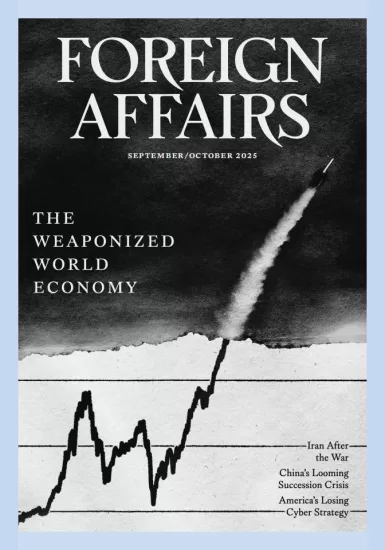
FOREIGN AFFAIRS MAGAZINE – SEPTEMBER 2025 PREVIEW

Foreign Affairs-外交事务2025.09&10月号下载PDF电子版网盘杂志订阅-易

FOREIGN AFFAIRS MAGAZINE: The latest issue features ‘The Weaponized World Economy’

The Weaponized World Economy

Surviving the New Age of Economic Coercion by Henry Farrell and Abraham Newman

The New Economic Geography

Who Profits in a Post-American World? Adam S. Posen

The Real China Model

Beijing’s Enduring Formula for Wealth and Power by Dan Wang and Arthur Kroeber

After the Trade War

Remaking Rules From the Ruins of the Rules-Based System by Michael B. G. Froman

The Fiscal Fantasies Of A “For-Profit” Government

BY INTELLICUREAN, JULY 21, 2025:

In the summer of 2025, former President Donald Trump and Commerce Secretary Howard Lutnick unveiled a bold proposal: the creation of an External Revenue Service (ERS), a federal agency designed to collect tariffs, fees, and other payments from foreign entities. Framed as a patriotic pivot toward self-sufficiency, the ERS would transform the U.S. government from a tax-funded service provider into a revenue-generating enterprise, capable of offsetting domestic tax burdens through external extraction. The idea, while politically magnetic, raises profound questions: Can the U.S. federal government become a “for-profit” entity? And if so, can the ERS be a legitimate mechanism for such a transformation?

This essay argues that while the concept of external revenue generation is not unprecedented, the rebranding of the U.S. government as a profit-seeking enterprise risks undermining its foundational principles. The ERS proposal conflates revenue with legitimacy, and profit with power, leading to a fundamental misunderstanding of the government’s role in society. We explore the constitutional, economic, and geopolitical dimensions of the ERS proposal, drawing on recent analyses from the Peterson Institute for International Economics, The Diplomat, and The New Yorker, to assess its fiscal viability, strategic risks, and national security implications.

Constitutional Foundations: Can a Republic Seek Profit?

The U.S. Constitution grants Congress the power to “lay and collect Taxes, Duties, Imposts and Excises” and to “regulate Commerce with foreign Nations” (Article I, Section 8). These provisions clearly authorize the federal government to generate revenue through tariffs and fees. Historically, tariffs served as a primary source of federal income, funding everything from infrastructure to military expansion during the 19th century.

However, the Constitution does not envision the government as a profit-maximizing entity. Its purpose, as articulated in the Preamble, is to “establish Justice, ensure domestic Tranquility, provide for the common defence, [and] promote the general Welfare.” These are public goods, not commercial outputs. The government’s legitimacy is grounded in its service to the people—not in its ability to generate surplus revenue.

The Federal Reserve offers a useful analogy here. While not a for-profit institution, the Fed earns more than it spends through its monetary operations—primarily interest on government securities—and remits excess income to the Treasury. Between 2011 and 2021, these remittances totaled over $920 billion. But this is not “profit” in the corporate sense. The Fed’s primary mandate is macroeconomic stability, not shareholder returns. Even during economic stress (as seen in 2022–2025), the Fed may run negative remittances, underscoring its non-commercial orientation.

In contrast, the ERS is framed as a profit center—an entity designed to extract wealth from foreign actors to reduce domestic tax burdens. This shift raises critical questions: Who are the “customers” of the ERS? What are the “products” it offers? And what happens when profit motives collide with diplomatic or humanitarian priorities?

Economic Modeling: Revenue vs. Net Gain

A rigorous analysis of Trump’s proposed tariffs comes from Chad P. Bown and Melina Kolb at the Peterson Institute for International Economics. In their April 2025 briefing, they use a global economic model to estimate the gross and net revenue generated by tariffs of 10%, 15%, and 20% on all imported goods.

Their findings are sobering:

  • A 15% universal tariff could generate $3.9 trillion in gross revenue over a decade (2025–2034), assuming no foreign retaliation.
  • However, after accounting for slower growth, reduced investment, and lower tax receipts from households and businesses, the net gain drops to $3.2 trillion.
  • If foreign countries retaliate with reciprocal tariffs, the net gain falls further to $1.5 trillion.
  • A 20% tariff results in the lowest net gain ($791 billion), due to intensified economic drag and retaliation.

These findings underscore a crucial distinction: tariffs are not free money. They impose costs on consumers, disrupt supply chains, and invite countermeasures. The ERS may collect billions, but its net contribution to fiscal health is far more modest—and potentially negative if retaliation escalates.

Additionally, tariff revenue is volatile and politically contingent. Tariffs can be reversed by executive order, invalidated by courts, or rendered moot by trade realignment. In short, the ERS lacks the predictability and stability necessary for a legitimate fiscal foundation. Tariffs are a risky and politically charged mechanism for revenue generation—making them an unreliable cornerstone for the country’s fiscal health.

Strategic Blowback: Reverse Friendshoring and Supply Chain Drift

Beyond economics, the ERS proposal carries significant geopolitical risks. In The Diplomat, Thiago de Aragao warns of a phenomenon he calls reverse friendshoring—where companies, instead of relocating supply chains away from China, move closer to it in response to U.S. tariffs.

The logic is simple: If exporting to the U.S. becomes prohibitively expensive, firms may pivot to serving Asian markets, leveraging China’s mature infrastructure and consumer base. This could undermine the strategic goal of decoupling from Chinese influence, potentially strengthening Beijing’s economic hand.

Examples abound:

  • A firm that invested in Mexico to reduce exposure to China redirected its exports to Latin America after Mexico was hit with new tariffs.
  • Another company shifted operations to Canada to avoid compounded U.S. duties—only to face new levies there as well.

This unpredictability erodes trust in U.S. trade policy and incentivizes supply chain diversification away from the U.S. As Aragao notes, “Protectionism may offer a temporary illusion of control, but in the long run, it risks pushing businesses away.”

The ERS, by monetizing tariffs, could accelerate this trend. If foreign firms perceive the U.S. as a hostile or unstable market, they will seek alternatives. And if allies are treated as adversaries, the strategic architecture of friendshoring collapses, leaving the U.S. economically isolated and diplomatically weakened.

National Security Costs: Alienating Allies

Perhaps the most damning critique of the ERS comes from Cullen Hendrix at the Peterson Institute, who argues that imposing tariffs on U.S. allies undermines national security. The U.S. alliance network spans over 60 countries, accounting for 38% of global GDP. These partnerships enhance deterrence, enable forward basing, and create markets for U.S. defense exports.

Tariffs—especially those framed as revenue tools—erode alliance cohesion. They signal that economic extraction trumps strategic cooperation. Hendrix warns that “treating alliance partners like trade adversaries will further increase intra-alliance frictions, weaken collective deterrence, and invite potential adversaries—none better positioned than China—to exploit these divisions.”

Moreover, the ERS’s indiscriminate approach—levying duties on both allies and rivals—blurs the line between economic policy and coercive diplomacy. It transforms trade into a zero-sum game, where even friends are fair targets. This undermines the credibility of U.S. commitments and may prompt allies to seek alternative trade and security arrangements.

Lutnick’s Barber Economics: Rhetoric vs. Reality

The ERS proposal is not merely a policy—it’s a performance. Nowhere is this clearer than in Howard Lutnick’s keynote at the Hill and Valley Forum, as reported in The New Yorker on July 21, 2025. Addressing a room of venture capitalists, defense contractors, and policymakers, Lutnick attempted to explain trade deficits using personal analogies: “I have a trade deficit with my barber,” he said. “I have a trade deficit with my grocery store. Right? I just buy stuff from them. That’s ridiculous.”

The crowd, described as “sophisticated tech and finance attendees,” was visibly uncomfortable. Lutnick’s analogies, while populist in tone, misread the room and revealed a deeper disconnect between economic complexity and simplistic transactionalism. As one attendee noted, “It’s obvious why Lutnick’s affect appeals to Trump. But it’s Bessent’s presence in the Administration that reassures us there is someone smart looking out for us.”

This contrast between Lutnick and Treasury Secretary Scott Bessent is telling. Bessent, who reportedly flew to Mar-a-Lago to urge Trump to pause the tariffs, represents the limits of ideological fervor when confronted with institutional complexity. Lutnick, by contrast, champions the ERS as a populist vessel—a way to turn deficits into dues, relationships into revenue, and governance into a business plan.

The ERS, then, is not just a fiscal experiment—it’s a philosophical battleground. Lutnick’s vision of government as a money-making enterprise may resonate with populist frustration, but it risks trivializing the structural and diplomatic intricacies of global trade. His “barber economics” may play well on cable news, but it falters under scrutiny from economists, allies, and institutional stewards.

Conclusion: Profit Is Not Purpose

The idea of a “for-profit” U.S. government, embodied in the External Revenue Service, is seductive in its simplicity. It promises fiscal relief without domestic taxation, strategic leverage through economic pressure, and a reassertion of American dominance in global trade. But beneath the surface lies a tangle of contradictions.

Constitutionally, the federal government is designed to serve—not to sell. Its legitimacy flows from the consent of the governed, not the extraction of foreign wealth. Economically, tariffs may generate gross revenue, but their net contribution is constrained by retaliation, inflation, and supply chain disruption. Strategically, the ERS risks alienating allies, incentivizing reverse friendshoring, and weakening collective security.

With Howard Lutnick as the plan’s leading voice—offering anecdotes like the barber and grocery store as proxies for international trade—the ERS becomes more than a revenue mechanism; it becomes a prism for reflecting the Administration’s governing style: transactional, simplified, and rhetorically appealing, yet divorced from systemic nuance. His “barber economics” may evoke applause from certain circles, but in the forums that shape long-term policy, it has landed with discomfort and disbelief.

The comparison between Lutnick and Treasury Secretary Scott Bessent, as reported in The New Yorker, captures this divide. Bessent, attempting to temper Trump’s protectionist instincts, represents the limits of ideological fervor when confronted with institutional complexity. Lutnick, by contrast, champions the ERS as a populist vessel—a way to turn deficits into dues, relationships into revenue, and governance into a business plan.

Yet governance is not a business, and the nation’s global responsibilities cannot be monetized like a corporate balance sheet. If America begins to treat its allies as clients, its rivals as profit centers, and its global footprint as a monetizable asset, it risks transforming foreign policy into a ledger—and leadership into a transaction.

The External Revenue Service, in its current form, fails to reconcile profit with purpose. It monetizes strength but neglects stewardship. It harvests dollars but undermines trust. And in doing so, it invites a broader reckoning—not just about trade and taxation, but about what kind of republic America wishes to be. For now, the ERS remains an emblem of ambition unmoored from architecture, where the dream of profit collides with the duty to govern.

THIS ESSAY WAS WRITTEN AND EDITED BY INTELLICUREAN USING AI

Review: AI, Apathy, and the Arsenal of Democracy

Dexter Filkins is a Pulitzer Prize-winning American journalist and author, known for his extensive reporting on the wars in Afghanistan and Iraq. He is currently a staff writer for The New Yorker and the author of the book “The Forever War“, which chronicles his experiences reporting from these conflict zones. 

Is the United States truly ready for the seismic shift in modern warfare—a transformation that The New Yorker‘s veteran war correspondent describes not as evolution but as rupture? In “Is the U.S. Ready for the Next War?” (July 14, 2025), Dexter Filkins captures this tectonic realignment through a mosaic of battlefield reportage, strategic insight, and ethical reflection. His central thesis is both urgent and unsettling: that America, long mythologized for its martial supremacy, is culturally and institutionally unprepared for the emerging realities of war. The enemy is no longer just a rival state but also time itself—conflict is being rewritten in code, and the old machines can no longer keep pace.

The piece opens with a gripping image: a Ukrainian drone factory producing a thousand airborne machines daily, each costing just $500. Improvised, nimble, and devastating, these drones have inflicted disproportionate damage on Russian forces. Their success signals a paradigm shift—conflict has moved from regiments to swarms, from steel to software. Yet the deeper concern is not merely technological; it is cultural. The article is less a call to arms than a call to reimagine. Victory in future wars, it suggests, will depend not on weaponry alone, but on judgment, agility, and a conscience fit for the digital age.

Speed and Fragmentation: The Collision of Cultures

At the heart of the analysis lies a confrontation between two worldviews. On one side stands Silicon Valley—fast, improvisational, and software-driven. On the other: the Pentagon—layered, cautious, and locked in Cold War-era processes. One of the central figures is Palmer Luckey, the founder of the defense tech company Anduril, depicted as a symbol of insurgent innovation. Once a video game prodigy, he now leads teams designing autonomous weapons that can be manufactured as quickly as IKEA furniture and deployed without extensive oversight. His world thrives on rapid iteration, where warfare is treated like code—modular, scalable, and adaptive.

This approach clashes with the military’s entrenched bureaucracy. Procurement cycles stretch for years. Communication between service branches remains fractured. Even American ships and planes often operate on incompatible systems. A war simulation over Taiwan underscores this dysfunction: satellites failed to coordinate with aircraft, naval assets couldn’t link with space-based systems, and U.S. forces were paralyzed by their own institutional fragmentation. The problem wasn’t technology—it was organization.

What emerges is a portrait of a defense apparatus unable to act as a coherent whole. The fragmentation stems from a structure built for another era—one that now privileges process over flexibility. In contrast, adversaries operate with fluidity, leveraging technological agility as a force multiplier. Slowness, once a symptom of deliberation, has become a strategic liability.

The tension explored here is more than operational; it is civilizational. Can a democratic state tolerate the speed and autonomy now required in combat? Can institutions built for deliberation respond in milliseconds? These are not just questions of infrastructure, but of governance and identity. In the coming conflicts, latency may be lethal, and fragmentation fatal.

Imagination Under Pressure: Lessons from History

To frame the stakes, the essay draws on powerful historical precedents. Technological transformation has always arisen from moments of existential pressure: Prussia’s use of railways to reimagine logistics, the Gulf War’s precision missiles, and, most profoundly, the Manhattan Project. These were not the products of administrative order but of chaotic urgency, unleashed imagination, and institutional risk-taking.

During the Manhattan Project, multiple experimental paths were pursued simultaneously, protocols were bent, and innovation surged from competition. Today, however, America’s defense culture has shifted toward procedural conservatism. Risk is minimized; innovation is formalized. Bureaucracy may protect against error, but it also stifles the volatility that made American defense dynamic in the past.

This critique extends beyond the military. A broader cultural stagnation is implied: a nation that fears disruption more than defeat. If imagination is outsourced to private startups—entities beyond the reach of democratic accountability—strategic coherence may erode. Tactical agility cannot compensate for an atrophied civic center. The essay doesn’t argue for scrapping government institutions, but for reigniting their creative core. Defense must not only be efficient; it must be intellectually alive.

Machines, Morality, and the Shrinking Space for Judgment

Perhaps the most haunting dimension of the essay lies in its treatment of ethics. As autonomous systems proliferate—from loitering drones to AI-driven targeting software—the space for human judgment begins to vanish. Some militaries, like Israel’s, still preserve a “human-in-the-loop” model where a person retains final authority. But this safeguard is fragile. The march toward autonomy is relentless.

The implications are grave. When decisions to kill are handed to algorithms trained on probability and sensor data, who bears responsibility? Engineers? Programmers? Military officers? The author references DeepMind’s Demis Hassabis, who warns of the ease with which powerful systems can be repurposed for malign ends. Yet the more chilling possibility is not malevolence, but moral atrophy: a world where judgment is no longer expected or practiced.

Combat, if rendered frictionless and remote, may also become civically invisible. Democratic oversight depends on consequence—and when warfare is managed through silent systems and distant screens, that consequence becomes harder to feel. A nation that no longer confronts the human cost of its defense decisions risks sliding into apathy. Autonomy may bring tactical superiority, but also ethical drift.

Throughout, the article avoids hysteria, opting instead for measured reflection. Its central moral question is timeless: Can conscience survive velocity? In wars of machines, will there still be room for the deliberation that defines democratic life?

The Republic in the Mirror: A Final Reflection

The closing argument is not tactical, but philosophical. Readiness, the essay insists, must be measured not just by stockpiles or software, but by the moral posture of a society—its ability to govern the tools it creates. Military power divorced from democratic deliberation is not strength, but fragility. Supremacy must be earned anew, through foresight, imagination, and accountability.

The challenge ahead is not just to match adversaries in drones or data, but to uphold the principles that give those tools meaning. Institutions must be built to respond, but also to reflect. Weapons must be precise—but judgment must be present. The republic’s defense must operate at the speed of code while staying rooted in the values of a self-governing people.

The author leaves us with a final provocation: The future will not wait for consensus—but neither can it be left to systems that have forgotten how to ask questions. In this, his work becomes less a study in strategy than a meditation on civic responsibility. The real arsenal is not material—it is ethical. And readiness begins not in the factories of drones, but in the minds that decide when and why to use them.

THIS ESSAY REVIEW WAS WRITTEN BY AI AND EDITED BY INTELLICUREAN.

Birthright, Borders, And The U.S. Constitution

In the July 11, 2025 episode of Bloomberg Law’s Weekend Law podcast, the spotlight turned to the Supreme Court and one of the most urgent constitutional questions of the present era: can the federal government deny citizenship to children born in the United States based solely on their parents’ immigration status?

At the center of the discussion was a new executive order issued by the Trump administration. The order aims to withhold automatic citizenship from children born to undocumented immigrants. In response, a federal judge in New Hampshire has not only issued a temporary nationwide block on the order but also certified a class-action lawsuit that could have sweeping implications.

This development, as legal analyst and former DOJ official Leon Fresco explained, is not merely procedural—it is strategic. The case, still in its early stages, may force the Supreme Court to revisit the meaning of the Fourteenth Amendment’s Citizenship Clause.


Legal Strategy: Class Action as Constitutional Tool

Fresco’s key insight concerned how litigants are adapting to recent changes in judicial thinking. After the Supreme Court expressed skepticism toward broad nationwide injunctions, many believed such tools were effectively dead. But Fresco pointed out that class-action certification remains a viable, and perhaps more precise, alternative.

The New Hampshire judge’s ruling created a nationwide class of plaintiffs: all children born on or after February 20, 2025, to parents who are either unlawfully present or not U.S. citizens or lawful permanent residents. The judge carefully excluded parents from the class, narrowing the focus to the children’s citizenship claims. This move strengthens the class’s legal position, emphasizing a uniform constitutional harm.

Fresco characterized this approach as both narrow in structure and expansive in effect. By building the case around a specific constitutional injury—the denial of citizenship by birth—the lawsuit avoids the kinds of inconsistencies that often weaken broader claims.


The Constitutional Question: What Does “Jurisdiction” Mean?

At the heart of the dispute lies the interpretation of the Citizenship Clause of the Fourteenth Amendment: “All persons born or naturalized in the United States, and subject to the jurisdiction thereof, are citizens of the United States.”

For over a century, the courts have understood this to include virtually everyone born on U.S. soil, with only narrow exceptions. The Trump administration’s order proposes a reinterpretation—arguing that undocumented immigrants and their children are not “subject to the jurisdiction” of the United States in the full constitutional sense.

This argument is novel, but not entirely new. Versions of it have circulated in fringe legal circles for years. What is new is the attempt to enforce this interpretation through executive power. If allowed to stand, it would mark a major departure from long-established constitutional norms.


Tactical Delay: The Risk of a Judicial “Stay”

Fresco raised a more immediate concern: that the Supreme Court may avoid ruling on the merits of the case altogether—at least for now. The Court, he warned, might grant a temporary stay that would allow the executive order to take effect while the lawsuit works its way through the lower courts.

This would mirror a pattern seen in other immigration cases, such as those involving Temporary Protected Status and humanitarian parole, where short procedural rulings allowed sweeping policy shifts without a full constitutional review.

The danger of such a stay is not theoretical. If the executive order goes into effect, children born under it would enter legal limbo. Denied citizenship, they would lack basic documents and protections. Challenging their status later could take years—possibly decades. In this way, even a temporary policy can create permanent consequences.


The Role of the Court: Principle or Procedure?

A central theme of the podcast segment was the evolving role of the judiciary in overseeing executive actions. Fresco questioned how the Court could reject a class-action lawsuit like this one without also undermining the logic that allows nationwide relief in other types of cases—such as defective products that cause uniform harm across the country.

If the courts are willing to permit class certification for consumer safety, why would they deny it in a case concerning citizenship—a matter of constitutional identity?

Fresco’s analogy was sharp: the law allows national class actions over faulty cribs or pharmaceuticals; why not over a birthright denied?

His point revealed the tension between procedural restraint and constitutional responsibility. If the Court is serious about limiting nationwide injunctions, it must offer a consistent, principled rationale for where it draws the line.


The Political Climate: Avoidance Through Silence

Toward the end of the discussion, Fresco referenced former Attorney General Alberto Gonzalez, who has speculated that the Supreme Court may simply lack the votes to strike down the executive order directly. That possibility may explain the Court’s hesitancy to take up the issue.

Justice Neil Gorsuch’s past remarks—asking how the Court might “get to the merits fast”—suggest at least some justices recognize the urgency. But urgency does not always lead to clarity. If the Court allows the order to take effect temporarily, and then delays review, it could set in motion changes that are difficult to reverse.

In effect, the Court would be allowing the executive branch to reshape constitutional practice through interim decisions. That prospect, Fresco warned, is not only legally unstable but socially volatile.


The Stakes: Citizenship as Constitutional Reality

Ultimately, what this case asks is not only a legal question but a civic one: Is citizenship a stable constitutional right, or can it be redefined by policy?

The class-action strategy now moving through the courts offers one possible defense: a method of forcing judicial engagement by focusing on clear constitutional harm and avoiding broad, unwieldy claims. It is, in Fresco’s words, an effort to meet the Court on its own procedural terms.

Yet the deeper conflict remains. The very idea of birthright citizenship—once considered legally untouchable—is now on trial. Whether the courts decide quickly or delay, the consequences will be lasting.


Conclusion: The Constitution on the Line

The Bloomberg Law discussion offered more than a legal update. It revealed how quickly constitutional assumptions can be unsettled—and how creative legal strategies are now being used to hold the line.

The New Hampshire ruling, and the class it created, represent a new phase in this fight. Narrow in scope but vast in significance, the lawsuit calls on the judiciary to answer directly: Is a child born on U.S. soil a citizen, or not?

In that answer lies the future of constitutional meaning—and the measure of whether the law remains anchored to principle, or drifts with the political tide.

THIS ESSAY AND REVIEW WAS WRITTEN BY AI AND EDITED BY INTELLICUREAN

REVIEW: “Judgment Calls – From Diddy’s Acquittal To The Supreme Court’s Shift”

THE FOLLOWING IS AN “AI REVIEW” OF THE JULY 3 EPISODE OF “BLOOMBERG LAW WITH JUNE GRASSO” PODCAST TRANSCRIPT:

In the dimly lit chambers of American justice, two parallel stories unfolded this term—one involving the cultural phenomenon of Sean “Diddy” Combs, the other the ideological recalibration of the United States Supreme Court. Each, in its own way, exposed the tensions inherent in a legal system grappling with the competing imperatives of moral condemnation, procedural fairness, and the inexorable gravitational pull of politics.

In federal court, Combs emerged, if not unscathed, then improbably triumphant. After six weeks of graphic testimony and the steady drip of lurid detail, jurors acquitted him of the most sensational accusations: racketeering conspiracy and sex trafficking, crimes that, had they stuck, would almost certainly have resulted in a life sentence. Instead, he was convicted only on two counts of transporting sex workers across state lines to participate in what prosecutors termed “freak-off parties.” In the pantheon of celebrity trials, this outcome was remarkable not merely for the verdict itself but for the rhetorical overreach that defined the government’s case.

Robert Mintz, a former federal prosecutor turned defense attorney, spoke to the case’s cautionary lesson about prosecutorial ambition. RICO—the Racketeer Influenced and Corrupt Organizations Act—was never an intuitive fit for Combs, a music mogul whose business dealings, however flamboyant, bore little resemblance to the mafia syndicates the statute was designed to dismantle. In the final analysis, jurors appeared unconvinced that the machinery of Combs’s empire—record labels, promotional companies, an entourage that blurred the line between personal and professional—was itself the instrument of a criminal conspiracy. They were similarly unconvinced that the two women at the heart of the government’s sex trafficking charges had been coerced rather than entangled in a toxic, if mutually complicit, set of relationships.

Perhaps more striking still was the defense’s strategy: they called no witnesses. Rather than counter the government’s narrative with competing testimony, Combs’s lawyers focused their energy on cross-examination, unspooling the contradictions and ambivalences embedded in the prosecution’s evidence. Here, too, lay a broader truth about modern criminal justice. The power to define the contours of the case—the charges themselves—can be as determinative as the evidence marshaled to prove them. When the government chooses to depict a defendant as the capo di tutti capi of an illicit empire, it must persuade a jury not only of wrongdoing but of a sweeping criminality that often strains credulity. When that narrative collapses, as it did here, the defense is left with the simpler task of pointing out the seams.

But Combs’s legal jeopardy is not yet at an end. Though acquitted of the most serious charges, he faces up to twenty years in prison on the counts that remain, even if the federal sentencing guidelines suggest a considerably lower range. The presiding judge, troubled by videotaped evidence of Combs assaulting one of the alleged victims, declined to release him pending sentencing—a reminder that in federal court, the most powerful voice is not the jury’s but the judge’s. It is not inconceivable that the final chapter of this saga will be harsher than the defense’s celebration suggested.

If Combs’s courtroom drama offered a microcosm of prosecutorial overreach, the Supreme Court’s term showcased a more profound shift: a conservative supermajority willing to reconfigure the balance of power between the judiciary and the executive—and, by extension, between individuals and the state. In conversation with constitutional law scholar Michael Dorf, host June Grasso illuminated the breadth of these changes. Over the past year, the Court issued a series of rulings that, taken together, represent a quiet revolution in the way the federal courts interact with presidential authority.

At the heart of this transformation was the Court’s decision to curtail nationwide injunctions—sweeping orders issued by district judges to block federal policies across the entire country. For decades, these injunctions served as a vital mechanism by which civil rights plaintiffs, immigrant communities, and other marginalized groups could halt executive overreach before it inflicted irreparable harm. Their disappearance is no mere procedural adjustment; it recasts the balance between the judiciary’s protective function and the executive’s prerogative to govern unencumbered.

This doctrinal shift accrued almost exclusively to the benefit of President Trump, whose administration had faced a phalanx of legal challenges. Whether the issue was the forced deportation of migrants, the exclusion of transgender Americans from military service, or the elimination of birthright citizenship, the Supreme Court’s majority showed an evident willingness to side with the executive branch on an emergency basis—often with scant explanation. Dorf described this posture as striking not merely for its partisanship but for its inconsistency: lower courts that blocked Trump policies were overruled with alacrity, even as those same justices castigated nationwide injunctions as judicial overreach.

At the same time, the term’s most divisive rulings revealed a Court emboldened to advance a culturally conservative agenda. In a 6-3 decision, the justices upheld Tennessee’s ban on gender-affirming care for minors, dismissing the equal protection claims of transgender plaintiffs and casting doubt on whether such discrimination should trigger heightened constitutional scrutiny. In another ruling, religious parents were granted the right to withdraw their children from public school curricula that included LGBTQ-themed storybooks—a decision that critics warn will invite broader challenges to any teaching that conflicts with sectarian belief. In the aggregate, these rulings did more than roll back hard-won protections for LGBTQ Americans. They signaled a willingness to prioritize religious objections over the rights of vulnerable communities, an alignment that recurred throughout the term.

For Dorf, the most unsettling dimension was not the conservative tilt per se but the Court’s apparent comfort with what he called a “soft authoritarian” style of governance. The Roberts Court had already repealed the constitutional right to abortion and limited the federal government’s capacity to regulate firearms. What distinguished this term was its readiness to facilitate the Trump administration’s disregard for judicial orders—an erosion not of precedent but of the rule of law itself.

Whether these developments portend a lasting reorientation of American jurisprudence remains to be seen. What is clear, however, is that the ideological polarization of the Supreme Court is reshaping the lives of countless citizens in ways that transcend conventional partisanship. In this respect, the travails of Sean Combs and the ambitions of the Roberts Court are, improbably, two facets of the same American story: one in which the legal system’s power to punish and to protect is increasingly mediated by political will—and by the narratives that prevail when the evidence, the law, and the culture clash in the crucible of the courtroom.

Segment 1: The Verdict in Sean “Diddy” Combs’ Case

Guests:

  • Robert Mintz, former federal prosecutor, partner at McCarter & English

Topics:

  • Combs’ acquittal on the most serious charges (racketeering, conspiracy, sex trafficking)
  • Conviction on two lesser felonies (transportation to engage in prostitution)
  • Defense’s strategy to challenge overcharging
  • Impact of the 2016 video showing domestic violence
  • Potential sentencing: between ~2–5 years under guidelines, but judge has broad discretion
  • Judge’s refusal to release Combs pending sentencing due to danger concerns
  • Broader implications of prosecutorial overreach and the difficulties of proving coercion in complex, long-term relationships

Segment 2: The Supreme Court Term Review

Guest:

  • Michael Dorf, constitutional law professor, Cornell Law School

Topics:

  • The Supreme Court siding repeatedly with the Trump administration
    • Disbanding nationwide injunctions (limiting checks on executive power)
    • Facilitating major policy shifts (transgender military ban, deportations, birthright citizenship challenges)
  • LGBTQ rights decisions:
    • Upholding Tennessee’s ban on gender-affirming care for minors
    • Requiring schools to exempt religious families from LGBTQ-inclusive curricula
    • Concerns about the erosion of protections under equal protection doctrine
    • Forthcoming cases on transgender sports participation and conversion therapy bans
  • Second Amendment developments:
    • Court upholding ghost gun regulations
    • Declining to broadly immunize gun manufacturers
    • Signaling possible caution but not reversal of the pro-gun rights direction
  • Emergency docket criticism:
    • Pattern of granting Trump administration emergency relief with limited justification
    • Disregard for procedural norms
  • Overarching movement:
    • From traditional conservatism into enabling a more authoritarian style of governance

Summary

This episode of Bloomberg Law, hosted by June Grasso, offered an in-depth analysis of two major legal stories:

1. The Sean “Diddy” Combs Case
After a six-week federal trial with emotionally charged testimony, Combs was acquitted of racketeering and sex trafficking but convicted of transporting sex workers across state lines—a felony under the Mann Act. Prosecutors’ strategy to use RICO laws typically reserved for mob cases ultimately backfired, allowing the defense to argue overreach. While the jury found Combs’ conduct disturbing, they did not believe it rose to organized criminal enterprise. Despite securing partial convictions, the prosecution faces criticism for overcharging, which opened avenues for defense cross-examination and ultimately undermined their case. Combs remains in custody as he awaits sentencing, which could be significantly harsher than defense estimates due to the judge’s concerns about continued danger.

2. The Supreme Court’s Term
Professor Michael Dorf described a term marked by sweeping decisions that advanced a conservative agenda, often benefiting the Trump administration. The Court stripped lower courts of their ability to issue nationwide injunctions, effectively removing a key check on executive overreach. In LGBTQ cases, the Court upheld bans on gender-affirming care for minors, sided with religious parents seeking exemptions from inclusive curricula, and signaled openness to further limits on trans rights in upcoming cases. While the Court maintained some gun regulations, its overall jurisprudence continues a rightward trajectory, blending traditional conservative principles with deference to Trump’s more aggressive policies. Emergency docket decisions frequently favored the administration without full briefing, raising concerns about procedural fairness and erosion of judicial norms. Ultimately, the Court’s direction was characterized as not just conservative, but increasingly aligned with authoritarian tendencies.

THIS POSTING WAS WRITTEN BY AI AND EDITED BY INTELLICUREAN

REVIEW: “A BIG, BEAUTIFUL BILL AND AN EVEN BIGGER DEBT: THREE PERSPECTIVES”

The following is an in-depth analysis of President Trump’s “One Big Beautiful Bill Act” written by ChatGPT from important, bi-partisan fiscal, economic and political sources, all listed below:

If there is one unassailable truth in American political life, it is that no grand legislative gesture arrives without the promise of prosperity—and the prospect of unintended consequences. Donald Trump’s “One Big Beautiful Bill,” signed into law on July 4th, stands as a monument to this dynamic: a sprawling package of permanent tax cuts, entitlement retrenchments, and fresh spending, all wrapped in a populist bow and accompanied by the familiar refrain that the deficits will somehow pay for themselves.

To understand the bill’s import—and its likely fallout—it helps to consider three vantage points. The first is that of Milton Friedman, who would see in these provisions a laboratory for the free market, tempered by fiscal illusions. The second is Paul Krugman’s, for whom this is a brazen experiment in upward redistribution. The third is David Stockman’s, whose uniquely jaundiced eye discerns an unholy alliance of crony capitalism and debt-fueled political theatre.

Friedman, the Nobel laureate and evangelist of free enterprise, might first commend the bill’s unapologetic tax relief. A permanent extension of the 2017 tax cuts is precisely the sort of measure he once called “a way to restore incentives, reduce distortions, and reward enterprise.” For Friedman, a tax system ought to be predictable, broad-based, and minimally intrusive. In this sense, the bill’s elimination of taxes on tips and overtime income, coupled with higher thresholds for the estate tax, will likely increase the incentive to work, save, and invest.

Yet Friedman would be quick to warn that no tax cut exists in a vacuum. The real test of fiscal virtue, he always argued, is not in slashing tax rates but in restraining spending. This bill, by combining aggressive tax cuts with continued defense expansions and only partial reductions to social spending, falls short of the discipline he prescribed. The result, Friedman would say, is a structural deficit that will eventually require either inflation or future tax hikes. “There is no such thing as a free lunch,” he liked to remind audiences. This is a lunch billed to generations unborn.

Krugman, viewing the same legislation, would perceive not a triumph of market freedom but an egregious abdication of public responsibility. He has long argued that the most misleading idea in modern politics is the notion that tax cuts inevitably pay for themselves. As the Congressional Budget Office’s scoring shows, the bill is likely to add over $3 trillion to the national debt in the next decade, even after accounting for higher GDP. Krugman would note that the permanent nature of the cuts deprives lawmakers of future leverage and crowds out investments in education, infrastructure, and health.

More pointedly, Krugman would argue that the bill’s distributional impact is regressive by design. Expanded deductions for capital gains and estates, the restoration of a higher SALT cap, and corporate incentives all tilt the benefits toward the affluent, while Medicaid cuts and SNAP work requirements fall hardest on those with the least. In Krugman’s view, this is not simply poor economics but a moral failing: a return to what he calls “the era of Dickensian inequality, dressed up in the rhetoric of growth.”

Yet the critique most likely to sting is the one that David Stockman would deliver. Unlike Krugman, Stockman began as a champion of supply-side tax reform. But he has since become its most unflinching critic. To him, the “Big Beautiful Bill” represents the final stage of a fiscal derangement decades in the making: a bipartisan addiction to borrowing and a refusal to reckon with arithmetic. “This is not capitalism,” Stockman might write, “it’s a simulacrum of capitalism—an endless auction of political favors financed by the Fed’s printing press.”

Stockman would remind readers that when he served as Reagan’s budget director, the expectation was that tax cuts would be offset by deep spending restraint. Instead, deficits ballooned and discipline eroded. The new bill, with its eye-watering cost and lack of credible offsets, is an even more flamboyant departure from any pretense of balance. Stockman would likely deride the Republican celebration as a form of magical thinking, no more credible than the illusions peddled by Democrats. In his telling, the bill is both symptom and accelerant of a broader collapse of fiscal sanity.

All three perspectives converge on a single point: the bill’s enormous impact on the debt trajectory. According to estimates from the Committee for a Responsible Federal Budget, the legislation could push the U.S. debt-to-GDP ratio past 145% by 2050—an unprecedented level for a peacetime economy. While proponents insist that higher growth will mitigate the burden, the Tax Foundation’s dynamic scoring suggests the additional output will cover only a fraction of the revenue loss.

Friedman would insist that economic growth requires both lower taxes and leaner government. Krugman would counter that social stability and productivity demand sustained public investment. Stockman would argue that the entire paradigm—borrowing trillions to finance giveaways—has become a bipartisan racket. Despite their ideological divergences, all three would agree that the arithmetic is merciless. Eventually, debts must be serviced, entitlements must be funded, and the dollar’s credibility must be defended.

What remains is the question of public memory. In the years ahead, as interest payments rise and fiscal constraints tighten, politicians will doubtless blame one another for the bill’s consequences. The narrative will fracture along familiar lines: Republicans will claim the tax cuts were sabotaged by spending; Democrats will argue the spending was hobbled by tax cuts. Independents will declare that neither side ever intended to balance the books. But the numbers, as Friedman and Krugman and Stockman all understood in their own ways, are immune to spin.

There is an old line, attributed variously to Keynes and to an anonymous Treasury mandarin, that the markets can remain irrational longer than you can remain solvent. Perhaps, in this case, Washington can remain irrational longer than the public can remain attentive. But eventually, the bill will come due—not only the legislation signed on Independence Day, but the larger bill for decades of self-deception.

A big, beautiful bill indeed. And perhaps, in the fullness of time, an even bigger, less beautiful reckoning.

Key Elements of the Bill

  • Permanent tax cuts (≈ $4.5 trillion): Extends nearly all parts of Trump’s 2017 Tax Cuts and Jobs Act, including individual rate brackets, expanded standard deduction, plus new deductions—no taxes on tips/overtime (through 2028), boosted SALT deduction ($40k cap for five years), larger child/senior credits, plus expansions like auto loan interest write-offs and “Trump Accounts” for parents apnews.com+15ft.com+15crfb.org+15.
  • Major spending cuts: $1–1.2 trillion in savings via Medicaid cuts (work requirements, provider taxes), SNAP/state cost-shifts, rollback of clean energy incentives .
  • Increased enforcement and defense: $150 B added to defense, another $150 B+ for border/ICE enhancements; ICE funding grows tenfold – now largest federal law enforcement budget .
  • Debt-ceiling hike: Allows a $4–$5 trillion statutory increase in borrowing authority as.com+3en.wikipedia.org+3reuters.com+3.

📊 Economic & Fiscal Outlook

🏛️ Congressional Budget Office (CBO)

🏦 CRFB & Budget Advocates

  • Committee for a Responsible Federal Budget (CRFB) puts the Senate’s reconciliation version at $4.1 trillion added debt through 2034—and warns a permanent version could add $5.3–5.5 trillion en.wikipedia.org.
  • CRFB also flags that Social Security and Medicare’s projected insolvency deadlines are now accelerated by roughly one year .

🧮 Tax Foundation

  • Estimates that permanent tax measures could yield a +1.2% GDP boost over the long run, but also slash federal revenue by $4 trillion (dynamically)—meaning growth would only cover ~19% of the revenue loss en.wikipedia.org+15en.wikipedia.org+15reuters.com+15.
  • Shorter-term growth boost around +0.6% by 2027, but turns mildly negative (–0.1%) by 2034 once fiscal constraints bite taxfoundation.org.

🌍 International Outlook (Moody’s, Reuters)

💬 Media & Policy Experts

  • Reuters warns of a “debt spiral,” with rising interest costs jeopardizing Fed independence .
  • FTWashington PostThe GuardianThe Economist describe it as the largest GOP tax/deficit expansion since Reagan, dubbing it a “reverse Robin Hood”—favoring corporations and wealthy over vulnerable groups .
  • Economists at Yale, Penn warn severe health-care cuts could increase preventable mortality and financial distress en.wikipedia.org+1ft.com+1.

🔍 Bottom Line Summary

MetricEstimate
Deficit Increase (2025–34)$3.3–4.1 T (CBO: ≈ $3.4T; CRFB Senate: ≈ $4.1T)
Debt-to-GDP TrajectoryRising, potentially 145–200% by 2050
GDP Growth Impact+0.6% by 2027, fading to –0.1% by 2034
Revenue Loss~$4–5 T over a decade (dynamic)
Insured Loss & Social Costs~11 M fewer insured; Medicaid/SNAP and health impacts significant
  • Neutral consensus: Deficit historians, nonpartisan agencies agree debt will balloon sharply in absence of offsetting revenues or spending reversals.
  • Growth trade-off: While tax relief offers modest short-term growth, it does not offset long-run fiscal burdens.
  • Debt consequences: Higher mandatory interest costs, credit rating erosion, pressure on policy flexibility, and future tax hikes or spending cuts loom.

🧠 Final Take

Trump’s “One Big Beautiful Bill” delivers sweeping tax cuts, spending reductions in social safety nets, and major border/defense expansions—all rolled into one 940-page, $4–5 trillion fiscal package. Bipartisan institutions like the CBO, CRFB, Tax Foundation, and independent watchdogs align on its massive impact:

  1. Adds trillions to the deficit, sharply escalating national debt.
  2. Offers modest, short-term output gains, but risks longer-term economic drag.
  3. Amplifies fiscal risk, stokes interest burden, and could strain future budgets.
  4. Contains explicit regressive elements—favoring higher-income households and corporations over lower-income families and health-care access.

Here are the three writers whose vantage points are considered:

1️⃣ Conservative / Republican

Milton Friedman

Why he stands out:

  • Nobel Prize–winning economist and prolific writer whose work shaped modern conservative and libertarian economic thought.
  • Champion of free markets, limited government, and monetarism (the idea that controlling the money supply is key to managing the economy).
  • His books and columns influenced Ronald Reagan and Margaret Thatcher and remain foundational in debates about taxes, deficits, and regulation.
    Major Works:
  • Capitalism and Freedom (1962) – argued that economic freedom underpins political freedom.
  • Free to Choose (1980, with Rose Friedman) – a best-selling defense of deregulation, school vouchers, and lower taxes.
  • Columns for Newsweek and extensive public outreach (including the PBS series Free to Choose).

2️⃣ Liberal / Progressive

Paul Krugman

Why he stands out:

  • Nobel Prize–winning economist and prominent columnist who shaped liberal economic commentary from the 1990s onward.
  • A sharp critic of supply-side tax cuts, deregulation, and austerity.
  • Influential in Democratic policy debates on stimulus spending, inequality, and health care.
    Major Works:
  • The Conscience of a Liberal (2007) – traced the rise of inequality and made a moral case for progressive taxation and social insurance.
  • End This Depression Now! (2012) – argued forcefully for Keynesian stimulus after the Great Recession.
  • Columns in The New York Times, where he has been one of the most-read voices on economic policy.

3️⃣ Independent / Centrist

David Stockman

Why he stands out:

  • Former Reagan budget director who later became an iconoclastic critic of both parties’ fiscal excesses.
  • He helped design the Reagan tax cuts, but later turned against supply-side orthodoxy and big deficits.
  • His writings blend libertarian skepticism of big government with scathing critiques of Wall Street bailouts and crony capitalism.
    Major Works:
  • The Triumph of Politics: Why the Reagan Revolution Failed (1986) – a landmark insider account of budget battles and exploding deficits.
  • The Great Deformation: The Corruption of Capitalism in America (2013) – an encyclopedic denunciation of central banking, stimulus, and fiscal irresponsibility.
  • Regular commentary and op-eds across financial and political publications (The New York TimesZero HedgeThe Atlantic).