
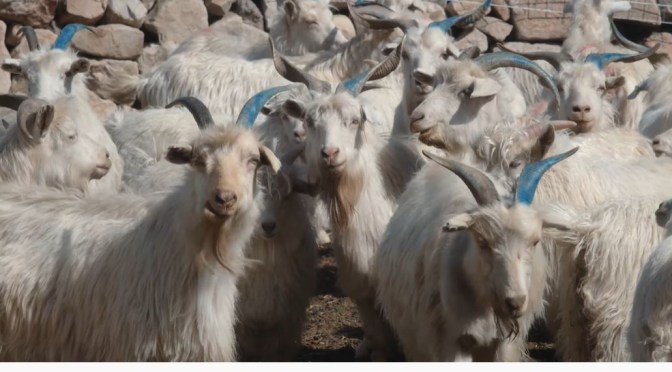
Troubled by his missing goat, Hu-Chun, a herder living in the steppes of Inner Mongolia, embarks on a journey to bring Ghalatar back into the fold. With a smartphone in hand and a motorcycle as his faithful steed, Hu-Chun traverses the mountain and desert plains herding around 500 goats. As a college-educated man who has returned from the city to continue his family’s agricultural way of life, Hu-Chun is part of a new generation of Mongolian herders embracing technology and a traditional lifestyle. He has also installed a 360-degree camera on top of a hill to monitor the precipitous terrain surrounding his home… continue reading on https://o6g7.app.link/kCWWETUZ1ib
All posts by She Seeks Serene

Analysis: How Moderna & Pfizer-BioNTech Created Vaccines In Record Time
The decision to pivot an entire business to focus on the coronavirus is an obvious one in hindsight, at least for Moderna, BioNTech and Pfizer, which succeeded beyond anyone’s expectations — and will reap billions of dollars in sales of their vaccines this year alone.
It wasn’t such a clear decision in the early months of 2020, though that’s when Moderna’s chief executive, Stephane Bancel, and BioNTech’s chief, Ugur Sahin, starting turning their ships, they told CNBC in interviews for this documentary about the vaccine race, produced by CNBC senior health and science reporter Meg Tirrell and senior digital producer Sam Rega.
“The night that China locked down Wuhan, I’m like: ‘When was the last time I know a city has been locked down because of an infectious disease?’” Bancel recalled. “And what goes through my mind is: what do the Chinese know that we don’t know?“ Bancel said he awoke sweating at 4 a.m., realizing, “Jeez, there’s going to be a pandemic like 1918.” For Sahin, it was reading a paper in the Lancet in late January describing the outbreak in China.
“I did a number of calculations, fast calculations, and realized it had already spread,” Sahin said. “And it was clear that it was already too late to stop the disease.” But he was convinced BioNTech, then focused mainly on personalized cancer therapies, may be able to do something. His company reached out to Pfizer, he said, proposing to work on a vaccine for the novel coronavirus using the same technology, messenger RNA, on which they’d already partnered to try to tackle the flu.
“We had the first contact a few days after starting the project,” Sahin said. “At that time, Pfizer was not yet interested.” Albert Bourla, Pfizer’s CEO, confirmed Sahin’s account, saying in the earliest months of 2020, he was focused on maintaining the company’s operations in China. But by late February, he said, he’d determined Pfizer needed to work on a treatment and a vaccine.
“What is the best approach?” Bourla said he asked his team. Kathrin Jansen, head of Pfizer’s vaccine research and development, said they assessed all existing technologies, including protein-based vaccines and vaccines using viral vectors. “They all have too few pros and too many cons,” she said.
But messenger RNA was a risk; it had never been used before as an approved vaccine or drug. “I wrestled a little bit with the decision,” Bourla said. But after another meeting with the team, “they convinced me.” That’s when Sahin called a second time. The outbreak, by that point, was already in New York, he said. Reaching Jansen, he described the work that BioNTech already had underway, and asked if Pfizer would like to work together. “And I said: absolutely,” Jansen remembered. “Let’s talk about this.”
At Moderna, it was never a question that messenger RNA would be the way forward; that was the technology around which the company was founded in 2010. But that didn’t mean questions didn’t exist. “Even going into March, there were voices that said vaccines were false hope,” recalled Dr. Stephen Hoge, Moderna’s president.
“It did feel for a period of time that we needed to defend even the idea of trying.” “When we were thinking about how do we get into Phase 1, what does it look like to prepare for a pandemic, the eyes of the world felt as though they were looking at Moderna as this biotech … ‘what are they trying to do?’” said Hamilton Bennett, Moderna’s senior director of vaccine access and partnerships.
“It was only when we transitioned in that March notification from the WHO that this was a global pandemic, it’s an emergency, that I think people started to realize that what we’re doing isn’t playing in a sandbox trying to demonstrate our technology,” Bennett said. “We’re developing a vaccine that’s going to stop the pandemic.” The companies succeeded, in what became one of the greatest medical races in history. Here, they recall how it happened.

Travel: Top Ten Beautiful Towns To Visit In Portugal
Portugal is a southern European country on the Iberian Peninsula, bordering Spain. Its location on the Atlantic Ocean has influenced many aspects of its culture: salt cod and grilled sardines are national dishes, the Algarve’s beaches are a major destination and much of the nation’s architecture dates to the 1500s–1800s, when Portugal had a powerful maritime empire.

Covid-19: Can Vaccines Keep Up With Variants?
The race between covid-19 vaccines and variants is on. Alok Jha, The Economist’s science correspondent, and Natasha Loder, health policy editor, discuss what this means for the future Read more of our coverage on coronavirus: https://econ.st/3t1L6wx

Hiking Tours: Sigmund-Thun Gorge In Austria (4K)
Where tremendous glaciers once covered the land, today one of Austria’s most astonishing spectacles of nature awaits amazed visitors. The gorge in Kaprun combines breathtaking beauty with mystical scenery and experiences that leave lasting memories.
Some 14,000 years ago, during the late ice age, a glacier completely covered the valley of Kaprun and gorged its way through the calcareous schist rocks of the Maiskogel and the Bürgkogel mountains. When the glacier melted, it left behind a gorge through which the river Ache of Kaprun ran. The river dug itself 32 metres deep into the ground and left behind strikingly smooth surfaces and natural whirlpools. Visitors move along narrow rock faces across wooden catwalks and numerous other bridges. Make sure not to miss the white water spectacle of Kaprun’s Ache River!

Science: Endometriosis Insights, Deep Learning That Predicts RNA Folding
News Intern Rachel Fritts talks with host Sarah Crespi about a new way to think about endometriosis—a painful condition found in one in 10 women in which tissue that normally lines the uterus grows on the outside of the uterus and can bind to other organs.
Next, Raphael Townshend, founder and CEO of Atomic AI, talks about predicting RNA folding using deep learning—a machine learning approach that relies on very few examples and limited data.
Finally, in this month’s edition of our limited series on race and science, guest host and journalist Angela Saini is joined by author Lundy Braun, professor of pathology and laboratory medicine and Africana studies at Brown University, to discuss her book: Breathing Race into the Machine: The Surprising Career of the Spirometer from Plantation to Genetics.

Front Covers: Country Life Magazine – August 25


Walking Tours: Metz – Northeastern France (4K)
Metz is a city in France’s northeastern Grand Est region, with gardens and leafy promenades along the Moselle and Seille rivers. In the old town, the Gothic Metz Cathedral is famed for its massive amount of stained glass windows, many by noted artists. Nearby, the Musée de la Cour d’Or displays artifacts from Roman to Renaissance times. The Centre Pompidou-Metz, with its undulating roof, exhibits contemporary art.

Front Page Views: Wall Street Journal – Aug 27

Morning News: Suicide-Bombings In Kabul, 3D- Printed Homes, OnlyFans
The suicide-bombings that have killed scores of people signal how the Taliban will struggle to rule Afghanistan; meanwhile the rest of the world’s jihadist outfits are drawing lessons from the chaos.
The swift reversal of an explicit-content ban by OnlyFans, a subscription platform, reveals a growing tension between pornography producers and payment processors. And the many merits of 3D-printed homes.
 Boomers Daily