This biography of Britain’s shortest-serving prime minister was overtaken by events, but its lively style and air of authority illuminates her failings
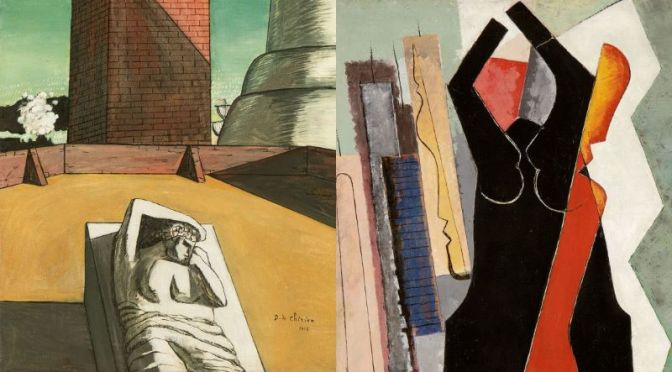
In this video, join essayist and New Yorker staff writer Adam Gopnik in an exploration of two masterpieces from the early twentieth century: Georgio De Chirico’s “Il Pomeriggio di Arianna (Ariadne’s Afternoon)”and Man Ray’s “Black Widow (Nativity).” Both painted near the outset of the first world war, these works not only capture the effusive zeitgeist of their age but prefigure the aesthetic movements that would come to characterize modern art.
Making their auction debut, “Il Pomeriggio di Arianna (Ariadne’s Afternoon)”and “Black Widow (Nativity)”will be offered as highlights of Sotheby’s Impressionist & Modern Art Evening Sale in New York. (28 October | New York) Learn more: https://www.sothebys.com/en/series/to…
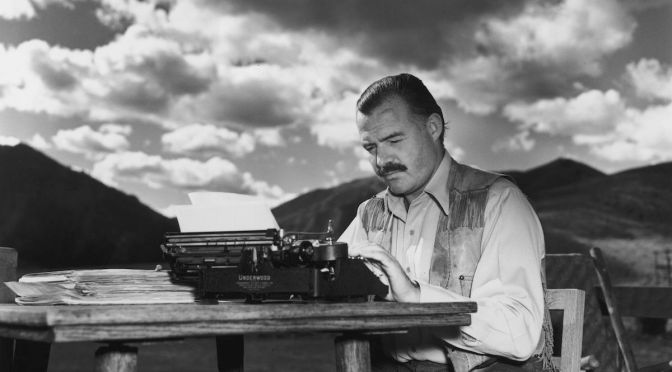
“In Another Country” is a poignant short story about the casualties of war, written by Noble Prize winner Ernest Hemingway, which deals with the experiences of an injured American army officer stranded and alienated in Italy who describes in first person narrative the events and the experiences of being rehabilitated during World War 1. It is a semi-autobiographical work of fiction.
The short story is about an ambulance corps member in Milan during World War I. Although unnamed, he is assumed to be Nick Adams, a character Hemingway made to represent himself. He has an injured knee and visits a hospital daily for rehabilitation. There the “machines” are used to speed the healing, with the doctors making much of the miraculous new technology. They show pictures to the wounded of injuries like theirs healed by the machines, but the war-hardened soldiers are portrayed as skeptical, perhaps justifiably so.
As the narrator walks through the streets with fellow soldiers, the townspeople hate them openly because they are officers. Their oasis from this treatment is Cafe Cova, where the waitresses are very patriotic.
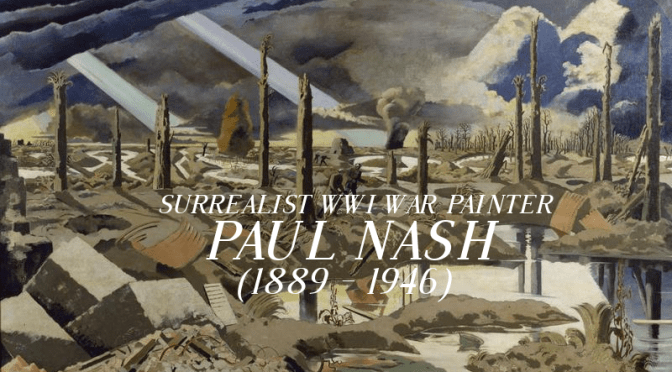
Paul Nash (11 May 1889 – 11 July 1946) was a British Surrealist painter and war artist, as well as a photographer, writer and designer of applied art. Nash was among the most important landscape artists of the first half of the twentieth century. He played a key role in the development of Modernism in English art.
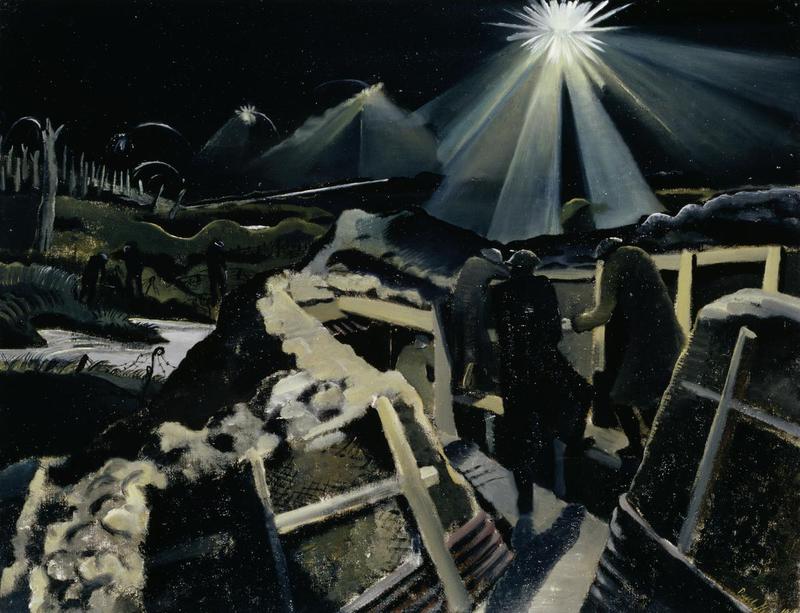
Paul Nash: The Ypres Salient at Night, 1918.
PAUL NASH in a woodcut self-portrait (1923)
Born in London, Nash grew up in Buckinghamshire where he developed a love of the landscape. He entered the Slade School of Art but was poor at figure drawing and concentrated on landscape painting. Nash found much inspiration in landscapes with elements of ancient history, such as burial mounds, Iron Age hill forts such as Wittenham Clumps and the standing stones at Avebury in Wiltshire. The artworks he produced during World War I are among the most iconic images of the conflict. After the war Nash continued to focus on landscape painting, originally in a formalized, decorative style but, throughout the 1930s, in an increasingly abstract and surreal manner. In his paintings he often placed everyday objects into a landscape to give them a new identity and symbolism.
Paul Nash: Ruined Country – Old Battlefield, Vimy, near La Folie Wood, 1918.
Official World War I Artist – In November 1917 Nash returned to the Ypres Salient as a uniformed observer with a batman and chauffeur. At this point the Third Battle of Ypres was three months old and Nash himself frequently came under shellfire after arriving in Flanders. The winter landscape he found was very different from the one he had last seen in spring. The system of ditches, small canals and dykes which usually drained the Ypres landscape had been all but destroyed by the constant shellfire. Months of incessant rain had led to widespread flooding and mile upon mile of deep mud. Nash was outraged at this desecration of nature. He believed the landscape was no longer capable of supporting life nor could it recover when spring came. Nash quickly grew angry and disillusioned with the war and made this clear in letters written to his wife. One such written, after a pointless meeting at Brigade HQ, on 16 November 1917 stands out,
I have just returned, last night from a visit to Brigade Headquarters up the line and I shall not forget it as long as I live. I have seen the most frightful nightmere of a country more conceived by Dante or Poe than by nature, unspeakable, utterly indescribable. In the fifteen drawings I have made I may give you some idea of its horror, but only being in it and of it can ever make you sensible of its dreadful nature and of what our men in France have to face. We all have a vague notion of the terrors of a battle, and can conjure up with the aid of some of the more inspired war correspondents and the pictures in the Daily Mirror some vision of battlefield; but no pen or drawing can convey this country—the normal setting of the battles taking place day and night, month after month. Evil and the incarnate fiend alone can be master of this war, and no glimmer of God’s hand is seen anywhere. Sunset and sunrise are blasphemous, they are mockeries to man, only the black rain out of the bruised and swollen clouds all though the bitter black night is fit atmosphere in such a land. The rain drives on, the stinking mud becomes more evilly yellow, the shell holes fill up with green-white water, the roads and tracks are covered in inches of slime, the black dying trees ooze and sweat and the shells never cease. They alone plunge overhead, tearing away the rotting tree stumps, breaking the plank roads, striking down horses and mules, annihilating, maiming, maddening, they plunge into the grave, and cast up on it the poor dead. It is unspeakable, godless, hopeless. I am no longer an artist interested and curious, I am a messenger who will bring back word from the men who are fighting to those who want the war to go on for ever. Feeble, inarticulate, will be my message, but it will have a bitter truth, and may it burn their lousy souls.”
Paul Nash: Void of War, 1918.
Nash’s anger was a great creative stimulus which led him to produce up to a dozen drawings a day. He worked in a frenzy of activity and took great risks to get as close as possible to the frontline trenches. Despite the dangers and hardship, when the opportunity came to extend his visit by a week and work for the Canadians in the Vimy sector, Nash jumped at the chance. He eventually returned to England on 7 December 1917.
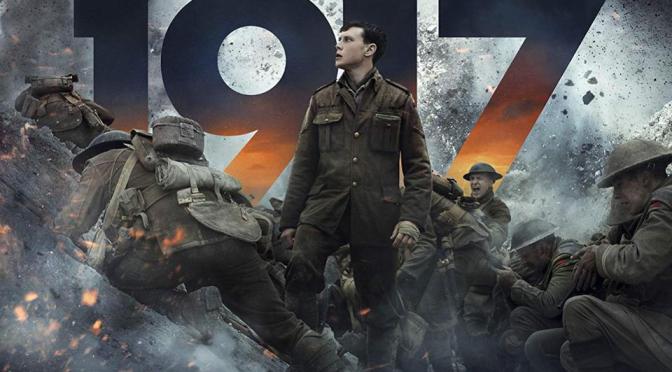
The war spectacle “1917,” directed by Sam Mendes (“American Beauty”), was unveiled in preview screenings on both coasts this past weekend and immediately announced itself as a significant Oscar player. The movie follows two British soldiers during World War I (George MacKay and Dean-Charles Chapman) as they’re given a seemingly impossible mission: Rush through dangerous territory to deliver a message that could save another battalion on the verge of annihilation.
Though “1917” recalls other Oscar-winning war movies like “Saving Private Ryan” and “Dunkirk,” Mendes distinguishes his effort by presenting the story as though “1917” were filmed all in one single take. It isn’t — Mendes and the cinematographer Roger Deakins employ all manner of clever methods to stitch together a great many different shots — but the average moviegoer won’t be able to spot the tells, and the you-are-there verisimilitude is potent.




 Boomers Daily