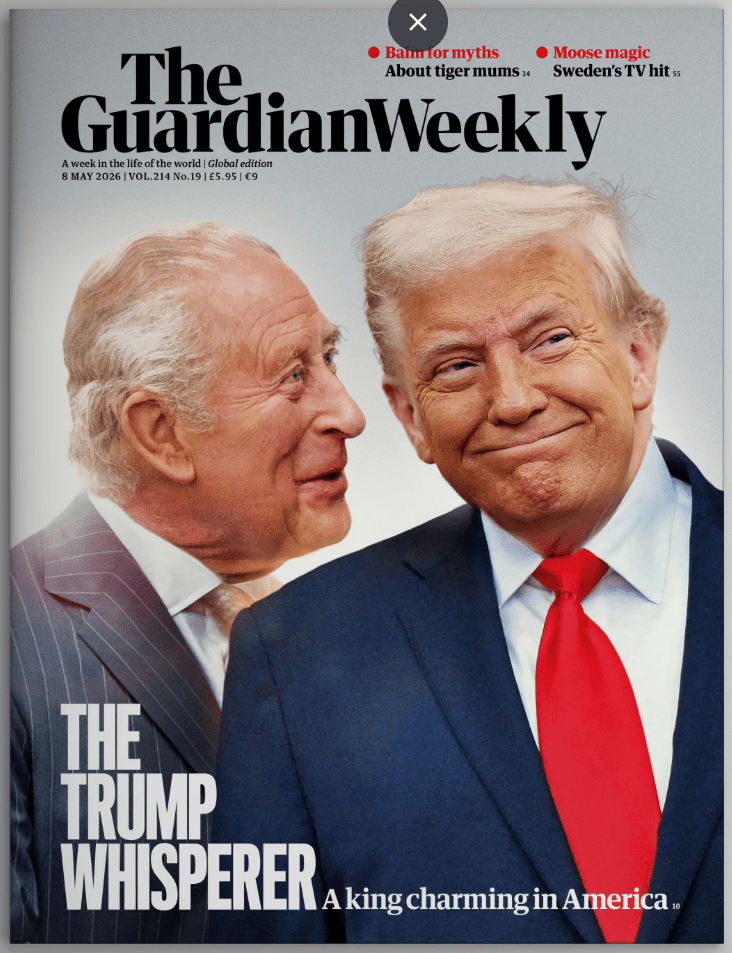
It’s fair to say that the Guardian Weekly does not cover many royal visits, but King Charles III’s US state visit was the most consequential of his reign so far. The king’s ostensible purpose was to celebrate America’s 250 years of independence but last week’s trip was freighted with other agendas, most important of which was to flatter his host, Donald Trump. Washington bureau chief David Smith’s cover story shows how “like a rapier wrapped in ermine, Charles managed to tame Trump while rebuking Trumpism”. Both David and our veteran foreign affairs commentator Simon Tisdall unpick the skill with which Charles spoke truth to this capricious and egotistical president and gave both sides of the heavily divided Congress much to praise. It was a performance of high diplomacy at a time of huge tension in the transatlantic relationship and beyond.
But the charm didn’t wash in New York where, as Adam Gabbatt’s sketch shows, the shadow of Jeffrey Epstein and Andrew Mountbatten-Windsor, Charles’s disgraced brother, lurked while the mayor, Zohran Mamdani, brought up the spectre of colonialism in the shape of the Koh-i-noor diamond, snatched under disputed circumstances.
Spotlight | A small town in Germany Landstuhl, the heart of the largest American military community outside the US, considers its future after Donald Trump’s decision to withdraw 5,000 troops, reports Deborah Cole
Environment | A gift of wings Patrick Barkham takes off for a flight of wonder with The Lost Words duo, who have reunited for a new book on endangered birds
Feature | A balm for tiger mother myths Rebecca Liu explores why a certain image of the tiger mum – strict, cold and demanding – is ubiquitous in popular culture
Opinion | Antiracists need to stand up for us all Another attack on the UK’s Jewish population demands a clear show of solidarity from those who march to protect minorities, argues Jonathan Freedland
Culture | Moose magic on the loose How do cameras capture Sweden’s seasonal TV hit, the Great Moose Migration? Malcolm Jack travels to an uninhabited island in the Ångerman river to ask the show’s makers
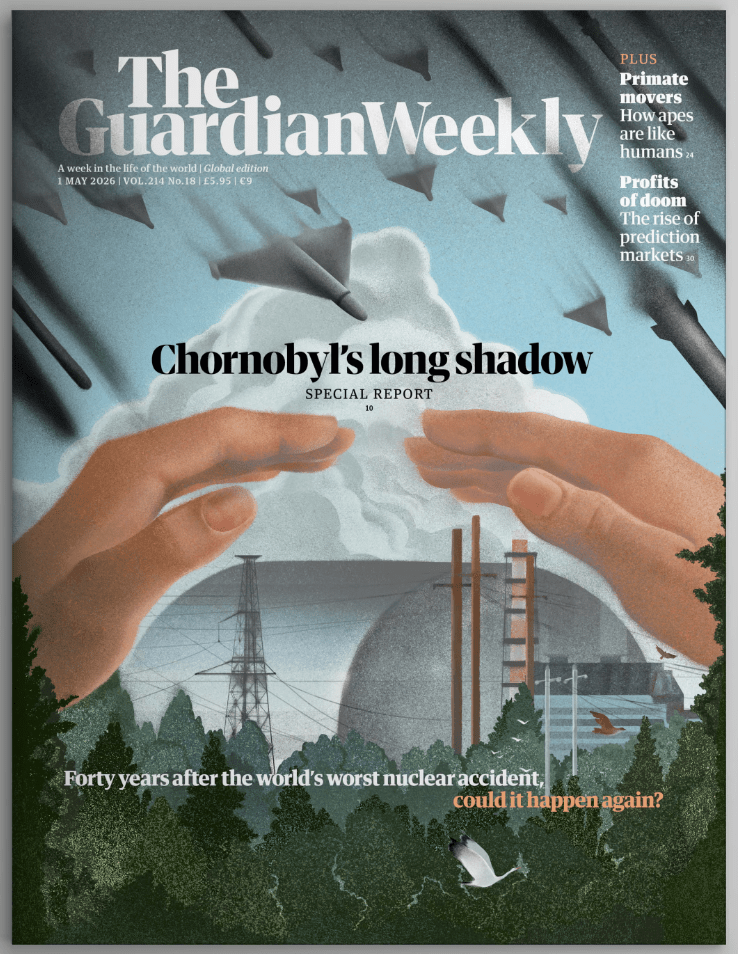
In March 2022, soon after the full-scale Russian invasion of Ukraine began, Kyiv-based illustrator Masha Foya produced what I think is one of the Guardian Weekly’s most powerful covers on the war, concerning the devastation of Mariupol. So it’s a pleasure to feature Masha’s work again for the current edition, this time marking 40 years since the Chornobyl nuclear disaster.
“Since childhood, the story of Chornobyl has always made me feel a strange dissonance – such a tragedy occurring on a beautiful spring day in April,” explains Masha on the thought process behind her design, in which seasonal greens fade away into ominous skies.
It also reflects present-day anxieties. For a special report, Pjotr Sauer visits the site of the world’s worst nuclear accident and sees up close how the giant containment structure around the failed reactor is in urgent need of costly repairs after a Russian drone strike, as fears grow of a possible new catastrophe.
Five essential reads in this week’s edition
Environment | Why apes are more like us than we ever thought Imagination, reason and ability to recognise faces from the past are not the sole preserve of humans, studies show. Gloria Dickie reports
Finance | The wagering of war Once largely siloed to sporting events, betting has now spread to include contracts on news events where insider information could pay handsomely. With over $1bn in perfectly timed bets on the Iran war having recently been seen, Lauren Aratani explores what exactly is going on
Feature | The big game hunters who believe they can save Africa’s wildlife One way to pay for wildlife conservation is to allow the rich to bag a few animals for high prices. But critics see this approach as an exercise in neocolonialism. Cal Flynwent in pursuit of answers
Opinion | Starmer’s listless government shows zombie politics is the new norm Distracted, listless and unambitious – the British PM’s true form has finally emerged. But whatever comes next must end this ruinous cycle for the country, argues Nesrine Malik
Culture | Iron Maiden on 50 years of heavy metal madness As a career-spanning documentary hits cinemas, the legendary rock band revisit their path from pubs to stadiums over half a century of headbanging hits. Harry Sword buckles up
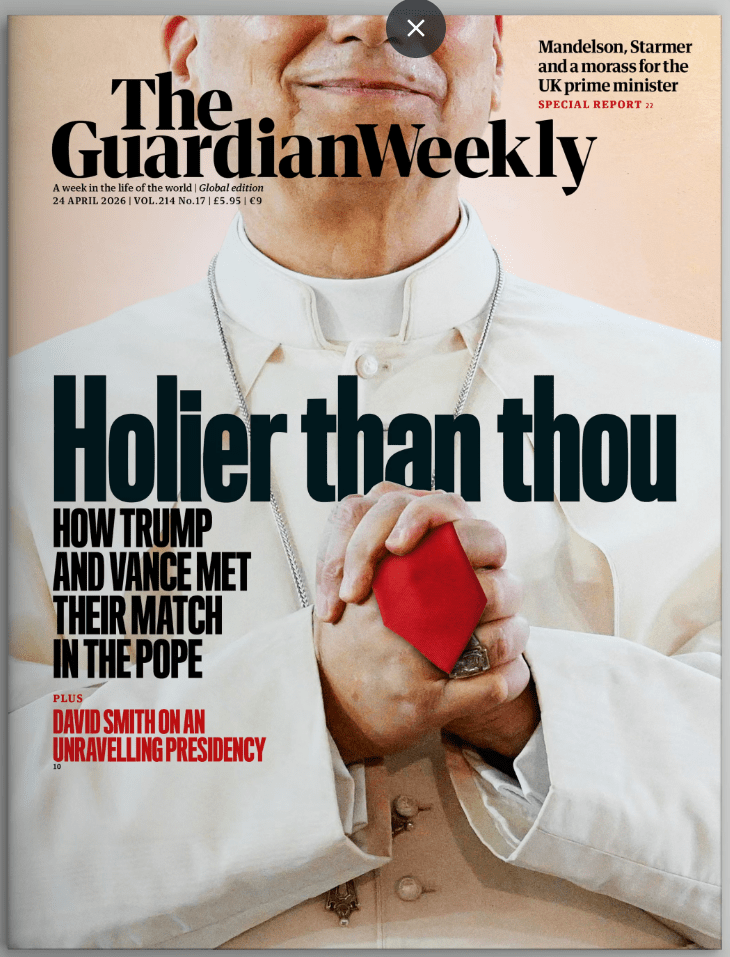
The Trump administration’s efforts to validate their incoherent war on Iran with some sort of Christian moral authority have led to a few, shall we say, interesting moments recently.
After bizarrely berating Pope Leo XIV as “WEAK on Crime, and terrible for Foreign Policy”, Donald Trump posted (and later deleted) a meme of himself as a Christ-like figure healing the sick. The self-styled “secretary of war” Pete Hegseth then confused what he evidently thought was a biblical passage with a bastardised version of a speech from the Quentin Tarantino movie Pulp Fiction.
Perhaps most damagingly of all, the vice-president, JD Vance, took Leo’s carefully considered thoughts on the concept of the “just war” as an opportunity to lecture the pope on theology.
Spotlight | Starmer and the scandal of Mandelson’s vetting The British prime minister came under huge pressure to resign this week over what he knew about Peter Mandelson’s appointment as UK ambassador to the US, even though he had failed Foreign Office security vetting. Pippa Crerar, Jessica Elgot, Paul Lewis and Kiran Stacey spearhead our coverage
Science | The magic of mushrooms Fungi play a key role in ecosystems and storing carbon, so African scientists are championing the preservation of “funga” as much as flora and fauna, writes Whitney Bauck
Feature | When older relatives lurch to the far right It starts with a “back in my day” nostalgic meme – then suddenly your elders are sharing AI-generated “boomerslop” and repeating conspiracy theories … Simon Usborne speaks to families dealing with rightwing political rifts
Opinion | Our governments are woefully underprepared for the AI revolution Every wave of new tech has come with a doomsday scenario. But governments just aren’t planning a human response on the scale required, warns Larry Elliott
Culture | How the female gaze caught the attention of film, TV and fiction From passionate romantasy novels to premium television dramas, culture is bringing the agency, desires and interior lives of women to the fore. It’s proving good for business, but is this a permanent revolution, asks Deborah Linton
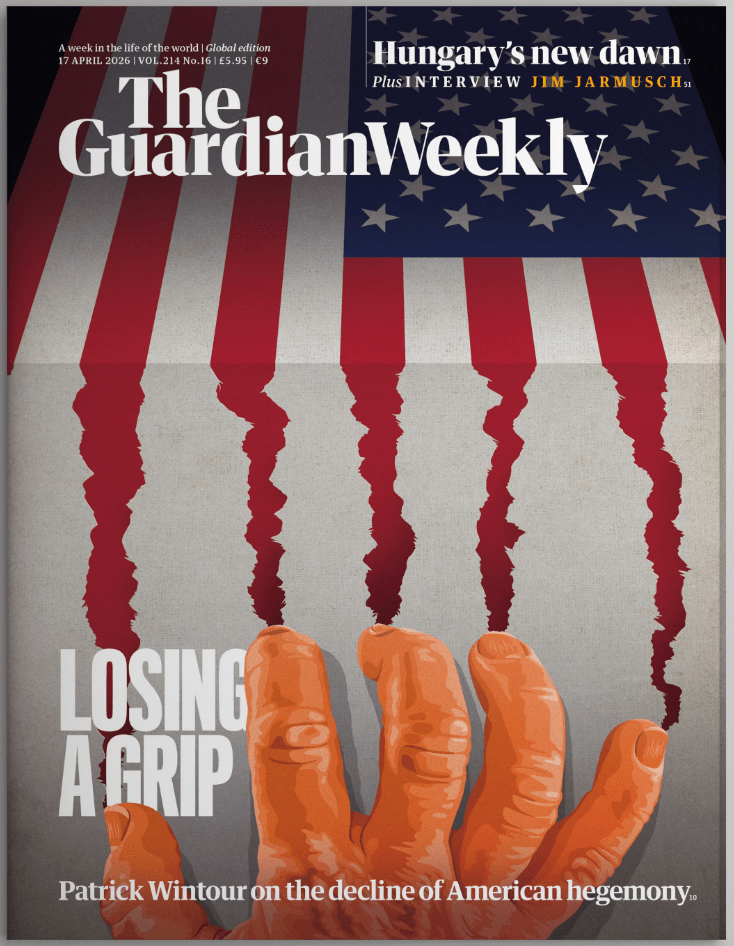
At the end of 2025, Patrick Wintour wrote a compelling essay for Guardian Weekly in which he described an interregnum in global history, where the rules-based order had been eroded and great powers once again jostled for control and influence.
This week’s edition sees Patrick return to a key aspect of that theme, the deteriorating global standing of the United States after a period of high-stakes brinkmanship with Iran. Donald Trump’s aborted threat that Iranian civilisation would “die … never to be brought back” unless it ceded to his demands exposed the limits of his apocalyptic foreign policy. It also pointed to the wider decline of American influence in a world where the US appears untrustworthy and strategically isolated.
Spotlight | Hungary’s new dawn After 16 years, Viktor Orbán’s populist grip on the country’s politics is over. But will his successor Péter Magyar be much different? Ashifa Kassam and Flora Garamvolgyi report amid jubilant scenes in Budapest
Science | The man who was bitten by snakes 200 times – on purpose Tim Friede put his “ass on the line” to help stop snakebite deaths – whose numbers appear to be rising amid the climate crisis. Oliver Milman met him
Feature | The brutal reality of life as a foreign student in the UK Universities in Britain rely on overseas applicants paying full fees, which has given rise to some unscrupulous recruiters and left many hopefuls and their families deep in debt. Samira Shackle investigates
Opinion | Netanyahu-ism has achieved nothing for Israelis It is the voting public in Israel that will settle their PM’s fate later this year. But, argues Jonathan Freedland, all they have heard are promises of “total victory” that prove to be hollow
Culture | Jim Jarmusch, the darling of indie cinema The 73-year-old has been at the cutting edge of US independent movies since the 1980s. As Father Mother Sister Brother opens in the UK, he tells Amy Raphael about grief, greed and “doing crazy shit” with Steve Coogan
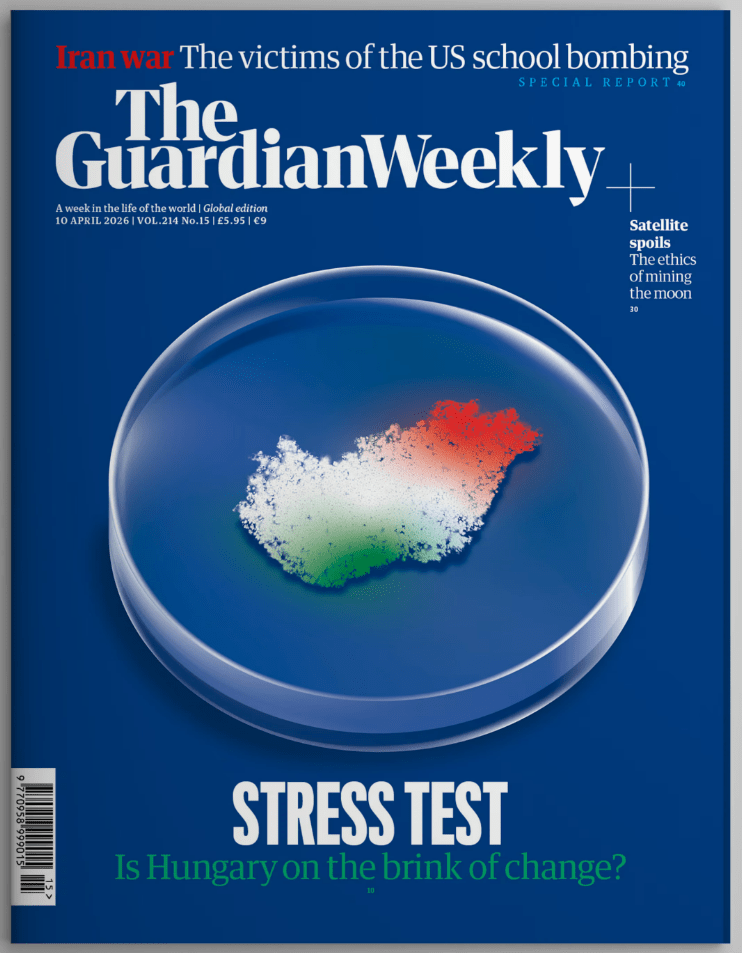
An irony of Viktor Orbán’s 16-year grip on power in Hungary is that his Fidesz movement was originally founded by pro-democracy, change-seeking young voters, even initially requiring members to be below the age of 35.
Now, in a crossroads election on 12 April, a new generation of Hungarians may be on the cusp of removing the rightwing populist prime minister, much to the dismay of his admirers in Moscow, Washington and Europe’s populist movements.
Orbán may have once described Hungary as “a petri dish for illiberalism” – as reflected by Harry Haysom’s cover art for us this week – but polls suggest his opponent Péter Magyar, a former top member of Fidesz who favours a closer relationship with the EU, could be the new change agent.
Spotlight | Was Trump conned by Netanyahu’s promise of an easy war? Senior US officials now consider the Israel PM’s pitch to have been overblown, creating potentially far-reaching consequences for both countries, writes Peter Beaumont
Science | The 21st-century moon prospectors Helium-3 is so rare that a palm-sized amount could be worth millions. As Artemis II flies by the moon and businesses look to the skies, is mining Earth’s satellite ethical? Oliver Holmes investigates
Feature | Can the UK’s cargo theft crisis be stopped? It costs the UK economy £700m ($920m) a year, and criminal gangs are operating with near impunity. Every time a lorry gets robbed, raided or hijacked, it’s Mike Dawber who investigates. ByStuart McGurk
Opinion | Ten years after Brexit, Trump is pushing Britain back towards the EU It’s the silver lining from this terrible age of Donald Trump, argues Gaby Hinsliff: his disdain and insults are fuelling the belief that the UK should renew ties with Europe
Culture | James McAvoy, froma Glasgow council estate to Hollywood stardom In his directorial debut, the X-Men actor is challenging stereotypes about his Scottish homeland via the remarkable tale of a real-life hip-hop hoax. Libby Brooks met him
‘
News, Views and Reviews For The Intellectually Curious







 Boomers Daily